

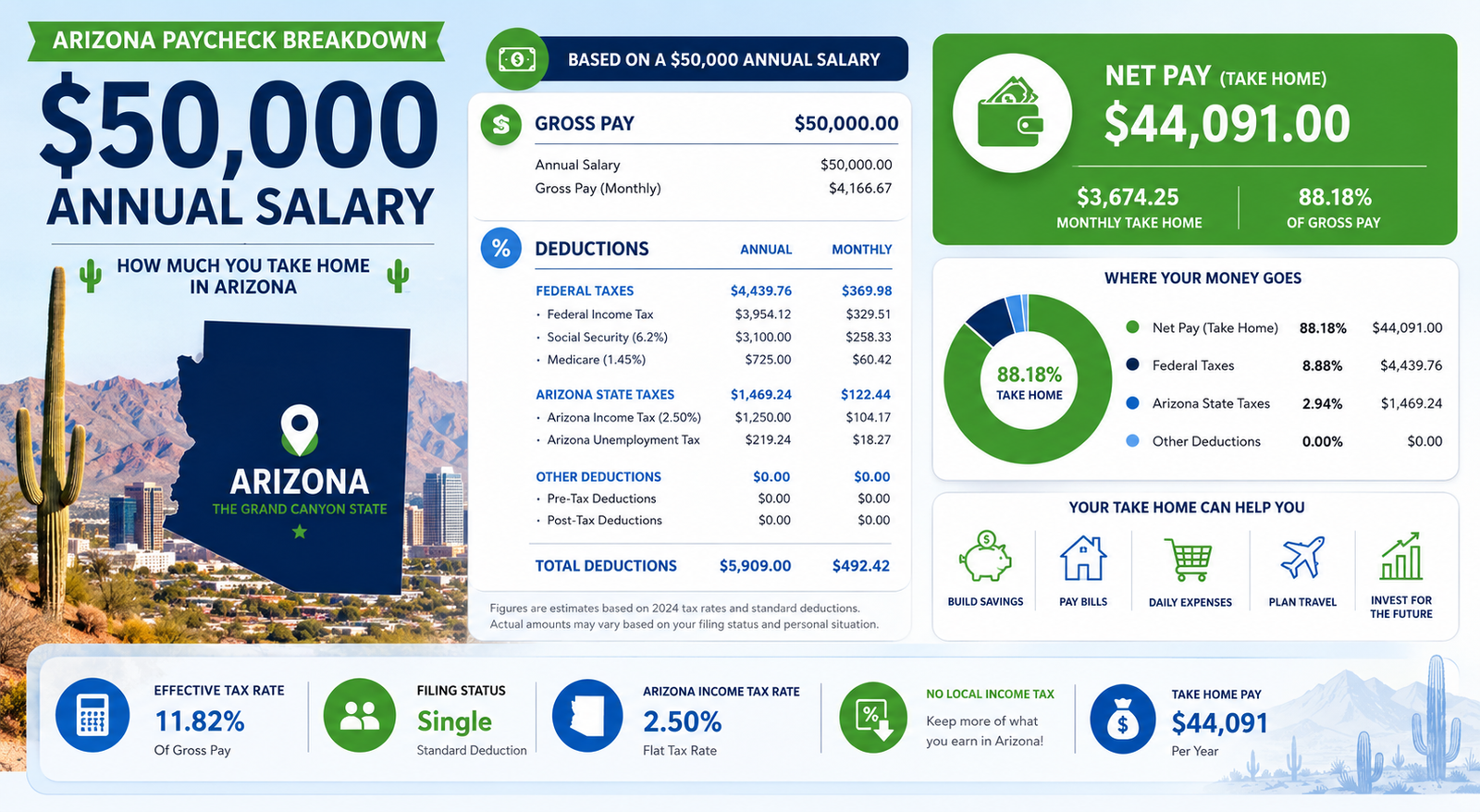
$50,000 Salary After Tax in Arizona (2026 Guide)
Wondering what a $50,000 salary after tax in Arizona actually looks like in 2026? You’re not alone. Whether you’re evaluating a job offer in Phoenix, planning a move to Tucson, or budgeting in Mesa or Chandler, knowing your real take-home pay is essential. In this guide, we break down every deduction—federal income tax, FICA, and Arizona’s flat state income tax—so you can see exactly how much hits your bank account each month.
Overview: $50,000 Salary in Arizona (2026)
Arizona stands out among U.S. states for its flat state income tax rate of just 2.5%—one of the lowest in the nation for states that levy an income tax. This means that regardless of how much you earn, the state takes a consistent, predictable slice. For a $50,000 earner, that translates to a relatively modest state tax burden compared to neighboring states like California or New Mexico.
All calculations in this guide are based on our Arizona paycheck calculator. We encourage you to run your own numbers through the calculator, especially if you have additional deductions like retirement contributions, health insurance premiums, or other pre-tax benefits that can significantly alter your final take-home figure.
For a single filer with no dependents taking the standard deduction, the math is refreshingly straightforward. Below, you’ll find a complete breakdown of where every dollar goes—from the gross $50,000 down to the net amount landing in your checking account twice a month.
$50,000 Salary After Tax in Arizona – At a Glance
| Pay Frequency | Gross Pay | Total Taxes | Take-Home Pay |
|---|---|---|---|
| Annual | $50,000.00 | $9,036.50 | $40,963.50 |
| Monthly | $4,166.67 | $753.04 | $3,413.63 |
| Bi-Weekly | $1,923.08 | $347.56 | $1,575.52 |
| Weekly | $961.54 | $173.78 | $787.76 |
All calculations in this guide are based on our Arizona paycheck calculator. Figures assume a single filer with the standard deduction and no additional pre-tax deductions.
Where Your Money Goes: Tax Breakdown
Understanding the composition of your tax burden is crucial. On a $50,000 salary in Arizona, three main forces reduce your gross pay: federal income tax, FICA payroll taxes (Social Security and Medicare), and Arizona state income tax. Here’s how they stack up:
The pie chart above visualizes the split. Notice that Arizona’s 2.5% flat tax is the smallest slice by a wide margin. The real heavy hitters are federal income tax and the mandatory FICA contributions. This is one reason Arizona is considered relatively tax-friendly for wage earners.
Detailed Tax Deduction Table
| Tax Category | Amount Deducted | Percentage of Gross |
|---|---|---|
| Federal Income Tax | $3,961.50 | 7.92% |
| Social Security (6.2%) | $3,100.00 | 6.20% |
| Medicare (1.45%) | $725.00 | 1.45% |
| Arizona State Tax (2.5% flat) | $1,250.00 | 2.50% |
| Total Taxes | $9,036.50 | 18.07% |
Your effective tax rate sits at just over 18%. That means for every dollar you earn, roughly 82 cents land in your pocket. This is a competitive rate compared to many other states, especially those with progressive tax structures that ramp up quickly on middle-class incomes.
Can You Live Comfortably on $50K in Arizona?
The answer depends heavily on where in Arizona you call home. A $50,000 salary stretches much further in Tucson than it does in Scottsdale or certain Phoenix suburbs. However, Arizona’s overall moderate cost of living—combined with no tax on groceries at the state level and relatively affordable utilities—makes $50K a workable salary for a single adult, especially if you budget carefully.
In Phoenix, average one-bedroom rents hover around $1,400–$1,600 per month. In Tucson, the same apartment might cost $1,000–$1,200. Mesa and Chandler fall somewhere in the middle, with rents typically ranging from $1,200 to $1,500. Below is a realistic monthly budget based on the take-home pay we calculated.
Sample Monthly Budget on $3,414 Take-Home (Arizona)
| Budget Category | Monthly Allocation | Notes |
|---|---|---|
| Housing (Rent/Mortgage) | $1,350 | Avg. 1BR in Mesa/Chandler area |
| Utilities & Internet | $260 | Electricity peaks in summer (AC usage) |
| Groceries | $420 | Arizona exempts groceries from state sales tax |
| Transportation | $340 | Gas, insurance, maintenance |
| Healthcare | $250 | Insurance premiums & out-of-pocket |
| Savings & Investments | $300 | Emergency fund & retirement |
| Discretionary | $340 | Dining, entertainment, shopping |
| Remaining | $154 | Buffer / additional savings |
This budget leaves a slim but real buffer. If you live in Tucson, you could free up $200–$300 more per month just from lower housing costs. In Phoenix, you might need to trim discretionary spending or find a roommate to stay comfortable.
🔍 Want to see your exact take-home pay based on your unique situation?
Calculate Your Real Take-Home Pay in Seconds →Free, instant results. No sign-up required.
How Arizona Stacks Up Against Neighboring States
Arizona’s flat 2.5% income tax is a significant advantage over many Western states. Below is a visual comparison of monthly take-home pay on a $50,000 salary across six states, illustrating why Arizona is an attractive destination for professionals seeking to maximize their net pay.
Approximate monthly take-home pay on $50K gross. Texas & Nevada have no state income tax. Colorado has a flat 4.4% rate. New Mexico and California use progressive brackets that reduce take-home at this income level. Use our paycheck calculator for Arizona to compare your specific scenario.
State-by-State Take-Home Comparison Table
| State | State Tax on $50K | Est. Annual Take-Home | Monthly Take-Home |
|---|---|---|---|
| Texas | $0 (no income tax) | $42,213 | $3,518 |
| Nevada | $0 (no income tax) | $42,213 | $3,518 |
| Arizona | $1,250 (2.5% flat) | $40,964 | $3,414 |
| Colorado | ~$2,200 (4.4% flat) | ~$40,013 | ~$3,334 |
| New Mexico | ~$1,800 (progressive) | ~$39,413 | ~$3,284 |
| California | ~$2,500 (progressive) | ~$38,713 | ~$3,226 |
Arizona holds a strong middle-ground position. You’ll take home about $1,200 more per year than a Californian earning the same gross salary, and only about $1,250 less than someone in tax-free Texas. When you factor in Arizona’s generally lower housing costs compared to coastal California, the financial advantage grows even larger.
Is $50,000 a Good Salary in Arizona in 2026?
For a single adult, $50,000 is a solid, livable salary across most of Arizona. In Tucson, it places you comfortably within the middle-income range, allowing for a decent apartment, a reliable car, and modest discretionary spending. In Phoenix, the same income requires tighter budgeting due to higher housing costs, but it remains entirely manageable—especially if you take advantage of Arizona’s lower taxes and reasonable grocery prices.
For a family of three or four, $50,000 becomes significantly tighter. Dual incomes or supplemental side earnings would be advisable in higher-cost metros like Chandler or North Phoenix. The good news? Arizona’s job market continues to grow in sectors like tech, healthcare, and logistics, meaning upward mobility is realistic.
Key takeaway: $50K is above the Arizona median individual income and, with smart budgeting, supports a comfortable lifestyle—especially if you live outside the priciest Phoenix zip codes.
5 Tips to Increase Your Take-Home Pay in Arizona
1. Max Out Pre-Tax Retirement Contributions
Contributing to a 401(k) or traditional IRA lowers your taxable income for both federal and Arizona state taxes. Even 5% of your salary ($2,500/year) can save you hundreds in taxes while building long-term wealth.
2. Use an HSA or FSA for Healthcare Costs
Health Savings Accounts and Flexible Spending Accounts let you pay for medical expenses with pre-tax dollars. In Arizona, this means avoiding both the 2.5% state tax and your federal marginal rate on those funds.
3. Review Your W-4 Withholding
Too many people over-withhold and give the IRS an interest-free loan. Use our Arizona paycheck calculator to dial in your withholding and boost your monthly cash flow.
4. Take Advantage of Arizona-Specific Credits
Arizona offers tax credits for qualifying charitable contributions and certain education expenses. These directly reduce your state tax liability dollar-for-dollar—far more valuable than a simple deduction.
5. Consider Your City Carefully
The difference between renting in Tucson versus Phoenix can exceed $400/month. If your job is remote or hybrid, choosing a lower-cost Arizona city can effectively give you a “raise” of several thousand dollars per year.
$50,000 Salary After Tax in Arizona – FAQs
How much is a $50,000 salary after tax in Arizona per month?
Approximately $3,414 per month for a single filer taking the standard deduction in 2026. This figure reflects all mandatory deductions including federal income tax, FICA, and Arizona’s 2.5% flat state tax.
Is Arizona a high-tax state for a $50,000 earner?
No. Arizona’s 2.5% flat income tax is among the lowest in the nation for states that levy an income tax. Your effective total tax rate on $50K is roughly 18%, which compares favorably to neighboring states like California and New Mexico.
Can I afford a one-bedroom apartment in Phoenix on $50K?
Yes, but it will consume 40–47% of your take-home pay. With careful budgeting—limiting discretionary expenses and possibly having a roommate—living in Phoenix on $50K is doable. Tucson and Mesa offer more breathing room.
What is the bi-weekly paycheck for a $50,000 salary in Arizona?
Your bi-weekly take-home pay is approximately $1,575.52, assuming standard deductions and a single filing status. This is the amount you’ll actually see deposited every two weeks.
Does Arizona tax Social Security or retirement income?
As of 2026, Arizona does not tax Social Security benefits, and the state offers exemptions on certain types of retirement income. This makes Arizona an appealing destination for retirees and long-term planners alike.
How does the Arizona standard deduction work for state taxes?
Arizona’s standard deduction for a single filer is structured differently than the federal one; however, the state’s 2.5% flat rate is applied to your Arizona taxable income after applicable state-level adjustments. The overall impact is a consistently low state tax bill.
Are groceries taxed in Arizona?
No. Arizona exempts most grocery items from state sales tax, which helps stretch your take-home pay further. This is a meaningful cost-of-living advantage compared to states that fully tax food purchases.
Disclaimer
⚠️ Important: All tax calculations in this guide are estimates based on our Arizona paycheck calculator and current tax law as of 2026. Actual take-home pay may vary depending on your specific filing status, dependents, pre-tax deductions (such as health insurance or 401(k) contributions), and any local tax obligations. This content is for informational purposes only and does not constitute financial or tax advice. We strongly recommend using our Arizona paycheck calculator to generate a personalized estimate and consulting a qualified tax professional before making financial decisions.
Understanding Your Take-Home Pay in Arizona
A $50,000 salary after tax in Arizona delivers a solid, predictable income stream—roughly $40,964 annually or $3,414 monthly. The state’s flat 2.5% tax rate keeps things simple and your tax burden relatively light. Whether you’re renting in Chandler, buying in Mesa, or enjoying Tucson’s lower cost of living, this salary can support a comfortable lifestyle when paired with smart budgeting.
The real power lies in knowing your numbers before you commit to a lease, a job, or a move. That’s why we built the free Arizona paycheck calculator—so you can see exactly how much you keep after taxes, in seconds.
Remember, tax laws evolve. Bookmark this guide, revisit our calculator when your situation changes, and take control of your financial future in the Grand Canyon State.
🧮 Ready to see your real take-home pay in Arizona?
See Exactly How Much You Keep After Taxes →Also check out FreeAiden for additional financial planning tools.