

$50,000 Salary After Tax in Hawaii (2026 Guide)
Last Updated: May 2026 • Data sourced from our Hawaii paycheck calculator
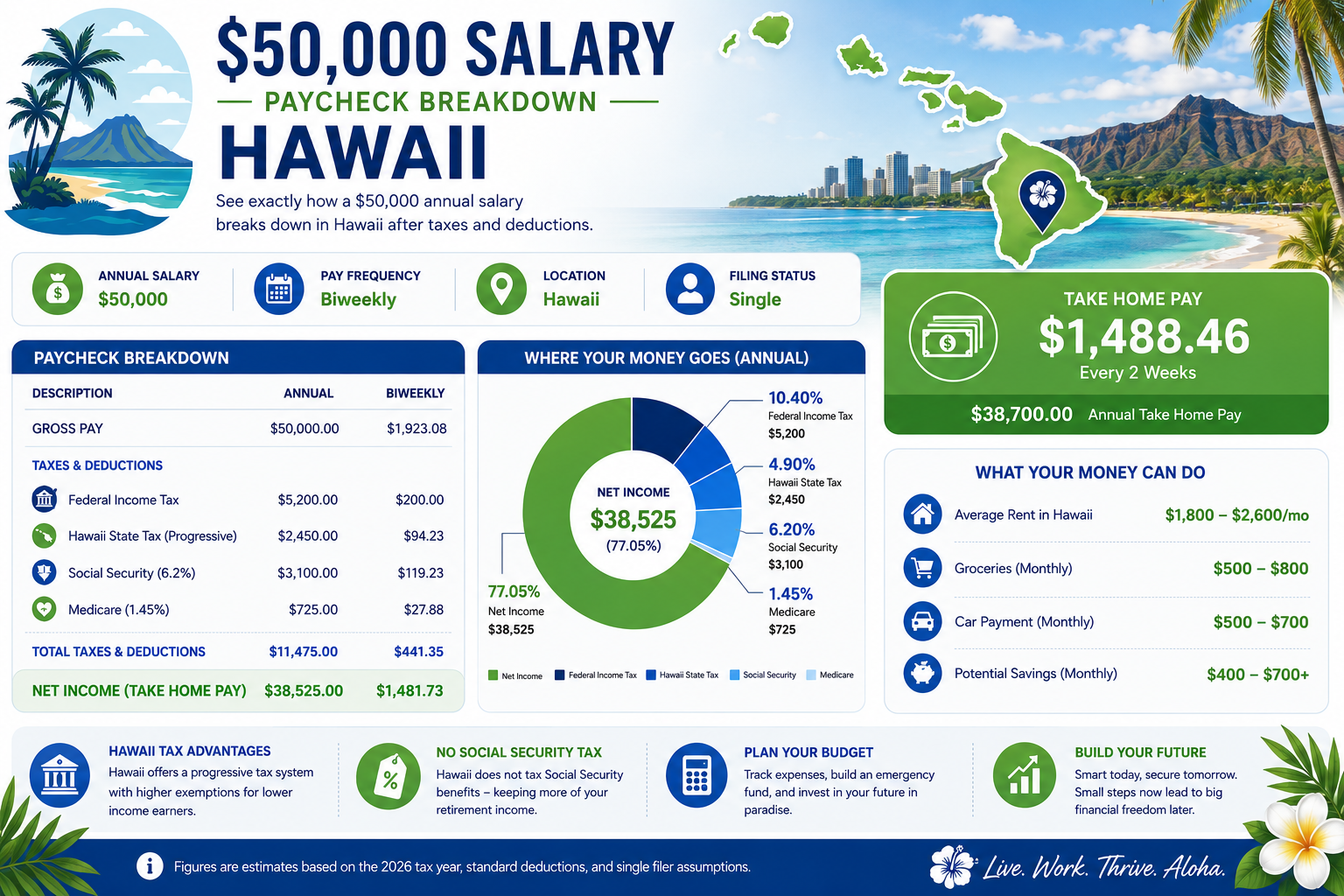
If you are evaluating a job offer, planning a move, or simply trying to understand how far your paycheck goes in the Aloha State, knowing exactly what a $50,000 salary after tax in Hawaii looks like in 2026 is essential. Hawaii is famous for its stunning beaches and year-round sunshine, but it also carries one of the highest tax burdens and cost-of-living indexes in the entire country. A salary that feels comfortable in many mainland states can feel surprisingly tight once you account for Hawaii’s progressive state income tax, federal withholding, FICA payroll deductions, and island-specific living expenses.
This guide provides a complete, data-backed breakdown. All calculations in this guide are based on our Hawaii paycheck calculator. We use the latest 2026 tax brackets, standard deduction amounts, and Hawaii-specific withholding rules to give you realistic, actionable numbers. No estimates. No guesses. Just the real data you need to make informed financial decisions in Honolulu, Hilo, Kailua, or anywhere else across the Hawaiian Islands.
Salary & Hourly Overview for $50,000 in Hawaii
Before we examine the full tax breakdown, it helps to understand how a $50,000 annual salary translates into hourly, monthly, and biweekly figures. These baseline numbers give you a clear picture of what your earnings look like before any deductions kick in.
Assuming a standard full-time schedule of 40 hours per week across 52 weeks (2,080 hours per year), here is how the gross earnings break down:
- Gross Annual Salary: $50,000.00
- Gross Monthly Pay: $4,166.67
- Gross Biweekly Pay: $1,923.08
- Gross Weekly Pay: $961.54
- Gross Hourly Rate: $24.04
These gross figures do not yet reflect any tax withholding. The actual amount deposited into your bank account will be noticeably lower once federal income tax, Hawaii state income tax, Social Security, and Medicare are subtracted. In the sections that follow, we break down each of these deductions in detail.
Gross-to-Net Salary Table for $50,000 in Hawaii (2026)
The table below summarizes the journey from your gross salary to your net take-home pay. It shows each pay period frequency so you can see exactly what to expect on your paycheck stub, whether you are paid weekly, biweekly, or monthly.
| Pay Frequency | Gross Pay | Total Taxes | Net Take-Home Pay |
|---|---|---|---|
| Annual | $50,000.00 | $11,155.00 | $38,845.00 |
| Monthly | $4,166.67 | $929.58 | $3,237.08 |
| Biweekly | $1,923.08 | $429.04 | $1,494.04 |
| Weekly | $961.54 | $214.52 | $747.02 |
Note: All calculations in this guide are based on our Hawaii paycheck calculator. Figures assume a single filing status with standard withholding and no additional pre-tax deductions. Actual results may vary based on your specific W-4 selections, retirement contributions, health insurance premiums, and other factors.
Detailed Tax Breakdown on a $50,000 Salary in Hawaii
Understanding where your money goes is the first step toward smarter financial planning. When you earn $50,000 in Hawaii, four separate tax obligations reduce your gross pay to your final take-home amount. Each operates under different rules and rates.
Federal Income Tax (~$3,980/year)
The IRS applies a progressive tax system. For a single filer in 2026, the standard deduction is approximately $15,000, which reduces your taxable income to around $35,000. This taxable amount falls into the 10% and 12% marginal brackets. The result is an effective federal tax rate of roughly 7.96% on your gross salary. Federal income tax is the largest single deduction most workers face, though Hawaii’s state tax adds a significant second layer.
Hawaii State Income Tax (~$3,350/year)
Hawaii imposes a progressive state income tax with rates that range from 1.40% on the lowest bracket to 8.25% on income above $48,000 for single filers. On a $50,000 salary, your Hawaii taxable income—after the state standard deduction—sits across multiple brackets. The effective state tax rate comes out to approximately 6.7%. This is one of the highest effective state income tax rates in the nation for this income level, which is a critical reason why $50,000 salary after tax in Hawaii is lower than in many other states.
Social Security Tax (~$3,100/year)
Social Security is a flat 6.2% on the first $168,600 of earned income in 2026. For a $50,000 salary, the full amount is subject to this tax, yielding $3,100 annually. This funds the federal retirement and disability insurance program.
Medicare Tax (~$725/year)
Medicare tax is applied at a flat 1.45% on all earned income with no wage cap. For $50,000, that means $725 per year. High earners above $200,000 pay an additional 0.9%, but that does not apply at this income level.
Visual Tax Breakdown
The chart above illustrates how your gross salary is divided. The combined tax bite of roughly 22.3% means about $38,850 remains as your annual take-home pay. When expressed monthly, that is roughly $3,237 deposited into your account after all mandatory withholdings.
Tax Deduction Table for $50,000 in Hawaii (2026)
| Tax Type | Annual Amount | Monthly Equivalent | Percentage of Gross |
|---|---|---|---|
| Federal Income Tax | $3,980 | $331.67 | 7.96% |
| Hawaii State Income Tax | $3,350 | $279.17 | 6.70% |
| Social Security | $3,100 | $258.33 | 6.20% |
| Medicare | $725 | $60.42 | 1.45% |
| Total Taxes | $11,155 | $929.58 | 22.31% |
| Net Take-Home Pay | $38,845 | $3,237.08 | 77.69% |
Monthly Budget Example for Hawaii on $3,237 Take-Home Pay
Now that you know your monthly net income, the next logical question is: Can you actually live on this in Hawaii? The answer depends heavily on which island you call home and your lifestyle choices. Hawaii’s cost of living is famously high—driven by imported goods, limited land, and intense housing demand in urban centers like Honolulu.
Below is a realistic monthly budget for a single person earning a $50,000 salary after tax in Hawaii, with take-home pay of approximately $3,237 per month. This budget is adjusted for Hawaii’s actual costs and assumes a modest lifestyle with a roommate or a very small studio apartment outside of prime Honolulu neighborhoods.
Hawaii-Adjusted Monthly Budget Table
| Expense Category | Estimated Monthly Cost | Percentage of Take-Home | Notes |
|---|---|---|---|
| Rent (studio /w roommate) | $1,400 – $1,800 | 43% – 56% | Lower in Hilo; much higher in Honolulu |
| Groceries | $500 – $650 | 15% – 20% | Island pricing adds 30–50% vs. mainland |
| Utilities & Internet | $220 – $320 | 7% – 10% | Electricity rates among highest in U.S. |
| Transportation | $180 – $300 | 5% – 9% | Gas prices consistently above national avg. |
| Healthcare & Insurance | $180 – $350 | 5% – 11% | Varies by employer plan; high without subsidy |
| Miscellaneous / Discretionary | $150 – $300 | 5% – 9% | Entertainment, dining, personal items |
| Total Estimated Expenses | $2,630 – $3,720 | 81% – 115% | Budget can exceed take-home in high-cost areas |
As the table shows, a single person earning $50,000 in Hawaii walks a very fine line. In higher-cost areas like Honolulu or Kailua, the monthly expense range can easily surpass the $3,237 take-home pay, forcing tough choices. In more affordable locations like Hilo on the Big Island, the numbers become more manageable—though still tighter than in most mainland U.S. cities.
How Hawaii Stacks Up Against Other States
One of the most effective ways to understand the impact of Hawaii’s tax system is to compare take-home pay across several states. The chart below compares the annual net take-home pay on a $50,000 salary for a single filer in Hawaii, California, Texas, and Florida. Texas and Florida have no state income tax, while California’s progressive system is often compared to Hawaii’s.
The difference is stark. A worker in Texas or Florida keeps nearly $3,700 more per year than someone earning the same $50,000 in Hawaii. That extra money—over $300 per month—can make a significant difference in quality of life, savings capacity, and financial flexibility.
Take-Home Pay Comparison Table
| State | State Income Tax | Annual Take-Home Pay | Monthly Take-Home | Difference vs. Hawaii |
|---|---|---|---|---|
| Hawaii | Progressive (1.4%–8.25%) | $38,845 | $3,237 | — |
| California | Progressive (1%–12.3%) | ~$40,500 | ~$3,375 | +$1,655 |
| Texas | None | ~$42,575 | ~$3,548 | +$3,730 |
| Florida | None | ~$42,575 | ~$3,548 | +$3,730 |
Is $50,000 a Good Salary in Hawaii?
This is the question at the heart of this guide. The short answer is that $50,000 is a modest but survivable salary for a single person in Hawaii—provided you live in a lower-cost area, share housing expenses, and budget carefully. However, it is not a comfortable salary by any stretch, and it would be extremely difficult to support a family on this income without a second earner.
Honolulu Perspective
In Honolulu, the median rent for a one-bedroom apartment hovers between $2,200 and $2,600 per month. That alone consumes roughly 70% to 80% of the $3,237 monthly take-home pay. Even with a roommate cutting that cost in half, groceries, utilities, transportation, and healthcare quickly absorb the remainder. On Oahu, a $50,000 salary demands strict budgeting, minimal discretionary spending, and likely a side income stream.
Hilo Perspective
Hilo on the Big Island offers a more affordable alternative. Rent for a one-bedroom can range from $1,100 to $1,500, which is significantly more manageable. Combined with slightly lower grocery and utility costs on the east side of the island, a $50,000 salary can support a modest but stable lifestyle. Hilo is one of the few places in Hawaii where a single person earning $50,000 can realistically live without constant financial strain.
Kailua Perspective
Kailua on Oahu’s windward side is a desirable beach town with housing costs closer to Honolulu levels. Rent for a one-bedroom averages $1,800 to $2,400. While the quality of life is high—with excellent beaches and a walkable town center—the financial reality on $50,000 is similar to Honolulu: tight. Most residents in this income bracket either split housing costs or commute from less expensive areas.
Want to see your exact take-home pay?
Our free paycheck calculator accounts for your specific filing status, exemptions, and Hawaii withholding.
Calculate your real take-home pay in seconds →Tips to Increase Your Take-Home Pay in Hawaii
While you cannot change Hawaii’s tax rates, there are several legal and practical strategies to keep more of your hard-earned money. Implementing even one or two of these can add hundreds of dollars to your annual budget.
- Maximize pre-tax retirement contributions: Contributing to a 401(k) or traditional IRA lowers your taxable income for both federal and Hawaii state purposes. Every dollar contributed reduces your current tax bill while building long-term wealth.
- Review your W-4 withholding: Many workers over-withhold and receive large refunds. While a refund feels good, it means you gave the government an interest-free loan. Use the paycheck calculator for Hawaii to fine-tune your withholding so you keep more in each paycheck.
- Claim Hawaii-specific tax credits: Hawaii offers a refundable food/excise tax credit for lower-income residents. Depending on your adjusted gross income and household size, you may qualify for a credit that offsets some of the high cost of groceries and goods.
- Use a Health Savings Account: If you are enrolled in a high-deductible health plan, HSA contributions are triple tax-advantaged: they reduce your taxable income, grow tax-free, and can be withdrawn tax-free for qualified medical expenses.
- Consider geographic arbitrage within Hawaii: Living in a lower-cost area like Hilo or parts of Maui’s upcountry while working remotely can dramatically improve your financial picture on the same $50,000 salary.
$50,000 Salary After Tax in Hawaii – FAQs
How much is a $50,000 salary after tax in Hawaii for a single filer?
A single filer earning $50,000 in Hawaii takes home approximately $38,845 per year, or $3,237 per month, after federal income tax, Hawaii state income tax, Social Security, and Medicare withholdings in 2026.
Is $50,000 a good salary in Hawaii?
$50,000 is considered a modest salary in Hawaii. For a single person sharing housing costs or living in lower-cost areas like Hilo, it can cover basic needs. However, in Honolulu or Kailua, it leaves very little financial breathing room after housing and essential expenses.
What is the Hawaii state income tax rate on $50,000?
Hawaii uses a progressive tax system with rates from 1.40% to 8.25%. The effective state tax rate on a $50,000 salary is approximately 6.7%, or around $3,350 annually, after applying the state standard deduction and personal exemption amounts.
How does Hawaii’s take-home pay compare to no-income-tax states?
Workers in states like Texas and Florida keep roughly $3,700 more per year on the same $50,000 salary compared to Hawaii. Over a decade, that difference exceeds $37,000 in additional take-home pay, purely due to the absence of state income tax.
Can you live comfortably in Honolulu on $50,000 a year?
Living comfortably in Honolulu on $50,000 is extremely challenging. With take-home pay of about $3,237 per month and median one-bedroom rents exceeding $2,200, housing alone consumes most of the budget. A roommate or supplemental income is strongly recommended for anyone attempting this.
How much federal income tax is deducted from a $50,000 salary in Hawaii?
Federal income tax on $50,000 for a single filer is approximately $3,980 annually, after the standard deduction of roughly $15,000. The taxable income of about $35,000 falls within the 10% and 12% marginal federal brackets.
What FICA taxes apply to a $50,000 salary in Hawaii?
FICA taxes include Social Security at 6.2% ($3,100/year) and Medicare at 1.45% ($725/year), for a combined $3,825 annually. These are mandatory payroll taxes that apply regardless of which state you live in.
How can I increase my take-home pay on a $50,000 salary in Hawaii?
Strategies include maximizing pre-tax 401(k) and IRA contributions, adjusting W-4 withholding, claiming Hawaii tax credits like the food/excise credit, using an HSA if eligible, and choosing more affordable areas like Hilo over Honolulu to reduce living costs.
Disclaimer
Important: All tax figures and take-home pay calculations presented in this guide are estimates based on our Hawaii paycheck calculator and reflect 2026 tax brackets as currently projected. Actual results may vary depending on your specific filing status, number of dependents, pre-tax deductions, employer benefits, and other individual factors. This content is for informational purposes only and does not constitute financial, tax, or legal advice. We strongly recommend consulting with a qualified tax professional or financial advisor before making any financial decisions. Always use the calculate your salary in Hawaii tool with your exact details for the most accurate estimate.
Understanding Your Take-Home Pay
Knowing exactly what a $50,000 salary after tax in Hawaii yields in 2026 is more than just a numbers exercise—it is a crucial piece of your financial planning puzzle. With approximately $38,845 in annual take-home pay, or $3,237 per month, you have a clear baseline to evaluate job offers, plan a move between islands, or decide whether Hawaii’s unmatched natural beauty justifies its steep financial demands.
Hawaii offers a lifestyle that no spreadsheet can fully capture. The warm climate, ocean access, rich cultural heritage, and strong sense of community are real benefits. But those benefits come at a price. Being prepared with accurate, data-backed numbers means fewer surprises and more confidence in your decisions.
If you are actively planning your finances, the single best step you can take is to run your own numbers through a reliable calculator. Taxes are personal, and small changes in your situation can meaningfully shift your take-home amount.
See exactly how much you keep after taxes.
Enter your details into our free Hawaii paycheck calculator and get a personalized, accurate breakdown in under 60 seconds.
Calculate your Hawaii take-home pay now →Or explore more resources at FreeAiden for additional financial planning tools and guides.