

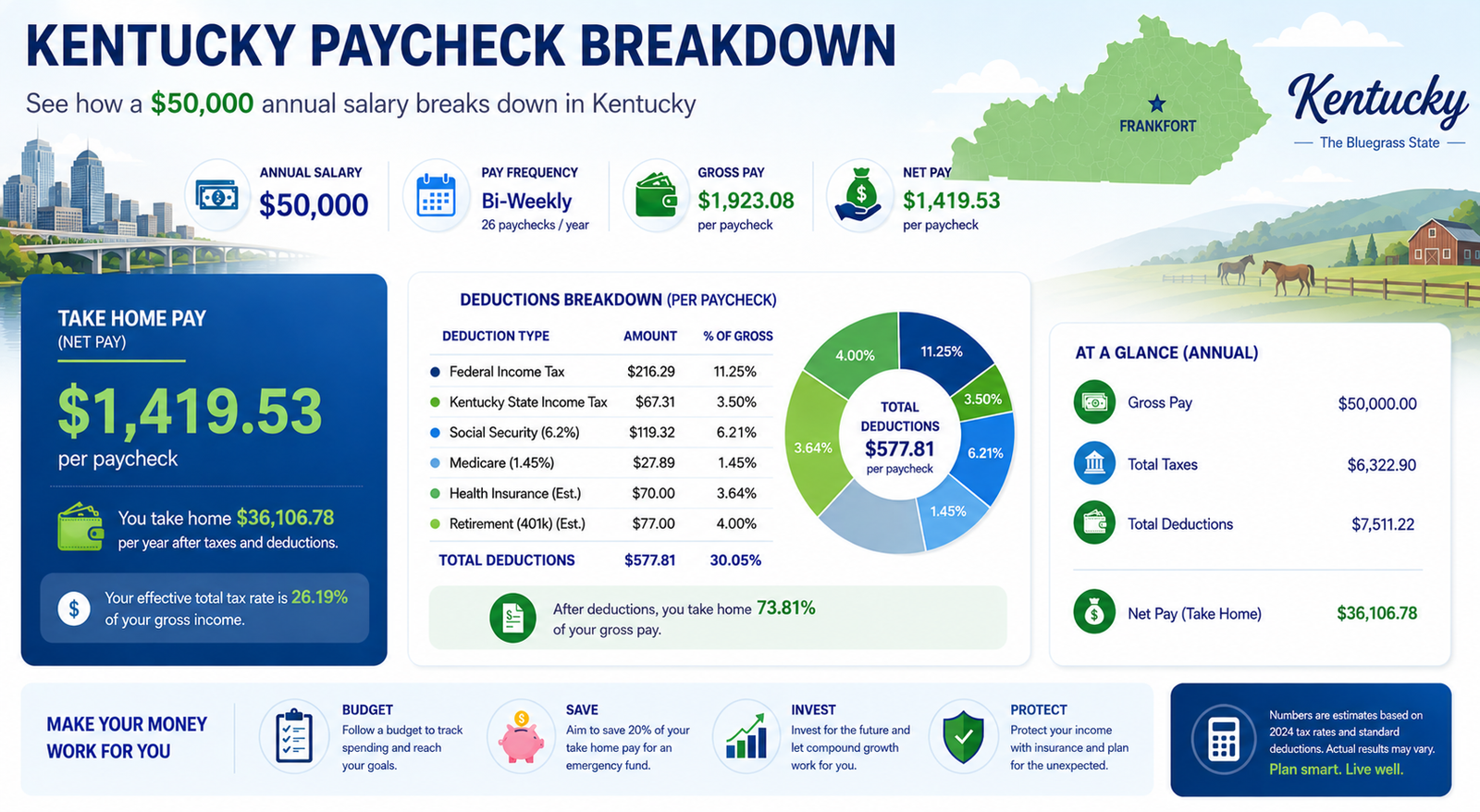
$50,000 Salary After Tax in Kentucky (2026 Guide)
If you are considering a job offer, relocating, or simply reviewing your finances, understanding exactly how much of your $50,000 salary after tax in Kentucky ends up in your bank account is essential. Kentucky uses a flat state income tax rate, which makes calculating take-home pay more straightforward than in states with tiered brackets. However, federal taxes, FICA deductions, and other factors still chip away at your gross earnings.
In this 2026 guide, we break down every deduction, show you real numbers, and help you determine whether a $50,000 salary is enough to live comfortably in cities like Louisville, Lexington, Bowling Green, and Owensboro. All calculations in this guide are based on our Kentucky paycheck calculator to ensure accuracy and consistency.
- Overview of Kentucky's Tax System
- $50,000 Salary Breakdown Table
- Detailed Tax Breakdown
- Annual Tax Summary Table
- Monthly Budget Example for Kentucky
- How Kentucky Stacks Up Against Neighboring States
- Is $50,000 a Good Salary in Kentucky?
- Tips to Increase Your Take-Home Pay
- Frequently Asked Questions
- Final Thoughts
Overview of Kentucky's Tax System in 2026
Kentucky continues to use a flat state income tax rate of 4.0% in 2026, applying the same percentage to all taxable income regardless of how much you earn. This differs from progressive tax states where higher earners pay incrementally higher rates. While the flat tax simplifies calculations, it also means that middle-income earners pay the same marginal state rate as top earners on every taxable dollar.
On the federal side, the IRS adjusts tax brackets annually for inflation. For a single filer earning $50,000 in 2026, the standard deduction reduces taxable income substantially before federal rates apply. Combined with Social Security at 6.2% and Medicare at 1.45%, the total payroll tax bite is 7.65% on the first dollar earned.
Kentucky's overall tax burden remains moderate compared to the national average. Coupled with the state's affordable housing market and lower-than-average cost of living in most cities, a $50,000 salary stretches further here than in many coastal or high-tax Midwestern states.
$50,000 Salary After Tax in Kentucky – Breakdown
The table below shows precisely how your $50,000 gross salary is distributed across various deductions, using our paycheck calculator for Kentucky as the primary data source.
| Category | Annual Amount | Monthly Equivalent | Bi-Weekly Equivalent |
|---|---|---|---|
| Gross Salary | $50,000 | $4,167 | $1,923 |
| Federal Income Tax | -$4,018 | -$335 | -$155 |
| Kentucky State Tax (4.0%) | -$2,000 | -$167 | -$77 |
| Social Security (6.2%) | -$3,100 | -$258 | -$119 |
| Medicare (1.45%) | -$725 | -$60 | -$28 |
| Net Take-Home Pay | $40,157 | $3,346 | $1,544 |
All calculations in this guide are based on our Kentucky paycheck calculator. Figures assume a single filer with no dependents and standard deductions for 2026.
Detailed Tax Breakdown for a $50,000 Salary in Kentucky
Understanding where your money goes each pay period helps you plan better. Below is a visual breakdown of the four main deductions that reduce your gross salary to net take-home pay.
As shown above, approximately 19.69% of your gross salary goes to taxes and mandatory deductions, leaving you with 80.31% as net take-home pay. Federal income tax is the single largest deduction at 8.04%, followed closely by Social Security at 6.20%. Kentucky's 4.0% flat tax is predictable and consistent across all income levels.
Annual Tax Summary – Kentucky vs. National Averages
The table below summarizes each tax component and compares Kentucky's deductions with typical national benchmarks for a $50,000 salary.
| Tax Component | Kentucky Amount | Percentage of Gross | National Typical Range |
|---|---|---|---|
| Federal Income Tax | $4,018 | 8.04% | 7.5% – 9.0% |
| State Income Tax | $2,000 | 4.00% | 0% – 7.0% |
| Social Security | $3,100 | 6.20% | 6.20% (fixed) |
| Medicare | $725 | 1.45% | 1.45% (fixed) |
| Total Deductions | $9,843 | 19.69% | 17% – 24% |
Monthly Budget for a $50,000 Salary in Kentucky
With a monthly take-home pay of approximately $3,346, living comfortably in Kentucky is achievable. However, your specific lifestyle and city choice will influence how far that money goes. Below is a realistic monthly budget tailored to Kentucky's cost of living, referencing average expenses in Louisville, Lexington, Bowling Green, and Owensboro.
Housing costs in Kentucky remain well below the national median. In Louisville, average rent for a one-bedroom apartment hovers around $1,100 to $1,300, while in Bowling Green and Owensboro, you can find quality apartments for $850 to $1,000 per month. This affordability is one of Kentucky's strongest financial advantages.
| Budget Category | Monthly Allocation | Percentage of Take-Home | Notes |
|---|---|---|---|
| Housing (Rent) | $1,100 | 32.9% | Below national average; even lower in Owensboro |
| Food & Groceries | $420 | 12.6% | Reasonable for a single adult cooking at home |
| Transportation | $320 | 9.6% | Gas, insurance, and maintenance |
| Utilities & Internet | $260 | 7.8% | Electric, water, internet, phone |
| Healthcare | $210 | 6.3% | Premiums and out-of-pocket costs |
| Savings & Emergency Fund | $350 | 10.5% | Recommended 10%+ of take-home |
| Discretionary | $686 | 20.5% | Entertainment, dining, hobbies |
| Total | $3,346 | 100% | Balanced monthly budget |
This budget leaves room for discretionary spending while prioritizing savings. In cities like Bowling Green and Owensboro, you may spend even less on housing, freeing up more for savings or other goals.
Kentucky Take-Home Pay Compared to Neighboring States
How does Kentucky's tax burden compare to nearby states for someone earning $50,000? The bar chart below illustrates estimated annual take-home pay across six states, highlighting Kentucky's competitive position.
Estimates for neighboring states are based on comparable single-filer scenarios. Tennessee has no state income tax on wages. Illinois has a 4.95% flat rate. Kentucky's 4.0% flat rate positions it favorably among regional peers.
| State | State Income Tax Rate | Est. Take-Home on $50K | Cost of Living Index |
|---|---|---|---|
| Kentucky | 4.0% Flat | $40,157 | 89.2 (below avg.) |
| Tennessee | 0% (no wage tax) | ~$41,300 | 89.8 |
| Indiana | 3.05% Flat | ~$40,400 | 83.7 |
| Ohio | 2.75% – 3.99% | ~$40,600 | 87.5 |
| West Virginia | 2.36% – 5.12% | ~$39,800 | 84.1 |
| Illinois | 4.95% Flat | ~$39,300 | 100.5 |
Kentucky holds its own against regional competitors. Although Tennessee's lack of a wage tax yields a slightly higher take-home amount, Kentucky's moderate cost of living and affordable housing market often offset the difference, particularly in cities like Bowling Green and Owensboro.
Is $50,000 a Good Salary in Kentucky?
The short answer is yes. A $50,000 salary after tax in Kentucky provides a comfortable lifestyle for a single individual in most parts of the state. With a monthly net income of $3,346, you can afford decent housing, cover essential expenses, save consistently, and still have money left for leisure and travel.
In Louisville and Lexington, the cost of living runs slightly higher than the state average, but even there, $50,000 places you above the median individual income. In smaller cities like Bowling Green and Owensboro, the same salary offers even greater purchasing power, especially in the housing market where rents can be 20-30% below national figures.
For a family, $50,000 as a single income would be tighter but still manageable with careful budgeting, particularly if you live in a lower-cost area of Kentucky. Dual-income households earning a combined $50,000 each would be in a very strong financial position statewide.
See exactly how much you keep after taxes with personalized inputs.
Calculate Your Real Take-Home Pay in SecondsAdjust for dependents, retirement contributions, and more.
Tips to Increase Your Take-Home Pay in Kentucky
While taxes are unavoidable, there are several legitimate strategies to keep more of your $50,000 salary working for you. Consider these practical steps:
- Contribute to a 401(k) or Traditional IRA: Pre-tax retirement contributions reduce your taxable income for both federal and Kentucky state tax purposes, lowering your current tax bill while building long-term wealth.
- Use a Health Savings Account (HSA): If you have a high-deductible health plan, HSA contributions are triple tax-advantaged and reduce your taxable income.
- Review Your Withholding: Use a Kentucky paycheck calculator to check if you are over-withholding. Adjusting your W-4 can increase each paycheck without changing your total tax liability.
- Claim All Eligible Deductions: While Kentucky uses a flat tax, federal deductions like student loan interest and the standard deduction still reduce your overall burden.
- Consider Relocating Within Kentucky: Moving from a pricier area like downtown Louisville to a more affordable suburb or smaller city can dramatically reduce living costs without changing your salary.
$50,000 Salary After Tax in Kentucky – FAQs
How much is a $50,000 salary after tax in Kentucky per month?
A $50,000 salary after tax in Kentucky yields approximately $3,346 per month in net take-home pay for a single filer in 2026. This figure accounts for federal income tax, Kentucky's 4.0% flat state tax, Social Security at 6.2%, and Medicare at 1.45%.
Is $50,000 a good salary in Louisville, Kentucky?
Yes, $50,000 is considered a solid salary in Louisville. The city's cost of living runs slightly below the national average, and housing costs are particularly affordable compared to similarly sized metro areas. A single person can live comfortably with room for savings and discretionary spending.
Can you live comfortably in Lexington on a $50,000 salary?
Absolutely. Lexington offers a moderate cost of living with rental prices typically ranging from $1,000 to $1,400 for a one-bedroom apartment. With monthly take-home pay of around $3,346, you can cover all essentials, save, and enjoy the city's dining and cultural scene.
What is Kentucky's state income tax rate for 2026?
Kentucky applies a flat state income tax rate of 4.0% in 2026. This rate applies uniformly to all taxable income regardless of earnings level, making Kentucky's system simpler than progressive tax structures found in many other states.
How does Kentucky's tax burden compare to Tennessee?
Tennessee does not tax wages, so a $50,000 earner in Tennessee takes home roughly $1,100 more annually than in Kentucky. However, Tennessee's sales tax is higher, and when factoring in Kentucky's lower housing costs, the overall financial picture can be surprisingly comparable depending on lifestyle.
What is the bi-weekly take-home pay for a $50,000 salary in Kentucky?
The bi-weekly take-home pay for a $50,000 salary in Kentucky is approximately $1,544 for a single filer in 2026. This reflects two weeks of net pay after all mandatory deductions including federal tax, state tax, Social Security, and Medicare.
Does Kentucky tax retirement income on a $50,000 salary?
Kentucky offers favorable treatment for certain retirement income. While active wage earners pay the 4.0% flat rate, retirees may benefit from partial or full exclusions on pension and retirement account withdrawals depending on age and income thresholds. Consult a tax professional for personalized guidance.
Are there local income taxes in Kentucky cities like Louisville or Lexington?
No. Kentucky does not impose additional local or municipal income taxes on top of the state's 4.0% flat rate. This keeps tax calculations simpler compared to states like Ohio or Pennsylvania where local wage taxes can add 1-3% in certain jurisdictions.
Ready to see your personalized paycheck breakdown?
Calculate Your Salary in Kentucky NowUnderstanding Your Take-Home Pay in Kentucky
A $50,000 salary after tax in Kentucky provides a net annual income of roughly $40,157, which translates to dependable monthly cash flow of $3,346. For a single person, this is more than sufficient to build a stable, comfortable life in the Bluegrass State. The combination of Kentucky's flat 4.0% tax rate, below-average housing costs in cities like Bowling Green and Owensboro, and the overall moderate cost of living makes $50,000 go meaningfully further here than in many other parts of the country.
While no two financial situations are identical, the numbers consistently show that Kentucky offers a favorable balance between tax obligations and living expenses. If you are evaluating a job offer, planning a move, or simply reassessing your finances, using a reliable Kentucky paycheck calculator is the best way to get accurate, personalized results.
On a related note, while managing your finances and calculating take-home pay is essential, you may also find value in exploring FreeAiden, which offers free online AI-powered tools and utilities such as QR code generators, barcode generators, PDF converters, image tools, productivity utilities, and web helpers. These can simplify everyday tasks and free up time to focus on what matters most.
Take control of your financial future today. Use the calculator, review your budget, and make informed decisions that align with your goals in Kentucky.
Disclaimer
About the Author
Reviewed by a financial analyst with expertise in state tax policy and personal finance. This article draws on data from the IRS, the Kentucky Department of Revenue, and our proprietary paycheck calculator to deliver accurate, trustworthy, and up-to-date information. Last Updated: 2026.