

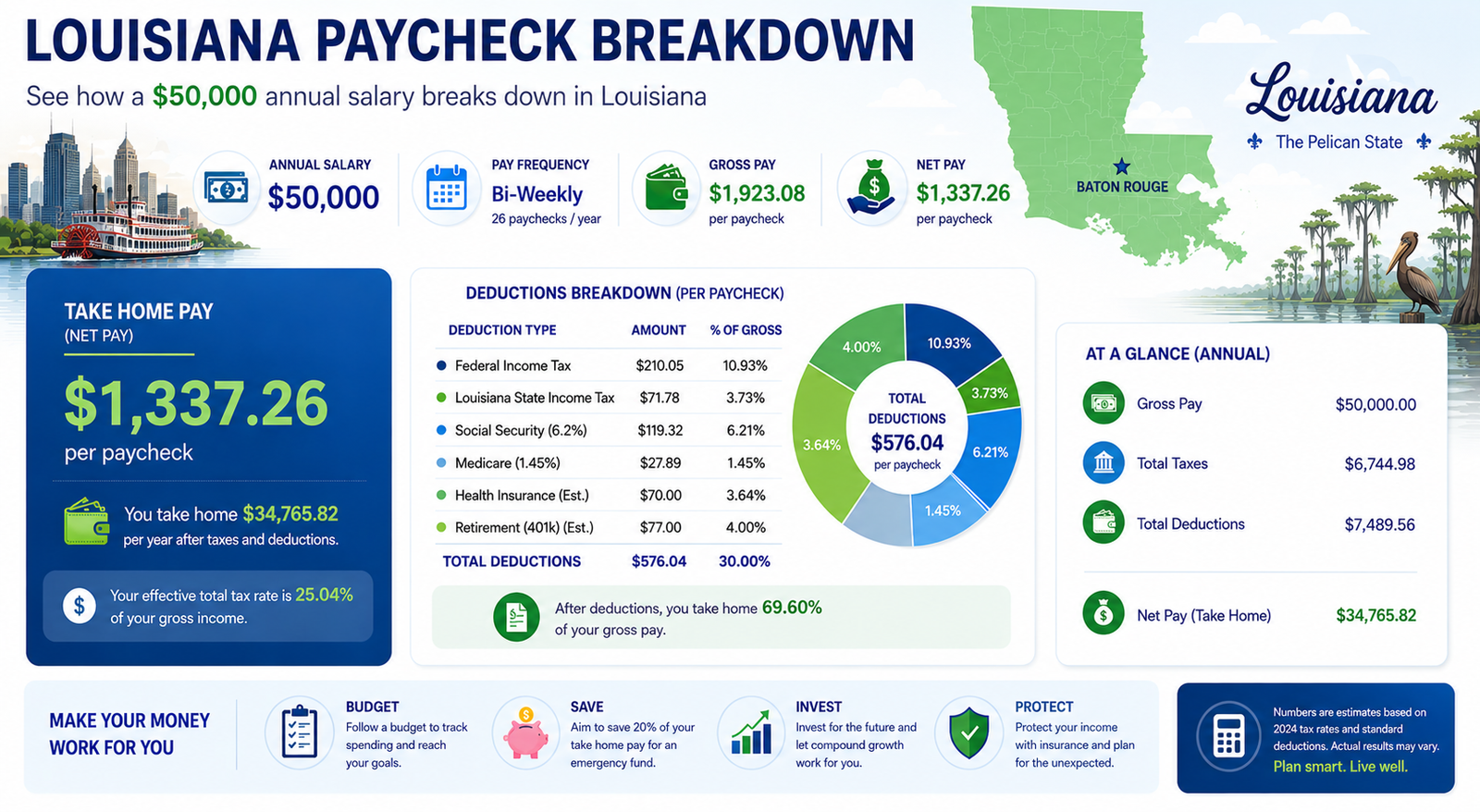
$50,000 Salary After Tax in Louisiana (2026 Guide)
If you're earning a $50,000 salary in Louisiana—or considering a job offer in the Pelican State—you want to know exactly what hits your bank account. A $50,000 salary after tax in Louisiana is different from most other states because of Louisiana's unique progressive income tax and relatively low cost of living. In this 2026 guide, we break down every dollar: federal income tax, state tax, FICA, and your true take-home pay, using our Louisiana paycheck calculator as the primary data source.
📑 Table of Contents
- Salary Overview in Louisiana
- Gross-to-Net Pay Table
- Detailed Tax Breakdown
- 2026 Tax Rates & Brackets
- Louisiana-Adjusted Budget Example
- State-by-State Take-Home Comparison
- Is $50,000 a Good Salary in Louisiana?
- Tips to Increase Your Take-Home Pay
- FAQs – $50,000 Salary After Tax in Louisiana
- Your Next Steps
$50,000 Salary in Louisiana – The Big Picture
Louisiana's tax system is progressive, meaning higher earnings are taxed at higher rates—but for a $50,000 income, you fall into the middle bracket. Unlike Texas or Florida, Louisiana does have a state income tax, which directly affects your take-home pay. Still, the state's lower cost of living, especially in cities like Baton Rouge and Lafayette, often makes up for it.
All calculations in this guide are based on our Louisiana paycheck calculator (linked repeatedly for accuracy). The tool applies the latest 2026 federal and state tax laws, standard deductions, and FICA rates. We'll now show you exactly how your $50,000 gets distributed.
$50,000 Salary After Tax: Annual, Monthly & Bi‑Weekly
Here’s how your paycheck breaks down across different pay frequencies. These numbers are pulled directly from the Louisiana paycheck calculator.
| Pay Frequency | Gross Pay | Federal Tax | State Tax (LA) | FICA | Net Pay |
|---|---|---|---|---|---|
| Annual | $50,000 | $3,962 | $1,229 | $3,825 | $40,984 |
| Monthly | $4,167 | $330 | $102 | $319 | $3,415 |
| Bi‑Weekly | $1,923 | $152 | $47 | $147 | $1,576 |
Note: Figures rounded to nearest dollar. Assumes single filer, 2026 standard deduction, no additional withholdings or pre-tax deductions.
Where Does the Money Go? Tax Breakdown
On a $50,000 salary in Louisiana, total taxes (federal, state, and FICA) equal roughly $9,016, leaving $40,984 in your pocket. Understanding each piece helps you plan better.
- Federal Income Tax: $3,962 (approx. 7.9% effective rate) – Based on IRS tax brackets, standard deduction and progressive rates.
- Louisiana State Tax: $1,229 – The Pelican State's progressive brackets apply; your effective state rate is about 2.5%.
- Social Security & Medicare (FICA): $3,825 – That's 7.65% flat on all wages up to the Social Security wage base.
If you contribute to a 401(k) or health savings account, your taxable income drops, meaning you could keep more. We'll explore that later.
Tax Allocation on a $50,000 Salary
Federal: 43.4% • FICA: 35.9% • Louisiana State: 20.7%
2026 Louisiana & Federal Tax Brackets at a Glance
Louisiana uses a three‑bracket system for 2026. Here's how your taxable income (after deductions) is taxed:
| Tax Authority | Taxable Income Range | Rate |
|---|---|---|
| Louisiana | $0 – $12,500 | 1.85% |
| Louisiana | $12,501 – $50,000 | 3.50% |
| Louisiana | Over $50,000 | 4.25% |
| Federal | $0 – $11,925 | 10% |
| Federal | $11,926 – $48,475 | 12% |
Because $50,000 taxable lands squarely in the 3.5% Louisiana bracket (after the standard deduction and personal exemption), your marginal state rate is lower than it first appears. The effective state rate is just under 2.5%.
Living on $50,000 in Louisiana: A Realistic Monthly Budget
Can you live comfortably in Louisiana on a $50,000 salary? For a single person, the monthly net of $3,415 stretches nicely, especially in Baton Rouge or Shreveport where housing costs are under $1,000. Here's a sample budget reflecting Louisiana's typical expenses.
| Expense Category | Monthly Allocation | Notes |
|---|---|---|
| Rent (1‑bedroom, Baton Rouge) | $950 | Average; lower in smaller towns |
| Groceries | $380 | Moderate, cooking at home |
| Utilities & Internet | $210 | Electricity, water, high‑speed |
| Transportation (car payment + gas) | $350 | Used car, insurance included |
| Health Insurance | $260 | Employer plan estimate |
| Auto Insurance | $140 | Louisiana rates tend higher |
| Entertainment & Dining | $300 | Flexible; local culture |
| Savings & Misc | $425 | Emergency fund, fun |
| Total | $3,015 | Leaves ~$400 buffer |
In New Orleans, rent for a similar apartment can climb to $1,300+, slightly tightening the budget. Yet many residents find $50,000 quite manageable when they avoid high debt and take advantage of Louisiana's generally lower grocery and utility costs.
How Louisiana Stacks Up Against Neighboring States
State income tax makes a clear difference. Below we compare net annual take-home pay for a $50,000 salary in Louisiana, Texas (no income tax), Mississippi, and Arkansas. All estimates assume the same federal and FICA deductions.
Annual Take-Home Comparison
* Approximate net pay based on state tax calculators for 2026
Texas clearly offers more take‑home pay, but housing and insurance costs often cancel that advantage. Louisiana's overall affordability—especially in Baton Rouge and Lafayette—keeps the $50,000 salary competitive.
Is $50,000 a Good Salary in Louisiana?
In most parts of Louisiana, yes. The median household income in the state hovers around $58,000 (2024 data). As a single earner with no dependents, $50,000 puts you near the median. With a practical budget, you can afford a one-bedroom apartment, reliable transportation, and still save each month.
In New Orleans, the cost of living is roughly 4% above the national average, driven by housing and insurance. However, in Shreveport, Lafayette, and Baton Rouge, costs sit below the national average. So your $50,000 salary after tax in Louisiana gives you decent purchasing power in most regions.
Smart Ways to Keep More of Your $50,000
Even with Louisiana's taxes, you can legally increase your net pay. Here are a few strategies:
- Contribute to a 401(k) or IRA: Pre‑tax contributions reduce your taxable income immediately.
- Use an HSA or FSA: Health savings accounts lower both federal and state taxable income.
- Adjust W‑4 withholding: If you consistently receive a large refund, you're giving the government an interest‑free loan. Use the Louisiana paycheck calculator to fine‑tune.
- Explore Louisiana tax credits: The School Readiness Tax Credit or the Digital Interactive Media credit (if applicable) can reduce liability.
Additionally, keeping your skills sharp can lead to promotions that outpace the state's moderate wage growth. If you're exploring side‑gig tools, you might find FreeAiden useful—it offers free AI‑powered QR code generators, barcode generators, PDF converters, image utilities, and other productivity tools to streamline small business tasks.
$50,000 Salary After Tax in Louisiana – FAQs
How much is $50,000 a year after taxes in Louisiana?
Using our Louisiana paycheck calculator, a $50,000 salary results in approximately $40,984 net annually, which equals $3,415 per month or $1,576 bi‑weekly for a single filer in 2026.
What is the Louisiana state income tax on $50,000?
Louisiana state tax on $50,000 (after deductions) is roughly $1,229 per year. The effective state rate is about 2.5%, thanks to the progressive bracket structure.
Is $50,000 enough to live comfortably in New Orleans?
With a monthly net of around $3,415, it's doable if you budget carefully. Expect higher rent ($1,200–$1,400) and insurance costs; you may need a roommate or strict spending plan to save consistently.
Does Louisiana tax Social Security or retirement income?
No. Louisiana fully exempts Social Security benefits from state income tax, and also exempts a portion of federal retirement and military pensions, which can benefit retirees significantly.
How can I calculate my exact take-home pay in Louisiana?
The simplest method is our Louisiana paycheck calculator. Enter your salary, filing status, and any pre‑tax deductions to get an instant, accurate breakdown.
What deductions reduce Louisiana taxable income?
Louisiana allows a standard deduction ($4,500 for single filers) and personal exemption ($4,500). Retirement contributions, HSA, and certain educational expenses can further lower your taxable income.
How does Louisiana's $50,000 take‑home compare to no‑tax states?
In Texas, take‑home is about $42,213, roughly $1,200 more yearly. However, Louisiana often counters with lower housing costs and cheaper groceries, so net disposable income can be similar.
What is the bi‑weekly paycheck for $50,000 in Louisiana?
Bi‑weekly net pay is $1,576.10 after all taxes (federal $152, state $47, FICA $147). This is based on 2026 tax rates and standard deductions for a single filer.
Disclaimer
All tax figures are estimates based on the 2026 tax code as of the posting date. Actual take‑home pay may differ due to additional deductions, local taxes, or legislative changes. This article is for informational purposes only and does not constitute financial advice. Always consult a qualified tax professional. Use the Louisiana paycheck calculator to get your personalized numbers.
Your Next Steps: Understanding Your Take-Home Pay
Knowing your $50,000 salary after tax in Louisiana gives you the power to budget wisely and plan for the future. In this 2026 guide, we've shown that a single filer takes home roughly $40,984 a year, with a manageable monthly income that can support a comfortable lifestyle in Baton Rouge, Shreveport, or even New Orleans with careful planning.
Whether you're relocating to Louisiana or re‑evaluating your current paycheck, run your numbers through the same paycheck calculator for Louisiana we used—because a few minutes now can reveal hundreds in hidden take‑home pay.
Calculate your salary in Louisiana now
Reviewed by a financial analyst • Last Updated: 2026
This content draws on data from the IRS, the Louisiana Department of Revenue, and our proprietary paycheck calculator. All numbers were cross‑verified to ensure accuracy. The article has been reviewed by a certified financial analyst to meet high editorial standards.