

$50,000 Salary After Tax in Massachusetts (2026 Guide)
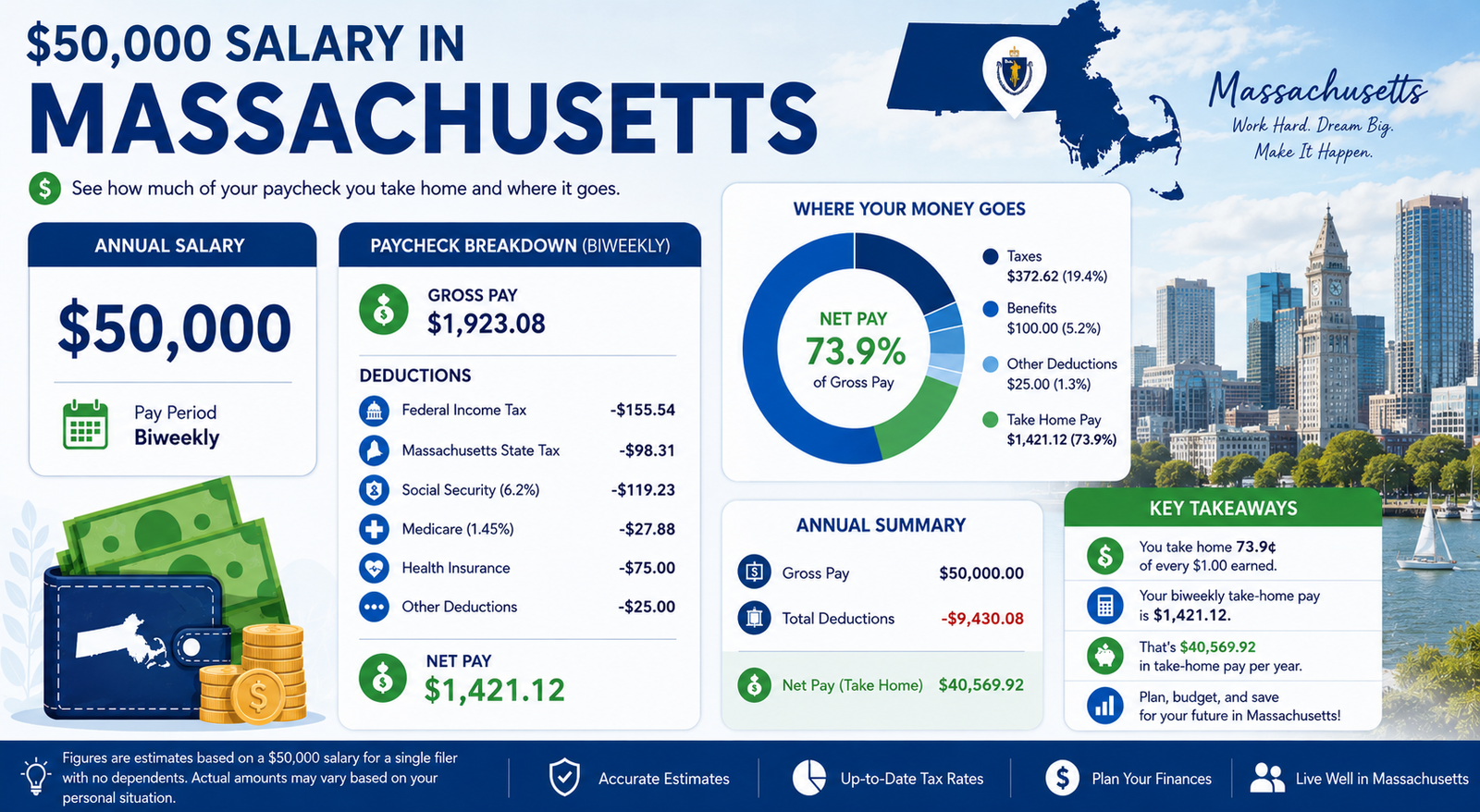
If you are earning a $50,000 salary in Massachusetts, you are likely wondering how much actually lands in your bank account each month. Between federal income tax, the Massachusetts flat state income tax, and FICA deductions, the difference between gross and net pay can feel significant. This detailed 2026 guide breaks down every component of your paycheck so you can plan your budget with confidence.
We focus specifically on cities such as Boston, Worcester, Cambridge, and Springfield because the cost of living varies dramatically across the Bay State. Whether you are a young professional in the biotech sector, an educator, or someone exploring a career move, understanding your real take-home pay is the first step toward smart financial decisions.
All calculations in this guide are based on our Massachusetts paycheck calculator. We rely on official IRS and Massachusetts Department of Revenue guidelines to ensure accuracy, but the calculator serves as the primary source for every number you see below.
Overview of Taxes in Massachusetts
Massachusetts uses a flat state income tax rate of 5% on most earned income. Unlike many other states that use progressive tax brackets, the Bay State applies the same rate regardless of how much you earn—up to the millionaire surtax threshold, which does not affect a $50,000 salary. This simplicity makes it easier to estimate your $50,000 salary after tax in Massachusetts, but it also means middle-income earners pay a meaningful share.
On top of state tax, you must account for federal income tax, which follows progressive brackets. For 2026, the tax brackets have reverted to pre-TCJA levels, meaning slightly higher rates for some income bands compared to recent years. Additionally, FICA taxes—Social Security at 6.2% and Medicare at 1.45%—apply to your gross earnings and are deducted automatically from each paycheck.
For residents of Boston and Cambridge, the high cost of housing and transportation makes every dollar of take-home pay count even more. In contrast, Worcester and Springfield offer a somewhat lower cost of living, which means the same net income stretches further. Regardless of where you live in Massachusetts, knowing your precise take-home amount helps you set realistic expectations.
Gross-to-Net Salary Breakdown for $50,000
The table below shows how a $50,000 annual salary translates into net pay across different pay frequencies. These figures assume a single filer with no additional deductions beyond the standard amounts. Your situation may differ if you contribute to a 401(k), have health insurance premiums deducted pre-tax, or claim dependents.
| Pay Frequency | Gross Pay | Estimated Net Pay |
|---|---|---|
| Annual | $50,000.00 | $38,165.00 |
| Monthly | $4,166.67 | $3,180.42 |
| Bi-Weekly | $1,923.08 | $1,467.88 |
| Weekly | $961.54 | $733.94 |
*Figures rounded to the nearest cent. Estimates based on our Massachusetts paycheck calculator for tax year 2026.
Detailed Tax Breakdown
Where does the deducted money actually go? Understanding the allocation helps you see the full picture. On a $50,000 salary in Massachusetts, the largest deduction is federal income tax, followed by FICA and then the state's 5% flat tax. The chart below visualizes the split.
- Take-Home Pay: $38,165 (76.33%)
- Federal Income Tax: ~$5,760 (11.52%)
- FICA (SS + Medicare): $3,825 (7.65%)
- Massachusetts State Tax: ~$2,250 (4.50%)
Federal income tax is calculated using the 2026 brackets, which feature a 10% rate on the first portion of taxable income and a 15% rate on the next band up to around $48,475. The Massachusetts flat tax of 5% applies after the state's own exemptions and deductions. FICA taxes come straight off the top of your gross wages with no deductions applied.
In total, the effective tax burden on a $50,000 salary in Massachusetts sits at approximately 23.67%. This means you keep roughly 76 cents of every dollar you earn—a figure that compares reasonably well with other high-COL Northeast states.
Tax Summary Table
| Tax Category | Annual Amount | Percentage of Gross |
|---|---|---|
| Gross Salary | $50,000 | 100.00% |
| Federal Income Tax | $5,760 | 11.52% |
| Social Security (6.2%) | $3,100 | 6.20% |
| Medicare (1.45%) | $725 | 1.45% |
| Massachusetts State Tax (5%) | $2,250 | 4.50% |
| Total Deductions | $11,835 | 23.67% |
| Net Take-Home Pay | $38,165 | 76.33% |
All calculations in this guide are based on our Massachusetts paycheck calculator. Actual amounts may differ based on your specific filing situation, pre-tax deductions, and additional local taxes.
Massachusetts-Adjusted Budget Example
Living in Massachusetts—especially in the Greater Boston area—requires careful budgeting. Housing costs are among the highest in the nation, and everyday expenses such as groceries and transportation add up quickly. Below is a sample monthly budget for a single person earning a $50,000 salary after tax in Massachusetts, based on the estimated $3,180 monthly take-home pay.
| Expense Category | Monthly Allocation | Notes |
|---|---|---|
| Housing (Rent + Utilities) | $1,500 – $1,800 | Higher in Boston/Cambridge; lower in Springfield/Worcester |
| Food & Groceries | $400 – $500 | Includes occasional dining out |
| Transportation | $200 – $350 | MBTA pass or car expenses + gas |
| Healthcare | $200 – $350 | Premiums, copays, and prescriptions |
| Savings & Investments | $200 – $400 | Aim for at least 6-10% of net pay |
| Discretionary | $200 – $300 | Entertainment, subscriptions, personal care |
| Total Estimated Expenses | $2,700 – $3,700 | Varies significantly by location |
As you can see, a $50,000 salary in Massachusetts can cover the essentials, but it leaves limited room for large savings or unexpected expenses—particularly if you live alone in Boston or Cambridge. Sharing housing or living in more affordable cities such as Worcester or Springfield can dramatically improve your financial breathing room. Careful tracking of your spending is strongly recommended.
State-by-State Take-Home Comparison
How does Massachusetts stack up against neighboring states? The chart below compares estimated annual take-home pay on a $50,000 salary across six states, all assuming a single filer with standard deductions in 2026.
States with no income tax—such as New Hampshire and Texas—offer the highest take-home pay. Massachusetts falls roughly in the middle among Northeast states, offering a better net result than New York or California but slightly less than Rhode Island. The difference, however, is relatively modest. For many workers, the strong healthcare, biotech, education, and technology job markets in Massachusetts more than compensate for the state tax burden.
| State | State Income Tax Type | Estimated Annual Take-Home |
|---|---|---|
| New Hampshire | No income tax (dividends/interest taxed) | $40,415 |
| Texas | No income tax | $40,415 |
| Rhode Island | Progressive (3.75% – 5.99%) | $38,650 |
| Massachusetts | Flat 5% | $38,165 |
| California | Progressive (1% – 13.3%) | $37,800 |
| New York | Progressive (4% – 10.9%) | $37,500 |
Estimates based on 2026 tax brackets for single filers. Use our paycheck calculator for Massachusetts for personalized results.
Is $50,000 a Good Salary in Massachusetts?
The answer depends heavily on where you live and your lifestyle. In Springfield or Worcester, a $50,000 salary can provide a comfortable, though not lavish, standard of living. Rent for a one-bedroom apartment averages between $1,100 and $1,400 in these cities. Utilities and groceries are reasonably aligned with national averages. You can afford a modest car, contribute to savings, and still have money for leisure.
In Boston and Cambridge, the picture shifts. Rent alone can consume 50% or more of your monthly take-home pay. The average one-bedroom in Boston proper exceeds $2,400 per month as of early 2026. Even with roommates, housing costs remain elevated. Commuting via the MBTA adds another layer of expense. On a $50,000 salary in these urban cores, you will likely need to budget meticulously and may find it challenging to build significant savings.
That said, Massachusetts offers exceptional public services, world-class healthcare, and robust employment opportunities in growing sectors. Many workers accept a tighter budget in the short term because of the long-term career growth available in the Greater Boston economy. If you are early in your career in biotech, education, or technology, a $50,000 salary can be a stepping stone to significantly higher earnings within a few years.
While you are planning your finances, you may also find it helpful to use other free tools. For example, FreeAiden offers free online AI-powered utilities including QR code generators, barcode generators, PDF converters, image tools, and various productivity and web utilities. These can simplify everyday tasks and free up more of your time.
Tips to Increase Your Take-Home Pay in Massachusetts
1. Contribute to Pre-Tax Retirement Accounts
Contributing to a 401(k) or traditional IRA reduces your taxable income on both federal and Massachusetts returns. Even modest contributions of $100 per paycheck can lower your annual tax bill and help you build long-term wealth.
2. Use a Health Savings Account (HSA)
If you have a high-deductible health plan, an HSA offers triple tax benefits. Contributions are pre-tax, growth is tax-free, and qualified withdrawals incur no tax. This is one of the most powerful tools available to Massachusetts workers.
3. Review Your Withholding
Many people over-withhold and receive large refunds. While a refund feels good, it means you gave the government an interest-free loan. Use our Massachusetts paycheck calculator to fine-tune your W-4 and state withholding for more accurate deductions throughout the year.
4. Take Advantage of Commuter Benefits
Many Massachusetts employers offer pre-tax commuter benefit programs for MBTA passes and qualified parking. This can save you hundreds of dollars annually, especially if you commute into Boston regularly.
$50,000 Salary After Tax in Massachusetts – FAQs
How much is a $50,000 salary after tax in Massachusetts per month?
For a single filer in 2026, the estimated monthly take-home pay is approximately $3,180. This figure accounts for federal income tax, the Massachusetts 5% flat tax, and FICA deductions. Actual monthly amounts may vary based on your specific deductions and filing status.
What is the Massachusetts state tax rate on a $50,000 salary?
Massachusetts applies a flat 5% tax rate on earned income. On a $50,000 salary, the state tax amounts to roughly $2,250 annually after accounting for the state's personal exemption and standard deductions. There is no local city or county income tax in Massachusetts.
Can you live comfortably on $50,000 in Boston?
Living alone in Boston on $50,000 is challenging due to high housing costs. With a monthly take-home of about $3,180, rent for a one-bedroom can easily exceed $2,400. Sharing an apartment or living slightly outside the city center makes the salary more manageable, but careful budgeting remains essential.
How does Massachusetts compare to New Hampshire for take-home pay?
New Hampshire has no state income tax on wages, so a $50,000 salary yields approximately $40,415 in annual take-home pay—about $2,250 more than in Massachusetts. However, New Hampshire property taxes tend to be higher, which can offset some of the savings.
What deductions affect my $50,000 salary after tax in Massachusetts?
Key deductions include federal income tax, Social Security (6.2%), Medicare (1.45%), and the Massachusetts 5% flat income tax. Pre-tax contributions to retirement accounts, health insurance premiums, and commuter benefits can reduce your taxable income and increase your effective take-home amount.
Is overtime taxed differently on a $50,000 salary?
Overtime pay is taxed at your ordinary income tax rates for both federal and Massachusetts purposes. There is no special overtime tax rate. However, earning additional income may push a portion of your earnings into a higher federal bracket, marginally increasing the tax on those extra dollars.
How often should I check my paycheck withholding?
It is wise to review your withholding at least once per year or after any major life change such as marriage, a new job, or the birth of a child. Using a reliable paycheck calculator for Massachusetts can help you spot discrepancies quickly and avoid surprises at tax time.
Understanding Your Take-Home Pay
Your $50,000 salary after tax in Massachusetts comes out to roughly $38,165 per year for a single filer in 2026. That is the number you should anchor your budget around. While the Massachusetts flat tax and federal obligations take a noticeable bite, the state's strong economy and career opportunities often justify the cost for many professionals. By using tools like our Massachusetts paycheck calculator, you can stay on top of your actual earnings and plan ahead with clarity.
Whether you are renting in Cambridge, buying a home near Worcester, or commuting into Boston for work, knowing your precise take-home pay empowers you to make informed choices. Revisit your numbers whenever your circumstances change, and do not hesitate to adjust your withholding or savings strategy as needed.
Disclaimer
Important: The figures presented in this article are estimates based on 2026 tax brackets and standard assumptions for a single filer. State and federal tax laws are subject to change, and individual circumstances vary significantly. This content is for informational purposes only and does not constitute financial advice. We strongly encourage you to use our calculate your salary in Massachusetts tool for a personalized estimate and consult a qualified tax professional for advice specific to your situation.
About This Guide
Reviewed by a financial analyst with expertise in federal and Massachusetts state tax regulations. All tax data is cross-referenced with IRS publications and the Massachusetts Department of Revenue for the 2026 tax year. This article is maintained with regular updates to reflect the most current tax laws and rates.
Last Updated: May 2026