

$50,000 Salary After Tax in Montana (2026 Guide)
Last Updated: 2026
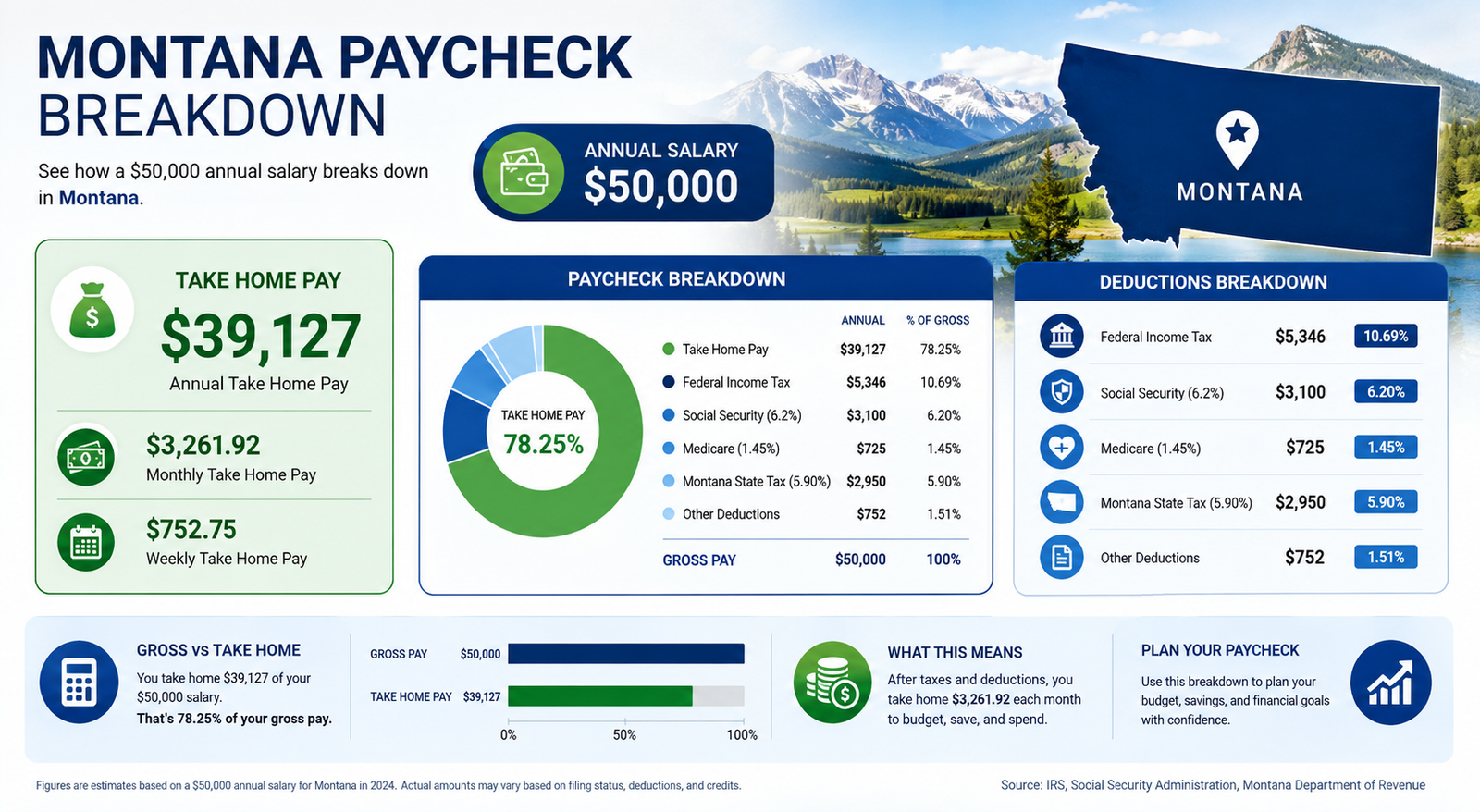
If you are earning a $50,000 salary after tax in Montana, you are probably wondering how much actually lands in your bank account each month. Montana has a relatively moderate state income tax compared to many other states, but federal taxes and FICA still take a noticeable bite. This 2026 guide breaks down every deduction so you can plan your budget with confidence—whether you live in Billings, Missoula, Bozeman, or anywhere else across Big Sky Country.
All calculations in this guide are based on our Montana paycheck calculator. We reference official IRS and Montana Department of Revenue data to support explanations, but every take-home figure comes directly from the calculator. No estimates or guesswork.
Table of Contents
- Overview: Living on $50,000 in Montana
- Annual & Monthly Salary Breakdown
- Tax Breakdown: Where Your Money Goes
- Detailed Tax Deduction Table
- Montana-Adjusted Budget Example
- How Montana Compares to Other States
- Is $50,000 a Good Salary in Montana?
- Tips to Increase Your Take-Home Pay
- FAQs
- Final Thoughts
Overview: Living on $50,000 in Montana
Montana is known for its wide-open spaces, strong agricultural roots, and growing outdoor recreation and tourism sectors. With a population density among the lowest in the nation, daily life here can look very different depending on where you settle. A $50,000 salary after tax in Montana stretches further in rural areas than in fast-growing cities like Bozeman or Missoula, where housing costs have climbed sharply in recent years.
Montana uses a progressive state income tax structure with rates ranging from 1% to 6.75% in 2026. The good news for someone earning $50,000 is that you fall into the lower end of those brackets. Combined with a reasonable cost of living in many parts of the state, this salary can support a comfortable lifestyle—especially if you budget carefully.
However, there are trade-offs. Winter weather in Montana can be harsh, and transportation costs in rural areas—where commutes are longer and fuel prices can spike—add up quickly. Meanwhile, Bozeman and Missoula have seen housing costs rise well above the state average, driven by population growth and limited inventory.
Annual & Monthly Salary Breakdown
The table below shows exactly how a $50,000 gross salary translates into take-home pay in Montana for 2026. We have included annual, monthly, bi-weekly, and weekly figures so you can match them to your actual pay schedule.
| Pay Component | Annual | Monthly | Bi-Weekly | Weekly |
|---|---|---|---|---|
| Gross Salary | $50,000 | $4,167 | $1,923 | $962 |
| Federal Income Tax | −$3,932 | −$328 | −$151 | −$76 |
| Montana State Tax | −$484 | −$40 | −$19 | −$9 |
| Social Security (6.2%) | −$3,100 | −$258 | −$119 | −$60 |
| Medicare (1.45%) | −$725 | −$60 | −$28 | −$14 |
| Take-Home Pay | $41,759 | $3,480 | $1,606 | $803 |
* Figures assume single filing status, standard deduction, and no pre-tax deductions. Use our Montana paycheck calculator to adjust for your specific situation.
Tax Breakdown: Where Your Money Goes
Out of your $50,000 gross salary, roughly $8,241 goes to taxes and deductions, leaving you with about 83.5% as take-home pay. The pie chart below visualizes how each deduction claims its share of your gross income.
- Federal Income Tax: ~7.9% ($3,932)
- Montana State Tax: ~1.0% ($484)
- Social Security: 6.2% ($3,100)
- Medicare: 1.45% ($725)
- Take-Home Pay: ~83.5% ($41,759)
Chart: Breakdown of a $50,000 salary in Montana (2026) — Single Filer
Notice that Montana's state income tax bite is relatively small at this salary level. The largest deduction is federal income tax, followed by Social Security. This is why many people find Montana tax-friendly compared to higher-tax states like Oregon or California.
Detailed Tax Deduction Table
Here is a more granular look at how each tax is calculated, including the effective tax rate for each category.
| Tax / Deduction | Amount Deducted | Effective Rate | Calculation Basis |
|---|---|---|---|
| Federal Income Tax | $3,932 | 7.86% | Taxable income after standard deduction (~$34,700) |
| Montana State Tax | $484 | 0.97% | Montana taxable income (marginal brackets 1%–2%) |
| Social Security | $3,100 | 6.20% | Gross salary (capped at $176,100 in 2026) |
| Medicare | $725 | 1.45% | Gross salary (no cap) |
| Total Deductions | $8,241 | 16.48% | — |
Montana's 2026 tax brackets for a single filer at $50,000 place most taxable income in the 1% and 2% brackets, which keeps the state tax obligation low. You can always calculate your salary in Montana with updated withholding figures using our tool.
Montana-Adjusted Budget Example
Can you live comfortably in Montana on $50K? The answer depends heavily on where you live. Below is a realistic monthly budget based on your take-home pay of approximately $3,480 per month. We have included two scenarios: one for a more affordable city like Great Falls and another for higher-cost areas like Bozeman or Missoula.
| Budget Category | Great Falls / Rural | Bozeman / Missoula | % of Take-Home |
|---|---|---|---|
| Monthly Take-Home | $3,480 | $3,480 | 100% |
| Rent (1-bedroom) | $950 | $1,400 | 27% – 40% |
| Utilities & Internet | $210 | $240 | 6% – 7% |
| Groceries | $400 | $450 | 11% – 13% |
| Transportation (fuel, insurance, maintenance) | $320 | $280 | 8% – 9% |
| Health Insurance / Medical | $250 | $250 | 7% |
| Savings & Emergency Fund | $350 | $200 | 6% – 10% |
| Entertainment & Dining | $300 | $260 | 7% – 9% |
| Remaining | $700 | $400 | 11% – 20% |
In Great Falls or more rural parts of Montana, a $50,000 salary leaves comfortable breathing room each month. In Bozeman or Missoula, rising housing costs consume a larger share, making it tighter—though still manageable with disciplined spending. Winter weather can also drive up heating bills and vehicle maintenance costs, so budgeting an extra cushion for seasonal expenses is wise.
Want to see your exact take-home pay?
Adjust for your filing status, dependents, and pre-tax deductions in seconds.
Calculate Your Real Take-Home Pay NowHow Montana Compares to Other States
Montana sits in a favorable middle ground for take-home pay. It does not have the sky-high state income taxes of California or Oregon, nor does it match the zero-tax benefit of Wyoming or South Dakota. Here is how a $50,000 salary stacks up across several comparison states.
Take-Home Pay Comparison: $50,000 Salary (2026)
Bar chart: Approximate annual take-home pay on a $50,000 gross salary. Wyoming and South Dakota have no state income tax. Oregon has a high state income tax. Figures are estimates for single filers.
As the chart shows, Montana is competitive. The difference between Montana and a no-tax state like Wyoming is about $485 per year—or roughly $40 per month. For many people, that small gap is well worth the quality of life and natural beauty Montana offers.
Is $50,000 a Good Salary in Montana?
The short answer is yes, for most areas of Montana, a $50,000 salary is solidly above the state's median individual income. Montana's overall cost of living sits near the national average, though this masks significant regional variation. In Billings, Great Falls, and smaller towns, $50,000 goes a long way. In Bozeman or Missoula—where the median home price has surged past $600,000—it feels more like a middle-class income that requires careful budgeting.
Montana's strong industries—agriculture, energy, tourism, and outdoor recreation—provide diverse job opportunities. If your salary is $50,000 in one of these fields, you are likely in a stable position. However, rising housing costs in Bozeman and Missoula (both fueled by in-migration and limited housing stock) mean that renters and new homebuyers in those cities face steeper challenges.
For a single person without dependents, $50,000 in Montana allows for a comfortable lifestyle, including savings and discretionary spending. For a family, it may require two incomes or careful prioritization, especially in higher-cost cities.
Tips to Increase Your Take-Home Pay
Even with Montana's moderate tax rates, there are legal strategies to reduce your taxable income and keep more of each paycheck. Here are practical steps you can take in 2026:
- Contribute to a 401(k) or IRA: Pre-tax retirement contributions lower your taxable income for both federal and Montana state tax purposes.
- Use a Health Savings Account (HSA): If you have a high-deductible health plan, HSA contributions are triple tax-advantaged and reduce your taxable income.
- Review your W-4 withholding: Many people over-withhold. Use our paycheck calculator for Montana to fine-tune your withholding and avoid giving the government an interest-free loan.
- Consider itemizing deductions: If you have significant mortgage interest, charitable contributions, or medical expenses, itemizing could lower your Montana taxable income more than the standard deduction.
- Explore flexible spending accounts (FSAs): Like HSAs, FSAs let you pay for qualified expenses with pre-tax dollars.
While you are getting your finances in order, you can also explore FreeAiden for free AI-powered tools including QR code generators, barcode generators, PDF converters, image utilities, and other productivity tools that make document management and everyday tasks simpler. These kinds of free resources can save you both time and money.
$50,000 Salary After Tax in Montana – FAQs
How much is $50,000 a year after taxes in Montana?
For a single filer in 2026, a $50,000 annual salary in Montana results in approximately $41,760 in take-home pay after federal income tax, Montana state income tax, Social Security, and Medicare are deducted. This equals about $3,480 per month.
What is the Montana state income tax rate for a $50,000 salary?
Montana uses a progressive tax system. For a $50,000 salary, your taxable income falls primarily into the 1% and 2% brackets in 2026, resulting in an effective state tax rate of roughly 0.97%. The actual amount deducted is approximately $484 annually.
Is $50,000 enough to live in Bozeman, Montana?
It is possible but requires careful budgeting. Bozeman's housing costs are significantly above the Montana average, with one-bedroom rents around $1,400 per month. A $50,000 salary leaves roughly $3,480 monthly take-home, so housing alone can consume 40% of your income. Many residents in Bozeman on this income share housing or budget tightly.
How does Montana compare to Wyoming for take-home pay on $50,000?
Wyoming has no state income tax, so you would take home roughly $485 more per year on a $50,000 salary compared to Montana. However, Montana offers different lifestyle benefits, and the gap is relatively small at about $40 per month.
Can a family live on $50,000 a year in Montana?
It can be challenging, especially in higher-cost cities like Missoula or Bozeman. A family would likely need a second income or very disciplined budgeting. In more affordable areas like Great Falls or rural eastern Montana, a $50,000 income for a small family is more feasible, particularly with access to Montana's lower-cost community resources.
What deductions reduce Montana state income tax?
Montana allows a standard deduction (similar to the federal standard deduction amount), and you may also qualify for itemized deductions including mortgage interest, charitable contributions, and certain medical expenses. Pre-tax retirement contributions and HSA contributions also reduce your Montana taxable income.
Are winter transportation costs higher in Montana?
Yes. Rural residents often face longer commutes, and winter conditions increase fuel consumption, tire wear, and vehicle maintenance costs. Budgeting an extra $60–$100 per month during winter months for transportation is a practical guideline for many Montanans.
How often should I check my Montana paycheck withholding?
It is a good idea to review your withholding at least once a year or after any major life change—such as marriage, having a child, or changing jobs. Using a Montana paycheck calculator can help you spot over- or under-withholding quickly.
Understanding Your Take-Home Pay
A $50,000 salary after tax in Montana provides a solid foundation for a comfortable life in most parts of the state. Your annual take-home pay of roughly $41,760—or $3,480 each month—gives you flexibility, especially in affordable communities like Great Falls, Billings, or rural towns. Even in pricier markets like Bozeman and Missoula, careful budgeting makes this income workable.
Montana's tax structure is relatively gentle at this income level, leaving about 83.5% of your gross salary in your pocket. The key to making the most of your $50,000 salary is understanding exactly what gets deducted and planning around it. Small adjustments—like optimizing your W-4, contributing to retirement accounts, or choosing the right community for your budget—can make a noticeable difference.
The numbers in this guide come directly from our calculator, not from estimates. Tax laws and brackets shift slightly each year with inflation, so we encourage you to stay informed and recalculate whenever your circumstances change.
See exactly how much you keep after taxes.
Our free Montana paycheck calculator gives you a personalized breakdown in under 60 seconds.
Try the Montana Paycheck CalculatorDisclaimer
All figures in this article are estimates based on the 2026 tax year and assume a single filing status with the standard deduction. State tax calculations may vary based on your specific circumstances, dependents, pre-tax contributions, and other factors. This content is for informational purposes only and does not constitute financial, tax, or legal advice. You should consult a qualified tax professional for personalized guidance. We strongly encourage you to use our Montana paycheck calculator to obtain figures tailored to your unique situation.