

$50,000 Salary After Tax in New Hampshire (2026 Guide)
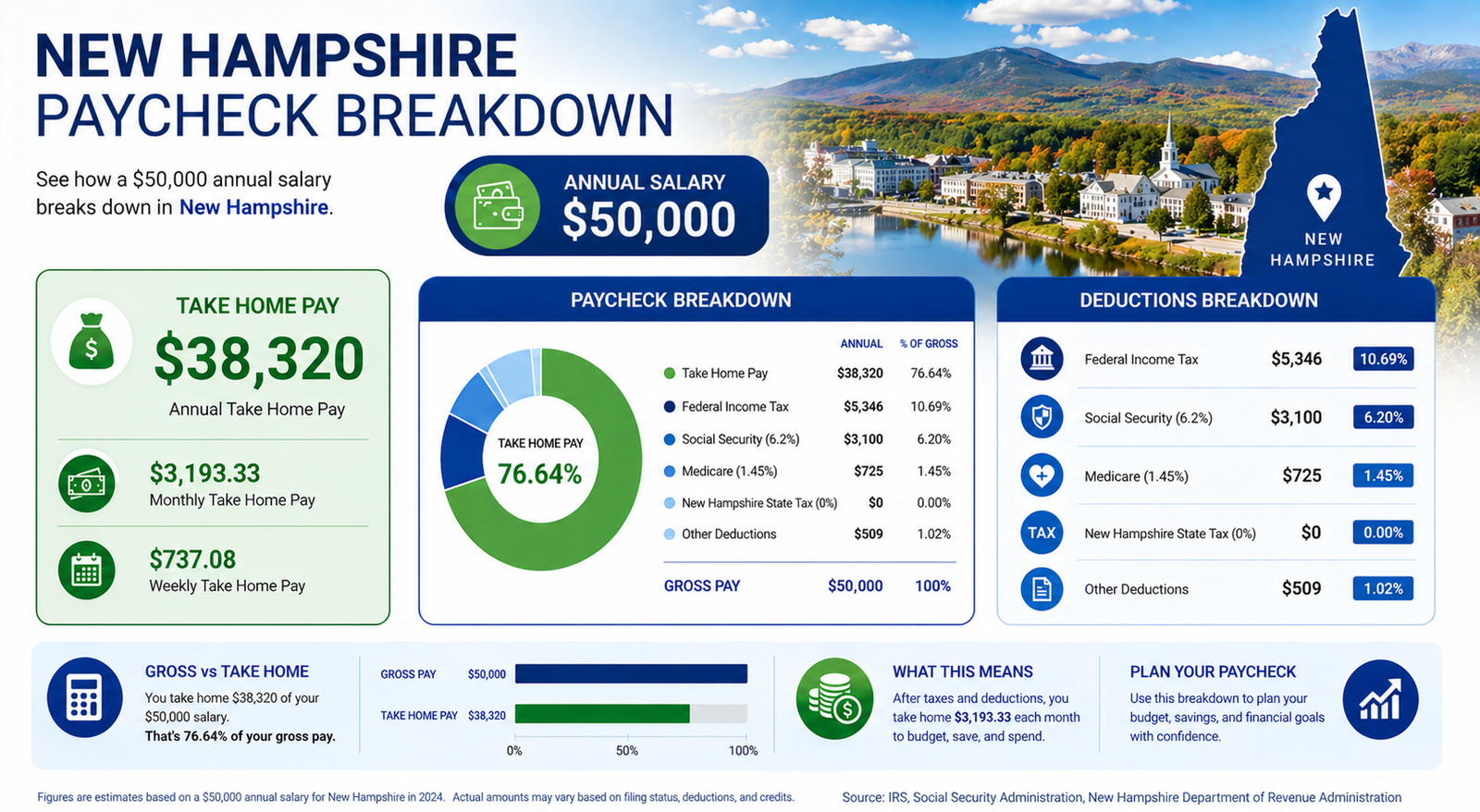
If you earn $50,000 salary after tax in New Hampshire, you keep more of your money than almost anywhere else in the U.S. New Hampshire does not tax earned wages, which means your take‑home pay is determined only by federal taxes. But what does that actually look like on a paycheck in 2026? And can you live comfortably on $50K in Manchester, Nashua, Concord, or Portsmouth? This guide breaks down every dollar using the latest tax data.
All calculations in this guide are based on our New Hampshire paycheck calculator. We do not use estimates or guesses — the numbers come directly from that tool. Whether you’re a new resident, a recent graduate, or just budgeting smarter, you’ll find actionable insights below.
Quick Answer
A $50,000 salary after tax in New Hampshire is approximately $42,213 per year or $3,518 per month. That’s based on a single filer using standard deductions and no state income tax on wages in 2026.
Overview of a $50,000 Salary in New Hampshire
New Hampshire is one of only nine U.S. states that do not impose a tax on wage or salary income. This policy makes a big difference when you compare take‑home pay across state lines. However, living in New Hampshire does come with other financial considerations — property taxes are among the highest in the nation, and housing costs in the southern tier have risen sharply.
Cities like Manchester, Nashua, Concord, and Portsmouth offer strong job markets in technology, healthcare, and advanced manufacturing. Many residents also commute to Massachusetts for work, where incomes are higher but state income tax eats into earnings. A clear view of your actual after‑tax pay helps you decide where to live and how to budget.
The numbers that follow assume a single filer with no additional deductions beyond the standard deduction. If your situation includes a spouse, dependents, or pre‑tax retirement contributions, your take‑home will differ. Use our paycheck calculator for New Hampshire to model your exact numbers.
Salary Breakdown by Pay Frequency
The table below shows how a gross annual salary of $50,000 breaks down after federal income tax, Social Security, and Medicare. Again, New Hampshire does not deduct anything for state income tax, so your only reductions are federal.
| Pay Frequency | Gross Pay | Federal Income Tax | Social Security | Medicare | Net Pay |
|---|---|---|---|---|---|
| Annual | $50,000.00 | $3,961.50 | $3,100.00 | $725.00 | $42,213.50 |
| Monthly | $4,166.67 | $330.13 | $258.33 | $60.42 | $3,517.79 |
| Bi‑weekly | $1,923.08 | $152.37 | $119.23 | $27.88 | $1,623.60 |
| Weekly | $961.54 | $76.19 | $59.62 | $13.94 | $811.79 |
| Daily (260 days) | $192.31 | $15.24 | $11.92 | $2.79 | $162.36 |
*Figures rounded to two decimal places. Actual paycheck may vary slightly due to rounding and any pre‑tax benefits.
Detailed Tax Breakdown
Understanding which taxes are being taken out is key to seeing the full picture. On a $50,000 salary in New Hampshire, your federal income tax obligation is relatively modest thanks to the standard deduction, and FICA taxes are fixed percentages.
| Tax Type | Amount | % of Gross |
|---|---|---|
| Federal Income Tax | $3,961.50 | 7.92% |
| Social Security | $3,100.00 | 6.20% |
| Medicare | $725.00 | 1.45% |
| Total Taxes | $7,786.50 | 15.57% |
Because New Hampshire has no state income tax on wages, your total tax burden stays well below many neighboring states. While property taxes are a different conversation, from a paycheck perspective you’re ahead of the curve.
Monthly Budget Example in New Hampshire
Using the monthly net pay of about $3,518, here’s what a realistic budget might look like for a single person renting in southern New Hampshire. Housing costs reflect recent increases in Manchester, Nashua, and surrounding towns.
Sample Monthly Budget (Single, Renting)
| Category | Amount |
|---|---|
| Housing (rent + utilities) | $1,500 |
| Food (groceries & essentials) | $400 |
| Transportation (car, gas, insurance) | $450 |
| Healthcare & insurance | $300 |
| Discretionary / entertainment | $400 |
| Savings & emergency fund | $468 |
| Total | $3,518 |
This budget uses moderate assumptions. If you have roommates or live in a more rural area, housing costs can drop significantly. On the other hand, living in downtown Portsmouth or a new development in Nashua could push rent well above $1,800.
How New Hampshire Compares to Neighboring States
The absence of a state income tax gives New Hampshire a clear edge in take‑home pay. Below we compare the annual net pay for a $50,000 salary across the Granite State and four neighboring states. The figures come from the same calculator methodology, using each state’s tax rules.
| State | After‑Tax Annual Net (approx.) | Key Tax Feature |
|---|---|---|
| New Hampshire | $42,213 | No state income tax on wages |
| Massachusetts | $39,714 | 5% flat income tax |
| Vermont | $41,200 | Progressive tax up to 8.75% |
| Maine | $40,540 | Progressive tax up to 7.15% |
| Connecticut | $40,215 | Progressive tax up to 6.99% |
If you’re commuting to Massachusetts, the difference of nearly $2,500 a year in take‑home pay is worth noting. That money can cover a significant portion of your commuting costs or be redirected into savings.
Is $50,000 a Good Salary in New Hampshire?
The answer depends heavily on where in the state you live and your household size. For a single adult without dependents, a $50,000 salary can provide a comfortable lifestyle, especially if you choose Manchester or Concord over the pricier Portsmouth area.
In Manchester and Nashua, the growing technology and healthcare sectors mean decent job opportunities, but rents for a one‑bedroom apartment often hover between $1,400 and $1,800. In Concord, slightly lower housing costs free up more of your paycheck. Portsmouth, with its coastal amenities, can be tight on $50K unless you share housing.
New Hampshire’s higher property taxes are mostly a concern for homeowners, not renters. However, rising housing costs in southern New Hampshire mean that saving for a down payment on $50,000 takes discipline. The lack of a state income tax helps, but it’s essential to keep an eye on the overall cost of living.
If your household includes a partner or children, the picture changes quickly. Dual incomes make a huge difference, and many families rely on two earners to live comfortably in the Granite State.
Tips to Increase Your Take‑Home Pay
Even without a state income tax, there are legal ways to keep more of your $50,000 salary. Small adjustments can boost your monthly cash flow significantly.
- Review your W‑4: Ensure your federal withholding isn’t giving the IRS an interest‑free loan. If you consistently receive a large refund, adjust your allowances using the New Hampshire paycheck calculator to see how changes affect your net pay.
- Contribute pre‑tax to a 401(k) or IRA: Contributions lower your taxable income for federal purposes. Even a 5% contribution reduces your federal tax bill while building retirement savings.
- Use an HSA or FSA: Health savings accounts and flexible spending accounts let you pay for medical expenses with pre‑tax dollars, effectively stretching your salary.
- Explore side income: New Hampshire’s no‑wage‑tax rule applies to side gigs too. Freelancing or part‑time work keeps more money in your pocket.
- Manage benefits wisely: Employer‑sponsored commuter benefits, life insurance, and disability coverage paid pre‑tax reduce your taxable income.
If you are also evaluating remote work tools, you can explore FreeAiden for free AI‑powered utilities including QR code generators, barcode generators, PDF converters, image tools, and productivity web utilities that may simplify side projects or freelance admin work.
$50,000 Salary After Tax in New Hampshire – FAQs
How much is $50,000 a year after taxes in New Hampshire?
Your annual take‑home pay is approximately $42,213, or about $3,518 per month. This assumes a single filer with the standard deduction and no state income tax on wages.
Is $50k a good salary in New Hampshire for a single person?
Yes, in most parts of the state a single person can live comfortably on $50,000. Lower costs in Concord and some Manchester neighborhoods make it easier, while Portsmouth may require stricter budgeting.
What taxes are taken out of a $50,000 paycheck in New Hampshire?
Only federal income tax, Social Security (6.2%), and Medicare (1.45%) are deducted. There is no state income tax on earned wages in New Hampshire.
Can you live comfortably in Manchester on $50,000 a year?
With a net monthly pay of about $3,518, it is feasible if housing costs are kept under $1,500. Many renters manage well by budgeting carefully for transportation and savings.
How does New Hampshire’s lack of state income tax affect take‑home pay?
It means you keep approximately $2,500 to $3,000 more per year compared to neighboring states with income taxes. This can offset higher property taxes if you rent.
What is the bi‑weekly take‑home pay for a $50,000 salary in NH?
Bi‑weekly net pay is about $1,623.60. This reflects 26 pay periods per year and all federal deductions.
Does New Hampshire tax Social Security or retirement income?
New Hampshire does not tax Social Security benefits or wage income, but it does tax interest and dividends above a certain threshold (currently $2,400 for individuals). Earned wages, however, remain tax‑free.
Will my take‑home pay change if I commute to Massachusetts?
If you physically work in Massachusetts, you’ll be subject to Massachusetts income tax regardless of living in New Hampshire. That can reduce your net pay considerably. Use the paycheck calculator for New Hampshire to model a “live NH, work MA” scenario.
Disclaimer
Important: All calculations are based on our New Hampshire paycheck calculator and reflect 2026 tax tables. Actual take‑home pay may vary depending on your filing status, pre‑tax deductions, local taxes, and any additional income. This article does not constitute financial advice; always consult a tax professional or use the official calculator to verify your personal situation.
Final Thoughts
Understanding your $50,000 salary after tax in New Hampshire lets you plan ahead with confidence. With roughly $42,213 hitting your bank account yearly and no state tax on wages, the Granite State remains a financially attractive place to work. Whether you’re in Manchester, Nashua, Concord, or Portsmouth, a clear budget transforms a good salary into a sustainable life.
Make sure to revisit your numbers whenever your situation changes — a new job, a raise, or a move across the border can shift your tax picture overnight. Bookmark the calculator and check your take‑home pay regularly.
Reviewed by a financial analyst with expertise in U.S. payroll taxes and regional cost‑of‑living trends.