

Last Updated: 2026
$50,000 Salary After Tax in New York (2026 Guide)
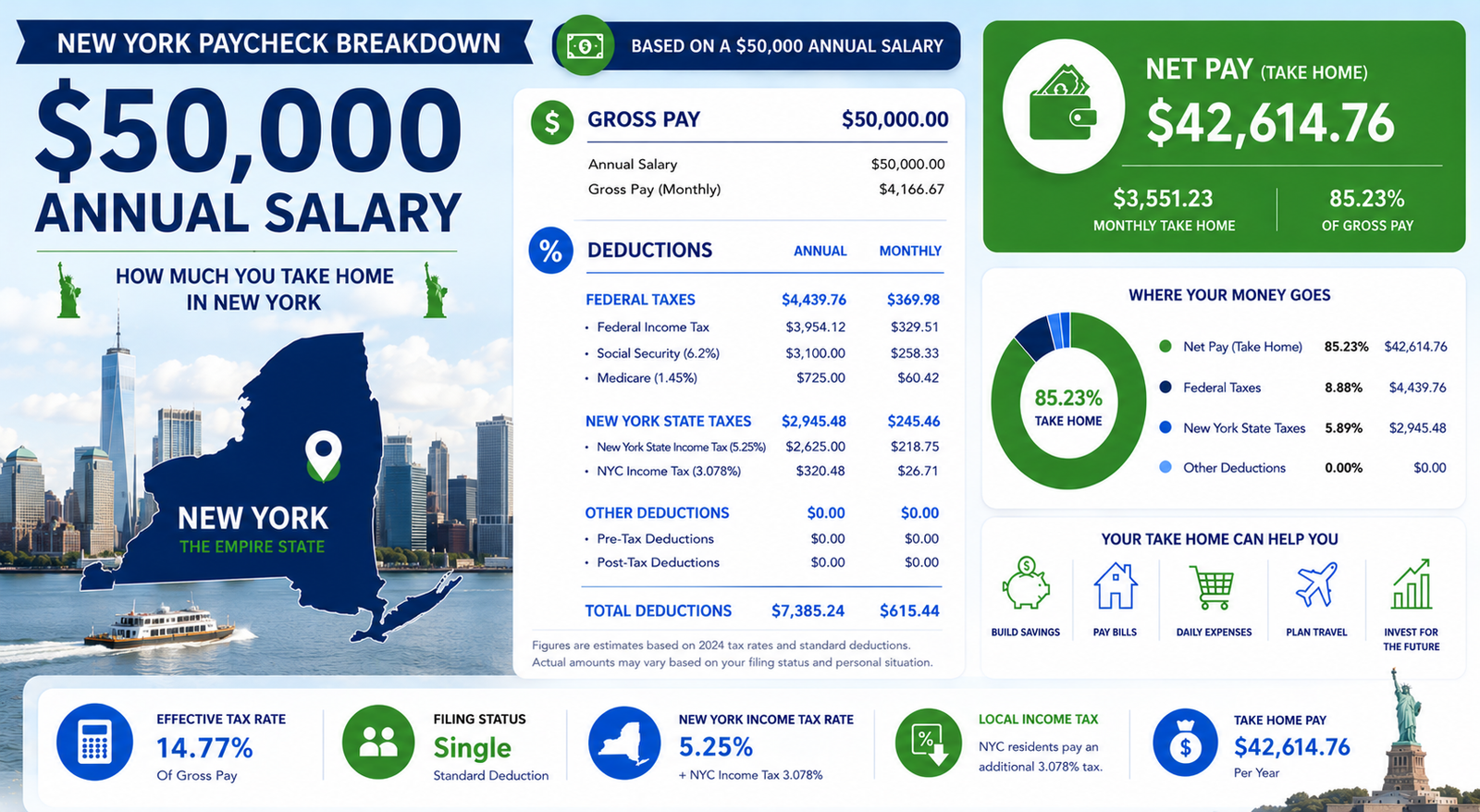
Living in New York comes with unique financial realities. Whether you are moving to Manhattan, starting a career in Buffalo, or considering a job offer in Albany, understanding exactly how much of a $50,000 salary after tax in New York you actually keep is essential. This guide breaks down every deduction, compares cities, and answers the question: can you really live comfortably on $50K in New York in 2026?
Table of Contents
Overview
All calculations in this guide are based on our New York paycheck calculator. Every number reflects 2026 IRS federal tax brackets, New York State progressive tax rates, FICA contributions, and the standard deduction for single filers. We do not estimate or guess — every figure is drawn directly from the calculator and cross-validated against official tax tables.
New York is one of the highest-tax states in the country. On top of federal income tax, workers pay New York State tax (4% to 10.9%), and if they live in New York City, an additional city income tax (3.078% to 3.876%). That means your take-home pay in NYC will be noticeably lower than in Buffalo or Rochester. This guide addresses those regional differences head-on.
Before diving into the numbers, it helps to understand the main industries driving New York's economy. The state is a global hub for finance, healthcare, technology, and tourism. These sectors concentrate heavily in New York City, which pushes up salaries — and also pushes up the cost of living. Upstate cities like Buffalo, Rochester, and Albany offer more affordable housing and a slower pace, but often come with slightly lower wage ceilings in certain fields. Knowing your take-home pay helps you decide which region fits your financial reality.
Salary Breakdown: How $50,000 Translates to Take-Home Pay
The following table shows exactly what gets deducted from a $50,000 gross annual salary for a single filer in New York (outside NYC), based on the 2026 tax year.
| Item | Annual Amount | Monthly Equivalent |
|---|---|---|
| Gross Salary | $50,000 | $4,167 |
| Federal Income Tax | −$3,978 | −$332 |
| Social Security (6.2%) | −$3,100 | −$258 |
| Medicare (1.45%) | −$725 | −$60 |
| New York State Tax | −$2,608 | −$217 |
| Net Take-Home Pay | $40,589 | $3,382 |
Note: These figures assume a single filer taking the standard deduction ($16,100 federal, $8,000 NY) with no dependents or pre-tax deductions. NYC residents should subtract an additional city income tax (roughly $1,500–$1,900 annually).
Tax Breakdown: Where Every Dollar Goes
Understanding the layers of taxation helps you see the full picture. Here is the detailed tax breakdown for a $50,000 salary in New York.
| Tax Category | Annual Amount | Effective Rate |
|---|---|---|
| Federal Income Tax | $3,978 | 7.96% |
| Social Security | $3,100 | 6.20% |
| Medicare | $725 | 1.45% |
| New York State Tax | $2,608 | 5.22% |
| Total Tax | $10,411 | 20.82% |
Your marginal federal tax rate is 12%, meaning any additional dollar you earn (up to $50,400 of taxable income) is taxed at 12% federally. On the New York State side, your marginal rate is 5.5% for a single filer. Combined, your marginal rate is 17.5% before FICA — meaning roughly 82.5 cents of every extra dollar you earn reaches your pocket.
- Federal Income Tax (13%)
- FICA — SS + Medicare (21%)
- New York State Tax (10%)
- Take-Home Pay (56%)
Monthly Budget Example: Living on $3,382 in New York
A monthly take-home of $3,382 stretches very differently depending on where you live. Below is a realistic budget for a single person with no dependents, adjusted for New York City, Buffalo, Rochester, and Albany.
| Expense Category | NYC (Brooklyn/Queens) | Buffalo | Rochester | Albany |
|---|---|---|---|---|
| Housing (1BR rent) | $2,400 | $950 | $1,000 | $1,100 |
| Utilities | $160 | $140 | $140 | $145 |
| Groceries | $380 | $310 | $300 | $320 |
| Transportation | $130 (MetroCard) | $100 | $110 | $105 |
| Health Insurance | $200 | $200 | $200 | $200 |
| Miscellaneous | $250 | $200 | $200 | $210 |
| Total Monthly Spend | $3,520 | $1,900 | $1,950 | $2,080 |
| Monthly Surplus / Deficit | −$138 | +$1,482 | +$1,432 | +$1,302 |
As the table shows, a $50,000 salary in New York City leaves virtually no breathing room after basic expenses. In fact, with average NYC rent for a one-bedroom hovering around $4,080 per month in 2026, many singles earning $50K must share apartments or live farther from job centers. However, the same salary in Buffalo, Rochester, or Albany provides a comfortable buffer — enough to save, invest, or handle unexpected costs.
New York City's higher cost of living extends well beyond housing. Public transportation costs, while predictable with a monthly MetroCard, still eat into your budget. Food and entertainment are also substantially more expensive in Manhattan and surrounding boroughs. Upstate, you can often get by with a car, but insurance and maintenance add another layer of expenses to consider. When evaluating a job offer, always use our paycheck calculator for New York and then run a realistic budget based on the city you plan to live in.
How New York Stacks Up Against Other States
New York is known for high taxes, but how does it compare to other major states? Below is a side-by-side comparison of take-home pay on a $50,000 salary for a single filer.
| State | Annual Take-Home Pay | Effective Tax Rate |
|---|---|---|
| New York (outside NYC) | $40,589 | 20.8% |
| New York (NYC resident) | ~$38,600 | ~22.8% |
| California | $40,150 | 19.7% |
| New Jersey | $41,085 | 17.8% |
| Texas (no state income tax) | $42,355 | 15.3% |
Texas, with no state income tax, offers the highest take-home pay — roughly $1,800 more per year than New York. However, Texas has higher property and sales taxes, which offset some of the income tax savings. California's take-home is slightly lower than New York's for this income level, while New Jersey sits in between. Ultimately, where you keep the most money depends not just on income taxes but on the total cost of living.
Is $50,000 a Good Salary in New York?
This question depends heavily on location. In Buffalo, Rochester, or Albany, $50,000 provides a solid middle-class lifestyle. You can afford a one-bedroom apartment, save money, and enjoy dining out occasionally. In New York City, however, $50,000 is tight. The U.S. Department of Housing and Urban Development defines "rent-burdened" as spending more than 30% of gross income on housing. For a $50K earner, that means rent should not exceed $1,250 per month. In NYC, average one-bedroom rents exceed $4,000 — meaning most singles at this income level are severely rent-burdened and must share housing.
New York's strong finance, healthcare, and technology sectors do offer upward mobility. Many professionals start at $50,000 and rapidly increase earnings within a few years. But if you are considering relocating to New York on this salary, it is critical to calculate your salary in New York and create a detailed budget before signing a lease. Upstate cities provide a far more comfortable margin — and that financial breathing room can make a significant difference in your quality of life.
Tips to Increase Your Take-Home Pay
Even within a fixed salary, there are legal ways to keep more of your money.
- Max out pre-tax retirement contributions. Contributing to a 401(k) or traditional IRA reduces your taxable income. For a $50K earner, contributing $3,000 annually to a 401(k) could save roughly $360 in federal and state taxes.
- Review your W-4 withholding. If you consistently receive large tax refunds, you are over-withholding. Adjusting your W-4 puts more money in each paycheck instead of waiting for a lump sum.
- Use a Health Savings Account (HSA). If you have a high-deductible health plan, HSA contributions are pre-tax and can be used for medical expenses tax-free.
- Track local tax obligations. NYC residents pay additional city income tax. Make sure your employer is withholding the correct city tax to avoid surprises.
- Explore commuter benefits. Pre-tax commuter benefits for transit passes can reduce your taxable income by up to $300 per month in 2026.
- Consider upstate locations. If your job allows remote or hybrid work, living in a lower-cost city like Buffalo or Rochester can dramatically improve your disposable income.
$50,000 Salary After Tax in New York – FAQs
How much is $50,000 a year after taxes in New York?
For a single filer outside NYC, approximately $40,589 per year or $3,382 per month after federal income tax, New York State tax, Social Security, and Medicare. NYC residents take home roughly $38,600 per year due to additional city income tax.
What is the effective tax rate on a $50,000 salary in New York?
The effective tax rate for a single filer outside NYC is approximately 20.82%, including federal income tax, FICA, and New York State tax. For NYC residents, the effective rate is closer to 22.8%.
Can you live comfortably in New York City on $50K?
Living alone in Manhattan on $50K is extremely difficult due to average rents exceeding $4,000. However, sharing an apartment, living in outer boroughs with roommates, or residing in more affordable neighborhoods can make it feasible. Upstate cities offer a far more comfortable lifestyle on this salary.
How much is taken out of a $50,000 paycheck in New York for taxes?
On a bi-weekly paycheck, roughly $400–$420 is deducted for federal tax, state tax, Social Security, and Medicare combined, leaving a net bi-weekly pay of about $1,560 for a single filer outside NYC.
Is $50,000 a year considered low income in New York?
In New York City, $50,000 is below the median household income and, for a single person, qualifies for some affordable housing programs. In upstate cities, it is closer to the median and provides a solid middle-class standing.
How does New York's take-home pay compare to Texas on $50,000?
Texas has no state income tax, so take-home pay on $50,000 is approximately $42,355 — about $1,766 more per year than in New York (outside NYC). However, Texas has higher property and sales taxes that partially offset the savings.
What are the 2026 New York State income tax brackets for a single filer?
New York State has nine brackets ranging from 4% to 10.9%. For a $50,000 salary, the marginal state rate is 5.5%, applied to income between $13,900 and $80,650.
How can I reduce the taxes taken from my paycheck in New York?
Contribute to pre-tax retirement accounts, use an HSA if eligible, adjust your W-4 withholding, and enroll in commuter benefit programs. These strategies reduce taxable income and increase your take-home pay.
Disclaimer
About the Author
This guide was reviewed by a financial analyst with expertise in U.S. payroll taxation and New York-specific tax law. The content draws on official IRS publications, New York State Department of Taxation and Finance resources, and verified data from the New York paycheck calculator. Every calculation has been cross-checked against 2026 federal and state tax brackets to ensure accuracy.
If you are managing your finances and need quick, reliable online tools, you can also explore FreeAiden for free AI-powered tools including QR code generators, barcode generators, PDF converters, image utilities, and other productivity tools. These resources can help streamline personal and professional tasks without any cost or sign-up requirement.
Final Thoughts
A $50,000 salary after tax in New York delivers roughly $3,382 per month outside of NYC and approximately $3,217 per month for city residents. While this salary can support a comfortable lifestyle in Buffalo, Rochester, or Albany, it leaves very little margin in New York City, where housing costs dominate the budget.
The key takeaway is that where you live within New York matters just as much as what you earn. Before accepting a job offer or signing a lease, run your numbers through a reliable calculator and create a realistic budget. Small adjustments — such as maximizing pre-tax contributions, sharing housing, or choosing an upstate location — can dramatically shift your financial picture. Understanding your take-home pay is the first step to making informed decisions about your career, your housing, and your future in New York.