

$50,000 Salary After Tax in North Carolina (2026 Guide)
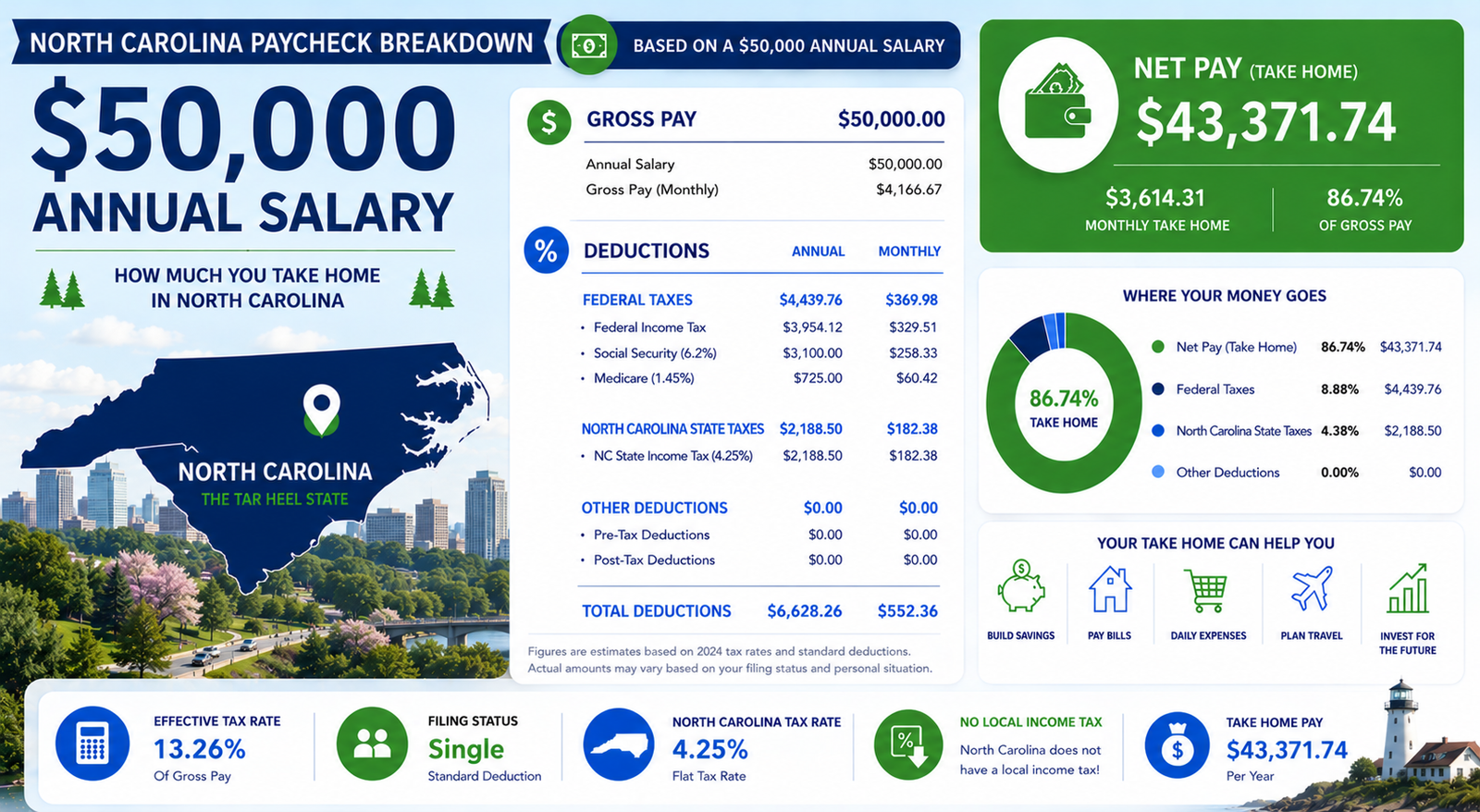
If you are considering a job offer, planning a move, or simply reviewing your household finances, understanding exactly how much of your earnings you keep is essential. A $50,000 salary after tax in North Carolina looks different in 2026 than it did just a few years ago, thanks to a multi-year series of state income tax cuts. In this comprehensive guide, we break down every component of your paycheck — federal income tax, FICA contributions, and the new 3.99% North Carolina flat tax — so you know precisely what to expect.
All calculations in this guide are based on our North Carolina paycheck calculator, which uses current 2026 federal and state tax parameters. Whether you live in Charlotte, Raleigh, Greensboro, or Durham, the numbers below give you a clear picture of your take-home pay.
Table of Contents
- Overview of $50,000 Salary in North Carolina
- Salary Breakdown: Gross to Net
- Tax Breakdown & Pie Chart
- Monthly Budget Example (NC-Adjusted)
- State-by-State Comparison & Bar Chart
- Is $50,000 a Good Salary in North Carolina?
- City-by-City Guide: Charlotte, Raleigh, Greensboro, Durham
- Tips to Increase Your Take-Home Pay
- FAQs
- Disclaimer
- About the Author
- Final Thoughts
Overview of $50,000 Salary in North Carolina
North Carolina has become one of the more tax-friendly states in the Southeast. The individual income tax rate fell to 3.99% for 2026, down from 4.25% in 2025 and 4.50% in 2024. This is the final scheduled reduction under the multi-year plan passed in 2021, cutting the rate nearly in half from the 5.25% that applied in 2021.
The state imposes a flat tax — everyone pays the same rate on taxable income regardless of earnings. North Carolina also does not have any local income taxes, which simplifies paycheck calculations compared to states like New York or Ohio. Combined with a cost of living that runs roughly 2% below the national average, a $50,000 salary stretches further here than in many northeastern or West Coast states.
For a single filer taking the standard deduction and with no pre-tax deductions such as 401(k) contributions or health insurance premiums, here is how the numbers line up for 2026.
Salary Breakdown: Gross to Net
The table below shows the complete path from gross salary to take-home pay. All figures are annualized for a single filer with no pre-tax deductions.
| Category | Amount (Annual) | Percentage of Gross |
|---|---|---|
| Gross Salary | $50,000 | 100.0% |
| Federal Income Tax | − $3,820 | 7.6% |
| Social Security (6.2%) | − $3,100 | 6.2% |
| Medicare (1.45%) | − $725 | 1.5% |
| NC State Tax (3.99% flat) | − $1,486 | 3.0% |
| Total Deductions | − $9,131 | 18.3% |
| Net Take-Home Pay | $40,869 | 81.7% |
Per-Pay-Period Breakdown
| Pay Frequency | Gross Pay | Net Pay |
|---|---|---|
| Monthly | $4,167 | $3,406 |
| Semi-Monthly | $2,083 | $1,703 |
| Bi-Weekly | $1,923 | $1,572 |
| Weekly | $962 | $786 |
Tax Breakdown & Pie Chart
The pie chart below illustrates how each tax category claims a portion of your gross salary. Federal income tax is the largest single deduction, followed closely by Social Security.
How each tax is calculated in 2026:
- Federal Income Tax: Based on IRS tax brackets. The federal standard deduction of $16,100 reduces taxable income to $33,900. The first $12,400 is taxed at 10% ($1,240), and the remaining $21,500 is taxed at 12% ($2,580), for a total of $3,820.
- Social Security: 6.2% on the first $184,500 of wages. At $50,000, the entire salary is subject to this tax.
- Medicare: 1.45% on all wages with no income cap. The additional 0.9% surtax does not apply at this income level.
- NC State Tax: North Carolina applies a 3.99% flat rate to taxable income after subtracting the $12,750 state standard deduction. Taxable state income is $37,250, yielding $1,486 in state tax. There are no local income taxes anywhere in North Carolina.
Note on Payroll Withholding: Your actual paycheck withholding may differ slightly from the tax liability shown here because employers use IRS Publication 15-T withholding tables that incorporate the standard deduction differently. The figures above represent your true annual tax liability and ultimate take-home pay. To see your personalized withholding estimate, use our North Carolina paycheck calculator.
Monthly Budget Example (NC-Adjusted)
With a monthly net income of approximately $3,406, the popular 50/30/20 budgeting framework suggests allocating 50% to needs, 30% to wants, and 20% to savings and debt repayment. The table below adapts this framework to typical North Carolina living costs.
| Budget Category | 50/30/20 Allocation | Monthly Amount |
|---|---|---|
| Needs (50%) | ||
| Housing (Rent/Mortgage) | $1,200 – $1,500 | |
| Utilities (Electric, Water, Internet) | $250 – $310 | |
| Groceries | $380 – $450 | |
| Transportation (Gas, Insurance, Maintenance) | $250 – $350 | |
| Health Insurance Premiums | $150 – $300 | |
| Needs Subtotal | 50% | ~$1,703 |
| Wants (30%) | ||
| Dining Out, Entertainment, Subscriptions | $400 – $600 | |
| Shopping, Hobbies, Travel | $200 – $422 | |
| Wants Subtotal | 30% | ~$1,022 |
| Savings & Debt (20%) | ||
| Emergency Fund, 401(k), IRA, Debt Paydown | $400 – $681 | |
| Savings Subtotal | 20% | ~$681 |
| Total | 100% | $3,406 |
Housing costs vary significantly by city. In Greensboro, a one-bedroom apartment averages around $1,025 per month, while in Charlotte the average rent for a one-bedroom runs closer to $1,650. This budget uses a moderate range that works for most North Carolina metro areas. In higher-cost cities like Charlotte and Raleigh, you may need to adjust the wants and savings categories downward or consider having a roommate.
Calculate your real take-home pay in seconds.
Enter your salary, filing status, and deductions to see exactly how much you keep after taxes.
Use the North Carolina Paycheck Calculator NowState-by-State Comparison
How does North Carolina stack up against neighboring states and popular relocation destinations? The bar chart and table below compare net take-home pay for a $50,000 salary across seven states, all using 2026 tax rules for a single filer with no deductions.
Chart: Annual net pay for a $50,000 salary, single filer, 2026. Texas and Tennessee are normalized to 100%.
| State | State Tax | Annual Net |
|---|---|---|
| Texas | $0 (no income tax) | $41,935 |
| Tennessee | $0 (no income tax) | $41,935 |
| North Carolina | $1,486 (3.99% flat) | $40,869 |
| South Carolina | ~$1,500 (1.99%–5.21%) | $40,855 |
| Virginia | ~$2,640 (2%–5.75%) | $39,777 |
| Georgia | ~$2,869 (5.49% flat) | $39,548 |
| New York | ~$3,048 (4%–10.9%) | $39,369 |
North Carolina sits in a strong position regionally. While Texas and Tennessee offer higher take-home pay by forgoing state income tax entirely, North Carolina's 3.99% flat rate is the lowest among states that do impose an income tax in this comparison group. When you factor in North Carolina's moderate cost of living — especially compared to New York — the practical purchasing power of a $50,000 salary in North Carolina is competitive.
Is $50,000 a Good Salary in North Carolina?
Whether $50,000 is a good salary in North Carolina depends heavily on where you live, your household size, and your lifestyle expectations. Here is how it compares to key benchmarks:
- Median Household Income: North Carolina's median household income is approximately $70,000 to $75,000. A $50,000 individual salary is below the household median but above the state's per capita income of roughly $43,000.
- Living Wage: MIT's Living Wage Calculator estimates that a single adult with no children needs approximately $40,000 to $45,000 per year in most North Carolina metro areas to cover basic expenses. At $50,000 gross (approximately $40,869 net), you are right at or slightly above this threshold.
- Comfortable Living: Using the 50/30/20 rule, a single person in Charlotte or Raleigh likely needs $55,000 to $65,000 to live comfortably without financial strain. In Greensboro or smaller cities, $50,000 provides more breathing room.
Overall, a $50,000 salary is sufficient for a single person to live decently in most parts of North Carolina, though in Charlotte and Raleigh you may find housing costs consume a larger share of your budget than desired. For families or those with significant debt, this salary level can feel tight.
City-by-City Guide: Charlotte, Raleigh, Greensboro, Durham
Charlotte
As the nation's second-largest banking center, Charlotte offers strong employment opportunities in finance and technology. The average rent for an apartment is approximately $1,650 per month, and median home values hover around $397,000. On a $50,000 salary, renting a one-bedroom in Charlotte is feasible but will consume about 48% of your net monthly income. Many young professionals in Charlotte share housing to keep costs manageable.
Raleigh
Raleigh's technology and research sectors continue to expand, anchored by Research Triangle Park. Average rent runs about $1,560 per month, with median home values around $434,000. The cost of living for a single person is estimated at roughly $2,700 per month. A $50,000 salary leaves a modest surplus after essential expenses, but career growth in the region's strong job market can quickly boost earnings.
Greensboro
Greensboro is one of the most affordable major cities in North Carolina. Average rent is approximately $1,330, and one-bedroom apartments can be found for as low as $1,025. The cost of living is about 2% below the national average. A $50,000 salary goes noticeably further here than in Charlotte or Raleigh, making Greensboro an attractive option for those prioritizing affordability while still enjoying urban amenities.
Durham
Durham combines a growing healthcare and research presence — led by Duke University and its medical system — with a vibrant downtown scene. Average rent is around $1,530 per month, and estimated monthly costs for a single person are approximately $2,538. A $50,000 salary covers living expenses with some room for discretionary spending and savings, though housing costs have risen in recent years.
Tips to Increase Your Take-Home Pay
Beyond negotiating a higher salary, several strategies can reduce your tax burden and increase the amount that lands in your bank account each month.
- Contribute to a 401(k) or 403(b): Pre-tax retirement contributions reduce your federal and state taxable income. For example, contributing $3,000 per year to a 401(k) could save approximately $360 in federal tax and $120 in NC state tax annually.
- Fund a Health Savings Account (HSA): If you have a high-deductible health plan, HSA contributions are pre-tax at both the federal and state level, plus withdrawals for qualified medical expenses are tax-free.
- Use a Flexible Spending Account (FSA): FSAs for healthcare or dependent care expenses reduce your taxable income. The 2026 healthcare FSA contribution limit is $3,300.
- Review Your W-4: Ensuring your W-4 is accurate prevents over-withholding. If you received a large refund last year, adjusting your W-4 could increase your monthly take-home pay.
- Explore North Carolina Tax Credits: While NC has limited credits compared to some states, credits for education expenses or child dependents may reduce your state tax bill.
- Consider Pre-Tax Commuter Benefits: Some employers offer pre-tax commuter benefits for parking and transit, which reduce taxable income.
For a full analysis of how each of these strategies affects your specific situation, calculate your salary in North Carolina with our free tool.
$50,000 Salary After Tax in North Carolina – FAQs
How much is a $50,000 salary after tax in North Carolina in 2026?
A $50,000 annual salary for a single filer with no pre-tax deductions yields approximately $40,869 after federal income tax ($3,820), Social Security ($3,100), Medicare ($725), and North Carolina state income tax ($1,486). This equals about $3,406 per month in net take-home pay.
What is the North Carolina state income tax rate for 2026?
North Carolina's individual income tax rate is a flat 3.99% for the 2026 tax year. This applies to all taxable income regardless of earnings level, after subtracting the state standard deduction of $12,750 for single filers. There are no local income taxes in North Carolina.
Can you live comfortably in Charlotte NC on a $50,000 salary?
A $50,000 salary in Charlotte is manageable but may feel tight if you live alone in a one-bedroom apartment near the city center, where average rents reach $1,650. Sharing housing or living farther from Uptown improves affordability. A budget-conscious single person can live comfortably; a family would likely find it challenging without a second income.
How does North Carolina's take-home pay compare to Texas on $50,000?
Texas has no state income tax, so a $50,000 salary yields approximately $41,935 net annually — about $1,066 more than North Carolina's $40,869. However, Texas property tax rates are significantly higher on average, which can offset some of the income tax savings for homeowners.
What is the bi-weekly take-home pay for a $50,000 salary in North Carolina?
For a single filer with no pre-tax deductions, the bi-weekly net pay is approximately $1,572. This represents roughly 81.7% of the $1,923 bi-weekly gross pay after all federal, FICA, and state tax deductions.
Does North Carolina tax 401(k) contributions?
No. Traditional pre-tax 401(k) contributions reduce your taxable income for both federal and North Carolina state income tax purposes. Contributions are not taxed until withdrawn in retirement. Roth 401(k) contributions are made with after-tax dollars and do not reduce current taxable income.
What is the average tax rate on a $50,000 salary in North Carolina?
The effective average tax rate is approximately 18.3% of gross income. This breaks down to 7.6% federal income tax, 6.2% Social Security, 1.5% Medicare, and 3.0% North Carolina state income tax. The marginal tax rate — the rate applied to the next dollar earned — is 22% federally plus 3.99% for NC state.
Are there any local income taxes in North Carolina cities like Charlotte or Raleigh?
No. North Carolina does not permit cities or counties to levy local income taxes. Regardless of whether you live in Charlotte, Raleigh, Greensboro, Durham, or any other North Carolina municipality, you pay only the 3.99% state income tax with no additional local wage tax.
Disclaimer
Important: The tax calculations in this guide are estimates based on 2026 federal and North Carolina state tax laws as of the date of publication. Individual circumstances vary based on filing status, deductions, credits, and other factors. This information is for educational purposes only and does not constitute financial or tax advice. Tax laws change periodically, and state estimates may vary from actual withholding. We strongly recommend consulting a qualified tax professional or financial advisor for personalized guidance. You should use the paycheck calculator for North Carolina to model your specific situation, and verify all figures with official IRS and North Carolina Department of Revenue resources before making financial decisions.
About the Author
This guide was reviewed by a financial analyst with expertise in U.S. federal and state taxation, payroll systems, and personal finance. All tax calculations are based on official IRS publications, North Carolina General Statutes, and the North Carolina paycheck calculator. The content is regularly updated to reflect changes in tax law and economic conditions in North Carolina.
Final Thoughts
A $50,000 salary after tax in North Carolina delivers approximately $40,869 in annual take-home pay, or about $3,406 per month. With North Carolina's flat income tax rate now at a competitive 3.99% and no local income taxes, the state offers one of the more favorable tax environments on the East Coast for middle-income earners.
Whether this salary meets your needs depends on your location within the state. Greensboro and smaller cities provide comfortable living at this income level, while Charlotte and Raleigh — with their growing banking and technology sectors — require more careful budgeting. The good news is that North Carolina's combination of moderate living costs, strong job markets in key industries, and declining income tax rates gives workers on a $50,000 salary a solid foundation to build upon.
You can also explore FreeAiden for free AI-powered tools including QR code generators, barcode generators, PDF converters, image utilities, and other productivity tools that can help streamline your personal and professional projects.
See exactly how much you keep after taxes.
Use our free paycheck calculator for North Carolina — updated with 2026 tax rates and available for all pay frequencies.
Calculate Your NC Take-Home Pay Now