

$50,000 Salary After Tax in North Dakota (2026 Guide)
Last Updated: 2026
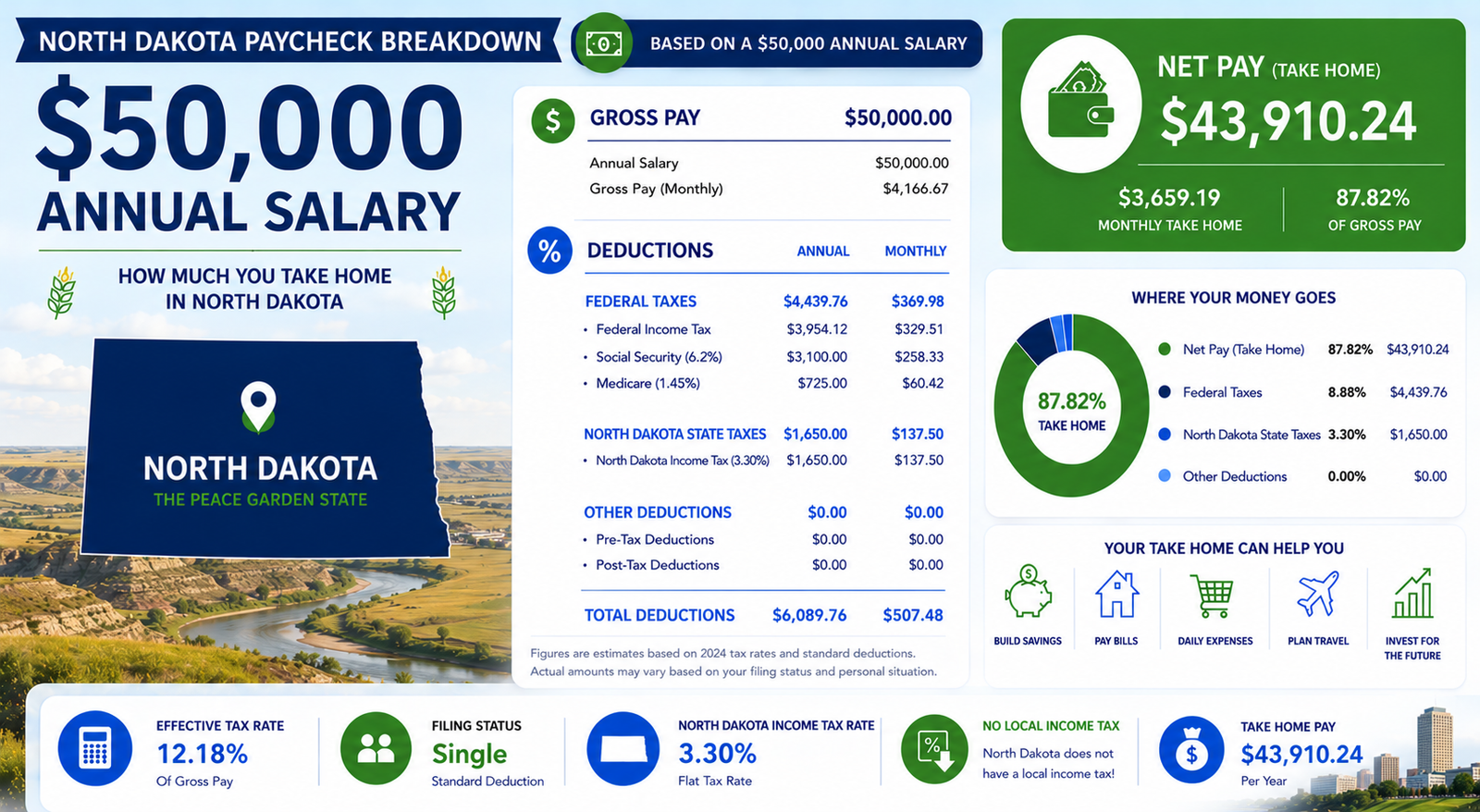
If you earn a $50,000 salary after tax in North Dakota you might wonder exactly how much lands in your bank account each month. This guide breaks down your real take‑home pay, North Dakota income taxes, federal withholding, and FICA deductions for 2026. Whether you live in Fargo, Bismarck, Grand Forks, or Minot, knowing your net pay helps you plan housing, groceries, and savings with confidence.
All calculations in this guide are based on our North Dakota paycheck calculator. We use 2026 tax parameters so you get the most accurate picture possible. Let's start with the bottom‑line answer.
You can get your precise numbers using our North Dakota paycheck calculator.
Table of Contents
Overview of a $50,000 Salary in North Dakota
North Dakota offers a unique blend of strong job growth and a lower cost of living compared to many U.S. states. The energy, agriculture, and healthcare sectors continue to expand, especially around Fargo, Bismarck, Grand Forks, and Minot. While winter heating bills can rise, affordable housing and short commutes offset many expenses.
On a gross $50,000 income, your take‑home pay is shaped by federal income tax, Social Security, Medicare, and North Dakota state income tax. The state’s progressive tax brackets are relatively modest, which leaves more money in your pocket than in higher‑tax neighboring states.
Salary Breakdown: Gross to Net Pay
| Pay Component | Annual | Monthly |
|---|---|---|
| Gross Salary | $50,000 | $4,167 |
| Federal Income Tax | − $4,012 | − $334 |
| Social Security (6.2%) | − $3,100 | − $258 |
| Medicare (1.45%) | − $725 | − $60 |
| North Dakota State Tax | − $398 | − $33 |
| Net Take‑Home Pay | $41,765 | $3,480 |
These numbers reflect a single filer using standard deductions. If you have dependents, contribute to a 401(k), or itemize, your take‑home will differ — that’s where a paycheck calculator for North Dakota becomes essential.
Tax Breakdown: Where Your Money Goes
Understanding the slices of your gross salary is key to smart budgeting. Below is a visualization of how your $50,000 is distributed.
| Tax Type | Amount | % of Gross |
|---|---|---|
| Federal Income Tax | $4,012 | 8.0% |
| Social Security | $3,100 | 6.2% |
| Medicare | $725 | 1.45% |
| ND State Income Tax | $398 | 0.8% |
| Total Taxes | $8,235 | 16.5% |
North Dakota’s top marginal rate is only 2.9%, which is why the state tax slice is so small. The federal portion makes up the largest deduction.
Monthly Budget Example for North Dakota
With a monthly take‑home of $3,480, you can build a realistic budget adjusted for North Dakota’s costs. Here’s a sample for a single renter in Fargo or Bismarck:
| Expense Category | Monthly Amount |
|---|---|
| Rent (1‑bedroom) | $850 – $1,100 |
| Utilities & Internet | $190 – $230 |
| Groceries | $340 – $420 |
| Transportation | $150 – $250 |
| Health Insurance | $130 – $200 |
| Savings & Investments | $400 – $500 |
| Discretionary | $300 – $400 |
Housing remains very affordable in most North Dakota cities. In Grand Forks or Minot, rent can be even lower. Harsh winters may push utility bills higher in January and February, so planning a buffer for heating is wise.
How North Dakota Compares to Other States
Your net pay on a $50,000 salary varies widely by state. North Dakota’s low income tax keeps more money in your pocket compared to many neighbors.
| State | After‑Tax Income (approx) | State Income Tax? |
|---|---|---|
| North Dakota | $41,765 | Yes (low) |
| Minnesota | $40,100 | Yes (higher) |
| South Dakota | $42,000 | None |
| Montana | $40,750 | Yes |
While South Dakota has no income tax, North Dakota’s cost of living – especially housing – often makes $50,000 go farther than in larger metro areas like Minneapolis.
Is $50,000 a Good Salary in North Dakota?
For a single person, yes. A $50,000 salary after tax in North Dakota provides a comfortable lifestyle in cities like Fargo, Bismarck, Grand Forks, and Minot. You can afford a decent apartment, cover all necessities, save for retirement, and still have room for leisure. Couples with dual incomes find even greater flexibility. However, if you have significant debt or multiple dependents, budgeting becomes tighter. Overall, North Dakota’s affordable housing and low state taxes make this income level solidly middle class.
Tips to Increase Your Take‑Home Pay
Even with a fixed salary, you can optimize what you keep:
- Adjust your W‑4: Ensure your withholding matches your actual tax liability to avoid overpaying all year.
- Contribute to pre‑tax accounts: A traditional 401(k) or HSA reduces your taxable income now.
- Check for North Dakota credits: Some residents qualify for property tax credits or renter’s rebates.
- Use flexible spending accounts: For medical or dependent care, FSA contributions are pre‑tax.
Calculate your exact North Dakota paycheck now
$50,000 Salary After Tax in North Dakota – FAQs
How much is $50,000 a year after taxes in North Dakota?
For a single filer in 2026, the net take‑home is roughly $41,765 per year, or $3,480 per month, after federal, state, and FICA deductions.
What is the North Dakota state income tax rate for a $50,000 salary?
North Dakota’s tax brackets are progressive. On $50,000, most income falls into the 1.1% bracket, with a small portion at 2.04%. The effective state tax rate is about 0.8%.
Is $50,000 a year enough to live in Fargo, ND?
Yes. Fargo’s median rent for a one‑bedroom is around $900–$1,000, leaving plenty of room for other expenses and savings on a $3,480 monthly net income.
How does North Dakota tax compare to Minnesota for a $50,000 salary?
Minnesota’s state income tax is higher; someone earning $50,000 in Minnesota might take home about $1,600 less each year. North Dakota’s low tax burden is a noticeable advantage.
What deductions reduce my taxable income in North Dakota?
Standard deduction ($14,100 for single filers in 2026) is automatically applied. Pre‑tax retirement contributions, health savings accounts, and certain education expenses lower your taxable income further.
Are there local income taxes in Bismarck or Grand Forks?
No. North Dakota cities do not impose local income taxes. The only income taxes are federal and state.
Does the $50,000 after‑tax estimate include health insurance?
No. Our calculation covers mandatory tax withholding only. Employer‑sponsored health premiums would further reduce your take‑home pay.
Can I live comfortably in Minot on $50,000?
Yes. Minot’s cost of living is lower than the national average, especially for housing. A $50,000 salary provides a comfortable, stable lifestyle.
While you're planning your finances, you might also find it helpful to explore FreeAiden for free online AI‑powered tools. They offer QR code generators, barcode generators, PDF converters, image utilities, and other productivity tools that can simplify your everyday tasks.
Disclaimer
Important: All figures are estimates based on 2026 tax parameters and the standard deduction. Your actual take‑home pay may vary depending on additional deductions, credits, marital status, and withholding choices. This article does not constitute financial advice. Always consult a tax professional or use an updated paycheck calculator for North Dakota for your unique situation.
Final Thoughts
Your $50,000 salary after tax in North Dakota delivers a solid take‑home of about $3,480 each month. With low state income taxes, affordable housing in cities like Fargo, Bismarck, Grand Forks, and Minot, and a growing job market, you’re well positioned to live comfortably and save for the future. Small optimizations to your withholding and pre‑tax contributions can make that number even better.
To see exactly how much you keep after taxes, try our interactive calculator:
Calculate your real take‑home pay in seconds