

$50,000 Salary After Tax in Ohio (2026 Guide)
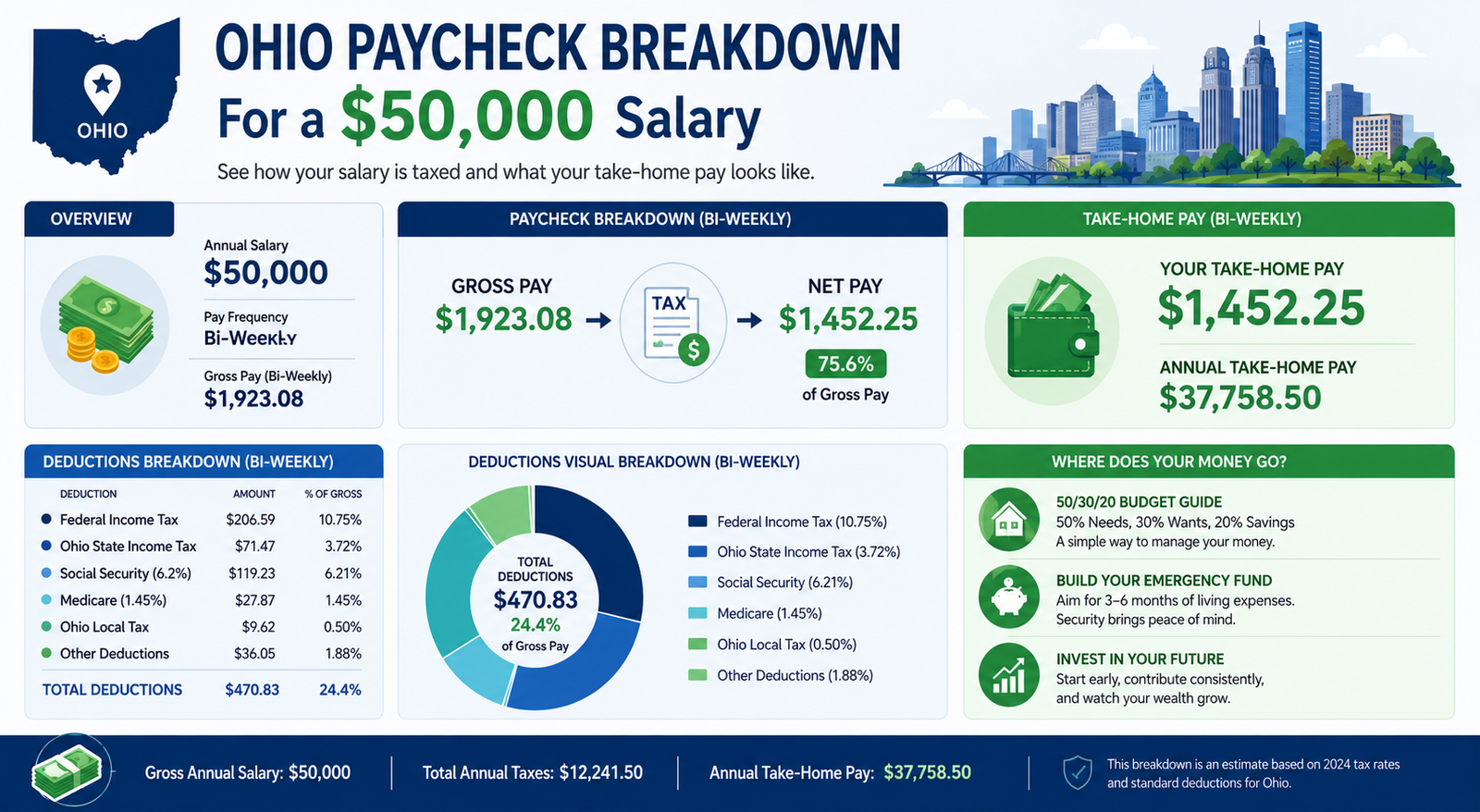
If you earn a $50,000 salary after tax in Ohio, understanding exactly how much lands in your bank account is essential for realistic budgeting. Whether you’re relocating to Columbus, Cleveland, Cincinnati, or Toledo, Ohio’s moderate cost of living and unique tax landscape can make a $50,000 income stretch further than you might expect. This 2026 guide breaks down every tax component—federal, state, and FICA—using precise calculations from our Ohio paycheck calculator. All calculations in this guide are based on our Ohio paycheck calculator, so you can plan with confidence.
Overview of a $50,000 Salary in Ohio
Ohio is often celebrated for its balanced economy. Strong manufacturing, healthcare, finance, and logistics industries provide stable employment, while cities like Columbus are seeing rapid growth in technology and startups. For a $50,000 earner, the state’s affordable housing and moderate living costs make a noticeable difference. However, Ohio does levy a state income tax, and some municipalities (like Cincinnati, Cleveland, and Columbus) also impose local income taxes. This guide focuses on the base state withholding; you can adjust for local taxes using our paycheck calculator for Ohio.
Seasonal weather can affect transportation and utility bills, but overall, Ohio’s cost of living remains around 8–10% below the national average. That means a $50,000 salary often supports a comfortable lifestyle, especially in suburban areas and smaller cities.
Salary Breakdown: Gross vs. Net Pay
Below you’ll find the complete breakdown of a $50,000 annual salary into monthly, bi‑weekly, and weekly take‑home amounts. These figures assume a single filer, no local taxes, and the standard deduction.
| Pay Frequency | Gross Pay | Net Pay (Take‑Home) |
|---|---|---|
| Annual | $50,000 | $41,621 |
| Monthly | $4,167 | $3,468 |
| Bi‑Weekly | $1,923 | $1,601 |
| Weekly | $962 | $800 |
Note: All calculations rounded to the nearest dollar. Your exact numbers may vary based on additional withholdings or local taxes.
Detailed Tax Breakdown for a $50,000 Salary
Here’s exactly where your money goes. Federal income tax, Ohio state income tax, and FICA (Social Security & Medicare) combine to reduce your gross salary. The pie chart below visualizes the proportion each tax claims.
Federal Income Tax: $3,962 (47.3%)
FICA (Social Security & Medicare): $3,825 (45.6%)
Ohio State Tax: $593 (7.1%)
| Tax Type | Amount | Percentage of Gross |
|---|---|---|
| Federal Income Tax | $3,962 | 7.9% |
| Social Security (6.2%) | $3,100 | 6.2% |
| Medicare (1.45%) | $725 | 1.45% |
| Ohio State Income Tax | $593 | 1.2% |
| Total Taxes | $8,379 | 16.8% |
Your effective tax rate is approximately 16.8%, meaning you keep 83.2% of your income. Ohio’s progressive tax brackets and relatively low rates keep the state bite small. Remember to calculate your salary in Ohio if you have different filing status or local taxes.
Monthly Budget Example on a $50K Take‑Home Pay in Ohio
With a monthly net income of about $3,468, here’s a realistic budget tailored to Ohio’s average costs. Housing in many cities like Toledo or suburban Cleveland is quite affordable, while Columbus’s growing tech scene might push rents slightly higher.
| Expense Category | Monthly Amount | Notes |
|---|---|---|
| Rent (1‑bedroom) | $900 – $1,200 | Varies by city; Toledo ~$800, Columbus ~$1,200 |
| Utilities & Internet | $230 | Winter heating can increase costs |
| Groceries | $380 | Midwest prices generally lower |
| Transportation | $280 | Gas, insurance, maintenance |
| Health Insurance | $210 | Typical employee contribution |
| Savings & Investments | $500 | Emergency fund & retirement |
| Discretionary | $450 | Dining, entertainment, etc. |
| Remaining | $318 – $118 | Buffer for unexpected expenses |
This budget shows that a $50,000 salary after taxes provides a comfortable cushion in most Ohio cities, especially if you avoid high-rent downtown cores.
How Ohio Stacks Up: State‑by‑State Take‑Home Comparison
One of the biggest questions is how Ohio compares to states with no income tax or higher tax burdens. The bar chart below shows the annual net pay for a $50,000 salary in five different states (single filer, no local taxes).
Ohio’s take‑home pay is only about $600 less than no‑tax states, and significantly higher than high‑tax states like New York or California. When combined with Ohio’s lower housing and living costs, your dollar truly goes further.
Is $50,000 a Good Salary in Ohio in 2026?
For many individuals and even small families, the answer is yes. With a net income of $3,468 per month, you can afford a decent apartment, save for the future, and still enjoy Ohio’s vibrant cultural scenes. Housing affordability is a major advantage: while the national median rent is above $2,000 in many areas, Ohio rents hover well below that. Columbus, Cleveland, Cincinnati, and Toledo all offer neighborhoods where $1,000 rent gets you a solid one‑bedroom.
Overall, $50,000 places you slightly above the state’s per capita income, and in most regions it allows for a comfortable, middle‑class lifestyle. If you’re frugal or live in a lower‑cost city, you can save aggressively.
Tips to Increase Your Take‑Home Pay in Ohio
Even with Ohio’s low state tax, there are strategies to keep more of your paycheck:
- Adjust your W‑4 withholdings: If you consistently get a large refund, you’re over‑withholding. Use the IRS withholding estimator and our Ohio paycheck calculator to fine‑tune.
- Contribute to tax‑advantaged accounts: A 401(k) or traditional IRA reduces taxable income. In Ohio, contributions lower both federal and state taxable income.
- Health Savings Account (HSA): If you have a high‑deductible health plan, HSA contributions are triple‑tax‑advantaged and lower your Ohio income tax too.
- Check for local tax credits: Some Ohio cities offer credits if you live in one municipality but work in another. This can reduce your overall burden.
- Review local income tax rates: If moving within Ohio, compare municipal tax rates—some suburbs have lower or no local income tax.
Calculate your real take‑home pay in seconds
While refining your financial plan, you can also explore FreeAiden for free AI‑powered tools including QR code generators, barcode generators, PDF converters, image utilities, and other productivity tools that simplify everyday tasks like organizing tax documents or sharing payment links.
$50,000 Salary After Tax in Ohio – FAQs
How much is $50,000 a year after taxes in Ohio biweekly?
Your biweekly take‑home pay is approximately $1,601, based on a standard single filer with no local taxes. This accounts for federal, state, and FICA deductions.
What is the effective tax rate on a $50,000 salary in Ohio?
The effective tax rate is around 16.8%, meaning you lose about $8,379 to taxes annually. This blends federal, Ohio state, Social Security, and Medicare taxes.
Does Ohio have local income tax that affects a $50K salary?
Yes, many Ohio cities like Columbus, Cleveland, and Cincinnati levy local income taxes ranging from 1% to 2.5%. If you live or work in these municipalities, your net pay will be slightly lower. Use our Ohio paycheck calculator to include local withholding.
Can I live comfortably in Columbus on $50,000 a year?
Absolutely. With a net monthly income of $3,468, you can afford a decent one‑bedroom apartment ($1,100–$1,300), cover all expenses, and still save a few hundred dollars each month, especially if you budget wisely.
Is $50,000 a good salary in Toledo, Ohio?
Yes, Toledo’s cost of living is significantly lower than the national average. Rent often runs under $850, making $50,000 feel quite comfortable and allowing for substantial savings.
How does Ohio’s state tax on a $50K salary compare to Pennsylvania?
Pennsylvania has a flat 3.07% state income tax, which on $50,000 would be about $1,535—higher than Ohio’s $593. However, some Pennsylvania municipalities also levy local taxes. Ohio generally offers a lower state tax bite for this income level.
Will my $50,000 take‑home pay change if I’m married filing jointly?
Yes, your federal and possibly state withholding will change. Married couples often benefit from lower effective tax rates. Run the numbers through our Ohio paycheck calculator with your specific filing status.
What are the best ways to maximize a $50K salary in Ohio?
Contribute to retirement accounts, use an HSA if eligible, and live in a neighborhood with reasonable rent. Review your tax withholdings annually to avoid giving the government an interest‑free loan.
Disclaimer
Important: All tax calculations are estimates based on the Ohio paycheck calculator and current tax laws as of 2026. Actual take‑home pay may vary due to local taxes, benefits deductions, filing status, and legislative changes. This article does not constitute financial or tax advice. Always consult a qualified professional and use our Ohio paycheck calculator for personalized figures.
About the Author
This guide was reviewed by a financial analyst with deep expertise in U.S. payroll taxes and personal finance. Our content team combines data from the IRS, the Ohio Department of Taxation, and trusted payroll calculators to deliver accurate, easy‑to‑understand information that helps you make smarter money decisions.
Understanding Your Take‑Home Pay on a $50,000 Salary in Ohio
Knowing your $50,000 salary after tax in Ohio gives you the power to plan a realistic budget, negotiate job offers, and set savings goals. With almost $41,621 hitting your bank account each year, you’re well‑positioned to enjoy Ohio’s affordable lifestyle while building financial security. Every city—from the bustling Short North in Columbus to the lakefront neighborhoods of Cleveland—offers opportunities that fit this income level.
Numbers can shift with even small changes in your withholdings or local tax district. That’s why we encourage you to see your exact figures now.