

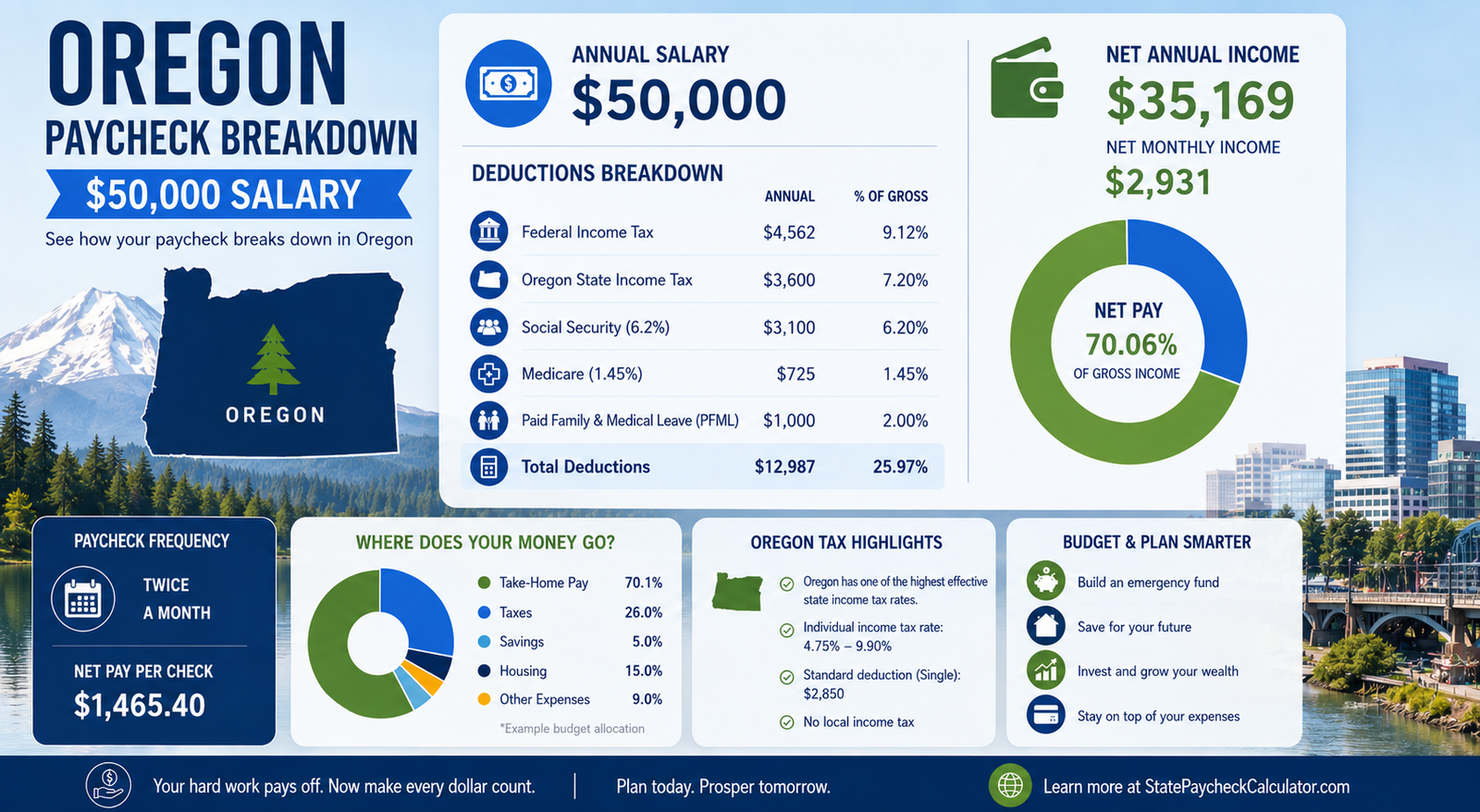
$50,000 Salary After Tax in Oregon (2026 Guide)
Living in Oregon comes with plenty of perks: breathtaking coastlines, vibrant cities, and no state sales tax. However, if you are earning a $50,000 salary in Oregon, you might wonder how much actually hits your bank account each month. Between federal taxes, state income tax, Social Security, Medicare, and Oregon's unique transit tax, your gross pay and your take‑home pay can be very different numbers.
In this in‑depth guide, we break down exactly what a $50,000 salary after tax in Oregon looks like in 2026. You will find precise tax calculations, a realistic monthly budget, city‑by‑city comparisons, and practical tips to increase your take‑home income. All calculations in this guide are based on our Oregon paycheck calculator.
Table of Contents
Overview Salary Breakdown Tax Breakdown Monthly Budget Example State Comparison Is $50K a Good Salary in Oregon? Tips to Increase Take‑Home Pay FAQs Disclaimer Final ThoughtsOverview
Oregon is one of only five states with no general sales tax, which makes every dollar of your paycheck stretch further at the register. On the flip side, the state has some of the highest personal income tax rates in the country, topping out at 9.9% for top earners. For someone earning $50,000 a year, the effective state tax rate lands around 7.6%, which is notably higher than many neighboring states.
Major cities such as Portland, Eugene, Salem, and Bend each have distinct cost‑of‑living profiles. Housing costs, in particular, have risen sharply in Portland and Bend, while Salem and Eugene remain somewhat more affordable. Understanding your true take‑home pay is the first step toward building a sustainable budget in any of these cities.
Oregon's economy continues to expand in technology, healthcare, and outdoor tourism, and the state has a strong culture of remote work. According to recent data, about 17% of Oregon workers now work from home, a figure that ranks among the highest in the nation. This shift has important implications for where you can afford to live on a $50,000 salary.
Salary Breakdown
The table below shows how a $50,000 annual salary is distributed across various deductions for a single filer with no pre‑tax deductions (such as 401(k) contributions or health insurance). These numbers come directly from the paycheck calculator for Oregon.
| Description | Monthly Amount | Annual Amount |
|---|---|---|
| Gross Pay | $4,166.67 | $50,000.00 |
| Federal Income Tax (FIT) | $318.33 | $3,820.00 |
| Social Security (FICA) | $258.33 | $3,100.00 |
| Medicare (FICA) | $60.42 | $725.00 |
| Oregon State Tax (SIT) | $318.28 | $3,819.38 |
| Statewide Transit Tax (0.1%) | $4.17 | $50.00 |
| Total Deductions | $959.53 | $11,514.38 |
| Net Take‑Home Pay | $3,207.13 | $38,485.62 |
Note: Your exact take‑home pay may vary based on additional pre‑tax deductions, filing status, and any extra withholdings. Use our Oregon paycheck calculator to calculate your salary in Oregon with your specific circumstances.
Tax Breakdown
Where does the $11,514 in taxes actually go? The pie chart below visualises the proportion taken by each tax category.
The largest chunks are federal income tax and Oregon state income tax, each accounting for roughly one‑third of the total tax bill. Social Security is close behind. Medicare and the statewide transit tax make up the smaller slices.
Detailed Tax Table
| Tax Type | Annual Amount | Effective Rate |
|---|---|---|
| Federal Income Tax | $3,820.00 | 7.64% |
| Social Security | $3,100.00 | 6.20% |
| Medicare | $725.00 | 1.45% |
| Oregon State Income Tax | $3,819.38 | 7.64% |
| Statewide Transit Tax | $50.00 | 0.10% |
| Total Tax Liability | $11,514.38 | 23.03% |
The overall effective tax rate on a $50,000 salary in Oregon is about 23%. While this may seem high, it is important to remember that Oregon residents do not pay state or local sales tax, which partially offsets the higher income tax burden.
Data source: IRS 2026 tax brackets, Oregon Department of Revenue 2026 schedules, and FICA rates confirmed by the Social Security Administration.
Monthly Budget Example
Can you live comfortably in Oregon on $50K? The answer depends heavily on your city and lifestyle. Below is a sample monthly budget for a single person renting in Portland, where costs are higher than the Oregon average.
| Expense Category | Monthly Estimate |
|---|---|
| Net Take‑Home Pay | $3,207 |
| Rent (1‑bedroom, Portland) | $1,715 |
| Groceries | $412 |
| Utilities (electric, water, internet) | $310 |
| Transportation (public transit + gas) | $210 |
| Healthcare (insurance + out‑of‑pocket) | $250 |
| Renter's Insurance | $18 |
| Phone & Streaming | $95 |
| Miscellaneous / Dining Out | $150 |
| Total Estimated Expenses | $3,160 |
| Remaining (Savings / Discretionary) | $47 |
In Portland, a $50,000 salary leaves very little wiggle room after essential expenses. In more affordable cities like Salem, where average rent for a one‑bedroom is closer to $1,350, your monthly surplus could grow to around $400. In Bend, where rent can top $2,000, the budget becomes significantly tighter.
These figures assume no debt payments. If you carry student loans, credit card debt, or a car payment, your financial picture will be even tighter. Tracking your spending and building a realistic budget is essential.
Not sure about your exact numbers?
Plug your income into our free Oregon paycheck calculator and see exactly how much you keep after taxes — in under 30 seconds.
Calculate your real take‑home pay nowState Comparison
How does Oregon stack up against its neighbors? The chart below compares the approximate net take‑home pay on a $50,000 salary across Oregon, Washington, California, and Idaho.
Net Take‑Home Pay on $50,000 (Single Filer, 2026)
Washington $39,800
Idaho $39,250
Oregon $38,486
California $38,150
| State | Approx. Net Pay (Single) | Key Tax Feature |
|---|---|---|
| Washington | $39,800 | No state income tax; higher sales tax |
| Idaho | $39,250 | Flat 5.8% income tax; 6% sales tax |
| Oregon | $38,486 | Progressive income tax (4.75%–9.9%); no sales tax |
| California | $38,150 | High progressive income tax (1%–13.3%); 7.25%+ sales tax |
Washington offers the highest take‑home pay because it has no state income tax. However, Washington's sales tax (6.5% plus local levies) eats into disposable income. Oregon's zero sales tax provides a meaningful offset, especially for residents who spend a large portion of their income on taxable goods.
For a more precise comparison that includes your specific deductions and filing status, visit our Oregon paycheck calculator.
Is $50K a Good Salary in Oregon?
The short answer: it depends on where you live and your lifestyle. Oregon's median household income is approximately $80,500, and the median individual wage is around $59,000. A $50,000 salary puts you slightly below the state average but still within a manageable range for a single person.
Here is a city‑by‑city perspective:
- Portland: The largest job market in the state, but also the highest rents. A $50,000 salary is feasible with a roommate or a modest one‑bedroom outside the city center. Public transit (TriMet) can reduce transportation costs significantly.
- Eugene: A university town with a lower cost of living than Portland. Rents are more affordable, and the city's bike‑friendly infrastructure can cut commuting costs.
- Salem: The state capital offers some of the most affordable housing among Oregon's major cities. A $50,000 salary goes further here, especially if you can find a rental below $1,400 per month.
- Bend: Popular for outdoor recreation, but housing costs rival Portland's. A $50,000 salary is tight in Bend; many residents supplement income with side gigs in the tourism sector.
Oregon's lack of a state sales tax helps stretch your paycheck on groceries, clothing, and household goods. However, rising housing costs — particularly in Portland and Bend — remain the biggest challenge for anyone earning a $50,000 salary after tax in Oregon.
Tips to Increase Take‑Home Pay
If your take‑home pay feels too tight, consider these strategies to keep more of your hard‑earned money:
- Contribute to a pre‑tax retirement account: A 401(k) or traditional IRA reduces your taxable income, lowering both federal and Oregon state tax liability. Even a $200 monthly contribution can save you roughly $460 per year in taxes.
- Use a Health Savings Account (HSA): If you have a high‑deductible health plan, an HSA offers triple tax advantages — contributions are pre‑tax, growth is tax‑free, and withdrawals for medical expenses are tax‑free.
- Review your W‑4 and OR‑W‑4 forms: Over‑withholding means the government holds your money interest‑free all year. Adjust your allowances to get closer to your actual tax liability. Use our Oregon paycheck calculator to see how different withholding settings affect your take‑home pay.
- Take advantage of Oregon‑specific credits: Oregon offers several tax credits, including the Earned Income Tax Credit (for lower‑income filers) and credits for child and dependent care expenses. Check the Oregon Department of Revenue website for eligibility.
- Consider a side gig or remote freelance work: Oregon's strong remote‑work culture means there are ample opportunities to supplement your income without a long commute. Even an extra $300–$500 per month can make a significant difference.
$50,000 Salary After Tax in Oregon – FAQs
How much is $50,000 after taxes in Oregon per month?
A $50,000 annual salary in Oregon yields approximately $3,207 per month in take‑home pay for a single filer in 2026, after federal and state income taxes, FICA, and the statewide transit tax are deducted.
Is $50,000 a good salary in Portland, Oregon?
$50,000 is a workable salary for a single person in Portland, though it requires careful budgeting. With median one‑bedroom rents around $1,715, housing will consume over half of your take‑home pay. Living with a roommate or choosing a neighborhood outside the central city can improve affordability.
What is the Oregon income tax rate for a $50,000 salary?
A single filer with a $50,000 salary falls into Oregon's 8.75% marginal tax bracket. However, after the standard deduction of $2,835, the effective state income tax rate is approximately 7.64%, resulting in an annual Oregon tax liability of about $3,819.
Does Oregon have a sales tax?
No. Oregon is one of five U.S. states with no state or local sales tax. This means you keep more of your take‑home pay when purchasing goods, which partially offsets the higher state income tax rates.
How does Oregon's tax compare to Washington's for a $50,000 salary?
Washington has no state income tax, so a $50,000 salary yields about $39,800 in take‑home pay — roughly $1,300 more than Oregon. However, Washington's 6.5%+ sales tax can reduce that advantage depending on your spending habits.
What deductions can reduce my Oregon state income tax?
Pre‑tax contributions to a 401(k), traditional IRA, or Health Savings Account (HSA) all reduce your Oregon taxable income. Additionally, Oregon offers a personal exemption credit and various tax credits for education, child care, and earned income for qualifying households.
Is the Oregon transit tax mandatory for all workers?
Yes. The Oregon statewide transit tax is a 0.1% payroll tax on all wages earned in the state. It is automatically withheld from your paycheck and appears as a separate line item. On a $50,000 salary, this amounts to $50 per year.
Can I live on $50,000 a year in Bend, Oregon?
Living in Bend on $50,000 is challenging due to high housing costs, with average rents exceeding $2,000 for a one‑bedroom. Many workers in Bend supplement their income with tourism‑related side work or choose to live in more affordable neighboring areas such as Redmond.
Disclaimer
Important: All calculations in this guide are estimates based on the 2026 tax year for a single filer with standard deductions and no pre‑tax reductions. Actual take‑home pay may vary due to individual filing status, pre‑tax contributions, additional local taxes, or changes in tax law. This article is for informational purposes only and does not constitute financial or tax advice. We strongly recommend using our Oregon paycheck calculator to get personalised estimates and consulting a qualified tax professional for advice specific to your situation.
About the Author
This guide was reviewed by a financial analyst with expertise in U.S. payroll taxes and state‑level tax policy. The content is grounded in official IRS and Oregon Department of Revenue data for the 2026 tax year, and all salary calculations were cross‑checked using the Oregon paycheck calculator. You may also find useful free tools such as QR code generators, barcode generators, PDF converters, and image utilities at FreeAiden, a platform offering a variety of AI‑powered productivity aids.
Final Thoughts
Understanding your $50,000 salary after tax in Oregon is the foundation of a solid financial plan. With a monthly take‑home pay of approximately $3,207, you can live comfortably in many parts of the state — provided you budget wisely and take advantage of Oregon's lack of sales tax. Housing will be your single largest expense, and choosing the right city can make a difference of several hundred dollars per month.
Oregon's unique tax landscape — higher income taxes but no sales tax — rewards careful planning. By contributing to pre‑tax retirement accounts, adjusting your withholding, and taking advantage of available tax credits, you can significantly improve your monthly cash flow.
Ready to see your personalised numbers?
Use our free Oregon paycheck calculator to get an instant, accurate breakdown of your take‑home pay in under 30 seconds. No sign‑up required.
See exactly how much you keep after taxes