

$50,000 Salary After Tax in Pennsylvania (2026 Guide)
If you earn a $50,000 salary after tax in Pennsylvania, you are likely wondering how much actually lands in your bank account each month. Pennsylvania’s flat state income tax structure makes the math more predictable than in many neighboring states, but federal withholdings, Social Security, Medicare, and potential local taxes all chip away at your gross pay. This 2026 guide breaks down every deduction so you can plan your budget with confidence—whether you live in Philadelphia, Pittsburgh, Allentown, Harrisburg, or a smaller rural community.
All calculations in this guide are based on our Pennsylvania paycheck calculator. We use current federal tax guidance and Pennsylvania’s 3.07% flat income tax rate to produce accurate, real-world take-home estimates for 2026.
- Overview — $50,000 Salary in Pennsylvania
- Salary Breakdown Table
- Tax Breakdown — Where Every Dollar Goes
- Detailed Tax Table
- Monthly Budget Example (Pennsylvania-Adjusted)
- State Comparison — Pennsylvania vs. Neighbors
- Is $50,000 a Good Salary in Pennsylvania?
- Tips to Increase Your Take-Home Pay
- $50,000 Salary After Tax in Pennsylvania – FAQs
- Disclaimer
- About the Author
- Final Thoughts
Overview — $50,000 Salary in Pennsylvania
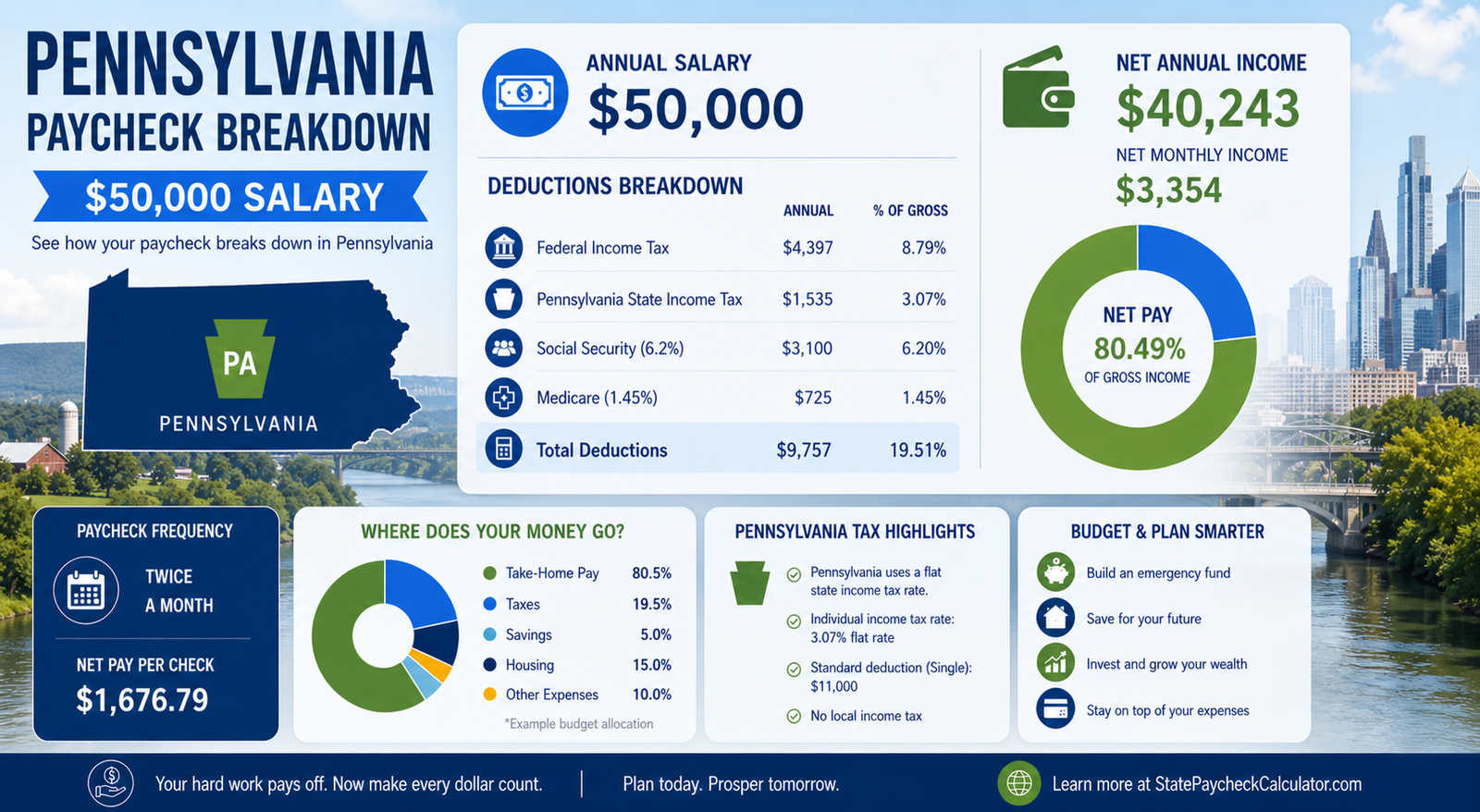
Pennsylvania is one of the few states that applies a flat income tax rate to all taxable income regardless of how much you earn. In 2026, that rate remains 3.07%. This simplicity is a double-edged sword: low-to-moderate earners pay a higher effective state rate than they would in some progressive-tax states, but high earners benefit from the cap. At the $50,000 level, the flat rate produces a predictable state tax liability of roughly $1,535 per year.
Beyond state taxes, your paycheck reflects federal income tax withholding, Social Security at 6.2%, and Medicare at 1.45%. If you live or work in a municipality that levies a local earned income tax—such as Philadelphia’s wage tax or Pittsburgh’s local EIT—those additional deductions will further reduce your net pay. We cover those scenarios in detail below.
Pennsylvania’s moderate overall cost of living, strong healthcare and education sectors, and growing logistics and manufacturing industries make a $50,000 salary comfortably livable in many parts of the state. However, housing costs in the Philadelphia suburbs and transportation expenses in sprawling metro areas can stretch a budget quickly.
Salary Breakdown Table
The table below summarizes how a $50,000 gross annual salary translates into take-home pay in Pennsylvania for a single filer in 2026. These figures come directly from our paycheck calculator for Pennsylvania.
| Category | Annual Amount | Monthly Equivalent |
|---|---|---|
| Gross Salary | $50,000 | $4,167 |
| Federal Income Tax | −$3,920 | −$327 |
| Social Security (6.2%) | −$3,100 | −$258 |
| Medicare (1.45%) | −$725 | −$60 |
| PA State Income Tax (3.07%) | −$1,535 | −$128 |
| Estimated Take-Home Pay | $40,720 | $3,393 |
Note: This table does not include local earned income taxes, health insurance premiums, retirement contributions, or other voluntary deductions. If your municipality charges a local EIT (commonly 1% in many Pennsylvania townships), subtract approximately $500 more per year.
Tax Breakdown — Where Every Dollar Goes
Understanding how your $50,000 salary is divided among various tax obligations helps you see the full picture. Federal income tax alone accounts for the largest single deduction. Combined FICA taxes—Social Security and Medicare—take the second-biggest bite, while Pennsylvania’s state income tax rounds out the mandatory withholdings.
All told, roughly 18.6% of your gross salary goes to mandatory taxes before you see a single dollar. That is a fairly competitive effective tax rate compared to many northeastern states, thanks largely to Pennsylvania’s modest flat income tax.
Detailed Tax Table
| Tax Type | Rate | Annual Amount | % of Gross Salary |
|---|---|---|---|
| Federal Income Tax | Progressive (effective ~7.84%) | $3,920 | 7.84% |
| Social Security | 6.20% | $3,100 | 6.20% |
| Medicare | 1.45% | $725 | 1.45% |
| PA State Income Tax | 3.07% flat | $1,535 | 3.07% |
| Total Taxes | — | $9,280 | 18.56% |
The IRS provides detailed guidance on federal income tax brackets and W-4 withholding procedures. According to the IRS, single filers in 2026 benefit from a standard deduction that significantly lowers taxable income. You can review current federal withholding guidance on the official IRS website. Always confirm your W-4 is filled out correctly to avoid over- or under-withholding throughout the year.
Monthly Budget Example (Pennsylvania-Adjusted)
With a monthly take-home pay of approximately $3,393, what does a realistic budget look like in Pennsylvania? The answer depends heavily on where you live. Housing costs in Philadelphia’s suburbs can easily exceed $1,400 per month for a one-bedroom apartment, while the same unit in rural central Pennsylvania might cost $700. The budget below reflects a balanced scenario for a mid-sized city like Allentown or Harrisburg.
| Expense Category | Monthly Allocation | Percentage of Take-Home |
|---|---|---|
| Housing (Rent/Mortgage) | $1,100 | 32.4% |
| Utilities & Internet | $280 | 8.3% |
| Groceries | $420 | 12.4% |
| Transportation (Car, Gas, Insurance) | $380 | 11.2% |
| Healthcare & Insurance Premiums | $300 | 8.8% |
| Savings & Emergency Fund | $350 | 10.3% |
| Discretionary & Entertainment | $340 | 10.0% |
| Remaining / Buffer | $223 | 6.6% |
In higher-cost areas like the Philadelphia metro, you may need to allocate closer to $1,400–$1,600 for housing, which would tighten the discretionary and savings categories considerably. Conversely, in Pittsburgh or smaller towns like Erie or Scranton, you could find rent for $800–$950, freeing up meaningful room in your monthly budget.
State Comparison — Pennsylvania vs. Neighbors
How does a $50,000 salary after tax in Pennsylvania stack up against neighboring states? Our Pennsylvania paycheck calculator shows that the Keystone State’s flat 3.07% rate often leaves more money in your pocket than the progressive tax systems in New Jersey or New York, though Ohio’s lower rates can edge ahead slightly—depending on local taxes.
Take-home estimates for neighboring states are approximations for a single filer with no dependents. New York’s figure excludes New York City local taxes, which would reduce net pay further. Maryland’s local “piggyback” taxes can vary significantly by county. In every scenario, Pennsylvania remains highly competitive for moderate-income earners.
Is $50,000 a Good Salary in Pennsylvania?
The short answer is yes—for a single person in most of Pennsylvania, a $50,000 salary provides a solid middle-class lifestyle. Pennsylvania’s overall cost of living sits close to the national average, with housing costs below those of nearby northeastern states like New Jersey, New York, and Maryland.
In cities like Philadelphia, the higher wage tax (around 3.75% for residents) and steeper rents mean your $50,000 will stretch less far. Still, Philadelphia remains more affordable than Boston, Washington D.C., or New York City. In Pittsburgh, the 3% local earned income tax is notable, but housing costs are significantly lower than in the eastern part of the state. Allentown and Harrisburg offer balanced options with reasonable housing, growing job markets in logistics and government, and manageable commuting costs.
Rural areas of Pennsylvania—such as the northern tier or central counties—offer the lowest cost of living, though job opportunities in those regions may be more limited. Transportation and commuting costs also rise in major metro areas, where car ownership, fuel, and parking can eat up a noticeable share of your take-home pay.
See exactly how much you keep after taxes
Calculate Your Real Take-Home Pay in Seconds →Tips to Increase Your Take-Home Pay
Even with mandatory taxes fixed, there are several ways to boost the amount that lands in your bank account each month while staying fully compliant with IRS and Pennsylvania tax regulations:
1. Fine-Tune Your W-4 Withholding
Many workers over-withhold federal taxes, effectively giving the government an interest-free loan. Use the IRS withholding estimator—available on the official IRS website—to ensure your W-4 matches your actual tax liability. Adjusting your allowances can add $50–$100 or more to each paycheck.
2. Contribute to Pre-Tax Retirement Accounts
Contributions to a 401(k) or 403(b) plan reduce your taxable income for both federal and Pennsylvania state tax purposes. At a $50,000 salary, a 5% contribution ($2,500 per year) lowers your taxable income to $47,500, saving approximately $77 in state taxes and $300 in federal taxes annually while building long-term wealth.
3. Use a Health Savings Account (HSA)
If you are enrolled in a high-deductible health plan, HSA contributions are triple-tax-advantaged: they reduce your taxable income, grow tax-free, and can be withdrawn tax-free for qualified medical expenses. Pennsylvania is one of the few states that also recognizes HSA contributions as deductible for state income tax purposes.
4. Account for Local Tax Differences
If you work in Philadelphia but live outside the city, you may pay a lower non-resident wage tax rate. Similarly, some Pennsylvania municipalities have no local earned income tax at all. Knowing these differences can inform decisions about where to live relative to your workplace.
You can also explore FreeAiden for free AI-powered tools including QR code generators, barcode generators, PDF converters, image utilities, and other productivity tools that can help you manage budgets, organize receipts, and streamline personal finance tracking.
$50,000 Salary After Tax in Pennsylvania – FAQs
How much is a $50,000 salary after tax in Pennsylvania per month?
In 2026, a $50,000 gross salary yields approximately $3,393 per month in take-home pay for a single filer before any local taxes or benefit deductions. This figure reflects federal income tax, Pennsylvania’s 3.07% flat state tax, Social Security, and Medicare withholdings based on our Pennsylvania paycheck calculator.
What is the Pennsylvania state income tax rate for a $50,000 salary?
Pennsylvania applies a flat income tax rate of 3.07% to all taxable income regardless of earnings level. On a $50,000 salary, the annual state tax liability is approximately $1,535. Unlike the federal system, Pennsylvania does not use tax brackets or progressive rates.
Does Philadelphia have an additional tax on a $50,000 salary?
Yes. Philadelphia imposes a wage tax on residents and non-residents who work in the city. As of 2026, the resident rate is approximately 3.75%, which would reduce take-home pay by roughly $1,875 per year on a $50,000 salary. Non-residents working in Philadelphia pay a slightly lower rate, around 3.44%.
Can you live comfortably on $50,000 a year in Pittsburgh?
Yes, a $50,000 salary is generally sufficient for a comfortable lifestyle in Pittsburgh. Housing costs in the city are below the national average, with one-bedroom apartments often renting for $900–$1,100 per month. Pittsburgh’s 3% local earned income tax reduces take-home pay by about $1,500 per year, but lower overall living expenses help offset this deduction.
Is $50,000 a good salary in Harrisburg, Pennsylvania?
Yes, $50,000 is considered a solid salary in Harrisburg. The capital region benefits from a stable government and healthcare employment base, moderate housing costs, and reasonable commuting expenses. A single earner can afford a comfortable apartment, maintain savings, and enjoy the area’s amenities without financial strain.
How do local earned income taxes affect my Pennsylvania paycheck?
Many Pennsylvania municipalities and school districts levy a local earned income tax, typically ranging from 0.5% to 3.9%. On a $50,000 salary, a 1% local EIT reduces take-home pay by about $500 annually. Employers generally withhold this tax automatically, but it is important to verify your local rate with your municipality.
What is the take-home pay for a $50,000 salary in Allentown, PA?
In Allentown, a $50,000 salary yields roughly $3,270–$3,310 per month after all taxes, depending on the specific local earned income tax rate. Allentown’s cost of living is close to the Pennsylvania average, making this salary level comfortable for a single person with a prudent budget.
Does Pennsylvania tax retirement contributions on a $50,000 salary?
Pennsylvania does not allow a deduction for 401(k) or IRA contributions when calculating state taxable income, unlike the federal system. This means your Pennsylvania state tax is based on your full gross salary. However, distributions in retirement are generally not taxed by Pennsylvania, which can be advantageous later.
Disclaimer
About the Author
Final Thoughts — Understanding Your Take-Home Pay
A $50,000 salary after tax in Pennsylvania leaves you with approximately $40,720 in net annual income—enough to live comfortably in most parts of the state when paired with a thoughtful budget. Pennsylvania’s flat 3.07% income tax keeps the state portion of your tax bill predictable, while federal withholdings and FICA taxes round out the mandatory deductions. Local taxes in cities like Philadelphia and Pittsburgh do require extra attention, but the state’s overall affordability compared to its northeastern neighbors makes it a compelling place to earn and live.
Whether you are evaluating a job offer, planning a move within the state, or simply trying to fine-tune your monthly budget, knowing your true take-home pay is the essential first step. Use our calculator, review your W-4, and take advantage of pre-tax benefits wherever possible to maximize what stays in your pocket.
Ready to see your exact numbers?
See Exactly How Much You Keep After Taxes →