

$50,000 Salary After Tax in South Dakota (2026 Guide)
Last Updated: 2026
If you earn a $50,000 salary after tax in South Dakota, you are in a uniquely advantageous position. South Dakota is one of only a handful of states with no state income tax on earned income. That means your take-home pay is higher here than in most other parts of the country. But exactly how much lands in your bank account each month? And can you genuinely live comfortably on $50,000 a year in cities like Sioux Falls, Rapid City, Aberdeen, or Brookings? This comprehensive 2026 guide answers all those questions and more.
All calculations in this guide are based on our South Dakota paycheck calculator. We break down every deduction, compare South Dakota against other states, provide a realistic monthly budget, and explain why the Mount Rushmore State remains one of the best places to keep more of what you earn.
Table of Contents
Overview: Why South Dakota Stands Out
South Dakota is one of nine U.S. states that do not tax earned income at the state level. For someone earning $50,000 a year, this policy alone can save thousands of dollars annually compared to living in a high-tax state like California or Minnesota. Beyond taxes, South Dakota offers a lower cost of living than the national average, affordable housing in many communities, and growing job opportunities in sectors such as healthcare, financial services, agriculture, and tourism.
Cities like Sioux Falls and Rapid City continue to see economic growth, while smaller communities like Aberdeen and Brookings offer tight-knit living with very reasonable housing costs. Seasonal weather does affect utility and transportation expenses, but overall, a $50,000 salary stretches further here than in most other regions.
Federal withholding estimates are based on current IRS tax guidance and paycheck withholding information available on the official IRS website. Our primary data source remains the South Dakota paycheck calculator, which provides precise take-home pay figures.
Salary Breakdown: Gross to Net
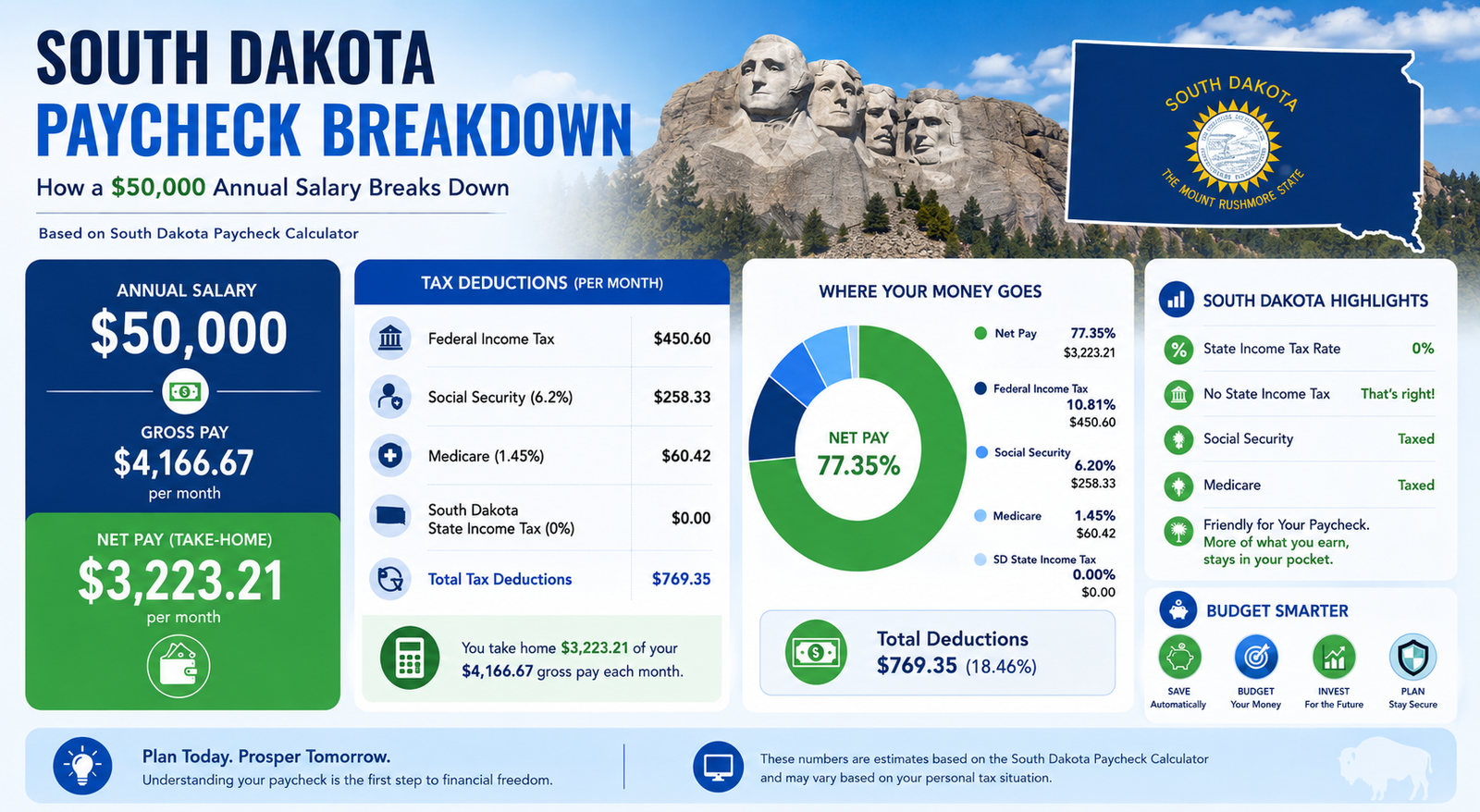
The table below shows the complete breakdown of a $50,000 annual salary in South Dakota for 2026. All figures are sourced from our paycheck calculator.
| Category | Annual Amount | Monthly Amount |
|---|---|---|
| Gross Salary | $50,000.00 | $4,166.67 |
| Federal Income Tax | -$4,835.00 | -$402.92 |
| Social Security (6.2%) | -$3,100.00 | -$258.33 |
| Medicare (1.45%) | -$725.00 | -$60.42 |
| Net Take-Home Pay | $41,340.00 | $3,445.00 |
As you can see, the total deductions amount to approximately $8,660 per year, leaving you with around $41,340 in net annual take-home pay. Your effective tax rate is roughly 17.3%, which is notably low by national standards. The absence of a state income tax in South Dakota is the primary reason for this favorable outcome.
Tax Breakdown: Where Your Money Goes
Understanding exactly which taxes apply to your paycheck helps you make informed financial decisions. Below is a detailed tax breakdown along with a visual pie chart illustrating the distribution.
| Tax Type | Annual Amount | Percentage of Gross |
|---|---|---|
| Federal Income Tax | $4,835.00 | 9.67% |
| Social Security | $3,100.00 | 6.20% |
| Medicare | $725.00 | 1.45% |
| State Income Tax | $0.00 | 0.00% |
| Total Taxes | $8,660.00 | 17.32% |
The IRS explains that federal income tax withholding depends on your W-4 elections, filing status, and any applicable deductions or credits. You can review current federal withholding guidance on the official IRS website. Social Security and Medicare taxes—collectively known as FICA—are fixed percentages applied to your gross earnings up to the annual wage cap for Social Security.
Because South Dakota has no state income tax on earned income, you avoid an additional deduction that workers in most other states face. This is a significant financial advantage that compounds over time.
Monthly Budget Example for South Dakota
With a monthly net take-home pay of approximately $3,445, what does a realistic budget look like in South Dakota? The table below reflects typical costs in cities like Sioux Falls and Rapid City, where housing remains affordable but seasonal weather can influence utility spending.
| Expense Category | Monthly Estimate | Notes |
|---|---|---|
| Housing (Rent/Mortgage) | $1,050 | 1-bedroom apartment in Sioux Falls area |
| Utilities & Internet | $260 | Higher in winter months |
| Groceries | $420 | Moderate grocery spending |
| Transportation | $310 | Gas, insurance, maintenance |
| Healthcare & Insurance | $280 | Premiums and out-of-pocket |
| Savings & Investments | $400 | Retirement and emergency fund |
| Discretionary & Entertainment | $350 | Dining out, hobbies, subscriptions |
| Remaining (Buffer) | $375 | Flexible / additional savings |
This budget leaves a comfortable buffer of around $375 each month. In more affordable communities like Aberdeen or Brookings, housing costs can drop significantly—sometimes below $800 per month for a one-bedroom apartment—freeing up even more room for savings or discretionary spending. The lower cost of living across South Dakota means a $50,000 salary provides genuine financial breathing room.
How South Dakota Compares to Other States
One of the most compelling reasons to live and work in South Dakota is the tax advantage. The bar chart below compares the net take-home pay from a $50,000 salary across four states: South Dakota, Minnesota, California, and Texas.
Comparison of estimated net take-home pay on a $50,000 gross salary (2026). South Dakota and Texas have no state income tax. Minnesota and California impose state income taxes that reduce net pay.
| State | State Income Tax | Est. Net Take-Home (Annual) | Difference vs. SD |
|---|---|---|---|
| South Dakota | None | $41,340 | — |
| Texas | None | $41,340 | $0 |
| Minnesota | 5.35% – 9.85% | $38,750 | -$2,590 |
| California | 1% – 13.3% | $37,150 | -$4,190 |
Compared to Minnesota, you keep roughly $2,590 more per year in South Dakota. Compared to California, the difference jumps to over $4,190 annually. Over a decade, those savings can add up to tens of thousands of dollars—money that stays in your pocket rather than going to state tax authorities.
Is $50,000 a Good Salary in South Dakota?
Yes, a $50,000 salary is considered a solid income in South Dakota. With no state income tax and a cost of living that sits below the national average, this salary level supports a comfortable lifestyle in most parts of the state. In Sioux Falls, the median household income hovers around $60,000–$65,000, so a single earner at $50,000 is in a respectable position. In Rapid City, housing costs are similarly manageable, and the growing tourism and healthcare sectors provide stable employment.
In smaller cities like Aberdeen and Brookings, $50,000 goes even further. Housing can be found well below the national median, and everyday expenses like groceries and transportation are generally affordable. Seasonal weather does nudge utility bills higher during winter months, but the overall financial picture remains highly favorable.
If you are relocating from a higher-cost state, you will likely feel an immediate improvement in your purchasing power. The combination of no state income tax and moderate living expenses makes South Dakota a compelling destination for professionals, remote workers, and families alike.
Tips to Increase Your Take-Home Pay
Even with a favorable tax environment, there are several strategies to boost your net pay and build long-term wealth on a $50,000 salary in South Dakota.
Optimize Your W-4 Withholding
Review your W-4 form periodically, especially after major life changes. The IRS provides a withholding estimator tool on their website. Adjusting your allowances can prevent over-withholding and put more money in each paycheck.
Contribute to Tax-Advantaged Accounts
Contributing to a 401(k) or traditional IRA reduces your taxable income. Even a modest contribution of $200 per month can lower your annual federal tax bill while building retirement savings.
Take Advantage of South Dakota's Low Cost of Living
Choose housing that fits comfortably within your budget. In Brookings or Aberdeen, rent can be 20–30% cheaper than in larger metro areas. Redirect those savings into an emergency fund or investments.
Explore Side Income Opportunities
South Dakota's growing gig economy, tourism industry, and remote work opportunities provide avenues for supplemental income. Even a few hundred extra dollars per month can accelerate debt payoff or savings goals.
You can also explore FreeAiden for free AI-powered tools including QR code generators, barcode generators, PDF converters, image utilities, and other productivity tools that can support small business ventures or freelance side hustles.
$50,000 Salary After Tax in South Dakota – FAQs
How much is $50,000 a year after taxes in South Dakota?
After federal income tax, Social Security, and Medicare deductions, a $50,000 salary in South Dakota yields approximately $41,340 in annual take-home pay. This equates to about $3,445 per month. South Dakota's lack of a state income tax significantly increases your net pay compared to most other states.
What is the effective tax rate on a $50,000 salary in South Dakota?
The effective tax rate for a $50,000 salary in South Dakota is roughly 17.3% when combining federal income tax and FICA taxes. This rate is considerably lower than what workers face in states with additional state income taxes.
Can you live comfortably in Sioux Falls on $50,000 a year?
Yes, you can live comfortably in Sioux Falls on a $50,000 salary. With average one-bedroom rent around $1,000–$1,100 and moderate utility and grocery costs, a monthly net income of $3,445 leaves room for savings, entertainment, and occasional travel. Budgeting wisely makes this income level quite sustainable.
How does South Dakota's no state income tax affect take-home pay?
South Dakota's no state income tax policy means you avoid an additional 2% to 9% deduction that workers in many other states face. On a $50,000 salary, this translates to savings of $1,000 to $4,500 or more per year compared to states with income taxes.
Is $50,000 a good salary for a family in South Dakota?
For a single person or a couple without children, $50,000 is a solid salary in South Dakota. For a family with children, it may require careful budgeting, particularly in Sioux Falls or Rapid City. Dual-income households will find the state's tax advantages even more beneficial.
Are there any local income taxes in South Dakota cities?
No. South Dakota does not allow cities or counties to impose local income taxes on earned income. Your paycheck is only subject to federal taxes and FICA, regardless of whether you live in Sioux Falls, Rapid City, Aberdeen, or Brookings.
How often should I use a paycheck calculator for South Dakota?
It is wise to use a paycheck calculator for South Dakota whenever you receive a raise, change jobs, adjust your W-4, or if federal tax laws change. Regular check-ins help you avoid surprises at tax time and ensure your withholding aligns with your financial goals.
Does South Dakota tax retirement income or investment earnings?
South Dakota does not tax earned income, and it also does not tax retirement income such as pensions, 401(k) distributions, or Social Security benefits. This makes it an attractive state for retirees and long-term savers.
Disclaimer
Important: The figures provided in this article are estimates based on our South Dakota paycheck calculator and current IRS guidance for the 2026 tax year. Actual take-home pay may vary depending on your specific W-4 elections, filing status, pre-tax deductions, and any additional income or credits. This content is for informational purposes only and does not constitute financial, tax, or legal advice. We strongly encourage you to calculate your salary in South Dakota using our tool for personalized results and consult a qualified financial professional for advice tailored to your situation.
Final Thoughts
A $50,000 salary after tax in South Dakota places you in a strong financial position. With a net take-home pay of approximately $41,340 per year and no state income tax eating into your earnings, you have more control over your money than workers in most other states. Whether you live in bustling Sioux Falls, scenic Rapid City, or the welcoming communities of Aberdeen and Brookings, $50,000 can support a comfortable lifestyle with room for saving and enjoyment.
The key is understanding exactly how much you keep after taxes and planning accordingly. Use the budget framework in this guide as a starting point, adjust for your personal circumstances, and revisit your numbers whenever your financial situation changes.
Use our free South Dakota paycheck calculator to get your personalized take-home pay estimate in under 30 seconds.