

Last Updated: 2026
$50,000 Salary After Tax in Vermont (2026 Guide)
If you are considering a job offer in the Green Mountain State or simply planning your finances, understanding your real take-home pay is the first crucial step. A $50,000 salary often sounds like a solid milestone, but the reality of your net income depends heavily on state-specific taxes and local living costs. The transition from gross salary to the actual cash deposited in your bank account can feel confusing, especially with Vermont's unique tax structure.
Living in Vermont presents a distinct mix of high-quality rural life and significant seasonal expenses. From the vibrant streets of Burlington to the historic charm of Montpelier and the ski-resort living in Stowe, a salary of $50K stretches differently depending on where you plant your roots. Higher heating and utility costs during long winter months and a smaller job market compared to larger states mean that budgeting isn't just smart; it is essential.
This comprehensive 2026 guide breaks down exactly what you take home from a $50,000 salary after tax in Vermont. We provide precise numbers, not estimates, so you can plan your finances with confidence and decide if living comfortably on $50K in Vermont is realistic for your lifestyle.
All calculations in this guide are based on our Vermont paycheck calculator.
Table of Contents
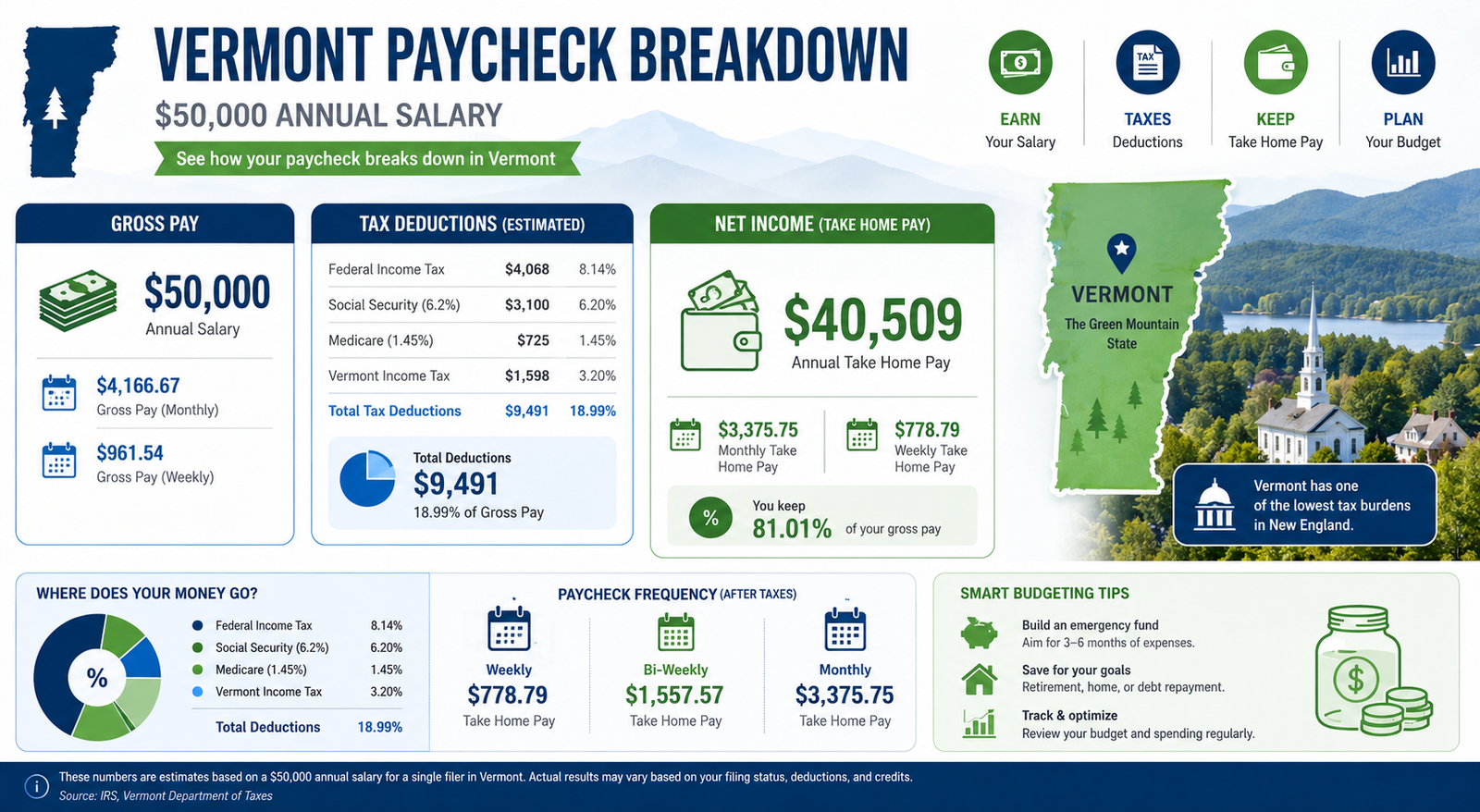
Overview of a $50,000 Salary in Vermont
Vermont imposes a progressive state income tax, meaning higher earnings are taxed at higher rates. Unlike states with a flat tax, your marginal rate in Vermont could climb higher than surrounding states like New Hampshire, which levies no income tax on wages. However, Vermont offers specific credits and deductions that slightly mitigate the burden for middle-income filers.
The main deductions from your paycheck include the federal income tax, Vermont state income tax, and FICA taxes which cover Social Security and Medicare. Federal income taxation follows the progressive bracket system, and according to the IRS, the standard deduction for 2026 will be adjusted for inflation, reducing your taxable income before rates are applied. You can review current federal withholding guidance on the official IRS website.
While Vermont’s robust education, healthcare, and tourism sectors drive the economy, job seekers in Burlington or Montpelier must weigh the high state taxes against the priceless quality of life. As you review the numbers below, remember that these figures assume a standard single filer with no additional deductions. Using a Vermont paycheck calculator can give you a more personalized result if you have dependents or itemize deductions.
$50,000 Salary Breakdown in Vermont
To fully grasp your earnings, you have to move beyond the annual figure. Breaking the salary down into monthly, bi-weekly, and hourly segments helps you visualize the physical cash flow you’ll manage every week. Because Vermont has relatively high income tax rates, the gap between your gross and net pay can be surprising if you are relocating from a no-tax state.
| Pay Frequency | Gross Pay | Take-Home Pay (Net) |
|---|---|---|
| Annual | $50,000 | $39,105 |
| Monthly | $4,167 | $3,259 |
| Bi-Weekly | $1,923 | $1,504 |
| Hourly (2080 hrs) | $24.04 | $18.80 |
Taking home approximately $1,504 every two weeks drastically impacts how you manage recurring bills in a state where heating fuel deliveries can cost several hundred dollars per delivery in the winter. While this gross hourly rate is substantially higher than Vermont's minimum wage, the net hourly rate better reflects your true spending power in Montpelier or Rutland.
Detailed Tax Breakdown for Vermont
Understanding where your money goes before it hits your pocket is the hallmark of financial literacy. For a single filer earning $50,000, the tax structure is not a single flat percentage; it's a blend of federal responsibility and Vermont's state-level demands. Federal payroll taxes, often called FICA, account for a significant flat deduction before we even get to income withholding.
| Tax Category | Annual Amount |
|---|---|
| Federal Income Tax | $4,206 |
| Vermont State Tax | $2,864 |
| Social Security | $3,100 |
| Medicare | $725 |
| Total Taxes | $10,895 |
Tax Distribution
The IRS explains that Social Security and Medicare taxes are mandatory payroll deductions which provide future retirement and healthcare benefits. Notice that Vermont state tax consumes a notable portion of your check. This is a critical factor when comparing similar roles across the Connecticut River in New Hampshire, where you would keep that state tax portion entirely.
Monthly Budget Example in Vermont
Living comfortably in Vermont on $50K means adapting to the local economic landscape. Unlike metropolitan sprawls, Vermont residents often face higher transportation costs due to rural living considerations and significant winter heating bills. The table below represents a conservative, balanced budget for a single person renting in a town like Rutland or the outskirts of Burlington.
| Expense Category | Estimated Monthly Cost |
|---|---|
| Rent (1 Bedroom) | $1,200 |
| Utilities & Heating | $280 |
| Groceries | $400 |
| Transportation (Car + Fuel) | $350 |
| Health Insurance | $200 |
| Renter's Insurance | $25 |
| Leisure & Dining | $250 |
| Total Expenses | $2,705 |
| Remaining Discretionary | $554 |
With a monthly net of $3,259, this budget leaves just over $550 for savings or unexpected costs. In high-cost resort communities like Stowe, rising housing prices could easily push rent to $1,600 or more, virtually erasing that buffer. However, in regions with strong tourism and agriculture sectors, side hustles can supplement this narrow margin.
Don't guess your paycheck. Plan every dollar perfectly.
Calculate Your Exact Vermont Take-Home PayVermont vs. Neighboring States on $50,000
Geographically, Vermont is small, but economically, it stands out for its tax structure. When comparing a $50,000 salary after tax in Vermont to adjacent states, the difference in take-home pay is stark, particularly when looking at New Hampshire which levies zero income tax on wages. This drives many professionals to live in Vermont for the lifestyle while commuting to New Hampshire or even considering remote work arrangements.
As the chart illustrates, Vermont's take-home pay is competitive with New York State but lags notably behind New Hampshire. If you are someone focused on sustainability and outdoor lifestyle, the value gained from Vermont's environment may offset the tax disadvantage relative to the White Mountains region.
Is $50,000 a Good Salary in Vermont?
Whether $50K is a good wage depends heavily on your household structure and location within Vermont. For a single professional living in Rutland or the rural Northeast Kingdom, $50,000 places you in a secure position where you can cover necessities and save moderately. However, in Burlington or Montpelier, where the cost of living is transitioning toward major metro levels, $50,000 demands strict budgeting.
The strong healthcare and education sectors in Vermont often pay competitive wages, but a smaller job market compared to larger states limits upward mobility without a strategic career pivot. The key variable is housing. Rising prices in desirable mountain and resort communities often mean that $50,000 is a stretched single-income budget, though it remains viable with roommates or dual-income households.
Tips to Increase Your Take-Home Pay
If the net figure of $39,105 feels tight, there are concrete steps you can take to widen your margin without simply asking for a raise. The most immediate administrative change involves adjusting your W-4 form to ensure you are not over-withholding for the IRS. Federal withholding estimates are based on current IRS tax guidance and paycheck withholding information available on the official IRS website.
- Adjust W-4 Withholdings: If you received a large refund last year, you likely overpaid. Adjusting your W-4 frees up monthly cash flow immediately.
- Contribute to a 401(k) or HSA: Pre-tax contributions lower your taxable income. In Vermont, this reduces both your federal and state tax base.
- Claim Vermont Tax Credits: Look into the Vermont Earned Income Tax Credit (EITC) and other local deductions specific to Green Mountain State residents.
- Utilize Free Tools: You can also explore FreeAiden for free AI-powered tools including QR code generators, barcode generators, PDF converters, image utilities, and other productivity tools to simplify your side hustle or freelance invoicing.
$50,000 Salary After Tax in Vermont – FAQs
How much is a $50,000 salary after tax in Vermont per month?
A $50,000 salary results in approximately $3,259 in monthly take-home pay after Vermont state taxes and federal deductions are accounted for, assuming standard single filing status.
Is Vermont heavily taxed compared to other states?
Yes, Vermont’s progressive state income tax brackets rank among the higher tiers nationally, which significantly impacts a $50,000 salary when compared to states like New Hampshire or Florida with no income tax.
Can I live comfortably in Burlington on a $50,000 salary?
Living comfortably in Burlington on this salary is challenging but possible with a strict budget. Rising rental costs in the city center mean you'll likely allocate over 35% of your net pay to housing.
What are the federal tax brackets for a $50,000 salary in 2026?
According to the IRS, after the standard deduction, a $50,000 earner falls into the 12% marginal federal bracket, though the effective federal rate is closer to 8.4% when calculated with our paycheck calculator.
How do Vermont winter costs affect a $50K budget?
Higher heating and utility costs during winter months can add $150–$300 extra monthly compared to summer. Failure to budget for this seasonal spike is a common pitfall for new Vermonters.
Does Vermont tax Social Security income?
While this guide focuses on wages, it is worth noting that Vermont does offer exemptions on Social Security income for retirees under certain income thresholds, which benefits long-term planning.
Disclaimer
Important: All calculations in this guide are based on our Vermont paycheck calculator, assuming a single filer with standard deductions in 2026. State estimates may vary based on your specific W-4 inputs, pre-tax deductions, or additional Vermont tax credits. This content is for informational purposes only and should not be considered financial advice. We encourage you to use the Vermont paycheck calculator to generate a precise calculation tailored to your unique tax situation.
Final Thoughts on Your Vermont Paycheck
Navigating a $50,000 salary after tax in Vermont requires a proactive mindset. The net income of $39,105 demands a deep appreciation for the state’s unique blend of high utility overhead and intangible quality-of-life returns. While you might take home less cash than your friends in Boston or Manchester, the value of Vermont's safety, community, and natural beauty frequently tips the scale.
To truly master your finances, you need specificity. Rough estimates lead to overdrafts. Precise calculations lead to freedom. See exactly how much you keep after taxes and begin building a budget that accounts for every leaf-peeping season and snowstorm.
Ready to see your real numbers?
Calculate Your Real Take-Home Pay in Seconds