

$50,000 Salary After Tax in Washington (2026 Guide)
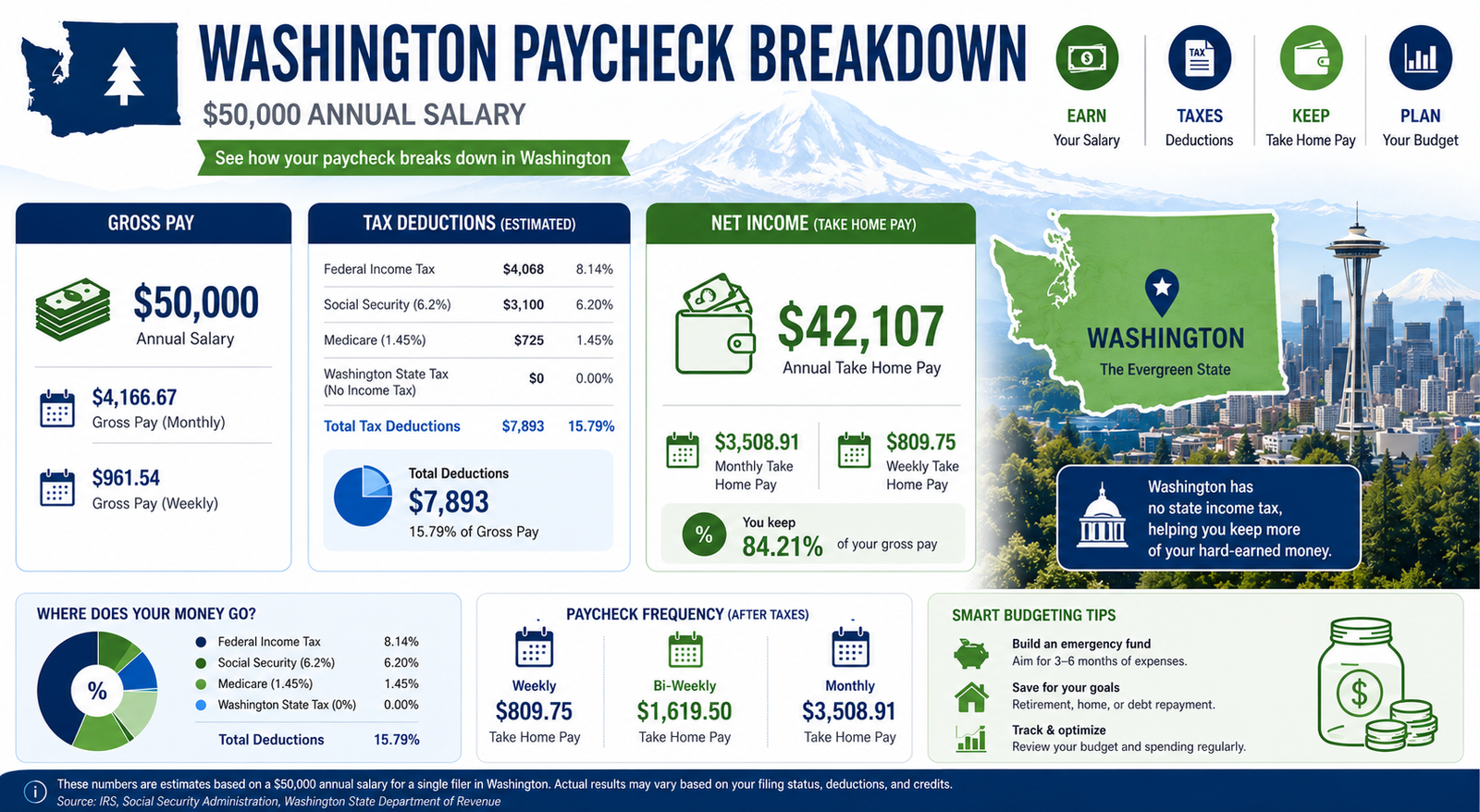
Understanding exactly how much of your $50,000 salary after tax in Washington you actually keep is essential for planning your budget, housing, and lifestyle. Washington State stands out because it does not tax earned income at the state level. That means your paycheck only faces federal withholdings and FICA taxes. However, living in cities like Seattle, Spokane, Tacoma, or Bellevue comes with varying costs that affect how far your take-home pay stretches.
All calculations in this guide are based on our Washington paycheck calculator. This tool uses the latest 2026 federal tax brackets, W-4 withholding guidelines aligned with official IRS guidance, and current FICA rates to produce accurate estimates for Washington residents.
Overview of Washington State Taxation
Washington is one of a handful of states that do not levy a personal income tax on earned wages. This policy benefits workers across the state, from tech professionals in Bellevue to healthcare workers in Spokane and aerospace employees in Tacoma. Because there is no state-level withholding, your paycheck only reflects federal obligations.
The federal government applies income tax based on progressive brackets. In addition, every worker pays FICA taxes, which fund Social Security and Medicare. According to the IRS, federal income tax withholding depends on your Form W-4 elections, filing status, and the current year's tax brackets. You can review current federal withholding guidance on the official IRS website.
For someone earning $50,000 in Washington during 2026, the absence of state income tax means thousands of dollars stay in your pocket compared to high-tax states like Oregon or California. Still, the Seattle metro area's higher housing and living costs mean you should budget carefully even with a favorable tax situation.
Washington also has a strong economy driven by technology, aerospace, healthcare, and trade industries. Remote work opportunities are growing, allowing some residents to earn a Seattle-level salary while living in more affordable eastern Washington communities.
Salary Breakdown Table
The table below shows how a $50,000 gross salary translates into take-home pay across different pay periods. These figures come directly from our paycheck calculator for Washington and assume a single filing status with the standard deduction for 2026.
| Pay Frequency | Gross Pay | Federal Income Tax | Social Security | Medicare | Take-Home Pay |
|---|---|---|---|---|---|
| Annual | $50,000 | $3,970 | $3,100 | $725 | $42,205 |
| Monthly | $4,167 | $331 | $258 | $60 | $3,517 |
| Bi-Weekly | $1,923 | $153 | $119 | $28 | $1,623 |
| Weekly | $962 | $76 | $60 | $14 | $812 |
All calculations in this guide are based on our Washington paycheck calculator. Figures are rounded to the nearest dollar. Your actual take-home pay may vary slightly depending on W-4 settings, pre-tax deductions, and additional withholdings.
Tax Breakdown and Pie Chart
Out of a $50,000 gross salary, total taxes amount to approximately $7,795 annually. This is composed of three federal components. The chart below shows how those tax dollars are distributed.
Federal income tax is the largest single deduction at nearly 51% of total taxes. Social Security tax, which is 6.2% of your gross wages up to the annual wage base limit, accounts for roughly 40%. Medicare tax at 1.45% makes up the remaining portion. Washington's lack of a state income tax means you avoid an additional 4% to 9% in state-level deductions that workers in many other states face.
Detailed Tax Table
The following table provides a line-by-line breakdown of how your $50,000 salary is taxed at the federal level. Federal withholding estimates are based on current IRS tax guidance and paycheck withholding information available on the official IRS website.
| Line Item | Amount | Notes |
|---|---|---|
| Gross Annual Salary | $50,000 | Base earnings before any deductions |
| Standard Deduction (2026 est.) | -$15,000 | Single filer standard deduction |
| Taxable Income | $35,000 | After standard deduction |
| Federal Income Tax | $3,970 | Progressive brackets: 10% and 12% |
| Social Security Tax (6.2%) | $3,100 | On gross wages up to the wage cap |
| Medicare Tax (1.45%) | $725 | No income cap for Medicare tax |
| Total Taxes | $7,795 | Sum of all federal deductions |
| Net Take-Home Pay | $42,205 | What you actually keep annually |
The IRS explains that your effective federal income tax rate on a $50,000 salary is approximately 7.9%, while your marginal rate falls within the 12% bracket. Combined with FICA taxes, your total effective tax rate is about 15.6%. That is significantly lower than what workers in states with additional income taxes experience.
Monthly Budget Example for Washington
A monthly take-home pay of $3,517 can support a comfortable lifestyle in many parts of Washington, though your location within the state makes a substantial difference. Housing costs in the Seattle metro area are notably higher than in eastern Washington cities like Spokane or the Tri-Cities region.
The budget below reflects a moderate lifestyle for a single person renting in the Seattle-Tacoma-Bellevue corridor. If you live in Spokane or a smaller town, your housing and transportation costs may be considerably lower, freeing up funds for savings or recreation.
| Expense Category | Monthly Allocation | Percentage of Take-Home |
|---|---|---|
| Housing (Rent + Utilities) | $1,450 | 41% |
| Food & Groceries | $520 | 15% |
| Transportation | $280 | 8% |
| Health Insurance & Medical | $260 | 7% |
| Savings & Emergency Fund | $350 | 10% |
| Entertainment & Dining Out | $240 | 7% |
| Miscellaneous & Personal | $417 | 12% |
This budget allocates roughly 41% of take-home pay to housing, which aligns with common affordability guidelines. In Spokane or Tacoma, you may find rent well below $1,450, while in downtown Seattle or Bellevue, a studio apartment alone can exceed $1,800. Adjusting your housing expectations based on location is one of the most impactful ways to manage your finances on a $50,000 salary in Washington.
State Comparison: Washington vs. Other States
Washington's lack of a state income tax gives residents a clear advantage. The bar chart below compares the estimated annual take-home pay on a $50,000 salary across five states, using each state's applicable income tax rates for 2026 alongside identical federal assumptions.
State comparison estimates are based on single-filer assumptions with standard deductions. Actual take-home pay may vary. All core calculations use our Washington paycheck calculator as the primary data source.
| State | State Income Tax | Est. Annual Take-Home | Difference vs. Washington |
|---|---|---|---|
| Washington | None | $42,205 | — |
| Texas | None | $42,205 | $0 |
| Oregon | 4.75% – 9.9% | $39,250 | -$2,955 |
| California | 1% – 12.3% | $38,600 | -$3,605 |
| New York | 4% – 10.9% | $37,800 | -$4,405 |
Compared to Oregon, a neighboring state, Washington residents keep nearly $3,000 more per year. Against New York, the difference exceeds $4,400 annually. These savings can substantially improve your quality of life or accelerate progress toward financial goals.
Is $50,000 a Good Salary in Washington?
Whether $50,000 is a good salary in Washington depends heavily on where you live and your personal circumstances. In Spokane, Tacoma, and many parts of eastern Washington, this income level supports a comfortable middle-class lifestyle. In the core Seattle-Bellevue metro area, the higher cost of living means $50,000 requires more careful budgeting.
The strong technology, aerospace, healthcare, and trade industries in Washington mean that many entry-level and mid-level positions start near or above this salary range. Remote work opportunities also allow workers to earn competitive wages while living in lower-cost regions of the state.
Outdoor lifestyle enthusiasts benefit from Washington's abundant natural amenities — hiking, skiing, and waterfront activities are accessible without significant expense. Transportation costs vary: Seattle has robust public transit options, while eastern Washington typically requires a personal vehicle.
For a single person with no dependents, $50,000 provides a solid foundation. You can afford a decent apartment, build savings, and enjoy recreational activities. For a family, this salary may feel tighter, especially in high-cost areas near Puget Sound. In summary, $50,000 is a livable salary across Washington, but your housing choices and location within the state are the primary factors that determine your comfort level.
Tips to Increase Your Take-Home Pay
Even with Washington's tax-friendly environment, there are several strategies to boost your after-tax income and keep more of your earnings:
Optimize your W-4 withholding. Review your Form W-4 annually to ensure you are not over-withholding. The IRS provides a withholding estimator tool on its official website that helps you align your withholdings with your actual tax liability.
Contribute to pre-tax retirement accounts. Contributions to a 401(k) or traditional IRA reduce your taxable income. If your employer offers a match, contributing enough to capture the full match is essentially free money that grows tax-deferred.
Use a Health Savings Account. If you have a high-deductible health plan, an HSA offers triple tax benefits: pre-tax contributions, tax-free growth, and tax-free withdrawals for qualified medical expenses.
Consider commuting and transit benefits. Some Washington employers offer pre-tax commuter benefits for public transit or vanpool expenses, which can reduce your taxable income while lowering your transportation costs.
Explore remote work opportunities. If your role allows it, working remotely from a lower-cost part of Washington while maintaining a Seattle-based salary can dramatically improve your disposable income. Many companies with offices in Bellevue and Seattle now offer flexible or fully remote arrangements.
You can also explore FreeAiden for free AI-powered tools including QR code generators, barcode generators, PDF converters, image utilities, and other productivity tools that can help streamline your personal finance tracking and document management.
$50,000 Salary After Tax in Washington – FAQs
How much is the take-home pay for a $50,000 salary in Washington state?
The estimated take-home pay for a $50,000 salary in Washington is approximately $42,205 per year or $3,517 per month for a single filer in 2026. This estimate assumes the standard deduction and no additional pre-tax deductions. Washington has no state income tax, so only federal taxes apply.
Does Washington state tax my salary if I earn $50,000?
No. Washington does not impose a personal income tax on earned wages. Your $50,000 salary is subject only to federal income tax, Social Security tax, and Medicare tax. This makes Washington one of the most tax-friendly states for workers.
Is $50,000 a year enough to live comfortably in Seattle?
Living comfortably on $50,000 in Seattle is possible but requires careful budgeting. Housing is the largest expense, with average rents for a one-bedroom apartment exceeding $1,800 in many neighborhoods. Sharing housing, using public transit, and taking advantage of free outdoor recreation can help make this salary work in the Seattle area.
How does a $50,000 salary in Washington compare to other states?
Washington residents keep more of their $50,000 salary compared to workers in states with income taxes. For example, the take-home pay in Oregon is roughly $39,250, in California about $38,600, and in New York around $37,800. Washington's lack of state income tax saves you between $3,000 and $4,400 annually.
What is the bi-weekly paycheck for a $50,000 salary in Washington?
The estimated bi-weekly take-home pay is $1,623. This reflects gross bi-weekly earnings of $1,923 minus federal income tax, Social Security, and Medicare withholdings. Your exact amount may vary based on W-4 settings and any pre-tax benefit deductions.
Can I afford to buy a home in Washington on a $50,000 salary?
Homeownership on a $50,000 salary is challenging in the Seattle-Bellevue metro area, where median home prices are high. However, in cities like Spokane, Tacoma, Yakima, and many rural communities, more affordable housing markets make homeownership achievable with disciplined saving and first-time homebuyer programs.
How can I maximize my take-home pay in Washington?
To maximize take-home pay, optimize your W-4 withholding to avoid overpaying taxes during the year, contribute to pre-tax retirement accounts and HSAs, and take advantage of employer-sponsored commuter benefits. Use a Washington paycheck calculator to model different scenarios and see the impact on your net pay.
Does Washington have any local income taxes that affect my $50,000 salary?
No. Washington does not permit cities or counties to levy local income taxes on earned wages. Unlike some states where municipal taxes can further reduce take-home pay, Washington residents at all income levels are exempt from both state and local income taxes on salaries.
Disclaimer
Important: All tax calculations and take-home pay estimates in this guide are for informational and educational purposes only. Actual results may vary based on your specific filing status, W-4 elections, pre-tax deductions, tax credits, and other individual circumstances. This content does not constitute financial, tax, or legal advice. We strongly recommend using our Washington paycheck calculator to estimate your personal situation and consulting with a qualified tax professional or financial advisor before making financial decisions. Federal tax information is based on IRS guidance available as of 2026 and is subject to change.
Final Thoughts: Understanding Your $50,000 Salary After Tax in Washington
A $50,000 salary after tax in Washington delivers approximately $42,205 in annual take-home pay for a single filer in 2026. That translates to about $3,517 each month to cover housing, food, transportation, savings, and lifestyle expenses. Washington's absence of a state income tax is a significant financial advantage, saving you thousands of dollars compared to residents of neighboring Oregon or other high-tax states.
Your purchasing power depends heavily on where in Washington you choose to live. Seattle and Bellevue command premium housing costs but offer robust job markets and urban amenities. Spokane, Tacoma, and eastern Washington communities provide more affordable living while still granting access to the state's renowned outdoor lifestyle and growing remote work infrastructure.
Budgeting wisely, optimizing your tax withholdings, and leveraging pre-tax benefits can further improve your financial picture. Whether you are relocating to Washington, negotiating a job offer, or simply reevaluating your financial plan, knowing your true take-home pay is the foundation of smart money management.