

States With No Income Tax: The Complete 2026 Guide to Tax-Free Living
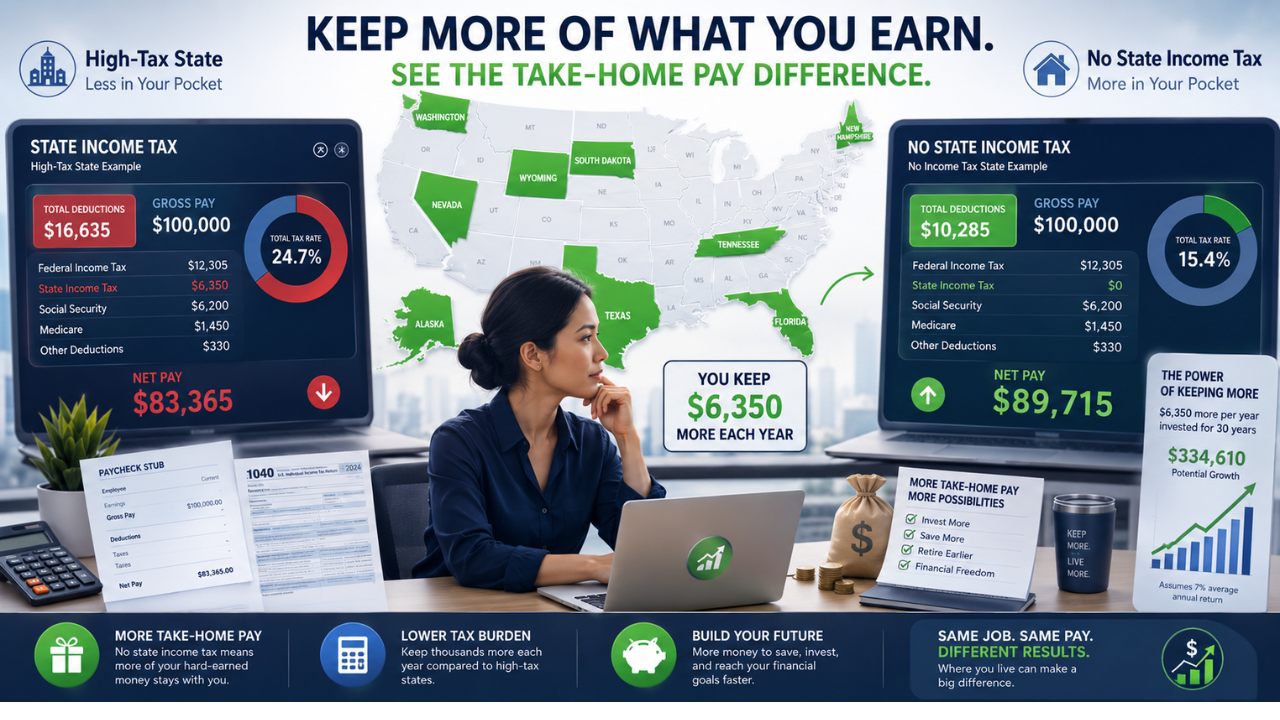
Understanding states with no income tax is one of the most powerful ways to take control of your financial future. Whether you are a remote worker exploring relocation, a retiree looking to stretch your savings, or a family trying to keep more of every paycheck, knowing which states do not tax earned income can help you make smarter money decisions. This guide explains everything you need to know — clearly, accurately, and based on official tax research.
Nine U.S. states currently do not impose a state-level individual income tax on wages. That means residents in those states get to keep more of their take-home pay each month. But there is more to the story. States without an income tax still need revenue to fund schools, roads, public safety, and other services. So they often rely on other types of taxes — like sales taxes, property taxes, and excise taxes — to fill the gap. According to the IRS, federal income taxes still apply to everyone regardless of where they live, and state tax policies vary widely across the country.
Table of Contents
- What Are States With No Income Tax?
- Which States Have No Income Tax?
- Complete List of No-Income-Tax States
- How States Without Income Tax Generate Revenue
- Federal vs State Income Taxes Explained
- Pros of Living in a No-Income-Tax State
- Cons of Living in a No-Income-Tax State
- How No State Income Tax Affects Your Paycheck
- Property Taxes vs Income Taxes
- Sales Taxes in No-Income-Tax States
- Best No-Income-Tax States for Retirees
- Best No-Income-Tax States for Remote Workers
- Cost of Living Considerations
- Should You Move to a No-Income-Tax State?
- Important Tax Considerations Before Relocating
- States With No Income Tax – FAQs
- Disclaimer
- Final Thoughts
What Are States With No Income Tax?
A state with no income tax is exactly what it sounds like: a U.S. state that does not levy a tax on the wages, salaries, tips, or other earned income of individuals who live or work there. When you receive your paycheck in one of these states, the state government does not take a cut. That is different from the federal government, which still collects federal income tax from every American worker regardless of where they live.
The Tax Foundation, a nonpartisan tax policy research organization, reports that individual income taxes account for roughly 33 percent of state tax collections nationwide. So when a state chooses not to impose an income tax, it must find other ways to fund its government operations. This usually means turning to sales taxes, property taxes, business taxes, and fees. Some states also benefit from natural resource revenues, such as oil and gas severance taxes.
It is important to understand that “no state income tax” does not mean “no taxes at all.” Residents of these states still pay federal income taxes to the IRS. They also pay Social Security and Medicare taxes. And depending on the state, they may face higher-than-average sales taxes or property taxes. Understanding these trade-offs is key to making an informed financial decision.
Which States Have No Income Tax?
As of 2026, nine U.S. states do not levy a broad-based individual income tax on wages and salaries. These no income tax states are spread across different regions of the country, each with its own unique approach to funding state government. Below is the complete list.
Complete List of No-Income-Tax States
| State | Income Tax Status | Avg. Sales Tax | Property Tax Level | Retirement Friendly | Cost of Living |
|---|---|---|---|---|---|
| Alaska | No income tax | No state sales tax (local up to ~1.82%) | Moderate–High | Yes (no tax on retirement income) | ~25% above national average |
| Florida | No income tax | 6.00% state + up to 2.5% local | Average (~0.74% effective) | Excellent (no tax on Social Security, pensions, 401(k), IRA) | ~3% above national average |
| Nevada | No income tax | 6.85% state (combined avg. 8.24%) | Low (one of the lowest nationally) | Yes (no tax on retirement income) | Near national average |
| New Hampshire | No income tax | No state sales tax | High (among the highest nationally) | Yes (no tax on wages or retirement income) | ~11% above national average |
| South Dakota | No income tax | 4.20% state (combined avg. 6.11%) | Average | Yes (no tax on retirement income) | ~8% below national average |
| Tennessee | No income tax | 7.00% state (combined avg. ~9.55%) | Low (one of the lowest nationally) | Excellent (no tax on Social Security, pensions, retirement accounts) | ~10% below national average |
| Texas | No income tax | 6.25% state (combined up to 8.25%) | High (1.36% effective, 7th highest nationally) | Yes (no tax on Social Security or retirement income) | ~8% below national average |
| Washington | No income tax* | 6.50% state (combined up to ~9.38%) | Average | Yes (no tax on retirement income; capital gains tax applies to high earners) | ~14% above national average |
| Wyoming | No income tax | 4.00% state (combined avg. ~5.36%) | Low | Yes (no tax on retirement income; ranked #1 retirement state in 2026) | Slightly below national average |
*Washington does not tax wage income but does impose a 7% capital gains tax on gains exceeding $262,000 per year, which may affect high-net-worth investors.
How States Without Income Tax Generate Revenue
A question people often ask is: how do no-income-tax states make money? The answer is that each state uses a different mix of revenue sources to fund government operations.
Six of the nine no-income-tax states collect more than half of their tax revenue from sales taxes. Florida, for example, derives about 64% of its tax revenue from sales taxes, driven heavily by tourism spending. Texas generates substantial revenue from oil and gas severance taxes alongside its sales tax. Nevada leans on gaming and hospitality taxes. Alaska and Wyoming benefit from natural resource extraction revenues. New Hampshire relies more on property taxes than any other no-income-tax state.
According to the Tax Foundation, states without an income tax often have higher-than-average sales tax rates or property tax rates compared to states that do impose an income tax. For instance, Tennessee has one of the highest combined state and local sales tax rates in the country at approximately 9.55%. Texas has the seventh-highest effective property tax rate in the nation at 1.36%.
Key Revenue Sources by State
Tourism & Sales Tax: Florida, Nevada
Natural Resources (Oil, Gas, Minerals): Alaska, Texas, Wyoming
Property Taxes: New Hampshire, Texas
Sales & Excise Taxes: South Dakota, Tennessee
No Sales Tax + Property Tax: New Hampshire (also no sales tax), Alaska (no state sales tax, local only)
Understanding how each state generates revenue helps explain why some no-income-tax states may feel more expensive than others when you factor in all the other taxes you pay.
Federal vs State Income Taxes Explained
One of the most common misunderstandings about moving to a state with no income tax is the idea that you stop paying taxes altogether. That is not the case. The difference between federal and state income taxes is critical to understand.
Federal income taxes are collected by the Internal Revenue Service (IRS) on behalf of the U.S. government. They apply to all U.S. citizens and residents regardless of which state they live in. Federal tax rates use a progressive bracket system, meaning the rate increases as your income rises. As of 2026, federal income tax brackets range from 10% to 37% depending on your taxable income and filing status. According to the IRS, you must file a federal tax return if your income exceeds certain thresholds, regardless of whether your state charges income tax.
State income taxes, by contrast, are collected by individual state revenue departments. Each state sets its own tax rates, brackets, deductions, and credits. Forty-two states levy some form of individual income tax. The nine states covered in this guide do not. But even within the nine no-income-tax states, you still file a federal return and pay federal taxes.
Quick Comparison
Federal Taxes: Paid by all Americans, collected by the IRS, fund national programs like defense, Social Security, and Medicare. Progressive bracket system (10%–37%).
State Taxes: Vary by state. Forty-two states charge income tax. Nine do not. State taxes fund schools, roads, public safety, and state-level programs. Rates and structures vary widely.
The IRS recommends that taxpayers understand both their federal and state obligations before making relocation decisions. Even if your new state does not charge income tax, you are still responsible for filing your federal return each year. You can learn more about federal tax rules directly at https://www.irs.gov/.
Pros of Living in a No-Income-Tax State
Pros
- Higher Take-Home Pay: Without state income tax withholding, each paycheck is larger. For a worker earning $75,000 per year, moving from a state with a 5% income tax rate to a no-income-tax state could save roughly $3,750 annually in state taxes alone.
- Retirement Tax Benefits: All nine no-income-tax states do not tax Social Security benefits, pension income, or retirement account withdrawals, making them especially attractive for retirees.
- Business-Friendly Climate: Several no-income-tax states also have low corporate taxes or no corporate income tax at all (Wyoming and South Dakota have no corporate income tax).
- Simpler Tax Filing: Fewer tax forms to file each year. Residents only need to file a federal return, reducing tax preparation time and cost.
- Economic Growth: States like Florida, Texas, and Tennessee have experienced strong population and job growth, partly driven by their tax-friendly reputations.
Cons
- Higher Sales Taxes: Tennessee (9.55% combined), Washington (up to 9.38%), and Nevada (8.24% combined) have some of the highest sales tax rates in the country.
- Higher Property Taxes: Texas and New Hampshire have property tax rates well above the national average, which can significantly impact homeowners.
- Higher Insurance Costs: Florida has the most expensive homeowners insurance in the U.S., averaging over $10,000 per year, driven by hurricane risk.
- Cost of Living Trade-Offs: Alaska and Washington have costs well above the national average, offsetting some of the tax savings.
- Public Service Impacts: Some no-income-tax states may spend less on education, infrastructure, or social services compared to higher-tax states.
How No State Income Tax Affects Your Paycheck
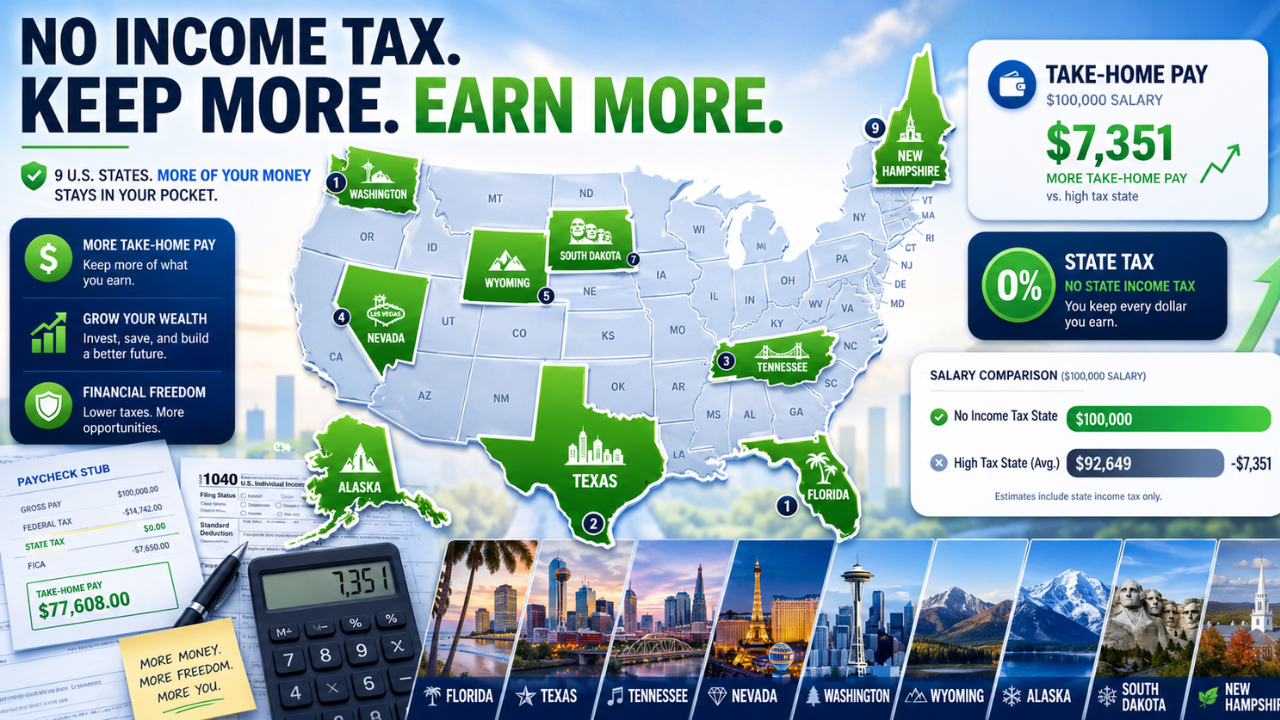
Your take-home pay — the amount actually deposited into your bank account after all deductions — is directly affected by where you live. In a state with no income tax, your employer does not withhold state income tax from your paycheck. That means more money lands in your account each pay period.
Here is a practical example. Suppose you earn a gross salary of $85,000 per year. If you live in California, which has a top marginal state income tax rate of 13.3% (though the effective rate for most earners is lower), you might pay around $4,000 to $5,000 in state income taxes annually. In a no-income-tax state like Texas or Florida, that state-level deduction simply does not exist. Over the course of a career, the savings can add up to tens of thousands of dollars.
See Your Real Take-Home Pay
Use our free paycheck calculator to compare your take-home pay across different states in seconds.
Calculate Your Paycheck NowHowever, it is important to remember that while state income tax withholding goes away, other deductions do not. Federal income tax, Social Security tax (6.2%), and Medicare tax (1.45%) are still withheld from every paycheck regardless of where you live. And if you live in a state with high sales taxes, you may end up paying more at the register, which can eat into the savings from having no state income tax.
Property Taxes vs Income Taxes: The Hidden Trade-Off
One of the most important tax trade-offs to understand when considering states without income tax is the relationship between property taxes and income taxes. States that forgo income tax revenue often generate a larger share of their budget from property taxes.
Texas is the most prominent example. The Lone Star State has no income tax, but its effective property tax rate of 1.36% ranks seventh highest in the nation. For a home valued at $350,000, that translates to approximately $4,760 in annual property taxes. New Hampshire has the third-highest property tax burden in the country, with per-capita property tax collections of $3,660, despite having neither an income tax nor a sales tax.
On the other end of the spectrum, Tennessee and Nevada have very low property tax rates. Tennessee's effective property tax rate is around 0.45%, one of the lowest in the U.S. Nevada also ranks among the lowest property tax states. For retirees or families looking to own a home without a heavy property tax burden, these states offer a double benefit: no income tax and low property taxes.
Property Tax at a Glance
Highest Property Taxes Among No-Income-Tax States: New Hampshire, Texas, Alaska
Lowest Property Taxes Among No-Income-Tax States: Tennessee, Nevada, Wyoming
Takeaway: If you plan to own a home, factor property taxes into your cost comparison. A state with no income tax but high property taxes may not save you as much as you expect.
Sales Taxes in No-Income-Tax States
Sales tax is another major consideration. Several no-income-tax states have above-average sales tax rates. Tennessee has the highest combined state and local sales tax rate among the nine at approximately 9.55%. Washington, Nevada, and Texas also have combined rates that can exceed 8% in many localities.
However, three no-income-tax states stand out for their sales tax policies. Alaska has no statewide sales tax, though some local municipalities may charge their own (the average combined rate is just 1.82%). New Hampshire has no state or local sales tax at all — making it the only state in the U.S. with neither an income tax nor a sales tax. And Oregon, while not a no-income-tax state, also has no sales tax, which is worth noting for comparison purposes.
For a household that spends a significant portion of its income on taxable goods and services, a high sales tax rate can offset a meaningful portion of the income tax savings. This is especially true for lower-income households, which tend to spend a larger percentage of their income on consumption.
Best No-Income-Tax States for Retirees
Retirees often have the most to gain from living in a no-income-tax state. Since all nine states do not tax Social Security benefits, pension income, or withdrawals from 401(k) plans and IRAs, retirees can preserve more of their nest egg. But some states stand out more than others when you consider the full picture — including cost of living, healthcare access, climate, and overall quality of life.
According to a 2026 study, Florida ranked as the top retirement destination among no-income-tax states. The Sunshine State offers no income tax, no estate tax, no inheritance tax, and no tax on Social Security, pensions, 401(k) plans, or IRA withdrawals. Combined with warm weather and a large number of retirement communities, it remains a perennial favorite.
Wyoming was ranked the number one state to retire in 2026 overall by one analysis, citing no personal income tax, the healthiest senior population, and strong Social Security income levels. Tennessee also scored highly for its low cost of living — roughly 10% below the national average — and excellent tax treatment of retirement income.
Florida
#1 Retirement State
No income tax, no estate tax, no tax on Social Security or pensions. Excellent healthcare access. Cost of living slightly above average.
Wyoming
#1 Healthiest Seniors
No income tax, no corporate tax, no estate tax. Low property taxes. Moderate cost of living. Best for health-conscious retirees.
Tennessee
Best Value
Cost of living ~10% below national average. No income tax. Low property taxes. Higher sales tax but overall affordability is excellent.
Nevada
Low Property Tax
No income tax, low property taxes. Warm, dry climate. Cost of living near national average. No tax on retirement income.
When evaluating the best states with no income tax for retirement, look beyond the tax rate alone. Consider housing costs, healthcare availability, climate preferences, and proximity to family. A state with no income tax but high housing costs and expensive healthcare may not be the financial win it first appears to be.
Best No-Income-Tax States for Remote Workers
Remote workers are in a unique position to benefit from no-income-tax states. If your employer allows you to work from anywhere, moving to a state with no income tax can instantly increase your take-home pay without requiring a raise or promotion.
According to tax guidance, as a remote worker, you must pay tax on all your income to the state you live in. If you live in one of the nine no-income-tax states, you generally do not owe state income tax on your wages — regardless of where your employer is headquartered. This is one of the clearest financial advantages of remote work.
However, there is an important caveat. Some states apply a “convenience of the employer” rule. If your employer is based in Arkansas, Connecticut, Delaware, Massachusetts, Nebraska, New York, or Pennsylvania, and you work remotely by choice rather than business necessity, your employer's state may still tax your income. In that scenario, moving to a no-income-tax state might not fully eliminate your state tax liability.
Remote Worker Tax Alert
Before relocating, check whether your employer is based in a state with a “convenience of the employer” rule. If so, you may still owe taxes to that state even if you live in a no-income-tax state. Consult a tax professional to understand your specific situation.
For remote workers seeking the best overall experience, New Hampshire offers a compelling combination: no income tax, no sales tax, and a high quality of life — though property taxes and housing costs are above average. Tennessee offers a low cost of living and no income tax, though its high sales tax may affect heavy spenders. Wyoming provides low taxes across the board and is especially attractive for self-employed remote workers and freelancers, as it also has no corporate income tax.
Cost of Living Considerations in No-Income-Tax States
Taxes are only one piece of the affordability puzzle. The overall cost of living — which includes housing, groceries, utilities, transportation, healthcare, and insurance — can vary dramatically among the nine no-income-tax states. In some cases, a high cost of living can completely offset the benefit of not paying state income tax.
As Andrey Yushkov, a senior policy analyst with the Tax Foundation's Center for State Tax Policy, explains: “The correlation between the cost of living and the absence of income tax in a state is relatively weak. Many other factors affect the cost of living, including property and sales taxes, excise taxes and home insurance. Therefore, the absence of income tax does not necessarily imply that it is cheaper for everyone to live there.”
Alaska, for example, has no state income tax and no statewide sales tax, giving it one of the lowest total tax burdens in the country. But its cost of living is approximately 25% above the national average, driven by high prices for groceries, utilities, transportation, and fuel. Washington has a cost of living about 14% above average. Meanwhile, Tennessee and South Dakota have costs 8–10% below the national average, making them the most affordable no-income-tax states overall.
Cost of Living Index (U.S. Average = 100)
Below Average: Tennessee (~90), South Dakota (~92), Texas (~92), Wyoming (~94)
Near Average: Nevada (~100), Florida (~103)
Above Average: New Hampshire (~111), Washington (~114), Alaska (~125)
Homeowners insurance is another major factor. Florida's average annual homeowners insurance premium exceeds $10,000, the highest in the nation. Texas averages around $4,789. By comparison, the national average is approximately $2,584. For homeowners on a fixed budget, these costs can be significant.
Compare Your Paycheck Across States
See exactly how much more take-home pay you could have by moving to a no-income-tax state. Our free calculator lets you compare your salary after taxes in all 50 states.
Calculate Your Take-Home PayShould You Move to a No-Income-Tax State?
Moving to a no-income-tax state can be a smart financial decision for many people, but it is not right for everyone. The decision should be based on your total financial picture, not just the absence of one tax.
Here are some questions to ask yourself before making the move:
- What is your current state income tax burden? If you live in a high-tax state like California, New York, or New Jersey, the savings from moving could be substantial. If you already live in a low-tax state, the difference may be smaller.
- Do you own a home or plan to buy one? Property taxes vary widely among no-income-tax states. If you are a homeowner, compare property tax rates carefully.
- How much do you spend on taxable goods and services? If you are a heavy consumer, a state with a high sales tax could offset some of your income tax savings.
- What is the cost of living in your target state? Housing, insurance, groceries, and transportation costs matter just as much as taxes.
- Are you a remote worker? If so, check whether your employer's state has a convenience rule that could still subject you to state income tax.
- Are you retired or nearing retirement? No-income-tax states are especially beneficial for retirees, as they do not tax Social Security, pensions, or retirement account withdrawals.
Important Tax Considerations Before Relocating
Relocating to a different state involves more than just packing boxes. State tax residency rules can be complex, and you want to make sure you are fully compliant with the tax laws of both your old state and your new state.
Residency and Domicile
Most states consider you a resident for tax purposes if you live there for more than 183 days (about six months) during the tax year. However, some states have stricter rules. Your domicile — the place you consider your permanent home — also matters. If you maintain a home in a high-tax state and spend significant time there, that state may still try to tax you as a resident. Keep detailed records of where you spend your time, and consult a tax professional if you have ties to multiple states.
According to the IRS, your federal tax obligations do not change based on which state you live in. You still file the same federal forms, and your federal tax liability is calculated based on your total income, regardless of where you earn it. State tax obligations, however, depend entirely on the specific rules of each state where you live and work.
Other considerations include:
- Part-Year Residency: If you move mid-year, you may need to file a part-year return in your old state and a part-year or full-year return in your new state.
- Reciprocity Agreements: Some neighboring states have agreements that simplify tax filing for cross-border commuters. Check whether such agreements exist between your old and new state.
- Estate and Inheritance Taxes: While all nine no-income-tax states have no estate or inheritance tax (except Washington, which has an estate tax), your previous state may still impose such taxes if you maintain ties there.
While you plan your finances, you might also find useful tools at FreeAiden, which offers free AI-powered utilities including QR code generators, barcode generators, PDF converters, image tools, and productivity resources — helpful for organizing your relocation paperwork and financial documents.
States With No Income Tax – FAQs
Which states have no income tax?
As of 2026, nine U.S. states have no state individual income tax: Alaska, Florida, Nevada, New Hampshire, South Dakota, Tennessee, Texas, Washington, and Wyoming. New Hampshire is the most recent addition, having repealed its tax on interest and dividend income effective January 1, 2025.
Is Florida a tax-free state?
Florida is a no-income-tax state, meaning it does not tax wages, salaries, Social Security benefits, pensions, or retirement account withdrawals. However, Florida does charge a 6% state sales tax (with local add-ons up to 2.5%), property taxes at an average effective rate of 0.74%, and a 5.5% corporate income tax. So while it is income-tax-free, it is not entirely tax-free.
Is Texas a no-income-tax state?
Yes, Texas has no state individual income tax. However, Texas has the seventh-highest effective property tax rate in the nation at 1.36%, and its combined state and local sales tax rate can reach 8.25%. Homeowners in Texas may pay significantly more in property taxes than they would in states with an income tax but lower property taxes.
Do no-income-tax states have higher sales taxes?
Several do. Tennessee has one of the highest combined sales tax rates in the U.S. at approximately 9.55%. Nevada's combined rate averages 8.24%, and Washington's can reach 9.38%. However, not all no-income-tax states have high sales taxes. Alaska and New Hampshire have no state sales tax at all, and Wyoming's combined rate averages around 5.36%.
Do you still pay federal taxes in states with no income tax?
Yes. Federal income taxes apply to all U.S. citizens and residents regardless of which state they live in. The IRS collects federal taxes based on your total income, and living in a no-income-tax state does not change your federal tax obligations. You must still file a federal tax return each year if your income exceeds the filing threshold.
Which state is best for retirees with no income tax?
The best no-income-tax state for retirees depends on personal priorities. Florida offers excellent healthcare access and a large retirement community, though housing and insurance costs are rising. Tennessee provides the best overall value with a cost of living about 10% below the national average. Wyoming ranks highly for senior health and low taxes. Nevada offers low property taxes and a warm climate. All nine states do not tax Social Security, pensions, or retirement account withdrawals.
Is Texas good for remote workers?
Texas can be an excellent choice for remote workers because of no state income tax and a cost of living about 8% below the national average. However, remote workers should be aware of Texas's high property taxes if they plan to buy a home. Renters, on the other hand, can enjoy the full benefit of no income tax without the property tax burden. Also check whether your employer's state has a convenience rule that could still subject you to state income tax.
Can moving to a no-income-tax state lower your taxes?
Yes, moving to a no-income-tax state can significantly lower your overall tax burden, especially if you are moving from a high-tax state like California, New York, or New Jersey. However, the actual savings depend on your income level, spending habits, homeownership status, and the specific state you choose. A comprehensive comparison of all taxes and costs — not just income tax — is essential before making the move.
Are no-income-tax states cheaper to live in?
Not necessarily. While some no-income-tax states like Tennessee and South Dakota have below-average costs of living, others like Alaska and Washington are significantly more expensive than the national average. Housing costs, insurance rates, utility expenses, and everyday prices can vary dramatically. A state with no income tax is not automatically a cheaper place to live.
What is the difference between a state with no income tax and a tax-free state?
A state with no income tax does not tax earned wages, but it still imposes other taxes such as sales tax, property tax, and excise taxes. A truly “tax-free” state does not exist in the U.S. Every state collects some form of tax revenue. Even Alaska, which has no income tax and no statewide sales tax, still collects property taxes and corporate taxes. The term “tax-free state” is often used loosely and can be misleading.
Disclaimer
This article is for educational and informational purposes only. Tax situations vary based on individual circumstances, and state tax laws are subject to change. The information provided here is not legal advice or tax advice. Readers should verify details directly with state tax agencies, the IRS, or a qualified tax professional before making financial or relocation decisions. Always consult the official IRS website at https://www.irs.gov/ and your state's department of revenue for the most current guidance.
Final Thoughts
Understanding states with no income tax is about more than just knowing which nine states make the list. It is about seeing the full financial picture: how each state funds its government, what other taxes you will pay, how much it costs to live there, and whether the move makes sense for your specific situation.
For many people, living in a no-income-tax state is a genuine financial advantage. Retirees can protect their Social Security benefits and retirement withdrawals. Remote workers can increase their take-home pay overnight. Families can redirect tax savings toward savings, investments, or daily expenses. But the savings are not automatic, and the trade-offs — in the form of sales taxes, property taxes, and cost of living differences — deserve careful attention.
Before you make any decision, run the numbers. Use a paycheck calculator to see exactly how your take-home pay would change. Compare housing costs, insurance rates, and everyday expenses in your target state. And when in doubt, speak with a qualified tax professional who can help you navigate residency rules and multi-state tax obligations.
Making an informed choice about where to live is one of the most impactful financial decisions you can make. With the right information, you can find the balance between low taxes, affordable living, and a high quality of life that works for you.
Ready to See Your Numbers?
Use our free salary after taxes calculator to compare your take-home pay in any state — including all nine no-income-tax states.
Calculate Your Salary After Taxes