

Form 1120: U.S. Corporation Income Tax Return Explained
Filing corporate taxes can feel overwhelming, especially if your business just incorporated or switched to C corporation status. Form 1120 is the official IRS return that C corporations use to report income, claim deductions and credits, and calculate the tax owed. This guide walks through every important part of the form using plain language and practical examples. This guide is based on official IRS Form 1120 instructions and educational tax resources. Whether you are preparing the return yourself or working with a tax professional, understanding the form helps you catch errors, meet deadlines, and avoid costly penalties.
Table of Contents
- What Is Form 1120?
- Who Must File Form 1120?
- Who Does Not File Form 1120?
- What Information Is Reported?
- Filing Deadlines
- Form 7004 Extension
- Corporate Tax Rates
- How to Complete Form 1120 Step-by-Step
- Income Section Explained
- Deductions Explained
- Tax and Payments Section
- Schedule K Overview
- Schedule L Overview
- Schedule M-1 and M-2 Explained
- Estimated Tax Payments
- Electronic Filing Requirements
- Common Filing Mistakes
- Penalties for Late Filing
- Form 1120 vs Form 1120-S
- Form 1120 FAQs
What Is Form 1120?
Form 1120 is the tax return specifically designed for C corporations in the United States. A C corporation is a legal business structure that pays income tax at the corporate level, separate from its owners or shareholders. When the corporation earns a profit, it reports that income on Form 1120 and pays tax directly to the IRS. If the corporation later distributes dividends to shareholders, those dividends get taxed again on the shareholders' personal returns. This is the well-known double taxation feature of C corporations.
The form itself is eight pages long and includes several schedules that dig into the corporation's financial details. Schedule K asks for other information about the business. Schedule L requires balance sheet data. Schedules M-1 and M-2 reconcile book income with tax income and track retained earnings. According to IRS guidance, every domestic C corporation must file Form 1120, even if it had no income or was inactive during the year.
Think of Form 1120 as the corporate equivalent of an individual's Form 1040. Just as individuals report wages, deductions, and credits, corporations report gross receipts, cost of goods sold, officer compensation, depreciation, and dozens of other line items that determine the final tax bill.
Who Must File Form 1120?
The IRS requires every domestic C corporation to file Form 1120 annually. This includes corporations that were formed under state law and elected to be taxed as C corporations, or that defaulted to C corporation status because no other election was made. The filing requirement applies even if the corporation had zero income, operated at a loss, or remained entirely inactive throughout the tax year.
Foreign corporations that conduct business in the United States may also need to file Form 1120-F, which is a separate but related return. However, if a foreign corporation has effectively connected income with a U.S. trade or business, it generally files Form 1120-F rather than the standard Form 1120.
Here is a quick checklist of entities that must file Form 1120:
- Domestic C corporations with any amount of gross income.
- C corporations with no income but still in existence at year-end.
- Corporations that liquidated or dissolved during the tax year.
- Certain foreign-owned domestic corporations with reportable transactions.
- Corporations with a fiscal year that ended during the calendar year.
If your business incorporated in Delaware, Nevada, Wyoming, or any other state and did not elect S corporation status by filing Form 2553, you are almost certainly a C corporation and must file Form 1120.
Who Does Not File Form 1120?
Several types of businesses do not file Form 1120 because they are taxed under different rules. S corporations file Form 1120-S. Partnerships and multi-member LLCs taxed as partnerships file Form 1065. Sole proprietors and single-member LLCs report business income on Schedule C attached to the owner's Form 1040. Nonprofit organizations that have tax-exempt status file Form 990 or 990-EZ.
This distinction matters because filing the wrong form can cause processing delays, incorrect tax calculations, and even penalties. If you recently formed an LLC and did not elect corporate tax treatment, you do not file Form 1120. Instead, you follow the default partnership or sole proprietorship rules.
What Information Is Reported on Form 1120?
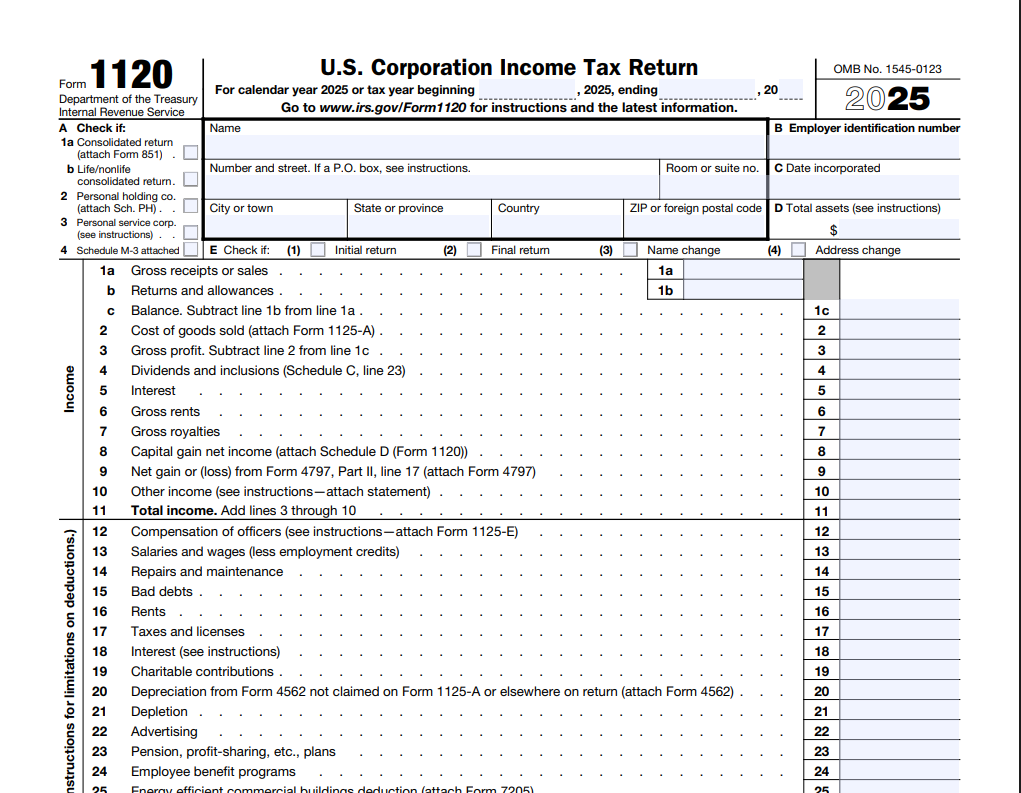
Form 1120 captures nearly every financial aspect of a corporation's operations during the tax year. Page 1 focuses on income and deductions. The corporation reports gross receipts or sales, cost of goods sold, dividends, interest income, rental income, capital gains, and other revenue sources. From total income, the corporation subtracts deductions such as officer compensation, salaries and wages, repairs, bad debts, rent, taxes, depreciation, advertising, and employee benefit programs.
Page 2 continues with the tax calculation. After determining taxable income, the corporation applies the corporate tax rate, subtracts any credits, and arrives at the total tax due. The form also accounts for estimated tax payments already made, any overpayment applied from the prior year, and the final balance owed or refund due.
The supporting schedules dig deeper. Schedule K asks yes-or-no questions about the corporation's activities, ownership, and transactions. Schedule L presents the corporation's balance sheet at the beginning and end of the tax year. Schedules M-1 and M-2 explain differences between financial statement income and taxable income, and show how retained earnings changed during the year.
Filing Deadlines
For calendar-year C corporations, Form 1120 is due on April 15 of the year following the tax year. For the 2026 tax year, the due date is April 15, 2026, since April 15 falls on a Wednesday. If April 15 lands on a weekend or federal holiday, the deadline shifts to the next business day.
Corporations using a fiscal year that ends on a date other than December 31 must file by the 15th day of the fourth month after the close of their tax year. For example, a corporation with a fiscal year ending June 30, 2026, must file Form 1120 by October 15, 2026.
Meeting the filing deadline is critical. The IRS imposes significant penalties for late filing, and interest accrues on any unpaid tax from the original due date. Even if your corporation cannot pay the full tax owed, filing on time reduces the penalty exposure substantially.
Form 7004 Extension
Corporations that need more time to prepare Form 1120 can request an automatic six-month extension by filing Form 7004. For a calendar-year corporation, this extends the filing deadline to October 15. Filing Form 7004 is straightforward, but it only extends the time to file, not the time to pay. The corporation must estimate and pay any tax owed by the original due date to avoid interest and late payment penalties.
According to IRS guidance, Form 7004 must be filed by the original due date of Form 1120. The extension is automatic, meaning the IRS does not send an approval notice. If the IRS rejects the extension request, it will notify the corporation. Most corporations that file Form 7004 correctly receive the full six-month extension without issue.
Corporate Tax Rates
Under current law, C corporations pay a flat 21% federal tax rate on taxable income. This flat rate applies regardless of how much or how little the corporation earns. Before 2018, corporations faced a graduated rate structure with brackets ranging from 15% to 35%. The Tax Cuts and Jobs Act replaced those brackets with the single 21% rate, which remains in effect for 2026 and beyond unless Congress passes new legislation.
The flat rate simplifies tax planning but also means that even a small corporation with modest profits pays the same marginal rate as a large multinational. There is no zero-percent bracket and no preferential rate for long-term capital gains at the corporate level. All income, including capital gains, is taxed at 21%.
Corporations also need to consider state corporate income taxes, which vary widely. Some states impose rates above 9%, while others have no corporate income tax at all. State taxes are generally deductible on Form 1120 as a business expense, reducing federal taxable income.
How to Complete Form 1120 Step-by-Step
Completing Form 1120 accurately requires gathering your corporation's financial records, including the income statement, balance sheet, general ledger, and supporting schedules for depreciation, amortization, and payroll. The form follows a logical flow that mirrors a standard income statement, moving from revenue to deductions to taxable income and finally to the tax calculation.
Before writing a single number, confirm that you have the correct version of Form 1120 for the tax year. The IRS updates the form annually, and using an outdated version can cause processing delays. Download the latest form directly from the IRS website. Also verify the corporation's employer identification number, legal name, and address. A mismatch between the return and IRS records is a common trigger for correspondence audits.
Income Section Explained
Lines 1 through 11 on page 1 of Form 1120 capture all sources of corporate income. Line 1a asks for gross receipts or sales. This is the total revenue from the corporation's primary business activities before subtracting returns and allowances. Line 1b reports returns and allowances, which reduce gross receipts to arrive at net sales.
Line 2 covers cost of goods sold. Corporations that produce, manufacture, or resell products must complete Form 1125-A and attach it to the return. The cost of goods sold includes direct materials, direct labor, and overhead costs allocable to producing the goods sold during the year. Subtracting cost of goods sold from net sales yields gross profit on line 3.
Lines 4 through 10 capture other income streams such as dividends, interest, gross rents, gross royalties, capital gains net income, and net gain from Form 4797. Line 11 totals all income items. Every entry on these lines should tie back to the corporation's accounting records. Discrepancies between the return and the books often prompt IRS inquiries.
Deductions Explained
Lines 12 through 29 on Form 1120 list allowable business deductions that reduce total income to arrive at taxable income. Each deduction must be ordinary and necessary for the corporation's trade or business. Common deductions include officer compensation on line 12, salaries and wages for non-officer employees on line 13, and repairs and maintenance on line 14.
Bad debts on line 15 require specific accounting treatment. The corporation can deduct business bad debts that became partially or wholly worthless during the tax year, but it must substantiate the deduction with documentation. Line 16 covers rents paid for business property, and line 17 reports taxes and licenses paid to state and local governments. Federal income tax is not deductible, but state income taxes, property taxes, and payroll taxes generally are.
Line 20 reports depreciation expense calculated on Form 4562. Corporations that placed significant assets in service during the year may also qualify for Section 179 expensing or bonus depreciation. Line 22 covers advertising, line 23 handles employee benefit programs including health insurance and retirement contributions, and line 26 reports pension and profit-sharing plan contributions. Each deduction category has specific IRS rules, so reviewing the instructions for each line prevents errors that could trigger an audit.
Tax and Payments Section
After subtracting total deductions from total income, line 30 shows taxable income before any net operating loss deduction or special deductions. The corporation then applies the 21% tax rate on page 2 to calculate the tentative tax. From this amount, the corporation subtracts any credits such as the general business credit, foreign tax credit, or prior year minimum tax credit.
The payments section on lines 31 through 33 accounts for estimated tax payments made during the year, any overpayment applied from the prior year's return, and amounts paid with Form 7004 extension requests. If total payments exceed the tax due, the corporation can request a refund on line 34 or apply the overpayment to the next year's estimated tax on line 35.
If the tax due exceeds total payments, line 36 shows the balance owed. The IRS charges interest on unpaid balances from the original due date, even if the corporation filed an extension. Paying as much as possible by the original deadline minimizes interest costs.
Schedule K Overview
Schedule K asks a series of questions about the corporation's structure, activities, and transactions during the tax year. The questions cover topics such as whether the corporation owns 50% or more of a foreign corporation, whether it made payments that require Form 1099 filing, and whether it has a captive insurance arrangement. Answering these questions accurately is important because they help the IRS identify potential compliance issues.
Many Schedule K questions are straightforward yes-or-no inquiries. Others require the corporation to attach additional forms or schedules if the answer is yes. For example, if the corporation answers yes to owning a foreign corporation, it may need to file Form 5471. Skipping Schedule K or answering incorrectly can lead to correspondence from the IRS requesting clarification.
Schedule L Overview
Schedule L presents the corporation's balance sheet at the beginning and end of the tax year. It includes assets such as cash, accounts receivable, inventory, and fixed assets on the left side, and liabilities and equity such as accounts payable, loans, capital stock, and retained earnings on the right side. The balance sheet must align with the corporation's financial statements and accounting records.
The IRS uses Schedule L to assess the corporation's financial position and to cross-check items reported elsewhere on the return. A large increase in loans to shareholders, for example, may indicate a constructive dividend that requires additional reporting. Corporations with total assets under $10 million may qualify for simplified Schedule L reporting, but all corporations should maintain accurate balance sheet records throughout the year.
Schedule M-1 and M-2 Explained
Schedule M-1 reconciles the corporation's financial statement net income with its taxable income. Many items that appear on the income statement are treated differently for tax purposes. For instance, municipal bond interest is included in book income but excluded from taxable income. Depreciation calculated under GAAP often differs from MACRS depreciation used for tax reporting. Schedule M-1 bridges these gaps.
Schedule M-2 tracks the corporation's unappropriated retained earnings. It shows the beginning balance, net income per books, dividend distributions, and other adjustments that result in the ending retained earnings balance. This schedule helps the IRS verify that the corporation properly accounted for distributions to shareholders and that the retained earnings figure on Schedule L is consistent.
Estimated Tax Payments
C corporations that expect to owe $500 or more in tax for the year must make quarterly estimated tax payments. These payments are due on the 15th day of the 4th, 6th, 9th, and 12th months of the corporation's tax year. For a calendar-year corporation, the due dates are April 15, June 15, September 15, and December 15. Each payment should equal 25% of the required annual payment, which is the smaller of 100% of the current year's tax or 100% of the prior year's tax (provided the prior year return covered 12 months).
Corporations use Form 1120-W as a worksheet to calculate estimated tax. The actual payments are made electronically through the Electronic Federal Tax Payment System. Missing an estimated payment or underpaying triggers the underpayment penalty, which the IRS calculates on Form 2220. Even if the corporation eventually pays the full tax by the filing deadline, the underpayment penalty can add up if quarterly payments were insufficient.
Electronic Filing Requirements
The IRS mandates electronic filing for corporations that file 10 or more returns of any type during the calendar year. This includes Form 1120, employment tax returns, information returns, and excise tax returns. The 10-return threshold applies in the aggregate, so a corporation that files quarterly payroll returns and a few 1099 forms may quickly exceed the limit.
Corporations subject to the e-file requirement must use IRS-approved software or work with an authorized e-file provider. Paper filing when e-filing is required can result in penalties. Even corporations below the threshold benefit from e-filing because it reduces processing time, provides immediate confirmation of receipt, and minimizes data entry errors. The IRS encourages all corporations to e-file regardless of the mandate.
Common Filing Mistakes
Filing Form 1120 correctly requires attention to detail across multiple schedules and calculations. One frequent mistake is entering the wrong employer identification number or corporate name, which causes the IRS to reject the return or misapply payments. Another is failing to sign and date the return. An unsigned Form 1120 is considered incomplete and may be treated as not filed.
Math errors in the income or deduction totals are surprisingly common, especially when numbers are transferred from supporting schedules. Corporations also forget to attach required schedules such as Form 1125-A for cost of goods sold or Form 4562 for depreciation. The Schedule M-1 reconciliation is another trouble spot. When book income and taxable income do not tie out with clear explanations, the IRS may flag the return for review.
Other common mistakes include misclassifying workers as independent contractors, overlooking state tax deductions, failing to report foreign bank accounts, and not making required estimated tax payments. A thorough review of the completed return against the corporation's financial statements catches most of these issues before filing.
Penalties for Late Filing or Payment
The IRS imposes a failure-to-file penalty of 5% of the unpaid tax for each month or partial month the return is late, up to a maximum of 25%. If the return is more than 60 days late, a minimum penalty applies. The failure-to-pay penalty is 0.5% of the unpaid tax per month, also capped at 25%. When both penalties apply in the same month, the failure-to-file penalty is reduced by the failure-to-pay amount.
Interest compounds daily on any unpaid tax from the original due date until the balance is paid in full. The IRS sets the interest rate quarterly based on federal short-term rates. Accuracy-related penalties of 20% may apply if the corporation substantially understates its tax liability or claims deductions without reasonable basis. Filing on time, paying as much as possible by the deadline, and maintaining strong documentation are the best defenses against these penalties.
Form 1120 vs Form 1120-S and Other Business Returns
Understanding how Form 1120 differs from other business tax returns helps business owners choose the right entity structure and file correctly. The table below compares Form 1120 with the other major business tax forms.
| Feature | Form 1120 (C Corp) | Form 1120-S (S Corp) | Form 1065 (Partnership) | Schedule C (Sole Prop) |
|---|---|---|---|---|
| Taxation level | Entity level (21% flat) | Pass-through to shareholders | Pass-through to partners | Individual owner's 1040 |
| Double taxation | Yes (corporate + dividend tax) | No | No | No |
| Due date | 4th month after year-end | 3rd month after year-end | 3rd month after year-end | April 15 with 1040 |
| Owner limit | No limit | 100 shareholders max | No limit | One owner |
| Estimated tax threshold | $500 or more expected tax | Shareholder-level estimates | Partner-level estimates | Individual estimated tax rules |
Choosing between a C corporation and an S corporation involves weighing the benefits of retained earnings and unlimited shareholders against the cost of double taxation. Many small businesses start as S corporations or LLCs to avoid entity-level tax, then convert to C corporation status if they seek venture capital funding or plan to reinvest profits substantially.
Plan Your Corporate Tax Strategy
Understanding how corporate taxes affect your bottom line starts with knowing your numbers. Use a reliable paycheck calculator to estimate officer compensation and see how salary decisions impact both the corporation and individual tax obligations. A clear picture of your salary after taxes helps you set reasonable compensation that satisfies IRS reasonable salary requirements.
Calculate Your Take-Home PayDownload Form 1120
Access the official Form 1120 directly from the IRS website. Review the official IRS instructions before completing or submitting your return.
Download IRS Form 1120 (PDF)Always use the current tax year version of Form 1120. Prior-year forms may not reflect updated tax law changes.
Form 1120: U.S. Corporation Income Tax Return Explained – FAQs
Do I need to file Form 1120 if my corporation had no income?
Yes. The IRS requires every domestic C corporation to file Form 1120 annually, even if it had zero gross receipts or was inactive. Filing the return confirms the corporation's status and prevents the IRS from assuming the entity dissolved or abandoned its filing obligation.
What is the corporate tax rate for 2026?
The federal corporate income tax rate is a flat 21% on all taxable income for C corporations. This rate applies regardless of the corporation's income level. State corporate taxes are additional and vary by jurisdiction.
Can I file Form 1120 electronically?
Yes. Corporations that file 10 or more returns annually must e-file. Even if you are below the threshold, e-filing is strongly encouraged because it speeds processing, confirms receipt, and reduces errors. Most tax preparation software supports corporate e-filing.
How is Form 1120 different from Form 1120-S?
Form 1120 is for C corporations that pay tax at the entity level. Form 1120-S is for S corporations that pass income, deductions, and credits through to shareholders. S corporations generally do not pay federal income tax at the corporate level.
What happens if I miss the Form 1120 filing deadline?
Late filing triggers a penalty of 5% of the unpaid tax per month, up to 25%. Interest also accrues on any unpaid balance. Filing as soon as possible, even if you cannot pay in full, reduces ongoing penalty accumulation.
Do C corporations pay estimated taxes?
Yes. Corporations expecting to owe $500 or more in tax must make quarterly estimated payments. The due dates fall on the 15th of the 4th, 6th, 9th, and 12th months of the tax year. Underpayment results in a penalty calculated on Form 2220.
Is Schedule L required for all corporations?
Most corporations must complete Schedule L to report balance sheet information. Corporations with total assets under $10 million may qualify for simplified reporting. Check the current-year Form 1120 instructions for specific filing thresholds.
What records should I keep after filing Form 1120?
Keep copies of the filed return, all supporting schedules, financial statements, general ledgers, depreciation records, and documentation for deductions claimed. The IRS generally recommends retaining tax records for at least seven years.
Can I deduct state income taxes on Form 1120?
Yes. State and local income taxes paid by the corporation are deductible as a business expense on line 17 of Form 1120. Federal income taxes are not deductible. Properly tracking state tax payments throughout the year ensures you claim the full deduction.
Before You Submit Form 1120
Filing Form 1120 correctly starts with organized records and a clear understanding of your corporation's financial picture. Before you submit the return, verify every number against your financial statements. Confirm that the employer identification number and corporate name match IRS records exactly. Double-check that all required schedules are attached, including Form 1125-A if you reported cost of goods sold and Form 4562 for depreciation.
Make sure the return is signed and dated by an authorized corporate officer. An unsigned return creates unnecessary delays and potential penalty exposure. If the corporation owes tax, arrange payment through EFTPS or include a check with the appropriate voucher. Even if you cannot pay the full amount, filing on time protects the corporation from the steeper failure-to-file penalty.
Keep a complete copy of the filed return and all supporting workpapers. Good recordkeeping supports future tax planning, makes amended returns easier, and provides documentation if the IRS ever selects the return for examination. For ongoing tax planning, use a paycheck calculator to model officer compensation and understand how salary decisions ripple through both corporate and personal tax obligations.