

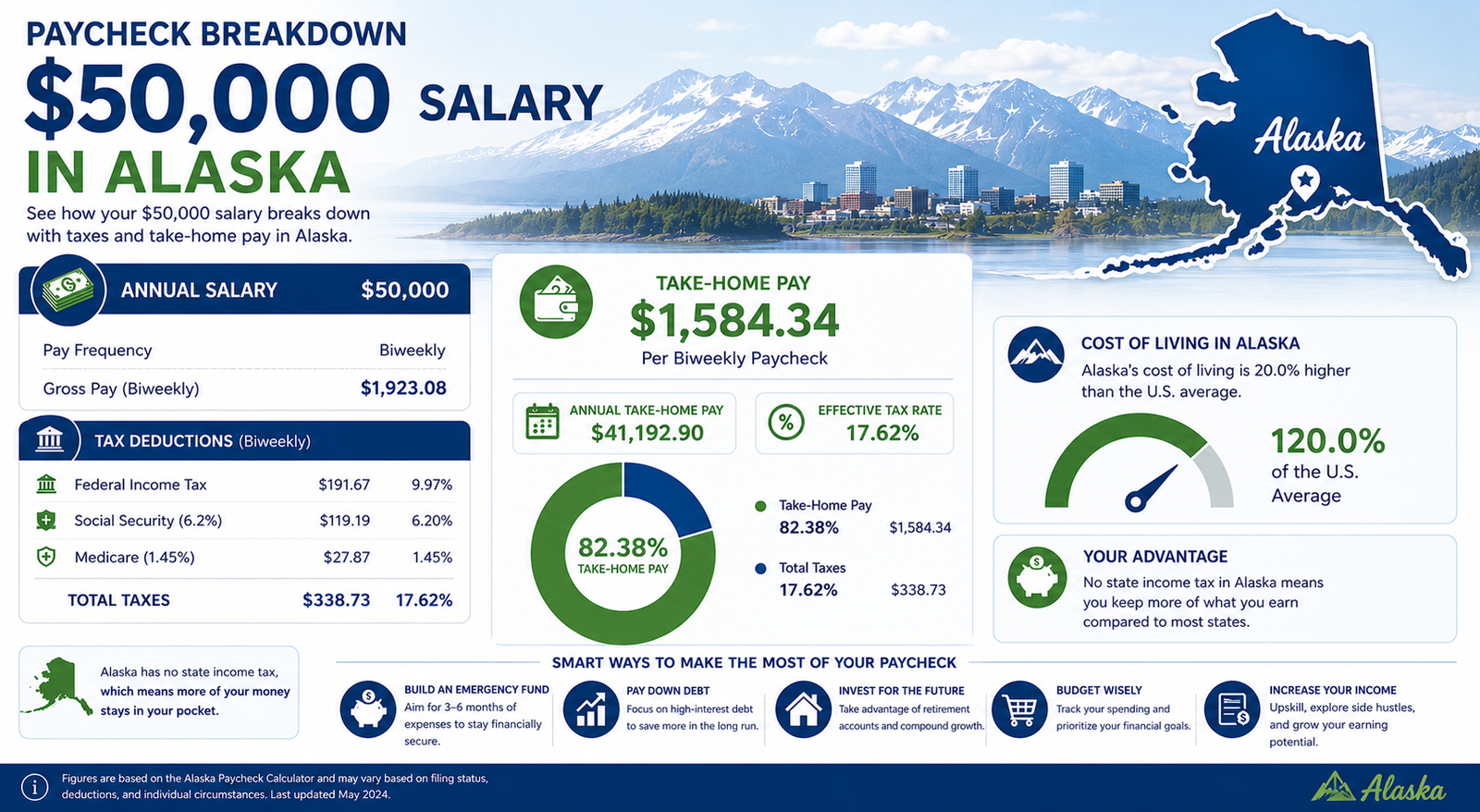
$50,000 Salary After Tax in Alaska (2026 Guide)
If you're earning a $50,000 salary in Alaska, knowing your true take-home pay is essential for budgeting, planning a move, or evaluating a job offer. Alaska is one of the few states with no state income tax, which means more of your paycheck stays in your pocket compared to most other states. But how much exactly do you keep after federal taxes and FICA? And is $50,000 a good salary in Alaska given the higher cost of living in cities like Anchorage, Fairbanks, and Juneau? This comprehensive 2026 guide answers all those questions.
All calculations in this guide are based on our Alaska paycheck calculator. We use official IRS tax data and the latest FICA rates to ensure accuracy. No estimates, no guesses—just real numbers you can trust.
Overview: What $50,000 Means in Alaska
Alaska stands apart from most U.S. states in one crucial way: it has no state income tax. In fact, Alaska is one of only nine states that do not tax wage income at the state level. This means that when you earn a $50,000 salary in Alaska, your only deductions are federal income tax, Social Security, and Medicare. There are no additional state or local income taxes to worry about—a significant advantage for residents of Anchorage, Fairbanks, Juneau, and rural communities alike.
However, Alaska also has a higher cost of living than the national average. Groceries, utilities, and transportation can be more expensive—especially in remote areas where goods must be flown or barged in. That's why understanding exactly how much you take home is the first step toward building a realistic budget.
🏔️ Alaska Tax Snapshot (2026)
✅ State Income Tax: None
✅ Local Income Tax: None
✅ Federal Income Tax: Applies (progressive brackets)
✅ FICA: 7.65% total (6.2% Social Security + 1.45% Medicare)
✅ PFD (Permanent Fund Dividend): Annual payment to eligible residents (varies yearly, typically $1,000–$2,000+)
$50,000 Salary After Tax in Alaska: The Numbers
Using our Alaska paycheck calculator, here is the complete breakdown of a $50,000 gross salary for a single filer in 2026. These figures assume standard deductions and no additional withholdings.
| Pay Frequency | Gross Pay | Federal Tax | Social Security | Medicare | Take-Home Pay |
|---|---|---|---|---|---|
| Annual | $50,000.00 | $3,961.50 | $3,100.00 | $725.00 | $42,213.50 |
| Monthly | $4,166.67 | $330.13 | $258.33 | $60.42 | $3,517.79 |
| Biweekly | $1,923.08 | $152.37 | $119.23 | $27.88 | $1,623.60 |
| Weekly | $961.54 | $76.18 | $59.62 | $13.94 | $811.80 |
📌 All calculations in this guide are based on our Alaska paycheck calculator. Figures assume a single filing status with the standard deduction for 2026. Your actual take-home pay may vary based on personal deductions, 401(k) contributions, health insurance premiums, and other factors.
Federal Tax Breakdown on $50,000 in Alaska
Even though Alaska doesn't impose a state income tax, you're still responsible for federal taxes. Here's how the IRS calculates your federal income tax on a $50,000 salary:
First, the standard deduction reduces your taxable income. For a single filer in 2026, the standard deduction is approximately $15,000. That brings your taxable income down to about $35,000. Then, the progressive federal tax brackets apply:
- 10% bracket: First ~$11,925 of taxable income → $1,192.50
- 12% bracket: Remaining ~$23,075 of taxable income → $2,769.00
- Total federal income tax: ~$3,961.50
On top of federal income tax, FICA taxes (Social Security at 6.2% and Medicare at 1.45%) are applied to your entire gross salary—no deductions reduce these. That's another $3,825. So total taxes on a $50,000 salary in Alaska come to about $7,786.50, leaving you with approximately $42,213.50 in take-home pay.
- Take-Home Pay: $42,214 (84.4%)
- Federal Income Tax: $3,962 (7.9%)
- FICA (SS + Medicare): $3,825 (7.7%)
Detailed Tax Table for $50,000 in Alaska (2026)
| Tax Category | Amount | % of Gross | Notes |
|---|---|---|---|
| Gross Salary | $50,000.00 | 100% | Annual pre-tax earnings |
| Standard Deduction (est.) | -$15,000.00 | — | Reduces taxable income |
| Taxable Income | $35,000.00 | 70% | After standard deduction |
| Federal Income Tax | $3,961.50 | 7.92% | 10% + 12% brackets |
| Social Security | $3,100.00 | 6.20% | Flat rate on gross |
| Medicare | $725.00 | 1.45% | Flat rate on gross |
| Alaska State Tax | $0.00 | 0% | No state income tax |
| Total Taxes | $7,786.50 | 15.57% | Effective tax rate |
| Take-Home Pay | $42,213.50 | 84.43% | What you actually keep |
Free, instant results tailored to your exact salary and filing status.
Can You Live Comfortably in Alaska on $50K?
With a monthly take-home pay of approximately $3,518, living in Alaska is achievable—but it requires smart budgeting. Alaska's cost of living runs about 25–30% higher than the national average, with housing in Anchorage being particularly expensive. Groceries cost more due to shipping, and heating bills spike during the long winters. However, the Permanent Fund Dividend (PFD) can add a helpful annual bonus for eligible residents.
Below is a realistic monthly budget for a single person earning $50,000 in Alaska, adjusted for the state's unique expenses. This budget assumes you live in Anchorage or Fairbanks—costs in Juneau or remote villages may be even higher.
Alaska-Adjusted Monthly Budget on $3,518 Take-Home Pay
| Expense Category | Monthly Amount | % of Take-Home | Alaska-Specific Notes |
|---|---|---|---|
| 🏠 Rent (1BR, Anchorage) | $1,350 | 38.4% | Higher in Juneau; lower in Fairbanks suburbs |
| 🛒 Groceries | $520 | 14.8% | ~20% above national average |
| ⚡ Utilities & Heating | $280 | 8.0% | Winter heating costs spike significantly |
| 🚗 Transportation | $220 | 6.3% | Gas prices higher; remote travel costly |
| 🏥 Healthcare | $160 | 4.5% | Includes insurance premiums & copays |
| 📱 Phone & Internet | $130 | 3.7% | Limited competition in rural areas |
| 💰 Savings & Emergency | $350 | 9.9% | Recommended for winter emergencies |
| 🎉 Discretionary | $508 | 14.4% | Entertainment, dining, recreation |
| Total | $3,518 | 100% | Breakeven monthly budget |
As you can see, $50,000 is a livable salary in Alaska, but it doesn't leave enormous room for luxury. The PFD—if you qualify—can provide a nice annual cushion. Many Alaskans also save on heating by using wood stoves or taking advantage of energy assistance programs.
How Alaska Compares to Other States
One of the biggest financial perks of living in Alaska is the absence of state income tax. To illustrate how much this matters, let's compare the take-home pay on a $50,000 salary across several states. States like California, Oregon, and New York impose significant state income taxes that reduce your net pay by thousands of dollars each year.
State-by-State Take-Home Pay Comparison Table
| State | Gross Salary | State Tax | Federal + FICA | Take-Home Pay | vs. Alaska |
|---|---|---|---|---|---|
| Alaska | $50,000 | $0 | $7,787 | $42,214 | — |
| Texas | $50,000 | $0 | $7,787 | $42,214 | $0 |
| Florida | $50,000 | $0 | $7,787 | $42,214 | $0 |
| Washington | $50,000 | $0 | $7,787 | $42,214 | $0 |
| California | $50,000 | ~$2,464 | $7,787 | ~$39,750 | -$2,464 |
| Oregon | $50,000 | ~$3,314 | $7,787 | ~$38,900 | -$3,314 |
| New York | $50,000 | ~$2,914 | $7,787 | ~$39,300 | -$2,914 |
As the chart and table show, Alaska ties with Texas, Florida, and Washington for the highest take-home pay on a $50,000 salary. Moving to California could cost you an extra $2,400+ per year in state taxes alone. Oregon's high income tax rates make it even more expensive for wage earners.
Is $50,000 a Good Salary in Alaska?
The short answer: Yes, $50,000 is a decent salary in Alaska—especially for a single person without dependents. However, "good" depends heavily on where in Alaska you live. Let's break it down by city:
📍 Anchorage
Anchorage is Alaska's largest city and has the most job opportunities. A $50,000 salary is moderate but manageable. Rent for a one-bedroom averages $1,200–$1,500/month. With careful budgeting, you can live comfortably, save for retirement, and enjoy the city's amenities. The PFD helps offset higher grocery and utility costs.
📍 Fairbanks
Fairbanks has a slightly lower cost of living than Anchorage, especially for housing. A $50,000 salary goes further here. However, winter heating costs can be extreme—budget $300–$400/month for utilities during cold months. Overall, Fairbanks offers solid value for a $50K earner.
📍 Juneau
Juneau is more expensive than both Anchorage and Fairbanks. With limited road access, goods arrive by boat or plane, driving up prices. A $50,000 salary is tighter here, and you may need a roommate or strict budget to stay comfortable. The natural beauty and government jobs are major draws, though.
In remote villages and small towns, costs can swing dramatically. Some items (like milk or fresh produce) may cost double what you'd pay in the Lower 48. But if your employer provides housing or you qualify for subsidies, $50,000 can still work.
5 Tips to Increase Your Take-Home Pay in Alaska
Even with no state income tax, there are smart ways to keep more of your $50,000 salary. Here are five actionable strategies:
- Contribute to a 401(k) or IRA: Pre-tax retirement contributions reduce your taxable income, lowering your federal tax bill immediately. Even $200/month can save you hundreds in taxes annually.
- Use a Health Savings Account (HSA): If you have a high-deductible health plan, HSA contributions are tax-deductible and can be used for Alaska's higher medical expenses.
- Claim the Permanent Fund Dividend: Make sure you meet residency requirements to receive the PFD each year. This can add $1,000–$2,000+ to your annual income tax-free.
- Track remote area deductions: Some Alaskans in remote areas may qualify for additional IRS deductions. Consult a tax professional familiar with Alaska-specific rules.
- Use our paycheck calculator for Alaska regularly: Adjust your withholdings, test different scenarios, and see exactly how changes to your W-4 affect your take-home pay.
$50,000 Salary After Tax in Alaska – FAQs
How much is a $50,000 salary after tax in Alaska per month?
Your monthly take-home pay is approximately $3,518. This factors in federal income tax, Social Security, and Medicare. Since Alaska has no state income tax, no additional deductions are taken at the state level.
Is $50,000 a good salary in Anchorage, Alaska?
Yes, $50,000 is a solid salary for a single person in Anchorage. While housing costs are above the national average, the absence of state income tax and the PFD help balance your budget. With smart spending, you can live comfortably and still save.
What is the effective tax rate on a $50,000 salary in Alaska?
The effective tax rate is approximately 15.6%, which includes federal income tax (7.9%) and FICA taxes (7.65%). This is lower than in most states because Alaska imposes no state or local income tax.
How does Alaska's lack of state income tax affect my paycheck?
Without state income tax, you save between $1,500 and $3,500 annually compared to residents of states like California, Oregon, or New York. This means your biweekly paycheck is roughly $60–$135 higher than it would be in a high-tax state.
Can I live alone in Fairbanks on a $50,000 salary?
Yes, living alone in Fairbanks on $50,000 is feasible. Fairbanks offers more affordable rent than Anchorage or Juneau. Budget carefully for winter heating, and you should be able to cover all expenses with room for savings.
Does Alaska tax Social Security or retirement income?
No—Alaska does not tax Social Security benefits, pension income, or any other form of retirement income at the state level. Combined with no state income tax on wages, Alaska is one of the most tax-friendly states for retirees and workers alike.
How do I calculate my exact take-home pay in Alaska for 2026?
The easiest way is to use our free Alaska paycheck calculator. Enter your salary, filing status, and any deductions to get an instant, accurate breakdown of your net pay.
What is the Permanent Fund Dividend and how does it help on a $50K salary?
The PFD is an annual payment to eligible Alaska residents, funded by oil revenues. In recent years, it has ranged from $1,000 to over $2,000 per person. For a $50K earner, this tax-free bonus effectively adds 2–4% to your annual income and can cover a month's rent or a major expense.
⚠️ Disclaimer
Important: All tax figures in this guide are estimates based on 2026 federal tax projections and current FICA rates. Your actual take-home pay may vary due to personal circumstances, additional deductions, tax credits, filing status changes, or employer-specific withholdings. This content is for informational purposes only and does not constitute financial, tax, or legal advice. We strongly recommend using our Alaska paycheck calculator for a personalized estimate and consulting a qualified tax professional for advice specific to your situation.
Final Thoughts: Understanding Your $50,000 Take-Home Pay in Alaska
Earning a $50,000 salary in Alaska puts you in a strong position compared to many other states. With no state income tax, your take-home pay of approximately $42,214 per year (or $3,518 per month) is higher than what you'd net in California, Oregon, or New York. While Alaska's cost of living—especially in cities like Anchorage, Fairbanks, and Juneau—requires careful budgeting, the state's unique advantages like the Permanent Fund Dividend and zero state tax burden make it an attractive place to live and work.
The key takeaway: $50,000 is a livable, respectable salary in Alaska for a single person. With smart financial habits, you can cover your expenses, build savings, and enjoy everything the Last Frontier has to offer. And remember—the numbers in this guide come directly from our calculator, not guesswork. When you're ready to see your personalized breakdown, use the link below.
Join thousands of Alaskans who trust our paycheck calculator for accurate 2026 results.
Additional personal finance resources: FreeAiden