

$50,000 Salary After Tax in Colorado (2026 Guide)
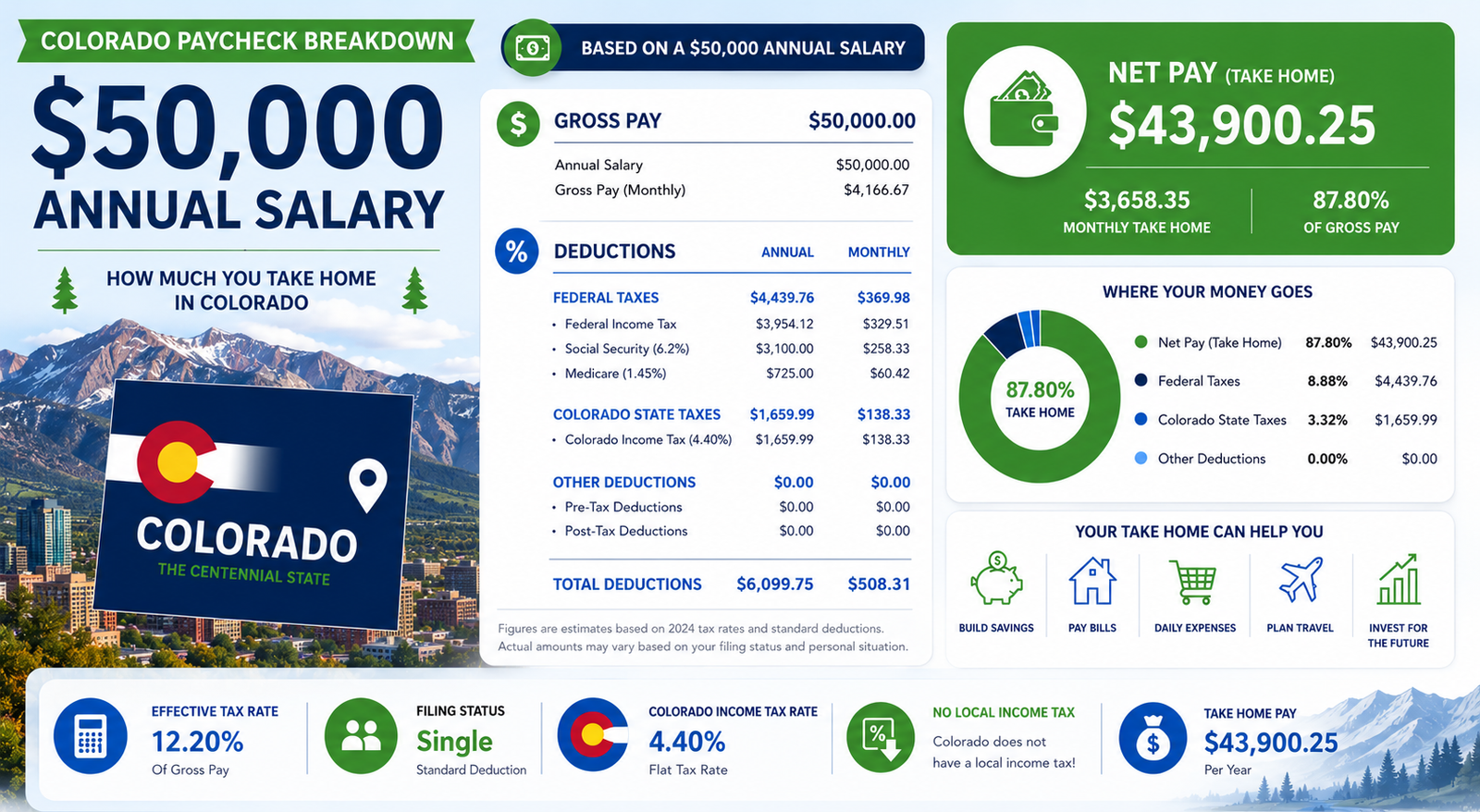
If you're earning $50,000 a year in Colorado, understanding your take‑home pay is the first step to building a realistic budget. The Centennial State uses a flat income tax rate, which makes your paycheck predictable—but federal taxes, FICA, and local cost of living still eat into your earnings. In this 2026 guide we break down exactly how much you keep, where your money goes, and whether a $50,000 salary lets you live comfortably in Denver, Colorado Springs, Aurora, or Boulder.
Colorado Tax Overview – Why Your Paycheck Looks the Way It Does
Colorado operates one of the most straightforward tax systems in the U.S. The state applies a flat income tax rate, meaning every resident pays the same percentage regardless of earnings. For 2026, the flat rate stands at 4.40%. Unlike many states, Colorado does not have local city or county income taxes, so you won’t see an extra Denver‑specific tax on your pay stub.
However, federal taxes still represent the biggest deduction. The IRS adjusts brackets and the standard deduction annually for inflation. In 2026, the single filer standard deduction rises to $15,000, which directly lowers your taxable income. Combined with Social Security (6.2%) and Medicare (1.45%), your gross $50,000 shrinks considerably before it hits your bank account.
All calculations in this guide are based on our Colorado paycheck calculator. We use the latest 2026 tax data—no estimates, no guesses.
$50,000 Salary After Tax in Colorado: Annual & Monthly Take‑Home
| Pay Frequency | Gross Pay | Net (Take‑Home) Pay |
|---|---|---|
| Annual | $50,000 | $40,630 |
| Monthly | $4,167 | $3,386 |
| Bi‑weekly | $1,923 | $1,563 |
| Weekly | $962 | $782 |
These figures assume single filing status, the standard deduction, and no pre‑tax deductions like 401(k) or health insurance. Use the paycheck calculator for Colorado to add your specific withholdings.
Where Every Dollar Goes – Tax Breakdown on a $50K Colorado Salary
Let’s visualize exactly how your gross salary gets divided among federal tax, state tax, FICA, and the amount you actually keep.
| Deduction | Annual Amount | Percentage of Gross |
|---|---|---|
| Federal Income Tax | $3,955 | 7.91% |
| Colorado State Tax (4.40% flat) | $1,591 | 3.18% |
| Social Security (6.2%) | $3,100 | 6.20% |
| Medicare (1.45%) | $725 | 1.45% |
| Total Taxes & FICA | $9,371 | 18.74% |
| Net Take‑Home Pay | $40,630 | 81.26% |
Colorado’s flat rate keeps things simple, but the 4.40% bite is higher than some neighboring states that use progressive brackets. Still, your effective state tax rate stays a manageable 3.18% of gross income.
Can You Live Comfortably on $50K in Colorado? A Realistic Monthly Budget
Living in Colorado—especially in metro areas like Denver or Boulder—means balancing a higher cost of living with your net pay. Here’s a sample budget built on a monthly take‑home of $3,386. (Note: actual rent and outdoor recreation spending vary widely.)
| Expense Category | Monthly Budget |
|---|---|
| Rent (1‑bedroom, Denver metro) | $1,700 |
| Utilities & Internet | $160 |
| Groceries | $420 |
| Transportation (gas/transit) | $200 |
| Health Insurance (marketplace avg) | $250 |
| Outdoor & lifestyle (ski pass, hiking gear) | $180 |
| Savings & emergency fund | $200 |
| Discretionary (dining, entertainment) | $276 |
| Total Expenses | $3,386 |
With this budget, you’re living close to the edge in Denver or Boulder, where median one‑bedroom rents hover around $1,800–$2,000. In Colorado Springs or Aurora, you could find rent for $1,400–$1,550, freeing up cash for savings or an extra 14er hike. The outdoor lifestyle that draws people to Colorado also adds unique costs—gear, national park passes, and ski season expenses can quickly add up.
Colorado vs. Other States: How Far Does $50K Go?
Not all states tax income equally. Below is a net pay comparison for a $50,000 salary across four different states, based on our calculator’s 2026 data.
Net pay amounts assume single filer, standard deduction, and no local taxes beyond state. Texas has no state income tax; California uses progressive brackets resulting in higher tax on $50K.
Is $50,000 a Good Salary in Colorado in 2026?
The answer depends heavily on where you live and your lifestyle. Statewide, the median household income hovers around $80,000, so a single earner at $50K is below that benchmark. However, many individuals, especially early‑career professionals, live comfortably with roommates or in more affordable suburbs.
In Denver and Boulder, $50,000 can feel tight. After renting a modest apartment, you’ll have limited breathing room. But in Colorado Springs or Aurora, the lower cost of housing makes the same salary stretch noticeably further. If you embrace Colorado’s free outdoor recreation—hiking, biking, camping—you can offset some entertainment costs and still enjoy the state’s incredible quality of life.
Smart Ways to Increase Your Take‑Home Pay in Colorado
Even on a $50,000 salary, a few strategic moves can boost your net pay or stretch your dollars:
- Contribute to a 401(k) or traditional IRA: Pre‑tax contributions lower your federal and state taxable income immediately.
- Use a Health Savings Account (HSA): If you have a high‑deductible health plan, HSA contributions are triple tax‑advantaged.
- Adjust your W‑4 withholding: If you received a large refund last year, you're giving the government an interest‑free loan. Update your W‑4 to keep more money each month.
- Explore Denver’s commuter benefits: Some employers offer pre‑tax transit or parking deductions.
Calculate your salary in Colorado now 🡥
Want to see exactly how much you keep after taxes?
Use the free Colorado paycheck calculator.
$50,000 Salary After Tax in Colorado – FAQs
How much is a $50,000 salary after tax in Colorado per month?
Your monthly net pay is roughly $3,386, assuming a single filer with standard deductions and no extra withholding. Use our Colorado paycheck calculator to add 401(k) or health insurance for a personalized amount.
What is the Colorado state tax rate for 2026?
Colorado applies a flat 4.40% state income tax on all taxable income. There are no local income taxes in the state.
Is $50,000 a livable salary in Denver?
It's manageable with careful budgeting. Sharing housing or living slightly outside the city center can make a significant difference. Expect to spend around 50% of your take‑home pay on rent if you live alone in Denver proper.
How does Colorado's flat tax compare to other states?
Colorado’s 4.40% flat rate is lower than Utah’s 4.55% but higher than states with no income tax, such as Texas. Your total tax burden depends heavily on federal obligations.
Will I pay Colorado income tax if I work remotely for an out‑of‑state company?
Yes, if you are a Colorado resident, you owe state income tax on all income regardless of where your employer is located. Colorado taxes worldwide income for residents.
Can I reduce my Colorado state tax legally?
You can reduce taxable income through pre‑tax retirement contributions, HSA contributions, and certain above‑the‑line deductions. Colorado generally conforms to federal adjusted gross income, so lowering your AGI helps.
Looking for additional tax planning strategies? Explore Free Aiden for financial insights.
Disclaimer
Final Thoughts: Understanding Your $50,000 Salary After Tax in Colorado
A $50,000 salary in Colorado delivers a reliable $40,630 in after‑tax income in 2026. While the flat state tax keeps your paycheck predictable, the high cost of living in popular Front Range cities means you'll need a solid budget—especially if you want to enjoy everything the Centennial State offers.
Whether you're moving to Denver or already working in Colorado Springs, knowing your net pay is the foundation of smart financial planning. Use the detailed breakdowns above as a starting point, but always plug your own details into the calculator for accuracy. The difference between a generic estimate and your real paycheck could be hundreds of dollars a month.