

$50,000 Salary After Tax in Connecticut (2026 Guide)
If you earn $50,000 a year and live in Connecticut, you are probably wondering how much of that money actually lands in your bank account. Understanding your $50,000 salary after tax in Connecticut is essential for budgeting, planning your housing costs, and making informed financial decisions. All calculations in this guide are based on our Connecticut paycheck calculator. We use official 2026 tax data to give you a clear, accurate picture of your take-home pay.
Connecticut has a progressive state income tax, a higher-than-average cost of living, and unique regional differences. Whether you live in Bridgeport, New Haven, Stamford, or Hartford, your net pay matters. This guide breaks everything down step by step so you can plan with confidence.
Table of Contents
Overview of a $50,000 Salary in Connecticut
Connecticut ranks among the states with a higher cost of living, especially in communities near New York City. However, a $50,000 salary can still provide a reasonable lifestyle depending on where you call home. The key is understanding exactly how much you take home after all deductions.
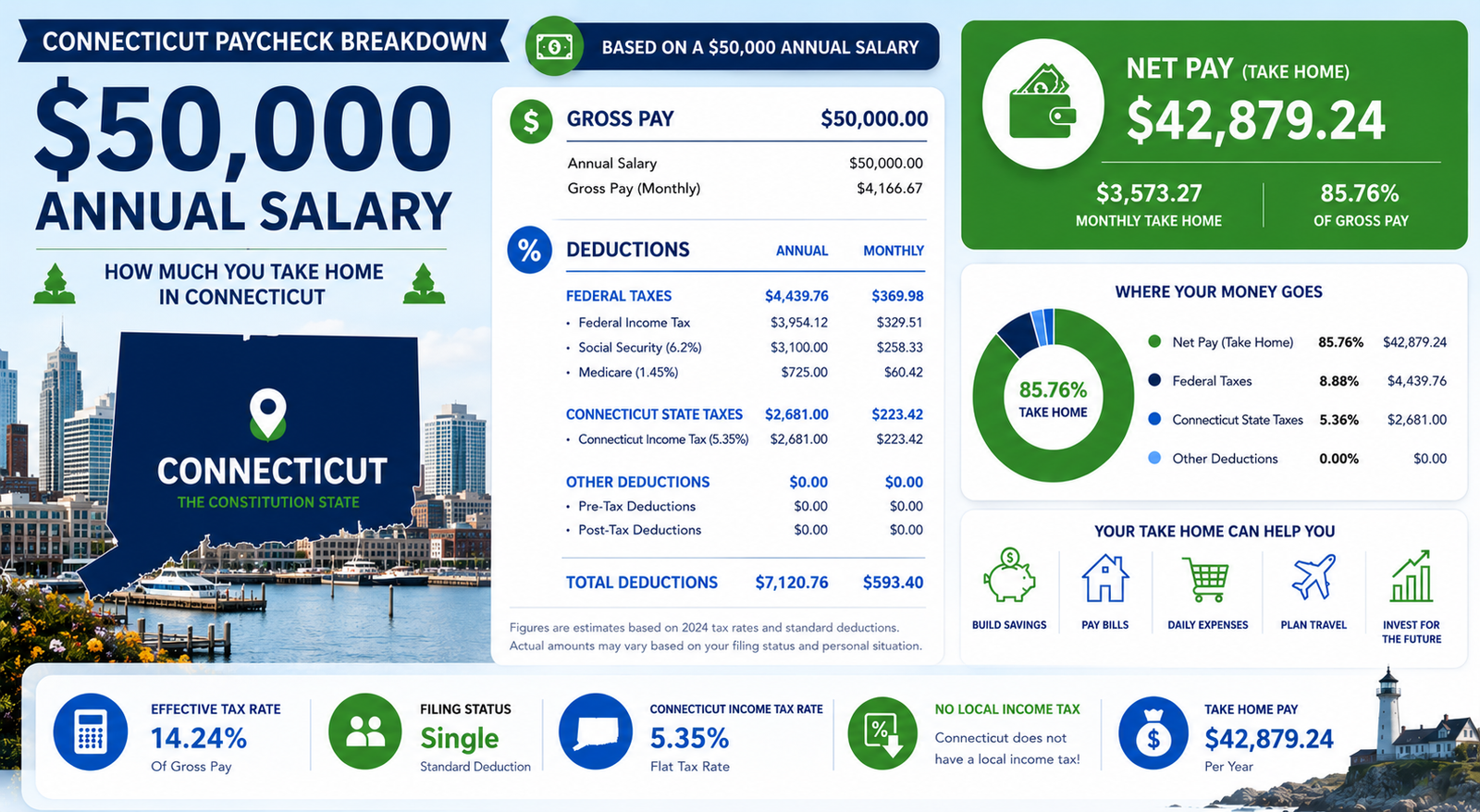
Your gross pay of $50,000 per year translates to about $4,167 per month before taxes. After mandatory deductions, approximately $40,935 remains as net take-home pay. That works out to roughly $3,411 per month or $1,574 every two weeks. These figures assume a single filer with the standard deduction and no additional withholdings.
All calculations in this guide are based on our Connecticut paycheck calculator, which uses the latest 2026 federal and state tax brackets.
Salary Breakdown: Gross to Net
| Pay Period | Gross Pay | Total Deductions | Net Take-Home Pay |
|---|---|---|---|
| Annual | $50,000.00 | $9,065.00 | $40,935.00 |
| Monthly | $4,166.67 | $755.42 | $3,411.25 |
| Bi-Weekly | $1,923.08 | $348.65 | $1,574.42 |
| Weekly | $961.54 | $174.33 | $787.21 |
These numbers give you a clear snapshot of your $50,000 salary after tax in Connecticut. Use our paycheck calculator for Connecticut to adjust for your specific filing status or additional deductions.
Tax Breakdown on a $50,000 Salary in Connecticut
Four main deductions reduce your gross pay. Understanding each one helps you see where your money goes and why your take-home pay lands at approximately $40,935 per year.
Federal Income Tax
For 2026, the standard deduction for a single filer is approximately $15,000. That leaves a taxable income of about $35,000. The first $11,925 is taxed at 10%, and the remainder up to $48,475 is taxed at 12%. Your total federal income tax comes to roughly $3,960 per year.
Social Security Tax
Social Security is a flat 6.2% on wages up to the annual limit. On a $50,000 salary, you pay $3,100 per year in Social Security tax. This funds your future retirement benefits through the Social Security program.
Medicare Tax
Medicare tax applies at 1.45% on all earned income with no wage cap. For $50,000, that equals $725 per year. This goes toward funding healthcare coverage for Americans aged 65 and older.
Connecticut State Income Tax
Connecticut uses a progressive tax structure. The first $10,000 of taxable income is taxed at 2%, and income from $10,001 to $50,000 is taxed at 4.5%. After the Connecticut standard deduction, your effective state tax is approximately $1,280 per year, or about 2.56% of your gross income.
- Take-Home Pay: $40,935 (81.87%)
- Federal Income Tax: $3,960 (7.92%)
- Social Security: $3,100 (6.20%)
- Medicare: $725 (1.45%)
- CT State Tax: $1,280 (2.56%)
Detailed Tax Deduction Table
| Deduction Type | Annual Amount | Monthly Amount | Bi-Weekly Amount | % of Gross |
|---|---|---|---|---|
| Federal Income Tax | $3,960.00 | $330.00 | $152.31 | 7.92% |
| Social Security (6.2%) | $3,100.00 | $258.33 | $119.23 | 6.20% |
| Medicare (1.45%) | $725.00 | $60.42 | $27.88 | 1.45% |
| CT State Income Tax | $1,280.00 | $106.67 | $49.23 | 2.56% |
| Total Deductions | $9,065.00 | $755.42 | $348.65 | 18.13% |
Connecticut-Adjusted Budget on a $50K Salary
Living in Connecticut means budgeting carefully, especially given the state's higher housing costs. The budget below assumes a single person living in a moderately priced area such as New Haven or Hartford. If you reside in Stamford or Bridgeport, housing costs may be significantly higher.
With a monthly net take-home of approximately $3,411, here is a realistic budget that accounts for Connecticut's cost of living. Keep in mind that commuting costs can rise sharply if you travel into New York City regularly.
Important Note: Housing costs in Fairfield County (Stamford, Greenwich, Bridgeport) often exceed $1,800 per month for a one-bedroom apartment. In Hartford or New Haven, you can find more affordable options in the $1,200 to $1,500 range. The budget below uses a moderate estimate suitable for central Connecticut.
Monthly Budget Breakdown
| Expense Category | Estimated Monthly Cost | Percentage of Net Pay |
|---|---|---|
| Housing (Rent, 1BR) | $1,400.00 | 41.0% |
| Food & Groceries | $450.00 | 13.2% |
| Transportation | $280.00 | 8.2% |
| Healthcare | $300.00 | 8.8% |
| Utilities & Internet | $220.00 | 6.4% |
| Insurance (Renter's, etc.) | $130.00 | 3.8% |
| Savings & Emergency Fund | $200.00 | 5.9% |
| Discretionary Spending | $431.25 | 12.6% |
| Total Monthly Expenses | $3,411.25 | 100% |
As you can see, housing consumes the largest portion of your budget. If you can reduce housing costs by living with a roommate or choosing a more affordable neighborhood, your discretionary spending and savings capacity increase significantly.
Want to see your exact take-home pay?
Calculate your real take-home pay in secondsHow Connecticut Stacks Up Against Neighboring States
Connecticut sits in the middle of the pack when compared to nearby northeastern states. New York generally takes a bigger bite out of your paycheck, while New Jersey offers a slightly higher take-home at this income level. Below is a visual comparison of approximate annual net pay for a $50,000 salary across five states.
Neighboring States Comparison Table
| State | Approx. Net Take-Home (Annual) | Effective State Tax Rate | Cost of Living Rank |
|---|---|---|---|
| New York | ~$40,250 | ~3.8% | Very High |
| Massachusetts | ~$40,650 | ~3.1% | High |
| Rhode Island | ~$40,900 | ~2.9% | Moderate-High |
| Connecticut | $40,935 | ~2.56% | High |
| New Jersey | ~$41,100 | ~2.2% | High |
Connecticut's progressive tax structure means that at the $50,000 level, your effective state tax rate is competitive compared to New York and Massachusetts. However, the overall cost of living, particularly housing near the New York City metro area, can offset that advantage.
Is $50,000 a Good Salary in Connecticut?
The answer depends heavily on your location and lifestyle. In Hartford, a $50,000 salary after tax gives you a manageable monthly budget of about $3,411. Housing is more affordable there, and you can live comfortably with careful planning.
However, in Stamford or Bridgeport, the story changes. Proximity to New York City drives up rents considerably. A one-bedroom apartment in Stamford can easily cost $2,200 or more per month. On a $3,411 monthly net income, that leaves very little room for other expenses.
In New Haven, the situation falls somewhere in the middle. With a mix of more affordable neighborhoods and access to public transportation, a $50,000 salary can support a reasonable quality of life. The key is to calculate your salary in Connecticut precisely and budget accordingly.
Tips to Increase Your Take-Home Pay in Connecticut
1. Adjust Your Tax Withholdings
Use the IRS Form W-4 to fine-tune your federal withholding. If you received a large refund last year, you may be over-withholding. Adjusting your W-4 can increase each paycheck by $50 to $100 or more.
2. Contribute to Pre-Tax Retirement Accounts
Contributions to a 401(k) or traditional IRA reduce your taxable income for both federal and Connecticut state purposes. Even contributing 3% to 5% of your salary can lower your tax bill while building long-term savings.
3. Explore Connecticut-Specific Credits
Connecticut offers various tax credits, including the Earned Income Tax Credit for qualifying individuals. Check with the Connecticut Department of Revenue Services to see if you qualify for any state-level credits that can reduce your tax burden.
4. Consider Commuting Costs Carefully
If you work in New York City but live in Connecticut, commuting costs can add up quickly. Metro-North monthly passes from Stamford to Grand Central can exceed $300. Factor this into your budget and consider whether living closer to work or negotiating remote work days could help.
5. Use a Health Savings Account
If your employer offers a high-deductible health plan with an HSA, contributions are pre-tax at both the federal and state level. This effectively increases your take-home pay by reducing your taxable income.
$50,000 Salary After Tax in Connecticut — FAQs
How much is a $50,000 salary after tax in Connecticut for 2026?
A $50,000 salary in Connecticut for 2026 results in approximately $40,935 in annual take-home pay. This breaks down to about $3,411 per month or $1,574 per bi-weekly paycheck after federal income tax, Social Security, Medicare, and Connecticut state income tax are deducted.
Is $50,000 a good salary in Connecticut?
A $50,000 salary in Connecticut is considered modest. While it exceeds the state's median individual income in some areas, Connecticut's high cost of living, especially in Fairfield County and near NYC, means $50K requires careful budgeting. In cities like Hartford or New Haven, it is more manageable than in Stamford or Bridgeport.
What is the Connecticut state income tax rate on a $50,000 salary?
Connecticut uses a progressive income tax system. For a $50,000 salary in 2026, the effective state tax rate is approximately 2.56%. The first $10,000 is taxed at 2%, and income from $10,001 to $50,000 is taxed at 4.5%. After the standard deduction, the actual CT tax owed is around $1,280 per year.
How much is taken out of a $50,000 paycheck in Connecticut for taxes?
On a bi-weekly paycheck of $1,923.08 gross, approximately $348.65 is deducted for taxes. This includes roughly $152.31 for federal income tax, $119.23 for Social Security, $27.88 for Medicare, and $49.23 for Connecticut state income tax. The net bi-weekly take-home is about $1,574.
Can you live comfortably on a $50,000 salary in Connecticut?
Living comfortably on $50,000 in Connecticut depends heavily on location. In Hartford or New Haven, a single person can manage with careful budgeting and a monthly take-home of around $3,411. However, in Stamford or near NYC, housing costs consume a much larger portion of income, making it significantly more challenging without a roommate or additional income.
How does Connecticut compare to New York or New Jersey for a $50K salary?
Connecticut generally offers a slightly higher take-home pay on a $50,000 salary compared to New York but less than New Jersey. New York's state tax is higher, while New Jersey's effective rate is lower for this income level. CT's progressive tax structure places it in the middle range among northeastern states for take-home pay at the $50K level.
What deductions are taken from a $50,000 salary in Connecticut?
The main deductions from a $50,000 salary in Connecticut include federal income tax (approximately $3,960/year), Social Security tax at 6.2% ($3,100/year), Medicare tax at 1.45% ($725/year), and Connecticut state income tax (approximately $1,280/year). Total deductions amount to roughly $9,065 annually, leaving a net take-home of $40,935.
Does Connecticut tax Social Security or retirement income differently?
Connecticut does exempt Social Security benefits from state income tax for individuals below certain income thresholds. For retirement planning purposes, a $50,000 salary earner contributing to a 401(k) or IRA may reduce both federal and Connecticut taxable income, potentially lowering their overall tax burden and increasing take-home pay.
Understanding Your Take-Home Pay
A $50,000 salary after tax in Connecticut gives you approximately $40,935 per year to work with. That comes out to about $3,411 each month. While Connecticut is not the cheapest state in the Northeast, smart budgeting and location choices can make this income level work well.
Remember that your specific situation may vary. Your filing status, number of dependents, retirement contributions, and employer benefits all affect your final take-home pay. The best way to get an accurate number is to use a reliable calculator with your exact details.
Connecticut's progressive tax system means that as your income grows, your effective tax rate increases gradually. Understanding this now helps you plan for future salary increases and career moves. Whether you are in Bridgeport, New Haven, Stamford, or Hartford, knowing your real take-home pay puts you in control of your financial future.
See exactly how much you keep after taxes.
Calculate your real take-home pay in secondsDisclaimer
All calculations in this guide are estimates based on our Connecticut paycheck calculator and publicly available tax information for 2026. Actual take-home pay may vary depending on your specific filing status, deductions, employer benefits, and other individual factors. This article is for informational purposes only and does not constitute financial advice. We strongly encourage you to use the Connecticut paycheck calculator to obtain a personalized estimate tailored to your situation. For professional tax advice, please consult a certified public accountant or licensed financial advisor.
Additional resources may be found at FreeAiden.