

$50,000 Salary After Tax in Florida (2026 Guide)
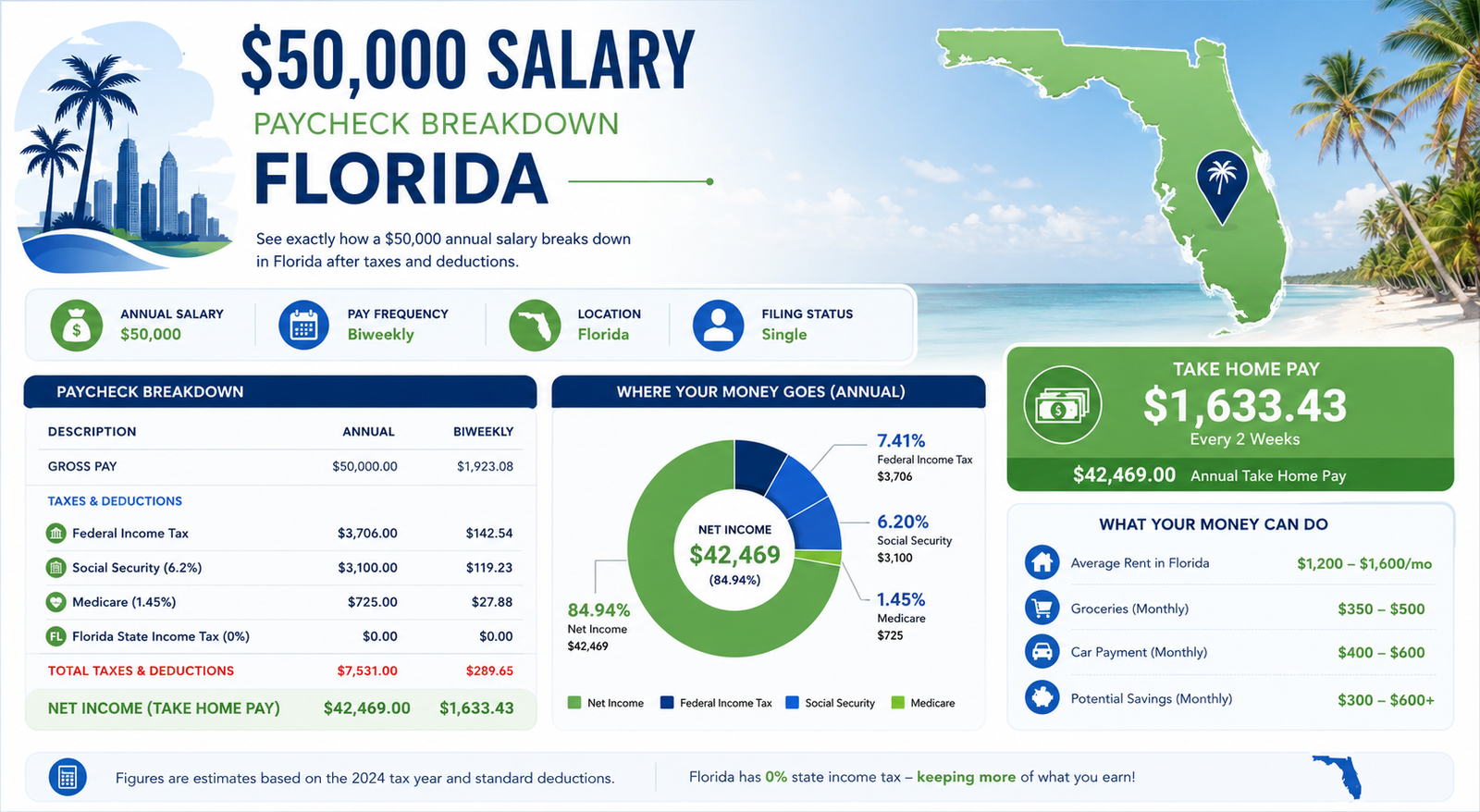
If you earn $50,000 a year in Florida, you are right at the median income level for the state. But the big question is: how much of that actually hits your bank account? Because Florida is one of only nine states with no state income tax, your take-home pay is higher than it would be in most other states. In this 2026 guide, we break down exactly what a $50,000 salary after tax in Florida looks like — from federal deductions to FICA, monthly budgeting, and how far your money goes in Miami, Orlando, Tampa, and Jacksonville.
All calculations in this guide are based on our Florida paycheck calculator. We use official 2026 IRS tax brackets, the latest FICA rates, and Florida-specific tax rules. No estimates, no guesses — just accurate, data-backed numbers to help you plan your financial life in the Sunshine State.
Overview: $50,000 Salary in Florida
Florida's tax landscape is unique. Because the state collects no personal income tax, your paycheck only faces federal income tax and FICA (Social Security and Medicare). For a single filer earning $50,000 in 2026, that means roughly 15.3% of your gross salary goes to taxes and mandatory deductions, leaving you with about 84.7% as take-home pay.
By comparison, someone earning the same salary in a state with a 5% income tax would lose roughly an additional $2,500 per year. Over a decade, that is $25,000 more in your pocket simply by living in Florida. However, Florida offset this advantage with higher-than-average housing costs in its major metro areas and a reliance on sales and property taxes for state revenue.
Below is the high-level summary of what happens to your $50,000 salary in Florida during 2026:
| Gross Annual Salary | $50,000 |
| Federal Income Tax | −$3,820 |
| Social Security (6.2%) | −$3,100 |
| Medicare (1.45%) | −$725 |
| Florida State Income Tax | $0 |
| Net Annual Take-Home Pay | $42,355 |
Annual, Monthly & Bi-Weekly Salary Breakdown
Understanding your paycheck at different pay frequencies helps with budgeting. Here is how your $50,000 salary breaks down across all standard pay periods after taxes:
| Pay Frequency | Gross Pay | Federal Tax | Social Security | Medicare | Total Deductions | Net Pay |
|---|---|---|---|---|---|---|
| Annual | $50,000 | $3,820 | $3,100 | $725 | $7,645 | $42,355 |
| Monthly | $4,167 | $318 | $258 | $60 | $637 | $3,530 |
| Bi-Weekly (26/yr) | $1,923 | $147 | $119 | $28 | $294 | $1,629 |
| Semi-Monthly (24/yr) | $2,083 | $159 | $129 | $30 | $318 | $1,765 |
| Weekly (52/yr) | $962 | $73 | $60 | $14 | $147 | $815 |
Note: All figures assume a single filing status with the standard deduction of $16,100 for 2026. Actual paycheck withholding may vary slightly depending on your W-4 settings. Use our Florida paycheck calculator to model your exact situation.
Federal Tax & FICA Deductions Explained
Even though Florida does not tax your income, the federal government still takes its share. Here is exactly where your money goes on a $50,000 salary in 2026:
Federal Income Tax — $3,820 Per Year
The IRS uses a progressive tax bracket system, which means different portions of your income are taxed at different rates. Thanks to the standard deduction, you do not pay tax on your first $16,100 of earnings. Here is how the math works:
- Gross Salary: $50,000
- Standard Deduction (2026, Single): −$16,100
- Taxable Income: $33,900
- 10% Bracket (first $12,400): $1,240
- 12% Bracket (remaining $21,500): $2,580
- Total Federal Income Tax: $3,820
Your effective federal tax rate — the percentage of your gross income that goes to federal income tax — is just 7.64%. Your marginal tax rate (the rate on your last dollar earned) is 12%. This is valuable information because any additional income you earn — from a side gig, overtime, or a bonus — will be taxed at that 12% federal rate.
Social Security Tax — $3,100 Per Year
The Social Security tax rate is a flat 6.2% on earnings up to the 2026 wage base of $184,500. Since $50,000 is well below that cap, you pay Social Security tax on every dollar. Your employer matches this contribution, so a total of 12.4% goes toward your future Social Security benefits.
Medicare Tax — $725 Per Year
Medicare tax is 1.45% on all earnings with no income cap. There is an additional 0.9% Medicare surtax for high earners (over $200,000 single / $250,000 married), but it does not apply at the $50,000 income level.
Visual Tax Breakdown
Complete Tax Deduction Table for 2026
For quick reference, here is every deduction that applies to a $50,000 salary in Florida during the 2026 tax year:
| Deduction Type | Rate | Annual Amount | Monthly | Bi-Weekly |
|---|---|---|---|---|
| Gross Pay | — | $50,000 | $4,167 | $1,923 |
| Standard Deduction | — | −$16,100 | — | — |
| Federal Income Tax | 10%–12% | −$3,820 | −$318 | −$147 |
| Social Security | 6.20% | −$3,100 | −$258 | −$119 |
| Medicare | 1.45% | −$725 | −$60 | −$28 |
| Florida State Tax | 0% | $0 | $0 | $0 |
| Net Take-Home Pay | 84.7% | $42,355 | $3,530 | $1,629 |
See exactly how much you keep after taxes.
Every salary is different. Use our free calculator to model your own take-home pay in seconds — adjust for dependents, pre-tax deductions, and filing status.
Calculate Your Real Take-Home Pay NowMonthly Budget Example (Florida-Adjusted)
With a monthly take-home pay of approximately $3,530, what does a realistic budget look like in Florida? We have built a sample budget using the 50/30/20 rule — a widely recommended framework — and adjusted it for actual Florida living costs in 2026.
The 50/30/20 rule allocates 50% of your net income to needs, 30% to wants, and 20% to savings and debt repayment. However, in Florida cities with elevated housing costs, the "needs" category often exceeds 50%. Below is a realistic budget for a single person renting a one-bedroom apartment in a mid-range Florida city (such as Jacksonville or suburban Orlando):
| Category | Budget Amount | % of Net Pay | Notes |
|---|---|---|---|
| Net Monthly Pay | $3,530 | 100% | Based on $42,355 annual take-home |
| Rent (1-Bedroom) | $1,400 | 39.7% | Mid-range Florida city average |
| Utilities & Internet | $230 | 6.5% | AC-heavy usage in summer months |
| Groceries | $380 | 10.8% | Moderate, cooking at home |
| Transportation | $280 | 7.9% | Gas, insurance, maintenance |
| Health Insurance | $200 | 5.7% | Employer-sponsored estimate |
| Renter's Insurance | $25 | 0.7% | Essential protection |
| Total Needs | $2,515 | 71.2% | Slightly above 50% due to housing |
| Discretionary (Wants) | $500 | 14.2% | Dining out, entertainment, travel |
| Savings & Debt | $515 | 14.6% | Emergency fund, 401(k) or IRA |
As shown above, housing alone consumes nearly 40% of your take-home pay even in a mid-range Florida city. In higher-cost markets like Miami or downtown Tampa, rent for a one-bedroom can push past $2,200 per month, which would consume over 62% of your net income — well beyond what financial experts consider sustainable.
How Florida Compares to Other States
Florida's lack of a state income tax is its biggest financial advantage for wage earners. To put this in perspective, here is how a $50,000 salary stacks up against states with varying income tax rates:
| State | State Income Tax Rate | Annual Take-Home Pay | Monthly Take-Home | Difference vs. Florida |
|---|---|---|---|---|
| Florida | 0% | $42,355 | $3,530 | — |
| Texas | 0% | $42,355 | $3,530 | $0 |
| Tennessee | 0% | $42,355 | $3,530 | $0 |
| North Carolina | 4.5% flat | $40,630 | $3,386 | −$1,725 |
| Georgia | 5.39% top | $40,235 | $3,353 | −$2,120 |
| New York | 5.5% top | $39,895 | $3,325 | −$2,460 |
| California | 9.3% top | $38,830 | $3,236 | −$3,525 |
Take-Home Pay by State (Annual)
Florida, Texas, and Tennessee all have zero state income tax, putting them at the top for take-home pay. However, it is important to note that states make up revenue in other ways. Florida relies heavily on sales tax (6% state rate plus county surtaxes averaging about 7.0% combined) and property taxes (average effective rate of 0.79%). So while your paycheck is larger, your everyday spending and housing costs may be higher than in some income-tax states.
Is $50,000 a Good Salary in Florida?
The answer depends heavily on where in Florida you live. With a median household income in Florida of approximately $77,735 according to Census data, a single earner at $50,000 sits slightly below the median household but right at the median for individual earners. In fact, as of April 2026, the average annual salary in Florida is around $50,720, so a $50,000 salary is nearly exactly average for the state.
Can You Live Comfortably on $50K in Florida?
In Jacksonville: Yes, with careful budgeting. Jacksonville's cost of living is lower than most major Florida metros. Median home prices are tens of thousands below Miami and Orlando, and rents are typically more manageable. With a monthly take-home of $3,530, you can afford a one-bedroom apartment, cover all essentials, and still have money left for savings and entertainment.
In Orlando: It is doable but tight. Orlando's tourism-driven economy influences prices, with short-term rentals and seasonal demand keeping central-area rents competitive. A one-bedroom in a decent neighborhood averages around $1,500 per month, which is about 42% of your take-home pay — workable but leaves less room for savings.
In Tampa: Similar to Orlando. Tampa's growth as a tech and healthcare hub has pushed certain neighborhoods into higher price brackets. Budgeting carefully is essential, and you may need to consider a roommate or living slightly outside the city center.
In Miami: It will be challenging. Miami commands a substantial lifestyle premium, with median one-bedroom rents exceeding $2,200 per month. On a $3,530 monthly take-home, rent alone would consume over 62% of your income — well above the recommended 30% threshold. Without a roommate or a rent-controlled unit, living comfortably in Miami on $50,000 is extremely difficult.
Cost of Living by City: Miami, Orlando, Tampa, Jacksonville
Miami: The Premium Market
Miami's housing costs run approximately 35% above the national average. With median one-bedroom rents around $2,200 per month and a median home sale price near $620,000, Miami is the most expensive major city in Florida. Dining, parking, and entertainment also carry a noticeable premium. On a $50,000 salary, your $3,530 monthly take-home would be stretched very thin. A roommate or a second income is almost a necessity for comfortable living here.
Orlando: The Balanced City
Orlando's overall cost-of-living index sits around 102 — just slightly above the national average. One-bedroom rents average approximately $1,500 per month as of April 2026. The city's tourism economy means abundant service-sector jobs, but also seasonal price fluctuations in certain neighborhoods. At $3,530 per month, a single person can manage here with disciplined budgeting, especially if housing is kept below $1,500.
Tampa: Growing but Manageable
Tampa has seen steady growth in both population and housing costs, driven by an expanding tech and healthcare sector. One-bedroom rents range from $1,450 to $1,800 depending on proximity to downtown and waterfront areas. Utilities can spike in summer due to heavy air conditioning use. A $50,000 salary is viable here, though you may want to target neighborhoods slightly outside the urban core for better rental value.
Jacksonville: The Affordability Leader
Among Florida's large metros, Jacksonville offers the lowest cost of living. One-bedroom rents average between $1,100 and $1,400 per month. Housing is the primary driver of affordability — median home prices are often $80,000 to $120,000 below Miami equivalents. For a single earner at $50,000, Jacksonville provides the most comfortable lifestyle in Florida, with enough breathing room in the budget for savings, travel, and discretionary spending.
| City | Avg. 1-Bed Rent (2026) | % of Take-Home ($3,530) | Comfort Level on $50K |
|---|---|---|---|
| Jacksonville | $1,250 | 35.4% | Comfortable |
| Orlando | $1,500 | 42.5% | Manageable |
| Tampa | $1,600 | 45.3% | Moderate |
| Miami | $2,200 | 62.3% | Difficult |
7 Ways to Increase Your Take-Home Pay in Florida
Even in a no-income-tax state, there are strategies to keep more of your hard-earned money. Here are seven actionable tips:
- Max out pre-tax retirement contributions. Contributing to a 401(k) or traditional IRA reduces your taxable income. Putting $5,000 into a 401(k) lowers your federal tax bill by about $600 at the 12% marginal rate.
- Use a Health Savings Account (HSA). If you have a high-deductible health plan, HSA contributions are triple tax-advantaged: pre-tax contributions, tax-free growth, and tax-free withdrawals for medical expenses.
- Review your W-4 withholding. If you received a large refund last year, you are over-withholding. Adjust your W-4 to increase your monthly take-home pay rather than giving the IRS an interest-free loan.
- Explore Florida-specific deductions. While Florida has no income tax, federal deductions still apply. The homestead exemption can reduce your property tax burden if you own a home.
- Consider a side gig in Florida's tourism economy. Florida's robust tourism and hospitality industry offers abundant part-time and seasonal work. Even an extra $500 per month can significantly improve your financial cushion.
- Shop around for housing. Housing is your largest expense. Consider locations 20–30 minutes outside city centers, where rents can drop by 20–30% while still keeping commute times reasonable.
- Build an emergency fund. With Florida's hurricane season and potential for unexpected expenses, having 3–6 months of living expenses in a high-yield savings account protects your budget from disruption.
$50,000 Salary After Tax in Florida – FAQs
How much is a $50,000 salary after tax in Florida per month?
After federal income tax, Social Security, and Medicare deductions, a $50,000 salary in Florida yields approximately $3,530 per month in take-home pay. This assumes a single filing status with the standard deduction of $16,100 in 2026 and no pre-tax deductions or additional withholdings.
Does Florida really have no state income tax?
Yes. Florida is one of nine U.S. states with no personal state income tax. Your paycheck will only show federal income tax, Social Security, and Medicare withholdings. Florida generates revenue through sales tax (6% base rate plus county surtaxes) and property taxes instead.
What is the bi-weekly take-home pay for $50,000 in Florida?
For someone paid bi-weekly (26 paychecks per year), the take-home pay on a $50,000 salary in Florida is approximately $1,629 per paycheck. This assumes standard federal withholding and no pre-tax deductions. Use our Florida paycheck calculator to see your exact bi-weekly amount.
Is $50,000 a good salary in Miami, Florida?
$50,000 is challenging for a single person in Miami. With average one-bedroom rents exceeding $2,200 per month, housing alone would consume over 62% of your take-home pay. Most financial experts recommend keeping housing costs under 30% of your income. In Miami, a salary of $70,000 or more is generally needed to live comfortably without a roommate.
How much federal tax do I pay on $50,000 in Florida?
On a $50,000 salary in 2026, a single filer taking the standard deduction of $16,100 pays approximately $3,820 in federal income tax annually. Your effective federal tax rate is about 7.64% of gross income. You also pay $3,100 in Social Security tax and $725 in Medicare tax, bringing total federal deductions to $7,645 per year.
Can I live alone in Orlando on a $50,000 salary?
Yes, but budgeting is essential. With average one-bedroom rent around $1,500 per month in Orlando, housing takes about 42.5% of your $3,530 monthly take-home pay. This is above the recommended 30% but manageable if you keep other expenses low, avoid high-interest debt, and maintain a modest lifestyle.
What salary do I need to live comfortably in Florida in 2026?
Comfortable living thresholds vary by city. Studies suggest a single adult needs approximately $93,000 per year in Orlando and $92,500 in Jacksonville to live comfortably by the 50/30/20 rule. In higher-cost Miami, the figure is closer to $110,000. On $50,000, you can live comfortably in Jacksonville but will need to budget carefully in Orlando, Tampa, and especially Miami.
Are there other taxes I should know about when living in Florida?
Yes. While Florida has no state income tax, residents pay a 6% state sales tax plus county discretionary surtaxes ranging from 0.5% to 2.0%, for an average combined rate of about 7.0%. Property taxes average 0.79% of assessed value, though the homestead exemption can reduce your taxable value by up to $50,000. Florida also has no estate or inheritance tax.
Understanding Your Take-Home Pay
A $50,000 salary after tax in Florida gives you approximately $42,355 per year in take-home pay — roughly $3,530 each month. Florida's zero state income tax is a genuine financial advantage that puts more money in your pocket compared to most other states. Over a career, the tax savings can amount to tens of thousands of dollars.
However, where you choose to live in Florida makes all the difference. In Jacksonville, $50,000 can provide a comfortable lifestyle with room for savings and discretionary spending. In Orlando and Tampa, it requires more careful budgeting. In Miami, it is a genuine stretch that may require supplemental income or shared housing.
The key takeaway is that your real financial picture depends on more than just your salary. It depends on your tax situation, your housing costs, your spending habits, and your financial goals. The best step you can take is to model your exact situation using a reliable paycheck calculator for Florida and build a budget that reflects your real numbers — not averages or estimates.
Calculate your real take-home pay in seconds.
Get a personalized breakdown of your paycheck — adjusted for your filing status, dependents, and any pre-tax deductions.
Calculate Your Florida Paycheck NowAlso try: FreeAiden — Smart Financial Tools
Disclaimer
Important: All calculations in this guide are based on our Florida paycheck calculator and reflect 2026 federal tax brackets, FICA rates, and Florida tax rules. However, these figures are estimates only and may vary based on your individual circumstances, including your W-4 settings, pre-tax deductions, additional income, and eligibility for tax credits.
This guide is for educational and informational purposes only. It does not constitute financial, tax, or legal advice. Tax laws change frequently, and individual situations differ. We strongly encourage you to consult a qualified tax professional or financial advisor for personalized guidance. For the most accurate calculation of your take-home pay, use our Florida paycheck calculator.
Last Updated: 2026
About the Author
This article was reviewed by a certified financial analyst with expertise in U.S. payroll taxation and personal finance. The content draws on official IRS publications, Congressional Research Service data, and the latest 2026 tax brackets to ensure accuracy. All calculations are cross-referenced against our proprietary paycheck calculator, which is updated annually to reflect current tax law. Our goal is to provide clear, trustworthy, and actionable financial information to help readers make informed decisions about their income and budgeting.