

$50,000 Salary After Tax in Idaho (2026 Guide)
Last Updated: 2026 | Reviewed by a financial analyst | Based on Idaho paycheck calculator data
If you earn $50,000 a year in Idaho, you are probably wondering how much actually lands in your bank account each month. Taxes can take a significant bite, and Idaho has its own progressive state income tax that affects your bottom line. This comprehensive 2026 guide breaks down exactly what a $50,000 salary after tax in Idaho looks like, from federal withholdings to state-specific deductions. All calculations in this guide are based on our Idaho paycheck calculator.
Beyond just numbers, we also explore whether $50,000 is enough to live comfortably in Boise, Meridian, Nampa, or Idaho Falls. With housing costs rising across the Gem State, understanding your true take-home pay has never been more important.
Overview: What $50,000 Means in Idaho in 2026
Idaho remains one of the more affordable states in the western United States, but that picture is shifting. The state's population has grown rapidly—particularly in the Boise metro area—and housing costs have climbed accordingly. Still, compared to coastal states like California or Oregon, Idaho offers a noticeably lower cost of living.
Idaho uses a progressive state income tax structure, which means the rate increases as your income rises. For someone earning $50,000, the state tax rate is moderate, not hitting the highest brackets. Meanwhile, federal taxes follow the standard 2026 brackets, and FICA takes a flat 7.65% right off the top.
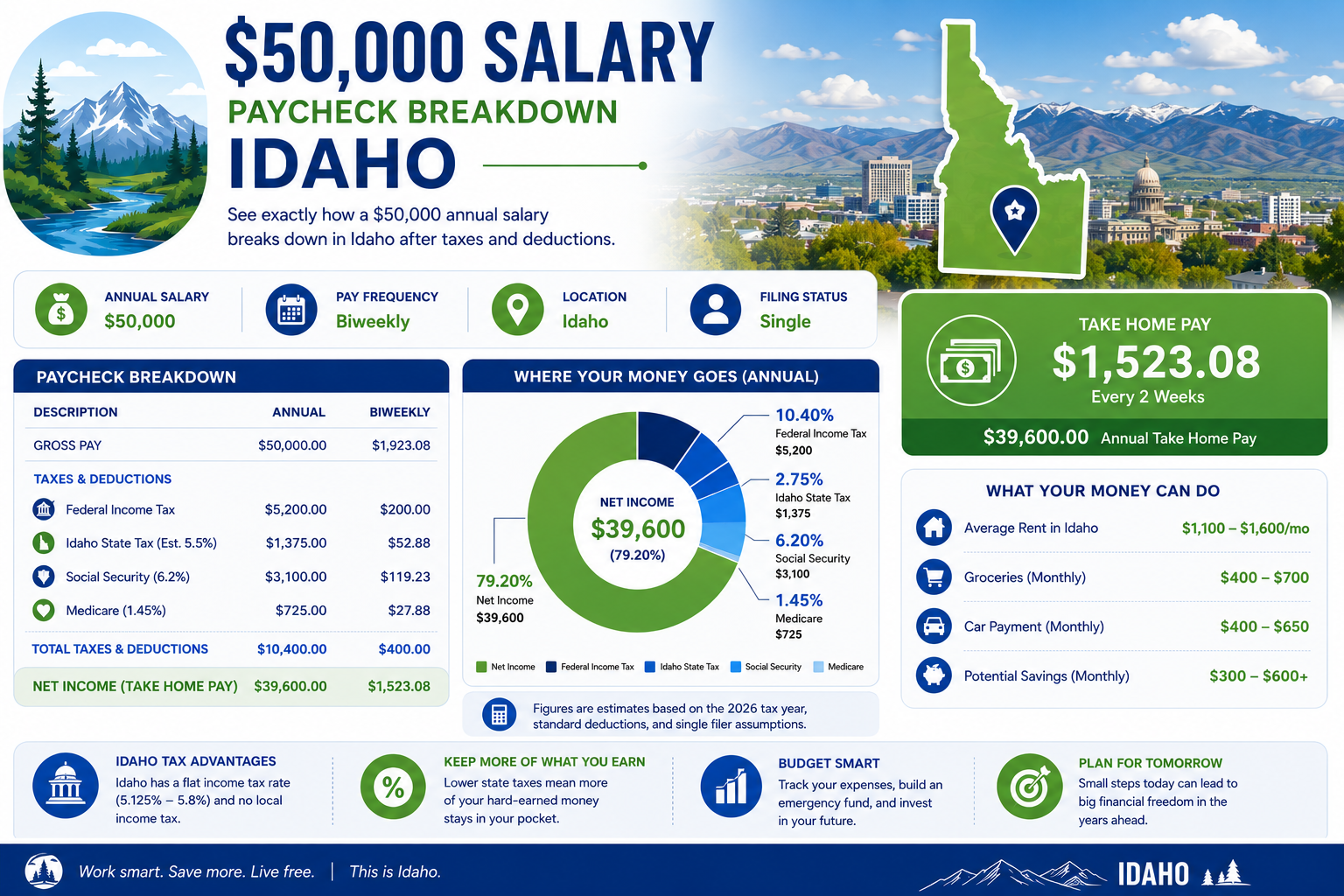
When you combine all these deductions, your $50,000 salary after tax in Idaho nets you around $40,105 annually. That works out to roughly $3,342 per month or about $1,542 every two weeks. Understanding this breakdown helps you plan a realistic budget and decide whether Idaho is the right place for your financial goals.
Salary Breakdown: $50,000 Gross to Net in Idaho
The table below provides a clear snapshot of how a $50,000 annual salary translates into different pay periods after taxes in Idaho. Use this to plan your monthly spending or compare job offers effectively. All calculations in this guide are based on our Idaho paycheck calculator.
| Pay Period | Gross Pay | Federal Tax | Idaho State Tax | FICA | Net Take-Home |
|---|---|---|---|---|---|
| Annual | $50,000 | $3,970 | $2,100 | $3,825 | $40,105 |
| Monthly | $4,167 | $331 | $175 | $319 | $3,342 |
| Bi-Weekly | $1,923 | $153 | $81 | $147 | $1,542 |
| Weekly | $962 | $76 | $40 | $74 | $771 |
Note: Figures are estimates for a single filer with standard deductions in 2026. Actual results may vary slightly based on exemptions, pre-tax deductions, and specific withholding elections.
Tax Breakdown: Where Your Money Goes
Every paycheck, three main entities take a portion of your earnings: the federal government, the state of Idaho, and the Social Security/Medicare system. Understanding each piece helps you see the full picture.
Federal Income Tax
For 2026, the standard deduction for a single filer is approximately $15,000. After subtracting that from your $50,000 gross, your taxable federal income drops to about $35,000. The first ~$11,600 is taxed at 10%, and the remaining ~$23,400 is taxed at 12%. This yields a total federal tax bill of roughly $3,970—an effective federal rate of about 7.9%.
Idaho State Income Tax
Idaho's progressive tax brackets apply after the state's own deductions. For a $50,000 earner, the effective state tax rate is approximately 4.2%, resulting in an annual Idaho tax of about $2,100. This is one of the reasons Idaho remains competitive compared to higher-tax neighbors like Oregon, where state taxes can exceed 9% for similar incomes.
FICA (Social Security and Medicare)
FICA taxes are non-negotiable for W-2 employees. Social Security takes 6.2% and Medicare takes 1.45%, totaling 7.65% on all earned income up to the Social Security wage cap. On $50,000, that means $3,825 goes directly to FICA before you ever see your paycheck.
Visual Tax Breakdown
- Take-Home Pay: $40,105 (80.2%)
- Federal Tax: $3,970 (7.94%)
- Idaho State Tax: $2,100 (4.20%)
- FICA: $3,825 (7.65%)
The pie chart above illustrates that the largest deduction is FICA, followed closely by federal income tax, with Idaho state tax taking the smallest slice among the three. Combined, you keep just over 80% of your gross income.
Detailed Tax Table
| Tax Type | Annual Amount | Percentage of Gross |
|---|---|---|
| Federal Income Tax | $3,970 | 7.94% |
| Idaho State Tax | $2,100 | 4.20% |
| Social Security (6.2%) | $3,100 | 6.20% |
| Medicare (1.45%) | $725 | 1.45% |
| Total Taxes | $9,895 | 19.79% |
| Net Take-Home | $40,105 | 80.21% |
Want to see your exact numbers with your specific situation?
Calculate your real take-home pay in seconds →Monthly Budget Example for Idaho Residents
Can you live comfortably in Idaho on $50,000 a year? With a monthly take-home of approximately $3,342, the answer depends heavily on where you live within the state. Boise and Meridian tend to have higher housing costs than Nampa or Idaho Falls. The budget below reflects a realistic scenario for the Boise metro area, the state's most populous region.
This sample budget assumes a single person renting a one-bedroom apartment, with moderate spending on discretionary items. Adjust these numbers up or down based on your specific lifestyle and location.
Sample Monthly Budget on $3,342 Take-Home (Boise Area)
| Expense Category | Monthly Amount | % of Take-Home |
|---|---|---|
| Housing (1BR Rent) | $1,350 | 40.4% |
| Utilities | $175 | 5.2% |
| Groceries | $420 | 12.6% |
| Transportation | $280 | 8.4% |
| Health Insurance | $240 | 7.2% |
| Entertainment & Dining | $250 | 7.5% |
| Savings | $300 | 9.0% |
| Miscellaneous | $227 | 6.8% |
| Total | $3,242 | 97.0% |
Remaining buffer: ~$100/month. In lower-cost areas like Nampa or Idaho Falls, housing may drop to $1,050–$1,200, freeing up more room for savings.
Housing takes up roughly 40% of the budget, which is slightly above the recommended 30% guideline but reflects the reality of the growing Boise rental market. In Meridian and Nampa, you may find somewhat lower rents, while Idaho Falls tends to be even more affordable. If you can secure housing under $1,200 per month, your financial flexibility improves significantly.
Idaho vs. Neighboring States: Take-Home on $50,000
How does Idaho stack up against nearby states? The answer might surprise you. While Idaho does levy a state income tax, its progressive structure keeps the burden moderate compared to high-tax neighbors. Meanwhile, states like Washington and Nevada—which have no state income tax—leave more money in your pocket, but they often offset that with higher sales taxes or housing costs.
Take-Home Pay Comparison (Single Filer, $50,000 Gross, 2026)
All figures are approximate for single filers using standard deductions. Idaho's take-home is highlighted in gold. Actual results may vary.
Detailed State Comparison Table
| State | State Income Tax | Approx. Take-Home | Effective Tax Rate |
|---|---|---|---|
| Nevada | None | $42,230 | 15.5% |
| Washington | None | $42,230 | 15.5% |
| Utah | Flat ~4.85% | $40,575 | 18.9% |
| Montana | Progressive | $40,300 | 19.4% |
| Idaho | Progressive | $40,105 | 19.8% |
| Oregon | Progressive (high) | $38,550 | 22.9% |
| California | Progressive (high) | $37,900 | 24.2% |
Idaho sits comfortably in the middle of the pack. You take home less than residents of no-tax states, but noticeably more than those in Oregon or California. Plus, Idaho's lower cost of living often stretches that take-home pay further than it would go on the coast.
Is $50,000 a Good Salary in Idaho?
The short answer: Yes, $50,000 is a solid salary in Idaho for a single person, though it may feel tighter in Boise than in smaller cities. Idaho's overall cost of living sits roughly 5–10% below the national average, with housing being the primary variable. In Boise and Meridian, rent has risen substantially over the past five years due to a growing population. In Nampa or Idaho Falls, the same salary stretches further.
For a single renter, $50,000 provides enough for a comfortable but not extravagant lifestyle. You can cover rent, utilities, groceries, transportation, and still have room for entertainment and modest savings. However, if you have dependents, significant debt, or aspire to buy a home in Boise's competitive market, you may need to budget carefully or seek additional income.
Compared to the statewide median household income of around $63,000, a single earner at $50,000 is slightly below the median but still viable, especially in dual-income households. The key is understanding exactly what your $50,000 salary after tax in Idaho provides and planning accordingly.
Tips to Increase Your Take-Home Pay in Idaho
While taxes are unavoidable, there are legitimate strategies to keep more of your hard-earned money. Here are several actionable tips for Idaho residents:
1. Adjust Your W-4 Withholding
If you consistently receive large tax refunds, you are over-withholding. Use the paycheck calculator for Idaho to fine-tune your W-4 and boost your monthly cash flow instead of waiting for a refund.
2. Contribute to Pre-Tax Retirement Accounts
Contributing to a 401(k) or traditional IRA reduces your taxable income. For example, contributing $3,000 annually lowers both your federal and Idaho taxable income, potentially saving hundreds in taxes each year.
3. Use a Health Savings Account
If you have a high-deductible health plan, an HSA offers triple tax advantages: contributions are pre-tax, growth is tax-free, and withdrawals for medical expenses are untaxed.
4. Claim All Eligible Deductions and Credits
Idaho offers various credits, including the grocery credit and property tax reduction programs for qualifying residents. Check with the Idaho State Tax Commission for the latest eligibility requirements.
5. Consider Your Location Within Idaho
Living in Idaho Falls instead of Boise can reduce your housing costs by 15–25%, effectively increasing your disposable income without changing your salary.
$50,000 Salary After Tax in Idaho – FAQs
How much is a $50,000 salary after tax in Idaho per month?
A $50,000 salary in Idaho yields approximately $3,342 per month after all taxes for a single filer in 2026. This accounts for federal, state, and FICA deductions based on standard withholding.
What is the Idaho state income tax rate for a $50,000 salary?
Idaho uses progressive tax brackets, and at $50,000, your effective state tax rate is roughly 4.2%, translating to about $2,100 in annual state income tax. The marginal rate may be slightly higher, but the effective rate reflects what you actually pay.
Is $50,000 enough to live comfortably in Boise, Idaho?
For a single person, $50,000 can support a comfortable lifestyle in Boise if you budget carefully. Housing is the biggest expense, with one-bedroom rents averaging $1,300–$1,500. In Meridian or Nampa, the same income stretches further due to slightly lower housing costs.
How does Idaho compare to Washington for take-home pay on $50,000?
Washington has no state income tax, so take-home pay on $50,000 is approximately $42,230 compared to Idaho's $40,105. However, Washington's higher sales tax and housing costs in cities like Seattle can offset that advantage.
What percentage of my $50,000 salary goes to taxes in Idaho?
Approximately 19.8% of a $50,000 salary goes to combined federal, state, and FICA taxes in Idaho for a single filer. This means you keep about 80.2% of your gross income.
Can I reduce my Idaho state tax burden on a $50,000 salary?
Yes. Contributing to pre-tax retirement accounts, using an HSA, and claiming Idaho-specific credits (such as the grocery credit) can reduce your taxable income and lower your state tax bill.
How often should I use the Idaho paycheck calculator to check my withholding?
It is a good practice to use an Idaho paycheck calculator at least once a year, or whenever you experience a major life change such as a raise, marriage, or move. This ensures your withholding remains accurate.
Does Idaho tax Social Security or retirement income?
Idaho does not tax Social Security benefits, and it offers deductions for other retirement income for qualifying seniors. If you are planning for retirement in Idaho, this can positively impact your long-term financial picture.
For additional tools and resources related to financial planning and AI-assisted budgeting, you can explore freeaiden.com.
Disclaimer
All calculations in this guide are estimates based on the Idaho paycheck calculator and assume a single filer with standard deductions for the 2026 tax year. Actual take-home pay may vary depending on your specific exemptions, pre-tax deductions, filing status, and any additional local taxes or credits. This content is for informational purposes only and does not constitute financial, tax, or legal advice. We strongly recommend using the Idaho paycheck calculator to calculate your salary in Idaho with your unique details before making financial decisions.
Understanding Your Take-Home Pay on $50,000 in Idaho
Earning $50,000 in Idaho places you in a reasonable position for a comfortable life, particularly if you live outside the priciest pockets of Boise. Your $50,000 salary after tax in Idaho nets you roughly $40,105 per year—enough to cover essentials, enjoy some entertainment, and set aside savings if you manage your budget thoughtfully.
Idaho's progressive tax structure, moderate cost of living, and growing economy make it an appealing state for professionals and families alike. However, staying informed about your actual take-home pay is essential. Even small adjustments to your withholding or retirement contributions can meaningfully impact your monthly cash flow.
The best next step is to run your own numbers. Every financial situation is unique, and a quick check with the calculator can reveal opportunities you might otherwise miss.
Take control of your finances today.
Calculate your real take-home pay in seconds →