

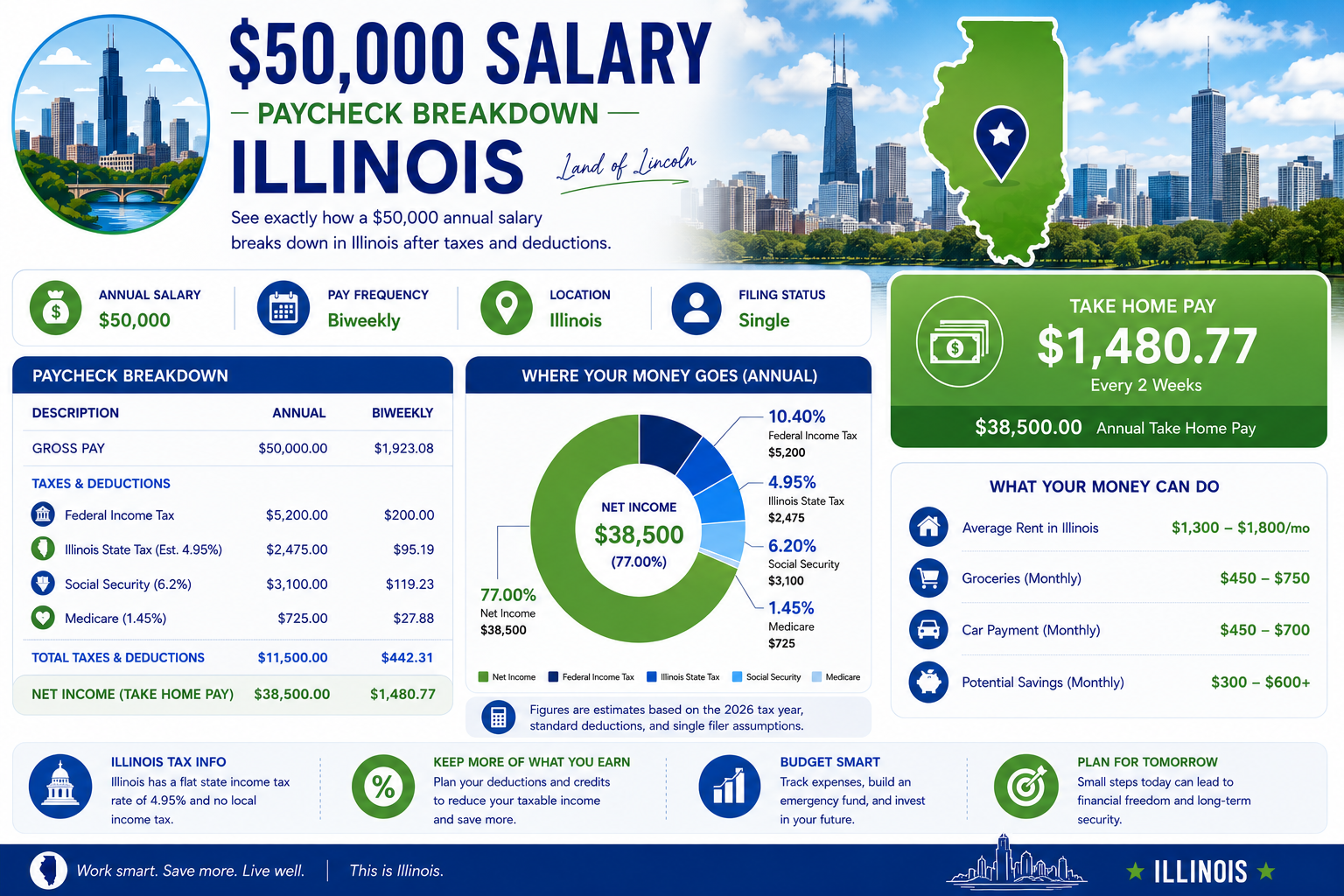
$50,000 Salary After Tax in Illinois (2026 Guide)
URL Slug: /50000-salary-after-tax-illinois-2026/
Meta Description: Discover exactly how much a $50,000 salary after tax in Illinois is in 2026. See federal, state & FICA breakdowns, monthly take-home pay, budgeting tips, and city-specific cost comparisons for Chicago, Aurora, Naperville & Springfield.
If you are earning $50,000 per year in Illinois, you probably want to know exactly how much ends up in your bank account each month. A $50,000 salary after tax in Illinois is not simply a matter of subtracting a flat percentage. Several deductions come into play, including federal income tax, Illinois state income tax, Social Security, and Medicare. Understanding your real take-home pay empowers you to plan your budget, decide where to live, and negotiate job offers with confidence.
Illinois uses a flat state income tax rate of 4.95%, which means every resident pays the same rate regardless of income level. While this simplifies the math compared to states with progressive brackets, the overall tax burden can still feel significant, especially in higher-cost metro areas like Chicago, Aurora, and Naperville. In contrast, cities such as Springfield offer more breathing room in your monthly budget.
All calculations in this guide are based on our Illinois paycheck calculator. We encourage you to use it for personalized results, because your exact take-home pay depends on factors like filing status, pre-tax deductions, and additional withholdings.
Table of Contents
- Quick Overview: $50K in Illinois
- Salary Breakdown Table
- How Your Taxes Are Calculated
- Tax Deduction Summary Table
- Illinois-Adjusted Budget Example
- Monthly Budget Table
- How Illinois Compares to Other States
- State Comparison Table & Chart
- Is $50,000 a Good Salary in Illinois?
- Tips to Increase Your Take-Home Pay
- FAQs – $50,000 Salary After Tax in Illinois
- Final Thoughts
Quick Overview: $50,000 Salary in Illinois
When you earn $50,000 in Illinois, your paycheck is affected by multiple layers of taxation. The federal government takes its share through a progressive income tax system, while Illinois applies its flat 4.95% rate on your taxable income. On top of that, FICA taxes for Social Security and Medicare are withheld automatically from every paycheck.
For a single filer taking the standard deduction, the combined tax bite reduces gross earnings by roughly 20%. That translates to about $10,140 in total taxes per year, leaving you with approximately $39,860 in annual take-home pay. On a monthly basis, you can expect around $3,322 deposited into your account after all mandatory withholdings.
Your bi-weekly paycheck, assuming 26 pay periods per year, comes to about $1,533. This figure is what you will actually see on your pay stub after taxes—a critical number for anyone budgeting rent, groceries, transportation, and savings in Illinois.
Salary Breakdown: Gross to Take-Home
| Pay Frequency | Gross Pay | Estimated Take-Home Pay |
|---|---|---|
| Annual | $50,000 | $39,860 |
| Monthly | $4,167 | $3,322 |
| Bi-Weekly (26 pay periods) | $1,923 | $1,533 |
| Weekly | $962 | $767 |
| Hourly (2,080 hours/year) | $24.04 | $19.16 |
These figures assume a single filing status with the standard deduction and no additional pre-tax contributions. Use our paycheck calculator for Illinois to adjust for your specific situation, including 401(k) contributions or health insurance premiums.
How Your Taxes Are Calculated on $50,000 in Illinois
Understanding where your money goes each paycheck is the first step toward smarter financial planning. Here is how the deductions stack up for a single filer earning $50,000 in Illinois during the 2026 tax year.
Federal Income Tax: The IRS uses a progressive bracket system. After applying the standard deduction (approximately $15,000 for a single filer in 2026), your taxable income drops to around $35,000. The first portion is taxed at 10%, and the remainder falls into the 12% bracket. The effective federal income tax rate on $50,000 gross is roughly 7.9%, resulting in approximately $3,962 withheld annually.
Illinois State Income Tax: Illinois imposes a flat 4.95% rate on taxable income after the standard exemption. For a $50,000 salary, this works out to roughly $2,355 per year. Unlike some neighboring states, Illinois does not have local city or county income taxes, which simplifies payroll calculations across Chicago, Aurora, Naperville, and Springfield alike.
Social Security & Medicare (FICA): Social Security takes 6.2% of your gross pay—about $3,100 annually on $50,000. Medicare claims another 1.45%, or $725 per year. Combined, FICA taxes total $3,825, and these are non-negotiable for W-2 employees.
Tax Breakdown Visualization
Tax Deduction Summary Table
| Tax Type | Annual Amount | Percentage of Gross |
|---|---|---|
| Federal Income Tax | $3,962 | 7.92% |
| Illinois State Tax (4.95% flat) | $2,355 | 4.71% |
| Social Security (6.2%) | $3,100 | 6.20% |
| Medicare (1.45%) | $725 | 1.45% |
| Total Taxes | $10,142 | 20.28% |
| Take-Home Pay | $39,858 | 79.72% |
Note: Totals are rounded to the nearest dollar. Slight variations may occur based on rounding in payroll systems. All calculations are derived from our Illinois paycheck calculator.
Illinois-Adjusted Budget on $50,000 After Tax
With a monthly take-home pay of approximately $3,322, crafting a realistic budget is essential. Your cost of living will vary dramatically depending on where in Illinois you reside. In Chicago, a one-bedroom apartment in a decent neighborhood can easily consume 40% or more of your take-home pay. In Aurora and Naperville, rents are somewhat lower but still elevated compared to the national average. Meanwhile, Springfield offers significantly more affordable housing options.
Property taxes in Illinois are among the highest in the nation, which affects renters indirectly through higher rental costs. If you own a home, property tax bills in some Chicago suburbs can exceed $5,000 per year even on modest homes. Factor this into your long-term planning if homeownership is a goal on a $50,000 salary.
Below is a sample budget tailored for a single person living in the Chicago metro area. Adjust the housing line item downward if you live in Springfield or other downstate communities.
Sample Monthly Budget (Chicago Metro)
| Expense Category | Estimated Monthly Cost | % of Take-Home Pay |
|---|---|---|
| Housing (Rent – 1BR) | $1,350 | 40.6% |
| Groceries & Household | $420 | 12.6% |
| Transportation (CTA/Metra or car) | $250 | 7.5% |
| Utilities & Internet | $200 | 6.0% |
| Health Insurance Premium | $180 | 5.4% |
| Entertainment & Dining | $250 | 7.5% |
| Savings & Emergency Fund | $350 | 10.5% |
| Remaining | $322 | 9.7% |
In Springfield, you could reduce housing costs to roughly $800–$950 per month, freeing up over $400 for additional savings or debt repayment. Adjusting your location is one of the most powerful levers for improving financial comfort on a $50,000 salary in Illinois.
How Illinois Compares to Other States on $50,000
Illinois sits in the middle of the pack when it comes to take-home pay on a $50,000 salary. States with no income tax, such as Texas, leave more money in your pocket. Neighboring Indiana, with its lower 3.05% flat rate, also offers a slight advantage. However, Illinois compares favorably to states like Wisconsin and Iowa, where effective tax rates at this income level can be higher due to progressive bracket structures.
Keep in mind that while some states have lower income taxes, they may recoup revenue through higher sales taxes, property taxes, or fees. Illinois has relatively high property taxes and a state sales tax rate of 6.25% (with local add-ons pushing it above 10% in Chicago). Always consider the full tax picture when comparing states.
Take-Home Pay Comparison: $50,000 Salary Across States
State-by-State Take-Home Comparison Table
| State | State Income Tax Rate | Est. Annual Take-Home on $50K |
|---|---|---|
| Texas | 0% (No state income tax) | $42,200 |
| Indiana | 3.05% flat | $40,800 |
| Missouri | Progressive (2.0%–4.95%) | $39,900 |
| Illinois | 4.95% flat | $39,860 |
| Wisconsin | Progressive (3.5%–7.65%) | $39,400 |
| Iowa | Progressive (4.4%–5.7%) | $39,300 |
Estimates are for single filers with standard deductions. Actual take-home pay varies. Visit calculate your salary in Illinois for precise figures.
Is $50,000 a Good Salary in Illinois in 2026?
The answer depends heavily on your location, lifestyle, and financial obligations. In Springfield or other downstate communities, $50,000 provides a comfortable middle-class lifestyle. You can afford a decent apartment, save for retirement, and still have discretionary income for travel or hobbies.
In the Chicago metro area—including Aurora and Naperville—the picture changes. Housing costs consume a much larger share of your income, and the overall cost of living runs about 15–20% above the national average. On $50,000 in Chicago, you will need to budget carefully, consider roommates, or live in outer neighborhoods to maintain financial stability.
For a single person with minimal debt, $50,000 is a solid foundation. For a family of four, this salary would be challenging anywhere in Illinois without a second income. The key is understanding your $50,000 salary after tax in Illinois and aligning your housing and lifestyle choices accordingly.
Tips to Increase Your Take-Home Pay in Illinois
1. Adjust Your W-4 Withholdings
Many taxpayers over-withhold and receive large refunds. While a refund feels rewarding, it means you gave the government an interest-free loan. Use the IRS withholding calculator to align your W-4 with your actual tax liability, boosting each paycheck.
2. Contribute to Pre-Tax Retirement Accounts
Contributions to a 401(k) or traditional IRA reduce your taxable income for both federal and Illinois state tax purposes. Even contributing 5% of your salary ($2,500/year) lowers your tax bill while building long-term wealth.
3. Use an HSA or FSA
Health Savings Accounts and Flexible Spending Accounts allow you to pay for medical expenses with pre-tax dollars. In Illinois, HSA contributions are also deductible on your state return, providing a double tax benefit.
4. Explore Remote Work Opportunities
If your job allows remote work, consider living in a lower-cost Illinois city like Springfield or Rockford while earning a Chicago-based salary. This geographic arbitrage can dramatically improve your disposable income.
Want to see exactly how much you keep after taxes?
Calculate Your Real Take-Home Pay in Seconds$50,000 Salary After Tax in Illinois – FAQs
How much is a $50,000 salary after tax in Illinois per month?
For a single filer in 2026, a $50,000 salary in Illinois yields approximately $3,322 per month in take-home pay after federal income tax, Illinois state tax, Social Security, and Medicare deductions. This assumes standard deductions and no additional pre-tax contributions.
What is the Illinois state income tax rate for a $50,000 salary?
Illinois uses a flat income tax rate of 4.95% on all taxable income, regardless of how much you earn. For a $50,000 salary, the state tax amounts to roughly $2,355 annually after the standard exemption is applied.
Can you live comfortably in Chicago on a $50,000 salary?
Living comfortably in Chicago on $50,000 requires careful budgeting. With monthly take-home pay around $3,322, rent for a one-bedroom apartment in many neighborhoods ranges from $1,200 to $1,800. Choosing a less expensive neighborhood, using public transit, and limiting dining out can make it feasible for a single person.
How does Illinois compare to Indiana for take-home pay on $50,000?
Indiana's flat state income tax rate is 3.05%, compared to Illinois' 4.95%. On a $50,000 salary, an Indiana resident takes home roughly $940 more per year than someone in Illinois. However, Indiana may have different property tax structures and local costs to consider.
What is the bi-weekly paycheck for a $50,000 salary in Illinois?
The bi-weekly take-home paycheck for a $50,000 salary in Illinois is approximately $1,533, assuming 26 pay periods per year. This reflects all standard deductions for a single filer using the default tax settings.
Does Illinois tax Social Security or retirement income?
No. Illinois is one of the few states that does not tax Social Security benefits, pension income, or retirement account withdrawals. This makes Illinois a relatively retiree-friendly state from an income tax perspective, despite its higher property taxes.
How can I reduce my Illinois state tax liability?
You can reduce your Illinois state tax liability by contributing to pre-tax retirement accounts like a 401(k) or traditional IRA, using an HSA, and claiming all available tax credits. Since Illinois uses a flat rate, the primary strategy is lowering your taxable income rather than shifting brackets.
Is $50,000 a good salary in Naperville or Aurora, Illinois?
In Naperville and Aurora, $50,000 is modest but manageable for a single person. Naperville's cost of living is higher than Aurora's, particularly for housing. Expect to allocate 35–45% of take-home pay to rent. Budgeting and limiting discretionary spending are key to making this salary work comfortably in these Chicago suburbs.
Final Thoughts: Understanding Your Take-Home Pay
A $50,000 salary after tax in Illinois provides a take-home pay of roughly $39,860 per year, or $3,322 monthly. While Illinois' flat 4.95% income tax is straightforward, the combined weight of federal and FICA taxes still claims about 20% of your gross earnings. Your financial comfort on this salary hinges on where you choose to live—Springfield offers breathing room, while Chicago and Naperville demand stricter budgeting.
The most important step you can take is to run your own numbers. Tax situations vary based on filing status, dependents, pre-tax contributions, and other factors. Our paycheck calculator gives you a personalized estimate in seconds, helping you plan with confidence rather than guesswork.
By understanding exactly where your money goes, you can make informed decisions about housing, savings, and career moves. Whether you are negotiating a job offer in Aurora or planning a move to Chicago, knowing your true take-home pay is the foundation of financial success in Illinois.
See exactly how much you keep after taxes—try the free calculator now.
Calculate Your Illinois Paycheck NowDisclaimer
This guide was reviewed by a financial analyst with expertise in U.S. payroll systems and state-level tax policy. The content is produced by the State Paycheck Calculator team, which is dedicated to providing accurate, transparent, and up-to-date salary and tax information for every state. Our tools and articles are trusted by thousands of users each month to make informed financial decisions. We reference official IRS publications and Illinois Department of Revenue guidance to ensure reliability.