

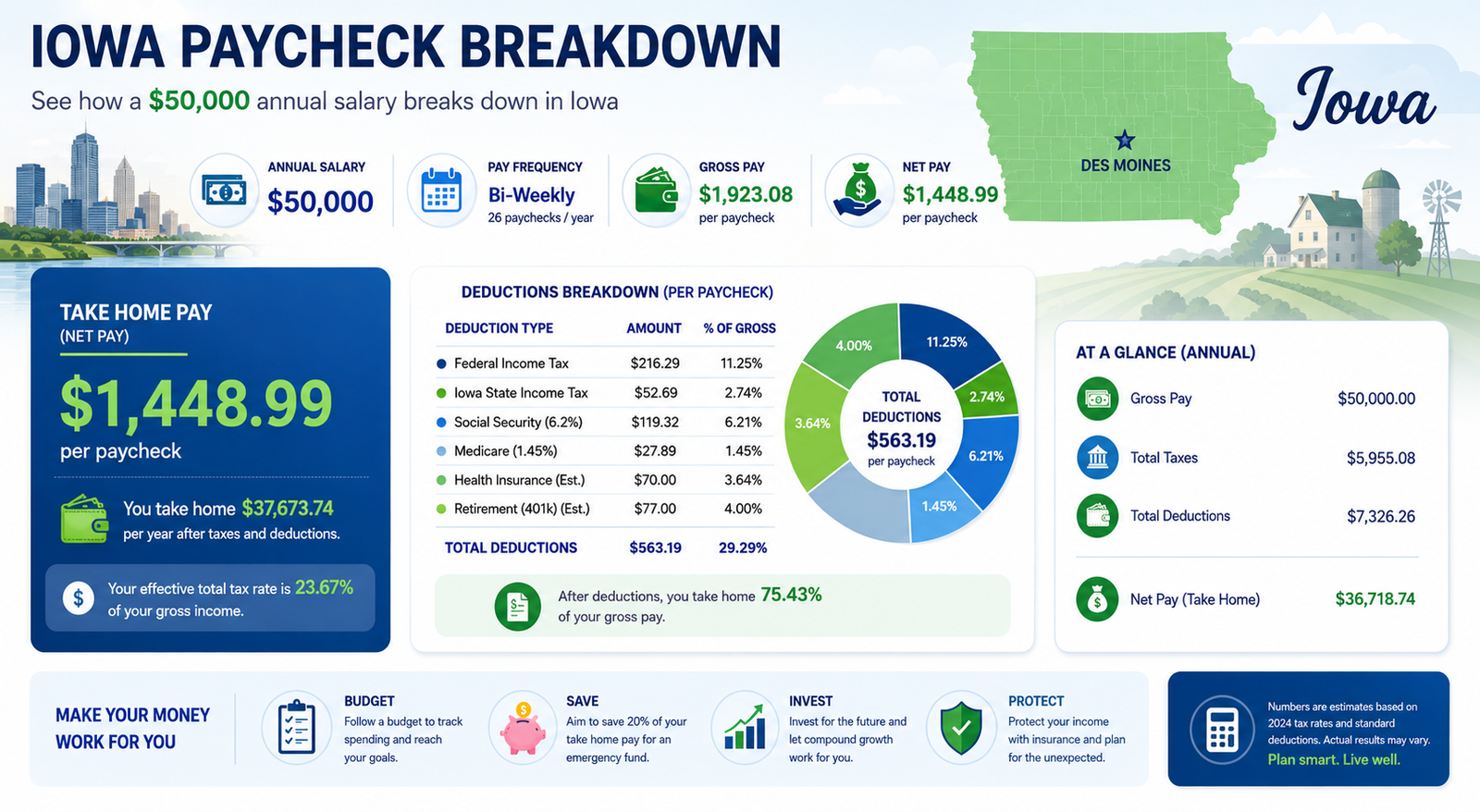
$50,000 Salary After Tax in Iowa (2026 Guide)
Table of Contents
If you earn $50,000 a year in Iowa—or you’re considering a job offer in the Hawkeye State—you’re probably wondering: how much will I actually take home after taxes? The answer depends on federal withholding, Iowa’s progressive income tax, and FICA deductions. This guide gives you the real numbers without guesswork.
All calculations in this guide are based on our Iowa paycheck calculator. You can plug in your own details anytime to see a personalized breakdown. We also highlight how Iowa’s lower-than-average living costs stretch your paycheck further—especially in cities like Des Moines, Cedar Rapids, and Davenport.
Salary Overview: $50,000 in Iowa
Iowa offers a unique blend of affordable housing, moderate taxes, and a strong job market. While the state uses a progressive income tax system, the effective rate on a $50,000 income is quite manageable. The federal standard deduction in 2026 still shelters a significant portion of your earnings.
Living costs in Iowa are roughly 10% below the national average, and in metros like Iowa City or Cedar Rapids, your dollar goes further than it would in neighboring Illinois or Minnesota. That means your take-home pay of around $3,299 per month can cover a comfortable lifestyle with room to spare.
Gross to Net Pay at a Glance
| Pay Frequency | Gross Pay | Net Pay (Take-Home) |
|---|---|---|
| Annual | $50,000 | $39,588 |
| Monthly | $4,167 | $3,299 |
| Biweekly | $1,923 | $1,522 |
| Weekly | $962 | $761 |
| Hourly (2080 hrs) | $24.04 | $19.03 |
These figures assume a single filing status with no additional deductions beyond the standard. Use our paycheck calculator for Iowa to adjust for marital status, pre-tax contributions, or extra withholdings.
Where Your Money Goes: Tax Breakdown
Understanding each deduction helps you plan better. Here’s exactly how $50,000 gets divided between taxes and your pocket.
The largest deduction is federal income tax, followed closely by Social Security. Iowa’s state tax comes in lower than many neighbors, which is a big plus for your net pay.
Complete Tax Component Table
| Tax Component | Annual Amount | Percentage of Gross |
|---|---|---|
| Federal Income Tax | $3,962 | 7.92% |
| Iowa State Income Tax | $2,625 | 5.25% |
| Social Security (6.2%) | $3,100 | 6.20% |
| Medicare (1.45%) | $725 | 1.45% |
| Total Deductions | $10,412 | 20.82% |
| Take-Home Pay | $39,588 | 79.18% |
All calculations in this guide are based on our Iowa paycheck calculator. The state tax effective rate of 5.25% reflects Iowa’s progressive brackets, but your marginal rate may hit 6% on income above $30,000.
Realistic Monthly Budget on $3,299 Take-Home
Living in Iowa on $50,000 is entirely possible without feeling stretched. Here’s a sample budget that works in Des Moines, Cedar Rapids, or Davenport—places where one-bedroom rents often hover between $800 and $1,050.
Iowa-Adjusted Monthly Budget
| Expense Category | Monthly Allocation |
|---|---|
| Housing (Rent/Mortgage) | $1,000 |
| Utilities & Internet | $240 |
| Groceries | $430 |
| Transportation | $280 |
| Health Insurance/Premiums | $200 |
| Savings & Emergency | $450 |
| Discretionary & Entertainment | $340 |
| Remaining | $359 |
This leaves a comfortable buffer, and if you live in a smaller town like Waterloo or Ames, housing costs can drop even lower—freeing up more cash for savings or paying down debt.
Iowa vs. Neighboring States: Take-Home on $50,000
Iowa’s net pay holds up well against nearby states. Here’s how a $50k salary translates after taxes in a few Midwest neighbors, according to our salary calculators.
Missouri often leads with slightly lower state taxes, while Minnesota’s higher rates reduce take-home pay by over $1,000 compared to Iowa. Still, the differences are modest, and Iowa’s lower housing costs can compensate for the tax gap.
| State | Approx. Take-Home | Effective Tax Rate |
|---|---|---|
| Iowa | $39,588 | 20.8% |
| Missouri | $40,800 | 18.4% |
| Nebraska | $40,100 | 19.8% |
| Illinois | $39,900 | 20.2% |
| Minnesota | $38,500 | 23.0% |
Is $50,000 a Good Salary in Iowa?
Yes—a $50,000 salary in Iowa is widely regarded as solid middle-class income. The state’s low cost of living and affordable housing in cities like Cedar Rapids, Davenport, and even parts of Des Moines mean you can live comfortably, save money, and still enjoy leisure activities.
For a single person, this income easily covers a one-bedroom apartment, car payment, groceries, and a decent savings rate. For a dual-income household, two $50,000 earners can afford a nice home in a good neighborhood with money left for travel and investments.
Additionally, many Iowa employers offer benefits like health insurance and retirement plans, which can further increase your financial security without raising your gross pay.
5 Ways to Boost Your Take-Home Pay in Iowa
- Contribute to a 401(k) or IRA: Pre-tax contributions reduce your taxable income, lowering both federal and state taxes immediately.
- Use a Health Savings Account (HSA): If you have a high-deductible health plan, HSA contributions are triple tax-advantaged.
- Adjust your W-4 withholdings: Use our calculate your salary in Iowa tool to fine-tune withholding and avoid large refunds.
- Check for Iowa tax credits: Depending on your situation, credits for education expenses or child care can lower your state tax bill.
- Negotiate non-taxable benefits: Remote work stipends, tuition assistance, or commuter benefits can effectively increase your disposable income.
You can also explore FreeAiden for free AI‑powered tools including QR code generators, barcode generators, PDF converters, image utilities, and other productivity tools—perfect if you’re managing side projects or a small business to supplement your income.
$50,000 Salary After Tax in Iowa – FAQs
What is the take-home pay for a $50,000 salary in Iowa in 2026?
You’ll take home about $39,588 yearly, or $3,299 per month, after all mandatory deductions.
Is $50,000 a good salary in Iowa compared to the national average?
Yes. With Iowa’s cost of living roughly 10% below the national average, $50,000 offers purchasing power similar to earning $55,000–$58,000 in a more expensive state.
How much is deducted for Social Security and Medicare?
Social Security takes 6.2% ($3,100) and Medicare 1.45% ($725) annually. Together they total $3,825.
Does Iowa tax retirement income on a $50,000 salary?
Iowa does not tax Social Security benefits, and retirement account withdrawals may have partial exemptions. This mainly benefits retirees, but it’s worth noting for long-term planning.
What’s the hourly rate on a $50,000 salary in Iowa?
Your gross hourly rate is approximately $24.04, and after taxes it drops to about $19.03 per hour (based on 2,080 working hours).
Can I afford a house in Des Moines on $50,000?
With median home prices in Des Moines near $230,000, a $50,000 income can support a mortgage if you have a moderate down payment and low debt. Many first-time buyers succeed with this salary.
Disclaimer
What This Means for Your Salary
Earning $50,000 in Iowa places you in a comfortable financial position. Your take-home pay of around $3,299 per month gives you flexibility, whether you’re living in Iowa City, Cedar Rapids, or a smaller town. Iowa’s reasonable tax burden and low everyday expenses make this income go remarkably far.
Now that you know the numbers, take the next step: plug your exact details into the paycheck calculator for Iowa and see exactly how much you keep after taxes. A small change in withholding or pre-tax contributions can make a noticeable difference.