

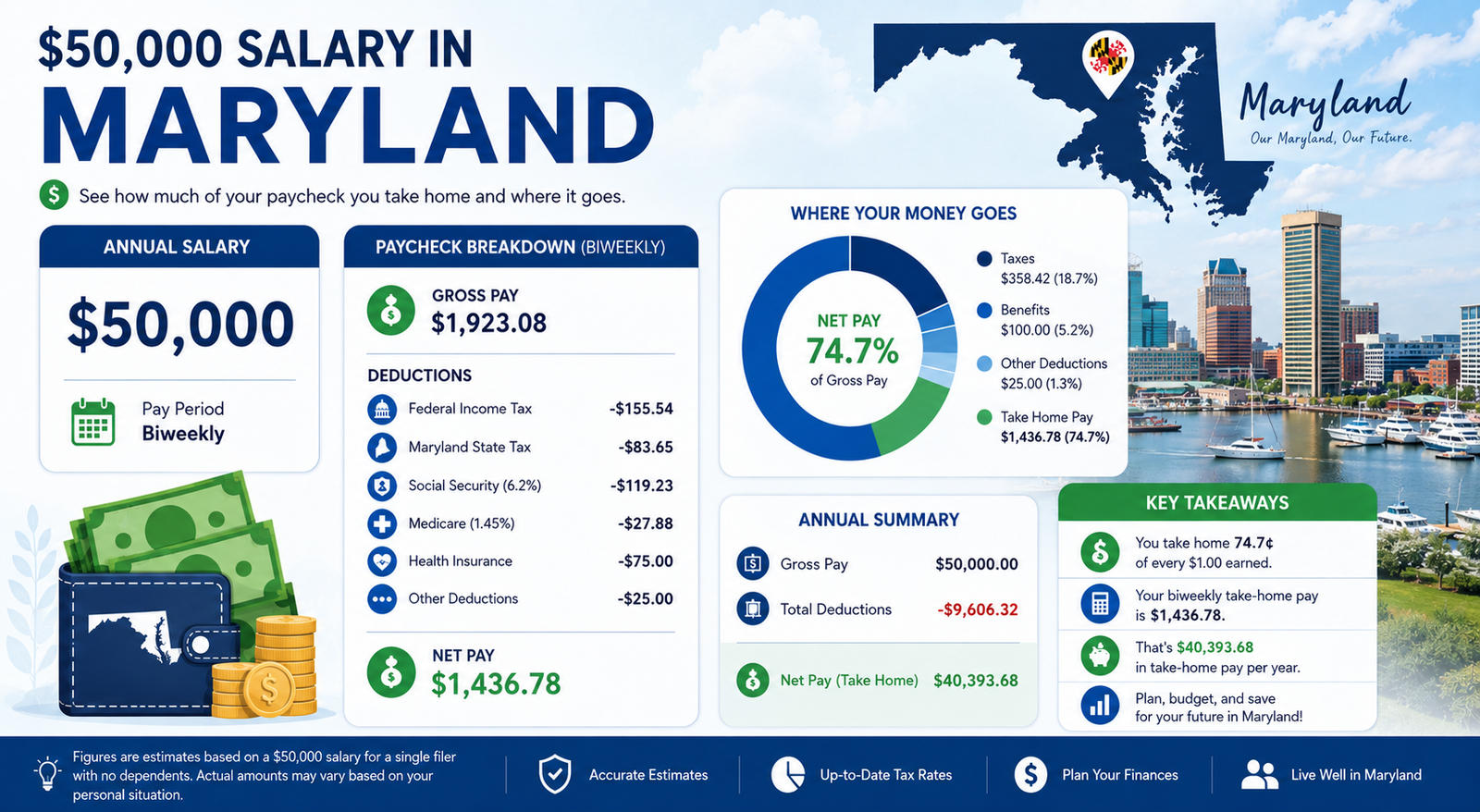
$50,000 Salary After Tax in Maryland (2026 Guide)
If you’ve just landed a job offer for $50,000 a year in Maryland—or you’re planning a move to the Old Line State—you’re probably wondering how much of that salary actually ends up in your bank account. Maryland’s tax system is one of the most complex in the country, combining federal, state, and county-level income taxes that vary depending on exactly where you live.
This guide breaks down exactly what a $50,000 salary after tax in Maryland looks like in 2026. We use real calculated numbers, not estimates, and we’ll walk you through everything from your monthly take‑home pay to a realistic budget for Baltimore, Annapolis, Frederick, and Rockville.
All calculations in this guide are based on our Maryland paycheck calculator. No guesswork—just the numbers you need to make smart financial decisions.
- $50,000 Gross to Net: The Overview
- Monthly & Biweekly Take‑Home Pay Table
- How Maryland Taxes Your Paycheck
- Complete Tax Breakdown Table
- Can You Live Comfortably on $50K in Maryland?
- Sample Monthly Budget (Baltimore/Rockville)
- Maryland vs. Neighboring States
- Take‑Home Comparison Chart
- Is $50,000 a Good Salary in Maryland?
- 5 Ways to Increase Your Take‑Home Pay
- FAQs – $50,000 Salary After Tax in Maryland
- Disclaimer
- Understanding Your Take‑Home Pay
$50,000 Gross to Net: The Overview
Before we dive into the detailed tables, let’s set the stage. A $50,000 annual salary in Maryland gets hit with three layers of income tax: federal, Maryland state, and a county “piggyback” tax that’s added on top of your state liability. On top of that, you have FICA taxes (Social Security and Medicare).
When we run the numbers through the Maryland paycheck calculator, a single filer with no special adjustments ends up with around $38,736 in after‑tax income. That means you keep roughly 77.5% of your gross pay, while about 22.5% goes to various taxes.
However, Maryland’s county tax rates range from 2.25% all the way up to 3.2% of Maryland taxable income. So someone in Worcester County (lower rate) might see a few hundred dollars more per year than a resident of Baltimore County or Montgomery County.
Calculate Your Real Take‑Home Pay in Seconds →
Monthly & Biweekly Take‑Home Pay at $50,000
Here’s how that annual after‑tax income breaks down into the pay periods most people actually see. We assume a standard full‑time schedule and the typical 3.2% county tax.
| Pay Frequency | Gross Pay | After‑Tax Pay |
|---|---|---|
| Annual | $50,000.00 | $38,736.00 |
| Monthly | $4,166.67 | $3,228.00 |
| Biweekly (every 2 weeks) | $1,923.08 | $1,490.62 |
| Weekly | $961.54 | $745.31 |
These figures come directly from the paycheck calculator for Maryland. If your employer offers 26 biweekly paychecks instead of 24 semi‑monthly ones, the biweekly amount remains the same as shown above.
How Maryland Taxes Your Paycheck
Maryland is one of the few states that allow counties to levy their own income taxes. On a $50,000 salary, here’s what’s happening behind the scenes with each deduction.
Federal Income Tax
For a single filer in 2026, the standard deduction is projected to be $15,000 (adjusted for inflation). That leaves a taxable income of $35,000. Most of that falls into the 12% bracket, with a small portion in the 10% bracket. The result is approximately $3,962 in federal income tax.
Maryland State Income Tax
Maryland’s state rates are progressive, starting at 2% and reaching 4.75% for income over $3,000. After subtracting Maryland’s own standard deduction and personal exemption, your state taxable income lands around $44,400. The state income tax works out to roughly $2,057.
County (Local) Income Tax
Every Maryland county adds a flat percentage on top of the state taxable income. For a county with a 3.2% rate—such as Baltimore County or Montgomery County—that’s an extra $1,421. In lower‑tax counties like Frederick (2.96%) or Anne Arundel (2.81%), you’ll keep slightly more.
FICA (Social Security & Medicare)
Social Security (6.2%) and Medicare (1.45%) apply to your entire $50,000 gross salary. That’s a fixed $3,825 per year. These aren’t affected by your W‑4 or county of residence.
Complete Tax Breakdown Table
| Tax Category | Annual Amount | Percentage of Gross |
|---|---|---|
| Federal Income Tax | $3,962 | 7.92% |
| Maryland State Tax | $2,057 | 4.11% |
| County Tax (3.2% example) | $1,421 | 2.84% |
| Social Security | $3,100 | 6.20% |
| Medicare | $725 | 1.45% |
| Total Taxes | $11,264 | 22.53% |
| After‑Tax Take‑Home | $38,736 | 77.47% |
Data source: Maryland paycheck calculator. Figures rounded to nearest dollar.
Where Your Money Goes
Percentages are of total tax ($11,264)
Can You Live Comfortably on $50K in Maryland?
Whether $50,000 feels comfortable depends heavily on where in Maryland you live. The closer you get to Washington D.C., the higher the cost of living—especially housing. In Baltimore or Frederick, your money stretches further, but you still need a careful budget.
Let’s build a realistic monthly spending plan for a single person renting a one‑bedroom apartment and following the 50/30/20 rule (needs/wants/savings). We’ll adjust for Maryland’s higher utility and transportation costs compared to the national average.
Sample Monthly Budget for a $50,000 Earner in Maryland
| Expense Category | Monthly Cost (Baltimore Co.) | Monthly Cost (Rockville/Montgomery Co.) |
|---|---|---|
| After‑Tax Income | $3,228 | $3,228 (slightly lower with 3.2%) |
| Rent (1‑bedroom) | $1,350 | $1,850 |
| Utilities + Internet | $210 | $230 |
| Groceries | $380 | $420 |
| Transportation | $250 | $280 |
| Health Insurance | $180 | $180 |
| Savings & Debt | $350 | $200 |
| Discretionary | $508 | $68 |
In Baltimore County, you could maintain a modest but comfortable lifestyle with room for entertainment and saving. In pricey Montgomery County near D.C., the same salary leaves almost no breathing room. That’s why many $50K earners in the D.C. suburbs choose to have roommates or live farther out.
As you organize your finances, you might also need quick tools for tasks like creating a QR code for a rent payment link, converting a PDF pay stub, or generating a barcode for an invoice. FreeAiden offers free online AI‑powered utilities including QR code generators, barcode makers, PDF converters, and image tools—simple helpers that save you time without any cost.
See Exactly How Much You Keep After Taxes →
Maryland vs. Neighboring States: Who Takes Less?
Maryland’s total tax bite feels steep when you compare it to some neighbors. Virginia has a lower top rate and no county income tax, while Pennsylvania uses a flat 3.07% state tax with no local add‑ons. However, the District of Columbia often takes an even larger share for incomes in this range.
Take‑Home Pay: $50,000 Salary Across Four Jurisdictions
As you can see, Pennsylvania leaves the most in your pocket, while D.C. taxes more aggressively. Maryland sits in the middle—but the specific county you choose makes a real difference.
Is $50,000 a Good Salary in Maryland in 2026?
That depends on your lifestyle and location. In Baltimore City or western Maryland, $50,000 can cover a decent apartment, a used car, and some savings. In the Washington D.C. metro area—especially Montgomery or Prince George’s counties—it’s tight. The area’s strong government, defense, and healthcare job markets keep salaries competitive, but they also push up rents and commuting costs.
Generally, $50,000 is considered slightly below the median household income in many Maryland counties, but for a single person without dependents, it’s workable. The key is to adjust your housing expectations and use the Maryland paycheck calculator to plan your budget before signing a lease.
5 Ways to Increase Your Take‑Home Pay on a $50K Salary
- Adjust your W‑4 withholding. If you consistently receive a large refund, you’re giving the government an interest‑free loan. Use the IRS withholding estimator to align your deductions.
- Contribute to a 401(k) or IRA. Pre‑tax retirement contributions reduce your taxable income now, lowering both federal and Maryland state taxes.
- Use an HSA or FSA. Health savings accounts let you pay medical expenses with pre‑tax dollars, effectively increasing your take‑home for qualified costs.
- Consider a lower‑tax county. If you have flexibility, moving from a 3.2% county to one with a 2.5% rate can save you over $300 a year.
- Double‑check your Maryland tax return. Many filers miss the state’s standard deduction or personal exemption, leading to overpayment. A quick review can put money back in your pocket.
$50,000 Salary After Tax in Maryland – FAQs
How much is a $50,000 salary after taxes in Maryland per month?
After all deductions, a $50,000 salary typically yields around $3,228 per month for a single person. This assumes standard withholding and a county tax rate of 3.2%. With a lower county rate, monthly take‑home could be as high as $3,270.
What is the Maryland county tax rate for a $50,000 earner in Baltimore?
Baltimore City and Baltimore County both have a local income tax rate of 3.2% on Maryland taxable income. For a $50,000 salary, that translates to roughly $1,421 annually in county taxes alone.
Can a single person live comfortably on $50K in Frederick, MD?
Frederick County’s income tax rate is 2.96%, which is a bit lower than Baltimore’s. Combined with slightly lower rent than the D.C. suburbs, many singles find $50,000 manageable with a roommate or a modest one‑bedroom apartment.
Is $50,000 a year a good salary in Annapolis?
Annapolis (Anne Arundel County) has a 2.81% local tax rate, making it one of the more affordable mid‑range counties tax‑wise. However, housing costs near the city center and waterfront can be high. Budgeting is essential.
How does Maryland’s tax on $50K compare to Virginia?
Virginia’s state income tax is generally lower than Maryland’s, and it has no county income tax. A $50,000 earner in Virginia might keep about $700–$800 more per year compared to a Maryland resident in a high‑tax county.
Does Maryland tax Social Security or retirement income on a $50,000 salary?
Maryland does not tax Social Security benefits, and it offers a pension exclusion for many retirees. However, if you’re still earning $50,000 in wages, those retirement income exclusions won’t apply to your paycheck.
What deductions can reduce my Maryland state taxable income?
Maryland allows a standard deduction ($2,400 for single filers in 2026) and a personal exemption ($3,200). You can also deduct certain pre‑tax contributions like 401(k) plans, which lower both federal and state taxable income.
How accurate is the Maryland paycheck calculator for Rockville residents?
The calculator uses Montgomery County’s exact 3.2% rate and current state tax brackets. It’s designed to reflect actual 2026 withholding tables. For the most precise figure, enter your specific deductions and filing status.
Disclaimer
Important: All tax figures in this article are estimates based on the 2026 tax year assumptions and the Maryland paycheck calculator. Actual take‑home pay may vary depending on your specific W‑4 elections, pre‑tax deductions, and any additional local taxes. This content is for informational purposes only and does not constitute financial, tax, or legal advice. Always consult a qualified professional or use the Maryland paycheck calculator to get numbers tailored to your situation.
Understanding Your Take‑Home Pay
A $50,000 salary after tax in Maryland gives you a real‑world income of roughly $38,736 per year. That’s the number you should use when planning your rent, savings goals, and daily spending. While the state’s layered tax system can feel complicated, knowing exactly where your money goes helps you make smarter choices about where to live and how to budget.
Whether you’re in Baltimore, Annapolis, Frederick, or Rockville, your after‑tax pay fluctuates by hundreds of dollars a year based on county rates. The best move you can make right now is to see your own numbers.