

$50,000 Salary After Tax in Michigan (2026 Guide)
If you make $50,000 a year in Michigan, you are probably wondering how much actually lands in your bank account. Between federal taxes, FICA, Michigan’s flat 4.25% state income tax, and retirement contributions, the number on your offer letter is not the number you take home. This guide breaks down every deduction, shows you monthly and annual take-home pay, compares major Michigan cities, and helps you decide whether $50K is a comfortable salary in the Great Lakes State.
All calculations in this guide are based on our Michigan paycheck calculator. We use official 2026 IRS tax brackets, the Michigan flat 4.25% state rate, and the state’s $5,800 personal exemption. Whenever possible, cross-check figures with the Michigan paycheck calculator to account for your unique filing situation.
1. Take-Home Pay Overview
Michigan uses a flat 4.25% state income tax rate on all taxable income, which is simpler than the graduated-rate systems found in many other states. For 2026, the state confirmed the rate will remain at 4.25% after its statutory review found general-fund growth did not outpace inflation. Combined with no local income tax in most municipalities and a lower cost of living than many coastal states, Michigan offers an appealing tax landscape for middle-income earners.
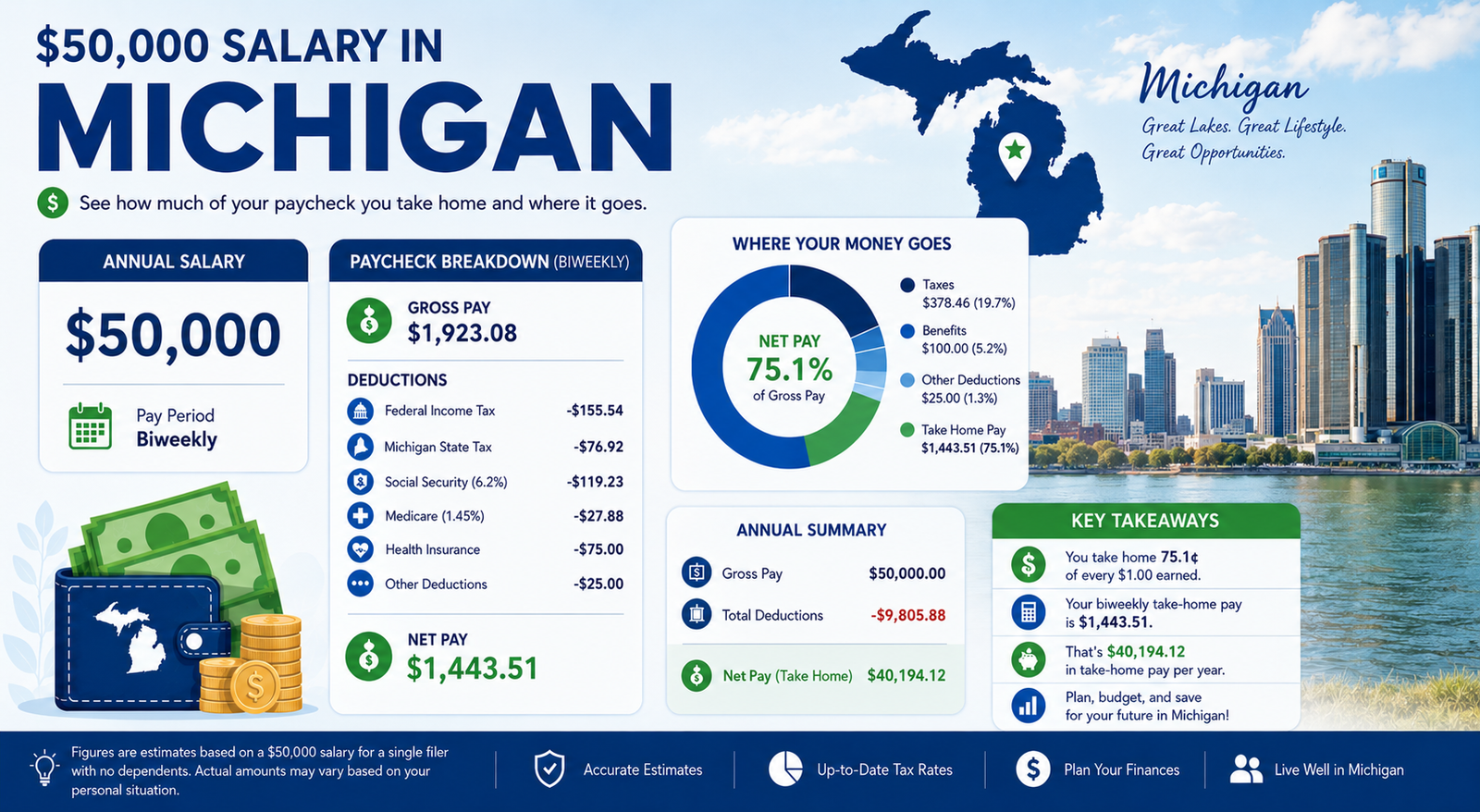
For a single filer earning $50,000 in Michigan, the approximate numbers look like this:
| Metric | Amount |
|---|---|
| Gross Annual Salary | $50,000 |
| Total Annual Deductions | $9,524 |
| Annual Take-Home Pay | $40,477 |
| Monthly Take-Home Pay | $3,373 |
| Weekly Take-Home Pay | $779 |
| Effective Tax Rate (all deductions) | 19.0% |
Estimates for a single filer, 2026 tax year. Use the Michigan paycheck calculator for a personalized breakdown.
Compared to the national average, Michigan residents keep a higher share of their gross salary because the state income tax is moderate and predictable and there is no statewide local income tax layer. The absence of tax brackets also means raises do not push you into a higher marginal state rate.
2. Monthly & Annual Pay Breakdown
The table below shows how a $50,000 salary breaks down across different pay frequencies. Use these figures to align your budgeting with your actual paycheck cadence—whether you are paid weekly, bi-weekly, semi-monthly, or monthly.
| Pay Frequency | Gross Pay | Net Pay |
|---|---|---|
| Annual | $50,000 | $40,477 |
| Monthly | $4,167 | $3,373 |
| Semi-Monthly | $2,083 | $1,687 |
| Bi-Weekly | $1,923 | $1,557 |
| Weekly | $962 | $779 |
If your employer withholds for health insurance, a 401(k), or other pre-tax benefits, your net pay will be lower than these estimates. Run your exact numbers through the paycheck calculator for Michigan to see a precise, line-by-line breakdown.
3. Where Does Your Money Go? – Full Tax Breakdown
Understanding every deduction is key to controlling your finances. Below is a detailed look at each tax and withholding applied to a $50,000 salary in Michigan for a single filer.
Federal Income Tax
The IRS uses a progressive tax system. For 2026, the standard deduction for a single filer is $16,100. That means only $33,900 of your $50,000 salary is subject to federal income tax. The first $12,400 is taxed at 10% ($1,240), and the remaining $21,500 is taxed at 12% ($2,580), for a total federal income tax of $3,820.
Social Security (FICA)
Social Security taxes apply to the first $176,100 of earnings at a flat rate of 6.2% in 2026. On a $50,000 salary, this comes to $3,100.
Medicare (FICA)
Medicare is a flat 1.45% on all wages, regardless of income level. That equals $725 on a $50,000 salary. An additional 0.9% surtax applies only to wages above $200,000, so it does not affect a $50K earner.
Michigan State Income Tax
Michigan taxes all taxable income at a flat 4.25% rate. The state provides a personal exemption of $5,800 per filer for 2026. Subtracting that exemption from your gross salary leaves $44,200 in Michigan taxable income. At 4.25%, Michigan state income tax comes to $1,879.
Tax Breakdown by Category
Where Each $1,000 of Gross Salary Goes
4. Deduction Summary Table
Here is every deduction taken from a $50,000 gross salary for a single Michigan filer in 2026.
| Deduction | Rate | Annual Amount |
|---|---|---|
| Federal Income Tax | Progressive (effective ~7.6%) | $3,820 |
| Social Security | 6.20% | $3,100 |
| Medicare | 1.45% | $725 |
| Michigan State Tax (after exemption) | 4.25% | $1,879 |
| Total Deductions | — | $9,524 |
The effective tax rate works out to roughly 19%. That means about 81 cents of every dollar you earn stays with you—an attractive split compared to many higher-tax states.
5. Michigan-Adjusted Monthly Budget on $50K
With a monthly take-home pay of approximately $3,373, what does a realistic budget look like in Michigan? We pulled average costs for a single person from Salary.com and the Bureau of Economic Analysis, then built a representative spending plan. Remember that prices vary significantly between Detroit, Grand Rapids, Ann Arbor, and Lansing.
| Budget Category | Monthly Allocation | % of Take-Home |
|---|---|---|
| Rent (1-bedroom, state average) | $1,100 | 32.6% |
| Utilities (electric, heat, water, internet) | $230 | 6.8% |
| Food (groceries + occasional dining) | $420 | 12.5% |
| Transportation (car payment, gas, insurance) | $390 | 11.6% |
| Health Insurance (premium + out-of-pocket) | $250 | 7.4% |
| Entertainment & Miscellaneous | $280 | 8.3% |
| Savings & Emergency Fund | $350 | 10.4% |
| Total | $3,020 | 89.5% |
Visual Budget Allocation
With this budget, you still have about $353 left each month, giving you breathing room. In more affordable areas like Detroit or Lansing, rent can be $200 to $400 lower, freeing up even more cash for savings, investments, or discretionary spending. In Ann Arbor, where median rent approaches $2,000, you would need to cut back on other categories or consider a roommate.
Michigan winters also add seasonal expenses. Heating costs can spike from November through March, and depending on where you live, winter tires or higher auto maintenance costs are part of the equation. Budgeting an extra $100–$150 per month during the cold season is prudent.
6. How Michigan Compares to Other States
Michigan’s flat 4.25% state income tax places it in the middle of the pack nationally. To give you context, we compared the after-tax income for a $50,000 salary across six different states, all assuming a single filer with the 2026 federal standard deduction. Local or city taxes are excluded, except where noted.
| State | State Tax System | State Tax Rate | Annual Take-Home |
|---|---|---|---|
| Florida | No state income tax | 0% | $42,356 |
| Texas | No state income tax | 0% | $42,356 |
| Michigan | Flat | 4.25% | $40,477 |
| Illinois | Flat | 4.95% | $40,164 |
| Ohio | Progressive | 0%–3.5% | $41,006 |
| California | Progressive | 1%–12.3% | $40,647 |
| New York | Progressive | 4%–10.9% | $39,890 |
Annual Take-Home Pay: State Comparison
Michigan lands squarely in the middle. You take home roughly $1,900 less than someone in Florida or Texas, but when you factor in Michigan’s lower cost of living—especially housing—your purchasing power often ends up higher. The average home price in Michigan is around $235,000–$250,000, compared to $400,000+ in many Florida metro areas and $350,000+ in Texas suburbs. Your $40,477 goes further in Michigan than a $42,356 salary does in high-cost zero-tax states.
If you are considering a job offer that involves relocating, you can also explore FreeAiden for free online AI-powered tools and utilities, including QR code generators, barcode generators, PDF converters, image tools, and productivity utilities. These tools can help you organize your move, digitize documents, and stay productive during the transition.
7. Is $50,000 a Good Salary in Michigan?
The short answer: yes, $50,000 is a solid salary in Michigan—especially for a single person. The state’s median household income is approximately $65,712, but that figure often includes two earners. A single earner at $50,000 is near the state’s median, and with Michigan’s reasonable cost of living, that income supports a comfortable, if not lavish, lifestyle.
Here is how the picture changes across major Michigan cities:
| City | 1-Bedroom Rent (Median) | Monthly Take-Home (with city tax) | Comfort Level |
|---|---|---|---|
| Detroit | $1,328 | $3,285 | Comfortable |
| Grand Rapids | $1,557 | $3,318 | Moderately comfortable |
| Lansing | $1,225 | $3,336 | Comfortable |
| Ann Arbor | $2,008 | $3,373 | Tight; roommate recommended |
Detroit offers the best combination of affordable rent and urban amenities. After paying the 2.4% city resident income tax, you still keep roughly $3,285 per month. With one-bedroom rents around $1,300, housing consumes about 40% of take-home pay—manageable by most budgeting standards.
Grand Rapids has seen rapid growth and rising rents, but $50,000 remains a workable salary. The 1.5% city income tax for residents is lower than Detroit’s, and while rents are higher than Detroit, the strong healthcare and manufacturing job market offers upward mobility.
Lansing, home to state government and Michigan State University, boasts the most affordable rents among the four cities. The 1% resident city tax is the lowest of the three cities that levy one. $50,000 goes a long way here.
Ann Arbor is the outlier. Median one-bedroom rent exceeds $2,000, meaning housing alone could consume 60% of take-home pay. On $50,000, living in Ann Arbor without a roommate or a second income stream is challenging. However, the city has the state’s highest average salaries, so a $50K earner may find opportunities to increase income quickly.
Across all four cities, Michigan’s strong automotive, manufacturing, healthcare, and technology sectors provide considerable job stability and career growth potential, making $50,000 a realistic starting point rather than a ceiling.
8. 5 Ways to Increase Your Take-Home Pay in Michigan
Even with a fixed salary, you have options to keep more of what you earn. Here are five strategies that Michigan residents can use.
1. Adjust Your W-4 and MI-W4 Withholdings
If you received a large refund last year, you are over-withholding. Updating your W-4 and Michigan MI-W4 forms with your employer can increase your monthly take-home pay right away. The goal is to get as close to zero refund as possible without owing penalties.
2. Maximize Pre-Tax Retirement Contributions
Contributing to a 401(k), 403(b), or traditional IRA reduces your taxable income at both the federal and Michigan state level. For example, contributing $3,000 a year to a 401(k) lowers your Michigan taxable income by $3,000, saving $127.50 in state taxes alone.
3. Use a Health Savings Account (HSA)
If you have a high-deductible health plan, HSA contributions are pre-tax at the federal level and also reduce Michigan taxable income. Funds grow tax-free and can be withdrawn tax-free for qualified medical expenses.
4. Claim the Michigan Homestead Property Tax Credit
If you own or rent a home in Michigan and your total household resources are below certain limits, you may qualify for the Homestead Property Tax Credit. The credit can directly reduce your state tax liability or generate a refund.
5. Review Your Pay Frequency and Benefits Elections
During open enrollment, carefully evaluate your benefit selections. Some optional benefits, such as supplemental life insurance or enhanced disability coverage, may reduce your take-home pay without providing proportional value. Opt for only what you truly need.
9. City Income Taxes: Detroit, Grand Rapids & Lansing
While most Michigan cities do not impose a local income tax, a handful do. Detroit, Grand Rapids, and Lansing are the most prominent examples. If you live or work in one of these cities, the local tax reduces your net pay beyond the state-level figures shown above.
| City | Resident Rate | Non-Resident Rate | Annual City Tax (on $50K) |
|---|---|---|---|
| Detroit | 2.4% | 1.2% | $1,061 |
| Grand Rapids | 1.5% | 0.75% | $663 |
| Lansing | 1.0% | 0.5% | $442 |
| Other Michigan cities | 0% | 0% | $0 |
If you live outside these cities but commute in for work, you generally pay the lower non-resident rate. If you both live and work in a city with a local tax, the resident rate applies. These city taxes are withheld directly from your paycheck by your employer.
When you calculate your salary in Michigan using our paycheck calculator, you can toggle city tax settings to see exactly how your location affects your take-home pay.
$50,000 Salary After Tax in Michigan – FAQs
How much is a $50,000 salary after taxes in Michigan?
For a single filer in 2026, a $50,000 salary in Michigan yields approximately $40,477 in annual take-home pay, or about $3,373 per month. This accounts for federal income tax, Social Security, Medicare, and Michigan’s 4.25% flat state income tax after the $5,800 personal exemption.
Is Michigan a high-tax state for middle-income earners?
No. Michigan’s flat 4.25% state income tax rate is moderate compared to states like California, New York, or Illinois. When combined with the state’s relatively low cost of living and affordable housing, middle-income earners often fare better in Michigan than in many other states.
Can you live comfortably in Michigan on $50,000 a year?
Yes, especially in cities like Detroit, Lansing, or Grand Rapids. A single person earning $50,000 can comfortably cover rent, utilities, food, transportation, and still save each month. In higher-cost cities like Ann Arbor, a roommate or additional income source makes the budget much easier.
Does Michigan have local income taxes?
Most Michigan cities do not levy a local income tax. However, a few cities—including Detroit (2.4% resident rate), Grand Rapids (1.5%), and Lansing (1.0%)—do impose city income taxes. Non-residents who work in those cities pay a reduced rate.
How does Michigan’s flat tax compare to a progressive system?
A flat tax means you pay the same rate (4.25%) on every dollar of taxable income, regardless of how much you earn. Progressive systems have multiple brackets where higher income is taxed at higher rates. Michigan’s flat system is simpler and ensures raises are not penalized with a higher marginal state tax rate.
What is the Michigan personal exemption for 2026?
Michigan allows a personal exemption of $5,800 per taxpayer and per dependent for 2026. This amount is subtracted from your gross income before the 4.25% state tax rate is applied, reducing your overall state tax liability.
How can I calculate my exact Michigan take-home pay?
The best way to get an accurate, personalized estimate is to use a dedicated Michigan paycheck calculator. Enter your salary, filing status, dependents, and any pre-tax deductions to see a detailed breakdown. Our calculator is updated for 2026 tax rates and Michigan-specific rules.
What are the biggest expenses to plan for when living in Michigan?
Beyond rent, Michigan residents should budget for winter heating costs (which can run $150–$250 per month in colder months), reliable transportation (the state is car-dependent with snowy winters), and auto insurance (Michigan historically has some of the highest rates in the nation, though recent reforms have moderated premiums).
Disclaimer
Important: All calculations in this guide are estimates based on 2026 federal tax brackets, Michigan’s flat 4.25% state income tax, the $5,800 Michigan personal exemption, and a single-filer standard deduction of $16,100. Actual take-home pay varies based on your specific filing status, number of dependents, city of residence, pre-tax deductions, retirement contributions, health insurance premiums, and other factors. This article is for informational purposes only and does not constitute financial or tax advice. Tax laws change frequently. We strongly recommend consulting a qualified tax professional or financial advisor and using our Michigan paycheck calculator for a personalized estimate.
Understanding Your Take-Home Pay
Earning $50,000 in Michigan puts you in a solid financial position. After all mandatory deductions, you take home approximately $40,477 per year, which translates to about $3,373 per month. That income supports a comfortable lifestyle in most parts of the state—from affordable Detroit to growing Grand Rapids and stable Lansing. Ann Arbor is the exception, where housing costs demand more careful budgeting.
Michigan’s flat 4.25% state income tax, reasonable cost of living, and diverse economy make it one of the more attractive states for middle-income earners. The key takeaway: your $50,000 salary after tax in Michigan goes further here than in many other parts of the country.
Ready to see your own numbers? Our Michigan paycheck calculator gives you a detailed, personalized breakdown in seconds. No guesswork, no generic estimates—just your real take-home pay.
Calculate My Michigan Take-Home Pay Now →