

$50,000 Salary After Tax in Minnesota (2026 Guide)
If you are starting a new job or negotiating a raise, understanding your net income is crucial. Specifically, knowing what a $50,000 salary after tax in Minnesota looks like in 2026 helps you plan your budget effectively. Minnesota has a progressive state income tax system, which means your take-home pay will differ significantly from states with no income tax.
In this guide, we break down exactly how much money lands in your bank account every month and year. We also explore living costs in major hubs like Minneapolis and Duluth to help you determine if this salary meets your lifestyle needs.
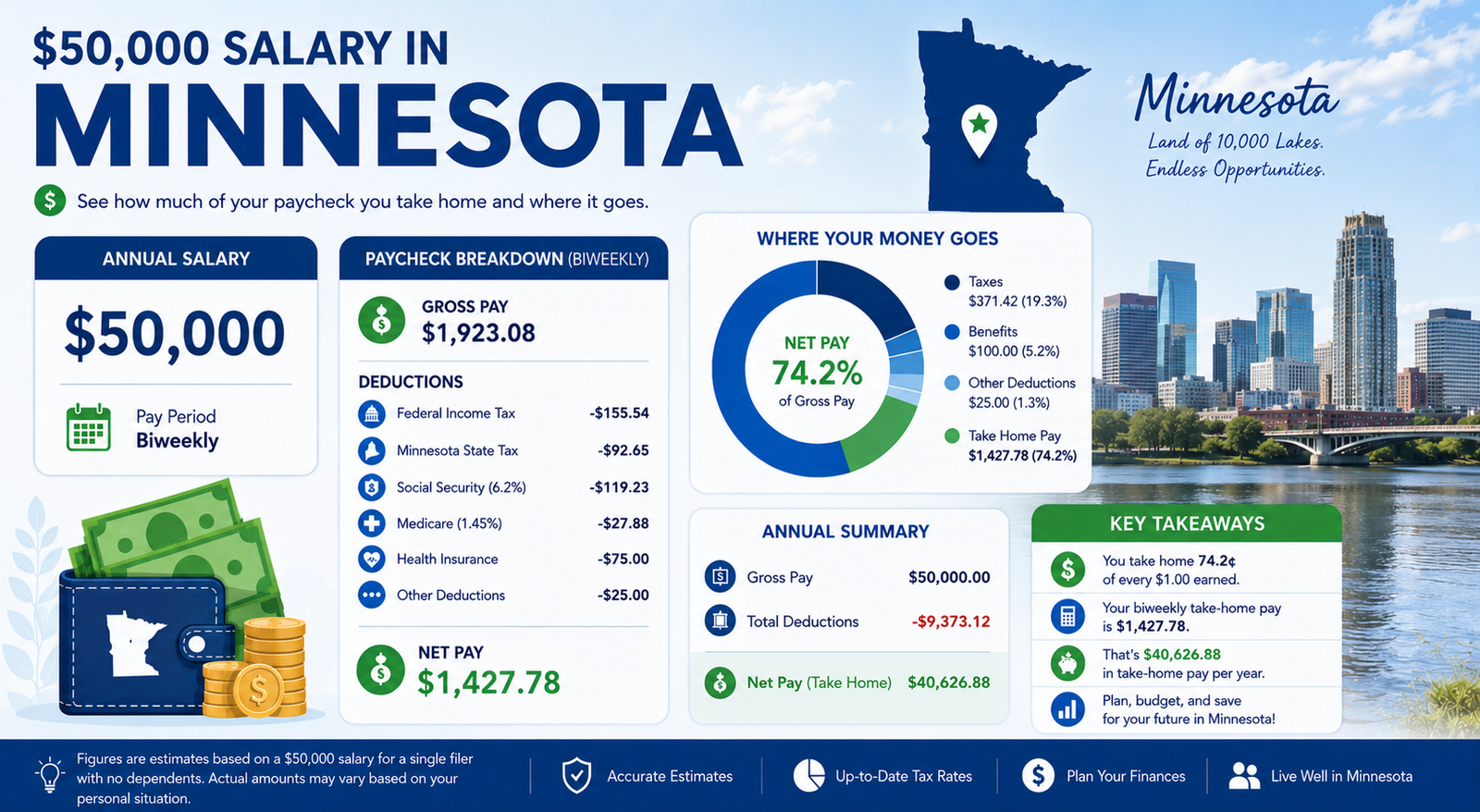
A $50,000 salary after tax in Minnesota is approximately $39,850 per year or $3,320 per month. This estimate accounts for Federal Income Tax, FICA (Social Security and Medicare), and Minnesota State Income Tax. All calculations in this guide are based on our Minnesota paycheck calculator.
Table of Contents
Salary Overview: Gross vs. Net
Earning $50,000 annually sounds substantial, but deductions reduce this amount before it reaches your pocket. In Minnesota, you face three main types of deductions: Federal taxes, State taxes, and FICA contributions.
Because Minnesota uses a progressive tax bracket system, higher portions of your income are taxed at higher rates. However, the first portion of your income is taxed at a lower rate. This structure ensures that while you contribute to state services, the impact is distributed fairly across income levels.
| Frequency | Gross Pay | Estimated Tax | Net Pay (Take Home) |
|---|---|---|---|
| Yearly | $50,000 | $10,150 | $39,850 |
| Monthly | $4,166 | $845 | $3,320 |
| Bi-Weekly | $1,923 | $390 | $1,533 |
| Weekly | $961 | $195 | $766 |
Note that these figures assume a single filer with no dependents and standard deductions. Your specific situation may vary based on pre-tax contributions like 401(k) or health insurance premiums.
Calculate Your Exact Paycheck
Every financial situation is unique. Use our tool to get precise numbers based on your specific deductions.
Calculate your salary in MinnesotaWhere Does Your Money Go? Tax Breakdown
Understanding the specific taxes deducted from your paycheck helps you appreciate the net figure. Here is how the $10,150 in total taxes is distributed.
1. Federal Income Tax
The IRS levies federal income tax based on national brackets. For a $50,000 salary, you fall into the lower-to-middle brackets. The standard deduction for single filers reduces your taxable income significantly, lowering your overall federal liability.
2. Minnesota State Income Tax
Minnesota is known for its robust public services, funded largely by state income tax. The state uses a progressive system with rates ranging from 5.35% to 9.85%. On a $50,000 salary, most of your income is taxed at the lower end of this spectrum, specifically the 5.35% and 6.80% brackets.
3. FICA (Social Security & Medicare)
FICA taxes are fixed percentages. You pay 6.2% for Social Security and 1.45% for Medicare. These contributions fund your future retirement benefits and current healthcare infrastructure for seniors.
Tax Distribution Pie Chart
| Tax Type | Rate (Approx) | Annual Amount |
|---|---|---|
| Federal Income Tax | ~12% | $6,000 |
| MN State Income Tax | ~5.35% - 6.8% | $3,000 |
| Social Security | 6.2% | $3,100 |
| Medicare | 1.45% | $725 |
| Total Tax | ~20.3% | $10,150 |
Living in Minnesota: A Budget Example
Can you live comfortably on $3,320 a month in Minnesota? The answer depends heavily on where you live. Housing costs in Minneapolis and Saint Paul are higher than in Rochester or Duluth. Additionally, Minnesota winters can drive up utility bills due to heating costs.
Below is a sample monthly budget for a single person living in the Twin Cities area. This budget prioritizes essentials while allowing for modest savings.
| Expense Category | Estimated Cost | Notes |
|---|---|---|
| Rent (1 Bedroom) | $1,400 | Average in Minneapolis/St. Paul |
| Utilities | $150 | Higher in winter for heating |
| Groceries | $350 | Cooking at home mostly |
| Transportation | $100 | Public transit or gas |
| Healthcare | $100 | Co-pays and prescriptions |
| Miscellaneous | $220 | Phone, internet, entertainment |
| Total Expenses | $2,320 | |
| Remaining Savings | $1,000 | From $3,320 Net Pay |
If you move to a smaller city like Duluth, rent might drop to around $900–$1,100, freeing up an additional $300–$500 per month for savings or debt repayment. This geographic flexibility is a key advantage of living in Minnesota.
Minnesota vs. Other States
How does a $50,000 salary in Minnesota compare to other states? States with no income tax, like Texas or Florida, will have higher take-home pay. However, they may lack the specific public services and infrastructure quality that Minnesota offers.
Take-Home Pay Comparison ($50k Salary)
As shown in the chart, Minnesota’s take-home pay is competitive compared to high-tax states like New York, though it trails behind no-income-tax states. When evaluating this, consider the value of Minnesota’s education systems, parks, and healthcare access.
Is $50,000 a Good Salary in Minnesota?
Whether $50,000 is "good" depends on your lifestyle and location. For a single individual, it is a manageable salary that allows for basic comfort and some savings, especially if you live outside the core of Minneapolis. However, for a family, this income would be tight given the costs of childcare and larger housing requirements.
Minnesota offers strong employment opportunities in healthcare, education, and technology. If you are early in your career, $50,000 is a solid starting point with room for growth. The state’s strong labor market supports wage progression over time.
Tips to Increase Your Take-Home Pay
Maximizing your $50,000 salary involves smart financial moves. First, contribute to a Traditional 401(k) if your employer offers it. This lowers your taxable income now, potentially dropping you into a lower tax bracket. Second, review your withholding allowances on Form W-4 to ensure you aren't overpaying taxes throughout the year.
Additionally, look for side hustles or freelance work. Minnesota has a vibrant gig economy, particularly in creative and tech sectors. Even an extra $500 a month can significantly boost your financial security.
You can also explore FreeAiden for free AI-powered tools including QR code generators, barcode generators, PDF converters, image utilities, and other productivity tools that might help you streamline side projects or personal organization.
Ready to Plan Your Finances?
Don't guess with your money. See exactly how much you keep after taxes.
Use the Paycheck Calculator for Minnesota$50,000 Salary After Tax in Minnesota – FAQs
What is the exact take-home pay for $50,000 in Minnesota?
For a single filer in 2026, the estimated take-home pay is $39,850 annually. This equals roughly $3,320 per month. This figure includes deductions for Federal Tax, MN State Tax, and FICA.
How much is the Minnesota state tax on a $50k salary?
Minnesota uses a progressive tax system. On a $50,000 salary, you will likely pay approximately $3,000 in state income tax. This varies slightly based on specific deductions and credits you qualify for.
Can I live in Minneapolis on $50,000 a year?
Yes, but it requires budgeting. Rent in Minneapolis is higher than the state average. You may need to find a roommate or live in a smaller apartment to maintain a comfortable savings rate on this income.
Does Minnesota have local income taxes?
Generally, no. Most residents only pay state and federal income taxes. However, always check with your specific municipality as local ordinances can change, though this is rare for general income tax purposes.
How does winter affect my budget in Minnesota?
Winters are cold and long. Expect higher heating bills from November to March. You should also budget for appropriate winter clothing and potentially higher transportation costs if you own a car needing winter tires or maintenance.
Is $50,000 enough to save for a house in Minnesota?
It is challenging but possible. With disciplined budgeting, saving $500–$800 a month is feasible. Over five years, this could accumulate a decent down payment, especially if you look at homes in areas outside the Twin Cities metro.
Understanding Your Take-Home Pay
Navigating your finances starts with clarity. Knowing your $50,000 salary after tax in Minnesota is the first step toward financial stability. While taxes take a significant chunk, the remaining income provides a foundation for a good quality of life in the North Star State.
Remember that these numbers are estimates. Your personal deductions, marital status, and specific city costs will influence your final budget. Use the resources provided to tailor this information to your life.
Calculate Your Real Take-Home Pay Now
Disclaimer
The figures provided in this guide are estimates based on 2026 tax brackets and standard deductions. They are for informational purposes only and do not constitute financial advice. Individual results may vary based on personal circumstances. Please consult a tax professional or use our Minnesota paycheck calculator for precise calculations.