

$50,000 Salary After Tax in New Jersey (2026 Guide)
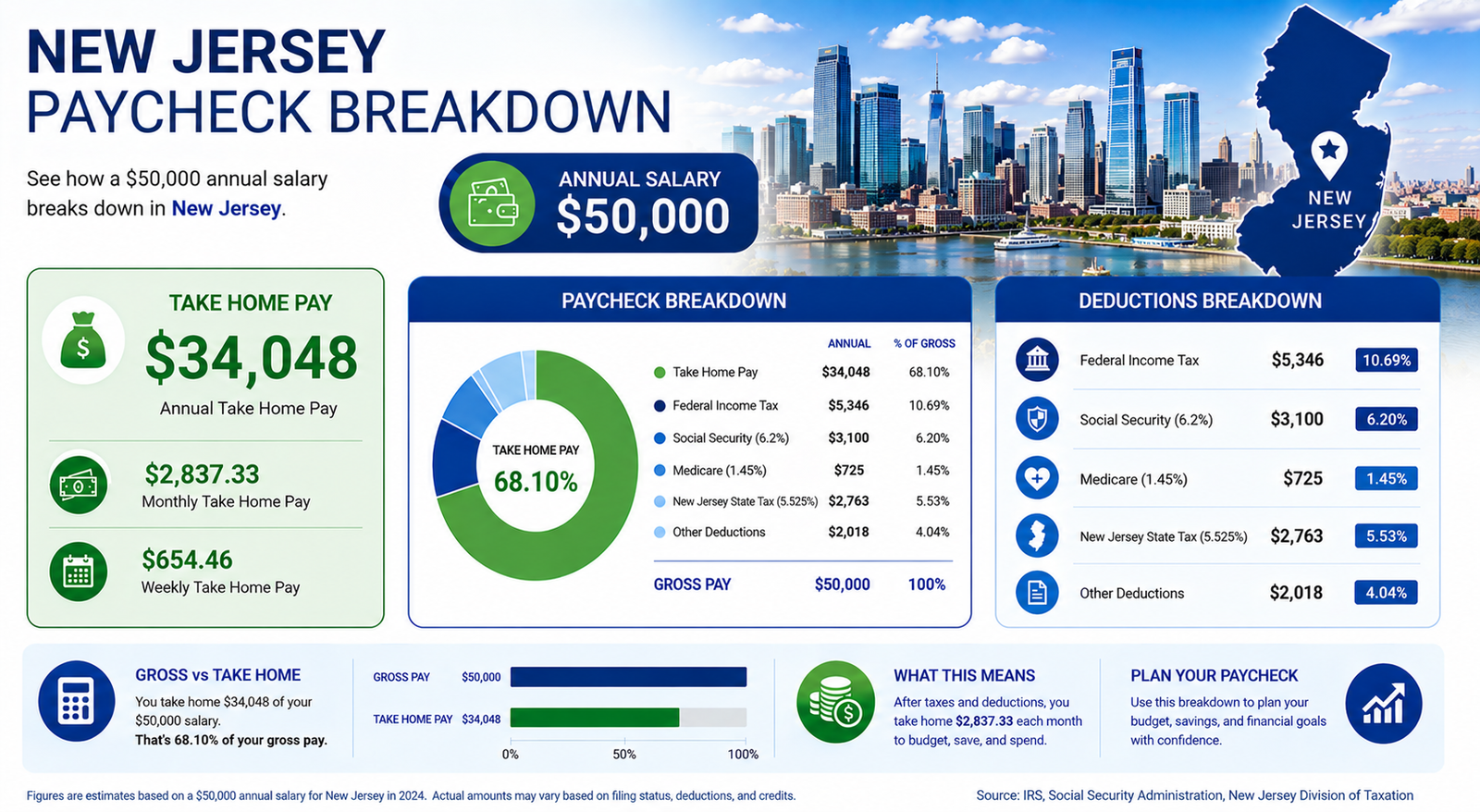
If you earn a $50,000 salary in New Jersey, you’re likely wondering what actually hits your bank account each month. Between federal taxes, state income tax, and FICA, the take‑home figure can feel like a puzzle. But you don’t need to guess. All calculations in this guide are based on our New Jersey paycheck calculator, so you get real numbers without the fluff.
We break down every deduction, compare New Jersey to nearby states, and show you a realistic monthly budget. Whether you live in Newark, Jersey City, Paterson, or Elizabeth, understanding your after‑tax income helps you plan rent, transportation, and savings confidently.
Overview
New Jersey is known for its strong job market in healthcare, finance, logistics, and pharmaceuticals. But it also comes with a higher cost of living, particularly in North Jersey communities that commute to New York City. A $50,000 salary in New Jersey can stretch differently depending on whether you rent in Newark or buy a home in Paterson.
Our New Jersey paycheck calculator factors in the latest 2026 tax rates and standard deductions. We use it to calculate every number in this article, so you don’t have to crunch the math yourself. Bookmark the tool to calculate your salary in New Jersey anytime your pay changes.
Salary Breakdown: Gross to Net
When you earn $50,000 annually, your employer withholds taxes before you see a cent. The table below uses the New Jersey paycheck calculator to show the exact flow from gross salary to take‑home pay.
| Detail | Annual | Monthly | Biweekly |
|---|---|---|---|
| Gross Salary | $50,000 | $4,167 | $1,923 |
| Federal Income Tax | −$3,962 | −$330 | −$152 |
| FICA (Social Security & Medicare) | −$3,825 | −$319 | −$147 |
| New Jersey State Tax | −$1,215 | −$101 | −$47 |
| Take‑Home Pay | $40,998 | $3,417 | $1,577 |
That means roughly 82% of your salary stays with you, while about 18% goes to income and payroll taxes. Compared to many states, New Jersey’s state income tax is moderate at this income level, but local property taxes and living costs still play a big role in your overall budget.
Tax Breakdown: Where Every Dollar Goes
Let’s look at each deduction individually. The federal tax is calculated after the standard deduction, while New Jersey uses its own tax brackets and a small personal exemption. FICA is a flat 7.65% on the first $50,000 of wages.
| Tax Category | Annual Amount | Effective Rate | Details |
|---|---|---|---|
| Federal Income Tax | $3,962 | 7.92% | Based on 2026 brackets, standard deduction |
| FICA | $3,825 | 7.65% | Social Security 6.2% + Medicare 1.45% |
| New Jersey State Tax | $1,215 | 2.43% | Graduated rates, personal exemption applied |
Visual Tax Breakdown
New Jersey’s tax bite at this income is relatively low compared to neighboring New York, but property taxes are some of the highest in the nation. That’s an important context for anyone planning to buy a home in Elizabeth or anywhere in the Garden State.
Monthly Budget Example (New Jersey–Adjusted)
Living on roughly $3,417 per month requires a strategic budget, especially in pricier areas near NYC. Below is a sample budget for a single person renting in Newark or Jersey City. It reflects realistic New Jersey costs but can be adjusted for Paterson or Elizabeth.
| Category | Monthly Allocation | Percentage |
|---|---|---|
| Housing (Rent + Utilities) | $1,350 | 39.5% |
| Transportation | $280 | 8.2% |
| Food (Groceries & Dining) | $480 | 14.0% |
| Healthcare & Insurance | $310 | 9.1% |
| Savings & Debt Repay | $400 | 11.7% |
| Personal & Miscellaneous | $347 | 10.2% |
| Remaining | $250 | 7.3% |
Housing takes the biggest bite, typical for North Jersey. If you commute to Philadelphia instead of NYC, costs may be lower. Still, $50,000 in New Jersey requires careful trade‑offs between location and lifestyle.
State Comparison: Take‑Home on $50K
How does New Jersey stack up against neighboring states? Using the same paycheck calculator for New Jersey and its equivalent state tools, here’s the annual net pay for a single filer in New Jersey, Pennsylvania, and New York (excluding NYC local tax).
| State | Annual Net Pay | Difference vs NJ |
|---|---|---|
| New Jersey | $40,998 | — |
| Pennsylvania | $40,678 | −$320 |
| New York (outside NYC) | $40,068 | −$930 |
New Jersey leaves about $930 more in your pocket than New York, and slightly more than Pennsylvania. But remember, property taxes and rent vary dramatically. The extra cash may be consumed by higher housing costs in Jersey City compared to a Pennsylvania suburb.
Is $50,000 a Good Salary in New Jersey?
The answer depends heavily on your household size and where you live. For a single adult with no dependents, $50,000 can support a modest but stable lifestyle in places like Elizabeth or Paterson. In Newark, you might need a roommate to keep housing below 40% of your take‑home pay.
If you commute daily to New York City, transportation and parking costs can eat up $300–$500 a month. That’s a real squeeze. On the other hand, working in New Jersey’s strong logistics or pharmaceutical sectors might mean a shorter, cheaper commute.
Comfort level is subjective. With a realistic budget, you can cover rent, food, healthcare, and still save a little each month. But you won’t feel wealthy in high‑cost North Jersey communities. For many, $50K is the starting point of a career, not the finish line.
Tips to Increase Your Take‑Home Pay
Even on a $50,000 salary in New Jersey, small adjustments can raise your after‑tax income or stretch your dollars further.
- Adjust your W‑4 withholding. If you got a big refund last year, you’re giving the IRS an interest‑free loan. Use the paycheck calculator for New Jersey to model different allowances and find your sweet spot.
- Contribute to pre‑tax retirement accounts. A 401(k) or traditional IRA reduces your taxable income now, which can lower both federal and New Jersey state tax while building long‑term wealth.
- Use an HSA or FSA. Healthcare flexible spending accounts lower your taxable income. In New Jersey, HSAs also offer federal tax advantages (though state treatment may differ slightly).
- Explore commuter benefits. Employers near NYC often offer pre‑tax commuter programs that save on NJ Transit or PATH fares.
You might also streamline other aspects of your financial life. For instance, you can explore FreeAiden for free AI‑powered tools including QR code generators, barcode generators, PDF converters, image utilities, and other productivity tools that help you stay organized without spending a dime.
$50,000 Salary After Tax in New Jersey – FAQs
How much is $50,000 a year after taxes in New Jersey?
Approximately $40,998 annually for a single filer, which equals $3,417 per month or $1,577 biweekly. This assumes standard deductions and no additional withholdings.
What is the New Jersey state income tax on a $50,000 salary?
The state tax amount is about $1,215 per year. New Jersey’s graduated rates start at 1.4% and climb to 5.525% on income between $40,000 and $75,000.
Is $50,000 a good salary in Newark, NJ?
For a single person, $50,000 can work in Newark if housing costs are managed. Renting a one‑bedroom often exceeds $1,300, so budgeting carefully is essential. With a roommate, it becomes more comfortable.
Can you live comfortably in Jersey City on $50K?
Jersey City’s proximity to NYC drives up rents significantly. Comfort on $50K usually requires splitting housing costs or living farther from transit hubs. A strict budget leaves little room for luxuries.
How does New Jersey tax compare to New York for a $50K salary?
New Jersey’s take‑home is about $930 higher than New York’s (outside NYC) because of lower state income tax at this bracket. When you add NYC local tax, the gap widens further.
Does the $50,000 after‑tax amount include property tax?
No. Property taxes are not deducted from paychecks but are a major expense in New Jersey, often exceeding $8,000 annually for a median home. This calculation only covers income and payroll taxes.
What’s the biweekly paycheck for $50,000 in New Jersey?
Biweekly take‑home is around $1,577 after federal tax, FICA, and state tax. Gross biweekly pay is $1,923.
Are there any New Jersey tax credits that increase take‑home pay?
Yes, the New Jersey Earned Income Tax Credit (NJEITC) and property tax relief programs exist, but eligibility depends on income and family size. They are not reflected in the standard paycheck withholding shown here.
Disclaimer
All calculations in this guide are based on our New Jersey paycheck calculator and reflect 2026 tax rates and standard assumptions for a single filer with no additional deductions. Your actual take‑home pay may vary depending on your specific withholdings, pre‑tax contributions, and personal circumstances. This content is for informational purposes only and does not constitute financial, legal, or tax advice. Always consult a qualified professional or use the new paycheck calculator to model your own situation.
Final Thoughts
Your $50,000 salary after tax in New Jersey translates to roughly $3,417 in monthly take‑home pay for a single filer in 2026. While it isn’t a lavish income, careful budgeting in cities like Paterson, Elizabeth, or even parts of Newark can deliver a solid lifestyle. The key is understanding your real pay—and that’s exactly what our calculator shows.
Whether you’re planning a move to Jersey City or comparing job offers across the Northeast, don’t guess. Use the New Jersey paycheck calculator to adjust for your exact situation and see your personalized numbers.