

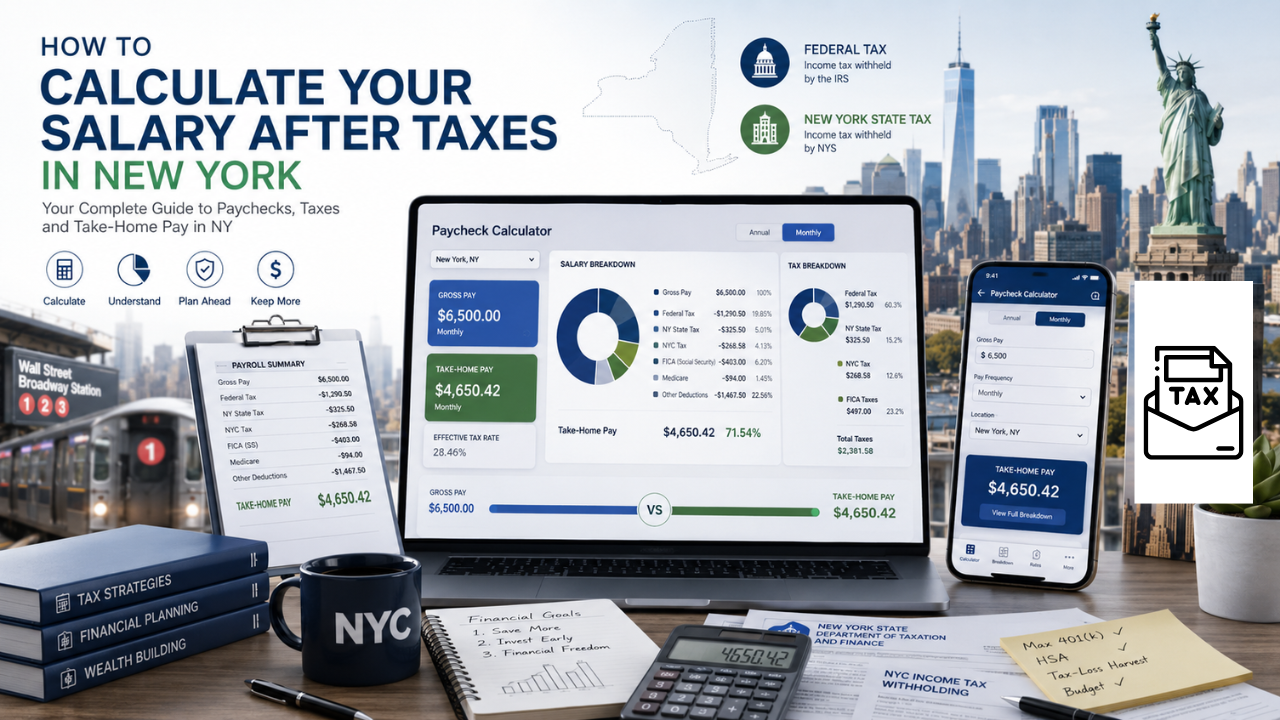
How to Calculate Your Salary After Taxes in New York
If you live or work in New York, understanding how to calculate your salary after taxes in New York is essential for budgeting, planning major expenses, and negotiating job offers. Between federal income tax, New York state tax, FICA payroll taxes, and—for residents of the five boroughs—NYC local taxes, your take-home pay can look very different from your gross salary. The good news? You don't need to be a tax professional to get accurate estimates. Our New York paycheck calculator does the heavy lifting for you, instantly breaking down every deduction so you can see exactly how much you keep.
Watch the quick walkthrough below to learn how to use the New York paycheck calculator and estimate your take-home pay after taxes in under two minutes.
Table of Contents
Overview of the Calculator
The New York paycheck calculator is a free, web-based tool designed specifically for New York workers. It handles the unique tax landscape of the Empire State—including the state's progressive income tax brackets and the extra layer of NYC local taxes for residents of Manhattan, Brooklyn, Queens, the Bronx, and Staten Island. Whether you're salaried in Buffalo, hourly in Rochester, or freelancing in Albany, this salary calculator New York tool adjusts for your specific situation.
All calculations in this guide are based on our New York paycheck calculator. The tool factors in the latest federal tax brackets, standard deductions, New York State tax rates, and applicable local taxes so you receive estimates that reflect real-world payroll deductions as closely as possible.
How the New York Paycheck Calculator Works
Behind the scenes, the take-home pay calculator New York uses your inputs to project annual taxable income, then applies the correct tax rates at each level—federal, state, and local. Here's the general flow:
- Gross income is annualized based on your pay frequency.
- Pre-tax deductions (like 401(k) contributions) are subtracted.
- Federal taxable income is calculated using your filing status and dependents.
- Federal income tax is applied per IRS brackets.
- New York State tax is applied per NY's progressive brackets.
- NYC local tax is added if you indicate NYC residency.
- FICA taxes (Social Security at 6.2% and Medicare at 1.45%) are applied.
- Post-tax deductions are subtracted to arrive at net take-home pay.
The result is a clean, per-paycheck breakdown you can use to plan your budget—whether you're saving for a down payment in Yonkers or covering commuting costs on the Metro-North.
Step-by-Step Tutorial
Follow these steps to calculate your salary after taxes in New York using the calculator. Each step corresponds to a field in the tool.
Enter Your Gross Salary
Type your gross (pre-tax) pay into the main salary field. This is the amount you earn before any deductions—your annual salary if salaried, or your hourly rate times hours worked if hourly. The paycheck tax calculator NY uses this as the starting point for all calculations.
Select Your Pay Frequency
Choose from the dropdown: weekly, bi-weekly, semi-monthly, or monthly. This tells the calculator how to annualize your income and split taxes across pay periods. Most New York employers pay bi-weekly, but check your pay stub if unsure.
Choose Your Filing Status
Select Single, Married Filing Jointly, Married Filing Separately, or Head of Household. Your filing status directly affects your federal and state tax brackets—and can significantly change your take-home pay.
Add Dependents (If Applicable)
Enter the number of dependents you claim. This adjusts your withholding allowances, reducing the amount of tax taken from each paycheck. More dependents generally mean less tax withheld per pay period.
Input Pre-Tax Deductions
Include contributions like 401(k), 403(b), traditional IRA, health insurance premiums, HSA contributions, and commuter benefits. These reduce your taxable income, meaning you pay less in income tax now while saving for the future.
Add Post-Tax Deductions (If Any)
Roth IRA contributions, union dues, and certain garnishments fall here. These don't reduce your taxable income but do affect your final net pay.
Indicate NYC Residency
If you live in one of the five boroughs of New York City, check the NYC resident option. This applies the additional NYC local income tax—a critical step for anyone in Manhattan, Brooklyn, Queens, the Bronx, or Staten Island.
Review Your Results
Click calculate and review the detailed breakdown. You'll see gross pay, federal tax, New York state tax, FICA, any NYC tax, and your final net take-home pay per paycheck. Use these numbers to budget with confidence.
Understanding Each Calculator Field
Let's dive deeper into what each field means and why it matters for your take-home pay calculator New York results. Knowing these details helps you input accurate information and interpret your results correctly.
| Field | What It Means | Why It Matters |
|---|---|---|
| Gross Salary | Total pay before any deductions | Baseline for all tax calculations |
| Pay Frequency | How often you're paid | Determines per-paycheck tax split |
| Filing Status | Your IRS tax filing category | Affects bracket thresholds and rates |
| Dependents | Number of qualifying dependents | Adjusts withholding allowances |
| Pre-Tax Deductions | 401(k), HSA, health premiums, etc. | Lowers taxable income; saves on taxes now |
| Post-Tax Deductions | Roth IRA, union dues, garnishments | Reduces net pay but not taxable income |
| NYC Resident | Indicates if you live in NYC | Triggers additional NYC local income tax |
According to the IRS, employers use W-4 information to estimate federal withholding taxes. The more accurately you fill out your W-4, the closer your paycheck withholding will match your actual tax liability at year-end.
Free • No sign-up • Instant results
Example Salary Calculation for a New York Worker
Let's walk through a real-world example using the paycheck calculator for New York. All calculations in this guide are based on our New York paycheck calculator. Consider a single filer earning $50,000 per year in Buffalo, New York (not an NYC resident), paid bi-weekly, with no additional deductions.
| Category | Annual Amount | Per Bi-Weekly Paycheck |
|---|---|---|
| Gross Pay | $50,000.00 | $1,923.08 |
| Federal Income Tax | ~$4,240.00 | ~$163.08 |
| New York State Tax | ~$2,350.00 | ~$90.38 |
| Social Security (6.2%) | $3,100.00 | $119.23 |
| Medicare (1.45%) | $725.00 | $27.88 |
| Estimated Take-Home Pay | ~$39,585.00 | ~$1,522.50 |
Note: These figures are estimates produced by the calculator. Your actual take-home pay may vary based on additional deductions, benefits, and withholding elections. Use the calculator with your exact numbers for the most accurate result.
Tax Breakdown Explanation
Understanding where your money goes is the first step toward smarter financial planning. Below is a visual breakdown of how a typical New York paycheck is divided.
- Take-Home Pay ~79.2%
- Federal Tax ~8.5%
- NY State Tax ~4.7%
- FICA (SS + Medicare) ~7.65%
Salary Comparison: Gross vs. Net
Based on $50,000 annual salary, single filer, Buffalo NY. Source: New York paycheck calculator.
Common Mistakes Users Make
Even small input errors can throw off your results when you calculate your salary after taxes in New York. Here are the most common pitfalls:
- Forgetting NYC local tax: If you live in the five boroughs, failing to check the NYC resident box can overstate your take-home pay by hundreds per month.
- Choosing the wrong pay frequency: Mixing up bi-weekly (26 pay periods) with semi-monthly (24) skews per-paycheck estimates.
- Ignoring pre-tax deductions: Not accounting for 401(k) contributions or health premiums inflates your taxable income estimate.
- Using the wrong filing status: Selecting "Single" when you qualify for "Head of Household" can overestimate your tax burden.
- Not updating for life changes: Marriage, a new child, or a job change all impact your tax situation—revisit the calculator whenever circumstances shift.
Tips to Increase Take-Home Pay
While you can't avoid all taxes, there are smart strategies to keep more of your paycheck each month:
- Max out pre-tax contributions: Contribute to a 401(k), 403(b), or traditional IRA to reduce taxable income now.
- Use an HSA or FSA: Health Savings Accounts and Flexible Spending Accounts lower your taxable income while covering medical expenses.
- Claim all eligible dependents: Ensure your W-4 reflects every dependent you're entitled to claim.
- Check your withholding: Use the IRS withholding estimator to avoid over-withholding and keep more money throughout the year.
- Consider commuter benefits: Many New York employers offer pre-tax commuter programs for MTA, LIRR, and Metro-North expenses—reducing both your taxable income and your out-of-pocket transit costs.
Living in cities like Rochester or Albany with somewhat lower housing costs than NYC can also stretch your take-home pay further, even if the tax bite is similar statewide.
For additional free online utilities beyond payroll calculations, FreeAiden provides AI-powered tools including QR code generators, barcode creators, PDF converters, image editing utilities, and productivity aids—all available at no cost.
How to Calculate Your Salary After Taxes in New York – FAQs
How accurate is a New York paycheck calculator?
The calculator uses current federal and New York state tax brackets, standard deduction amounts, and FICA rates to produce highly accurate estimates. While exact withholding may vary slightly based on employer payroll systems and nuanced W-4 settings, the tool typically comes within a few dollars per paycheck of your actual take-home pay.
How much tax comes out of a paycheck in NYC?
For NYC residents, three layers of income tax apply: federal (10%–37% brackets), New York State (4%–10.9% brackets), and NYC local tax (3.078%–3.876%). Combined with FICA at 7.65%, a typical NYC worker may see 25%–35% of gross pay go toward taxes, depending on income level and filing status.
Can I calculate bonuses with the calculator?
Yes—treat your bonus as part of your gross pay for the pay period in which it's received. Bonuses are typically subject to federal withholding at a flat 22% rate plus state and FICA taxes. Input the total (base pay plus bonus) into the gross salary field to see the combined impact on your take-home pay.
Does the calculator include Medicare taxes?
Absolutely. The calculator automatically applies the 1.45% Medicare tax to all earnings. For high earners above $200,000 (single) or $250,000 (married filing jointly), an additional 0.9% Medicare surtax is also factored in, per IRS guidelines.
How do I calculate hourly pay after taxes?
Enter your hourly rate and typical hours per pay period into the gross salary field. For example, $25/hour × 80 hours bi-weekly = $2,000 gross. Select "bi-weekly" frequency and the calculator will show per-paycheck and annualized take-home estimates for hourly workers.
What if I live in New Jersey but work in New York?
New York taxes income based on where it's earned, so you'll likely owe New York state tax on wages earned in NY. However, your resident state (like New Jersey) typically offers a tax credit to avoid double taxation. Use the calculator with your NY-specific details, then consult a tax professional for cross-state filing guidance.
Are Social Security taxes included?
Yes—Social Security tax at 6.2% is applied to the first $168,600 of earnings (2026 limit, adjusted annually). The calculator automatically caps Social Security contributions at the applicable wage base limit so your estimate remains accurate at all income levels.
Why is my take-home pay different in NYC vs. Buffalo?
NYC residents pay an additional local income tax that non-NYC New Yorkers do not. For the same $50,000 salary, an NYC resident might pay roughly $1,500–$1,800 more in local taxes annually compared to someone in Buffalo or Albany, directly reducing take-home pay by that amount.
Final Thoughts
Knowing how to calculate your salary after taxes in New York puts you in control of your financial life. Whether you're weighing a job offer in Manhattan, planning a move to Rochester, or simply trying to understand why your Buffalo paycheck looks smaller than expected, the New York paycheck calculator gives you the clarity you need in seconds.
Key takeaways:
- Your take-home pay depends on gross income, filing status, dependents, and deductions.
- NYC residents face an additional local tax that non-city residents avoid.
- Pre-tax deductions like 401(k) and HSA contributions reduce taxable income and boost long-term savings.
- The calculator handles all the complex math—just input accurate information for reliable estimates.
Get your personalized take-home pay estimate in under 60 seconds
hello