

Schedule 2 (Form 1040): Additional Taxes Explained
If you’ve ever spotted Schedule 2 (Form 1040): Additional Taxes Explained in your tax paperwork and felt a pang of confusion, you’re not alone. This form is where the IRS requires you to report taxes that go beyond your regular income tax — things like self-employment tax, penalties on early retirement withdrawals, or even household employment taxes. Understanding it can save you from costly errors. This guide is based on official IRS Schedule 2 (Form 1040) instructions and educational tax resources, breaking down every line so you can file with confidence.
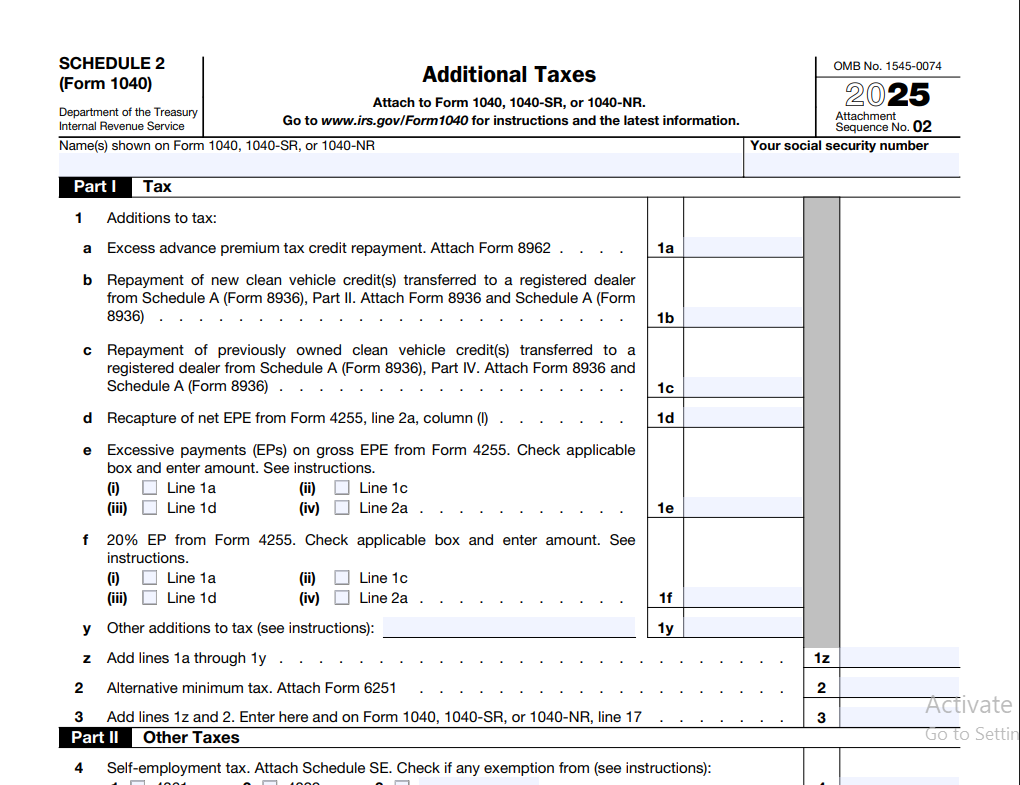
Schedule 2 (Form 1040) is an additional tax form that accompanies your federal income tax return. It reports taxes beyond regular income tax, such as self-employment tax, household employment taxes, and excess advance premium tax credit repayment. Taxpayers attach it to Form 1040 when any of these additional taxes apply.
Table of Contents
- What Is Schedule 2 (Form 1040)?
- Who Needs Schedule 2?
- When Is Schedule 2 Required?
- What Additional Taxes Are Reported on Schedule 2 (Form 1040)?
- Understanding Part I of Schedule 2
- Understanding Part II of Schedule 2
- How Schedule 2 Connects to Form 1040
- Step-by-Step Instructions for Completing Schedule 2
- Common Filing Mistakes
- Examples of When Schedule 2 Is Required
- How Schedule 2 Relates to Other IRS Schedules
- Download Schedule 2 (Form 1040)
- Schedule 2 (Form 1040): Additional Taxes Explained – FAQs
- Filing Schedule 2 Correctly
What Is Schedule 2 (Form 1040)?
Schedule 2 is an attachment to your individual income tax return, Form 1040. Its sole job is to list certain taxes that are not part of the ordinary income tax calculation. Think of it as a dedicated parking spot for additional taxes — the ones that often catch taxpayers off guard. The IRS created this form to keep the main 1040 clean while still collecting everything the law requires.
Instead of squeezing self-employment tax or early IRA withdrawal penalties onto the front page, those amounts live here, organized into two parts. Part I covers taxes that largely arise from earned income or special situations like unreported tips, while Part II deals with taxes tied to tax‑favored accounts and other obligations. The bottom‑line total then moves to your Form 1040, so the IRS sees a complete picture of what you owe.
Who Needs Schedule 2?
Not every taxpayer needs Schedule 2. You’ll include it only if at least one of the additional taxes applies to you. According to IRS guidance, common filers who need this form include:
- Self-employed individuals with net earnings of $400 or more (self-employment tax).
- Household employers who paid cash wages above the annual threshold.
- Workers who received tips not reported to their employer, or whose employer didn’t withhold enough Social Security tax.
- Anyone who took an early distribution from an IRA or retirement plan and owes the 10% additional tax.
- Taxpayers who must repay excess advance Premium Tax Credit subsidies.
- People with Health Savings Account (HSA) or Coverdell ESA violations that trigger penalty taxes.
- Investors subject to the Net Investment Income Tax.
- A small number of homeowners still repaying the first‑time homebuyer credit.
If none of these situations sound familiar, you likely won’t need the form. But it’s wise to double‑check, because missing a required Schedule 2 can delay processing and lead to IRS notices.
When Is Schedule 2 Required?
Schedule 2 becomes mandatory the moment you have an additional tax liability. The IRS doesn’t give you a choice — if the tax exists, you must attach the schedule. The trigger isn’t a specific income level; it’s the type of transaction or income. For instance, even a small side gig generating $450 in net profit requires Schedule 2 for self-employment tax. A $2,000 early IRA withdrawal with no exception likewise demands the schedule, regardless of your overall income.
The form is also required if you’re repaying an advance premium credit excess, or if you check a box on Form 1040 indicating you owe other taxes from a list of possibilities (like the box for “Other taxes” on line 23). In short, if the IRS expects the money, Schedule 2 is the official reporting vehicle.
What Additional Taxes Are Reported on Schedule 2 (Form 1040)?
The form groups additional taxes into two clear categories. Part I (lines 1 through 6) captures employment‑related taxes and the first‑time homebuyer credit repayment. Part II (lines 7 through 12) covers taxes on tax‑favored accounts, the net investment income tax, and other miscellaneous additional taxes. Together they ensure every extra dollar the government is entitled to gets recorded correctly.
Below is a quick-reference table of the main additional taxes you’ll encounter:
| Tax Type | Where on Schedule 2 | Who Typically Pays |
|---|---|---|
| Self-employment tax | Part I, line 1 | Freelancers, gig workers, small business owners |
| Unreported tip income Social Security/Medicare tax | Part I, line 2 | Employees with cash tips not reported to employer |
| Uncollected Social Security/Medicare tax on wages | Part I, line 3 | Employees whose employer didn’t withhold enough |
| Additional tax on IRAs/retirement plans | Part I, line 4 | Those taking early distributions before age 59½ |
| Household employment taxes | Part I, line 5 | Household employers paying nannies, caregivers |
| Repayment of first‑time homebuyer credit | Part I, line 6 | Taxpayers still repaying 2008 credit |
| Additional tax on HSAs/MSAs | Part II, line 7-8 | Those with non‑qualified HSA or MSA distributions |
| Additional tax on Coverdell ESAs / QTPs | Part II, line 9 | Non‑qualified education account withdrawals |
| Net Investment Income Tax | Part II, line 10 | Higher‑income investors |
| Other additional taxes (recapture, etc.) | Part II, line 11 | Various special situations |
Understanding Part I of Schedule 2
Part I is where you’ll report taxes that are closely tied to work, retirement account withdrawals, and a couple of niche items. Each line corresponds to a different tax form or calculation. The IRS expects you to compute the tax on the referenced form first, then transfer the final number to the matching line on Schedule 2.
Line 1 – Self-employment tax: This is the largest category for many. If you earned self-employment income, you compute the tax on Schedule SE. The result goes to line 1. The tax covers both the employee and employer portions of Social Security and Medicare, which means it can be a substantial amount. Even a modest side business can trigger this.
Line 2 – Social Security and Medicare tax on tip income not reported to employer: When you receive tips and don’t report them to your employer, or report less than required, you use Form 4137 to calculate the unreported Social Security and Medicare tax. The computed total lands on line 2.
Line 3 – Uncollected Social Security and Medicare tax on wages: If your employer failed to withhold enough of these taxes — for example, on certain group‑term life insurance — you figure the tax using Form 8919 and then enter it on line 3.
Line 4 – Additional tax on IRAs, other qualified retirement plans: Taking money out of a traditional IRA or 401(k) before age 59½ usually incurs a 10% penalty. This additional tax is computed on Form 5329. Even a small early withdrawal can trigger it, so don’t overlook this line.
Line 5 – Household employment taxes: If you hired a nanny, housekeeper, or other household employee and paid cash wages above the annual threshold ($2,700 for 2026, subject to inflation adjustments), you use Schedule H to figure Social Security, Medicare, and federal unemployment taxes. Transfer the household employment taxes to line 5.
Line 6 – Repayment of first‑time homebuyer credit: Taxpayers who claimed the credit in 2008 and are still making annual repayments enter the amount here. This line also serves as a catch‑all for a few other rare tax items, so check the instructions carefully.
Understanding Part II of Schedule 2
Part II picks up where Part I leaves off — it focuses on taxes related to tax‑advantaged accounts that were used improperly, the net investment income tax, and any other additional taxes not captured earlier.
Line 7 – Additional tax on HSAs: Health Savings Accounts offer great tax benefits, but if you take a distribution for non‑medical expenses, you’ll pay a 20% additional tax. Compute this on Form 8889 and enter the penalty on line 7.
Line 8 – Additional tax on Archer MSAs or Medicare Advantage MSAs: Similar to HSAs, non‑qualified MSA distributions trigger an extra tax. Use Form 8853 to determine the amount.
Line 9 – Additional tax on Coverdell ESAs or qualified tuition programs: Withdrawals from education savings accounts that aren’t used for qualified education expenses may be subject to a 10% additional tax. Figure it with Form 5329 and put the tax here.
Line 10 – Net Investment Income Tax (NIIT): This 3.8% tax applies to certain investment income when your modified adjusted gross income exceeds $200,000 (single) or $250,000 (married filing jointly). The calculation happens on Form 8960, and the final amount moves to line 10. Many taxpayers with rental income or capital gains discover they need this line.
Line 11 – Other additional taxes: A small box asks you to check which form supports the entry — often Form 5329 for various penalty taxes, or forms for recapture of credits. The IRS uses this line to capture everything else that doesn’t fit neatly above.
Line 12 totals all Part II taxes. Then line 13 combines the Part I total (line 6) and Part II total (line 12) into the grand total additional tax.
See how additional taxes affect your paycheck.
Calculate your estimated take-home payHow Schedule 2 Connects to Form 1040
The flow between Schedule 2 and your Form 1040 is deliberately simple. After you finish both parts, line 13 of Schedule 2 becomes the single number you transfer. This amount goes directly onto Form 1040, line 23 (Other taxes, including self-employment tax). From there, it’s added to your regular income tax to reach the total tax on line 24.
Line 13 → Form 1040
Line 23 + Income Tax = Total Tax
(Line 24)
Because this total feeds directly into your tax liability, an error on Schedule 2 will skew your bottom line. That’s why every step matters.
Step-by-Step Instructions for Completing Schedule 2
Follow this practical sequence to fill out the form accurately. Keep your supporting tax forms nearby — you’ll need them.
- Identify which additional taxes apply. Review your year: Did you have self-employment income? Take an early IRA distribution? Hire household help? List every trigger.
- Complete the underlying forms first. For self-employment tax, do Schedule SE. For IRA penalties, do Form 5329. Never guess a number — the IRS matches these forms.
- Fill in Part I, lines 1–6. Transfer the totals from the appropriate forms. If a line doesn’t apply, leave it blank.
- Total Part I on line 6. Add lines 1 through 5, and write the sum on line 6.
- Move to Part II, lines 7–11. Again, work from the separate forms (8889, 8960, 5329, etc.). Check the box for the relevant form on line 11 if required.
- Enter the Part II total on line 12. Sum lines 7 through 11.
- Combine both parts on line 13. Add line 6 and line 12. This is your total additional tax.
- Copy line 13 to Form 1040, line 23. Double-check the number before moving on.
Taking these steps in order reduces the risk of missing a critical figure. It also mirrors how professional software handles the data flow.
Common Filing Mistakes
Even careful taxpayers slip up on Schedule 2. Here are the most frequent errors the IRS sees, and how you can avoid them.
1. Forgetting to attach Schedule 2 when required
If you have any additional tax, leaving the form out will cause a mismatch. The IRS will send a notice and possibly adjust your return. Always include it if you have a dollar amount on line 23 of the 1040 that came from Schedule 2.
2. Putting self-employment tax directly on the 1040
Some filers mistakenly write the self-employment tax amount on the dotted line next to line 23 without filing Schedule 2. The IRS needs the schedule to verify the calculation. Use Schedule 2, and transfer the total properly.
3. Miscalculating the additional tax on early IRA distributions
Not all early distributions are taxable at 10%. Exceptions exist for disability, medical expenses, or substantially equal periodic payments. If you qualify for an exception, file Form 5329 correctly. Otherwise, you may overpay.
4. Misreporting household employment taxes
Taxpayers often forget that paying a nanny above the threshold triggers both Schedule H and Schedule 2. They then miss the tax entirely. Keep records of cash wages paid.
5. Omitting the Net Investment Income Tax
High‑income investors sometimes overlook Form 8960. If your income crosses the threshold and you have investment income, the NIIT applies and must appear on Schedule 2, line 10.
Examples of When Schedule 2 Is Required
Real‑world scenarios make the triggers concrete.
Example 1 – Freelancer with a side gig: Maria earned $8,200 from freelance graphic design in 2026. Her net profit triggers self-employment tax. She completes Schedule SE, enters the $1,159 tax on Schedule 2, line 1, and attaches it to her 1040. Without the schedule, the IRS wouldn’t properly credit her Social Security earnings.
Example 2 – Early 401(k) withdrawal: James, age 47, withdrew $6,000 from his 401(k) to cover an emergency. No exception applies. He owes a $600 additional tax. Form 5329 calculates it, and Schedule 2, line 4 reports it. His tax bill increases, and he avoids a penalty notice later.
Example 3 – Household employer: The Lopez family paid a nanny $15,000 during the year. They file Schedule H and compute $2,295 in Social Security and Medicare taxes. That amount lands on Schedule 2, line 5, ensuring the IRS credits the nanny’s earnings record.
How Schedule 2 Relates to Other IRS Schedules
Schedule 2 never works in isolation. It pulls from several other forms and schedules. Understanding these connections helps you see the full tax picture.
- Schedule SE (Self-Employment Tax): Supplies the number for line 1.
- Form 4137: Feeds unreported tip tax to line 2.
- Form 8919: Calculates uncollected Social Security/Medicare tax for line 3.
- Form 5329: Handles additional taxes on IRAs, Coverdell ESAs, and other plans; its outputs go to lines 4, 9, and sometimes line 11.
- Schedule H: Computes household employment taxes for line 5.
- Form 8889: Determines HSA additional tax for line 7.
- Form 8853: Provides Archer MSA penalty tax for line 8.
- Form 8960: Calculates net investment income tax for line 10.
- Form 8962: Premium Tax Credit; excess repayment can flow to Part I, line 6 or Part II, depending on the situation.
When you use tax software, these links are built in. But if you’re filing on paper, you must manually transfer each amount. Verifying each form’s result against Schedule 2 is a vital review step.
Plan ahead: Know what you’ll owe after additional taxes.
Estimate your annual after-tax incomeDownload Schedule 2 (Form 1040)
Always use the most current version from the IRS website. For additional free tools to simplify your tax planning, you can explore resources like FreeAiden.
Schedule 2 (Form 1040): Additional Taxes Explained – FAQs
Yes. If your net earnings from self-employment are $400 or more, you must file Schedule 2 to report self-employment tax. The form calculates Social Security and Medicare taxes for self-employed individuals and the total flows to your Form 1040.
Early distributions from traditional IRAs, 401(k)s, or similar plans before age 59½ generally incur a 10% additional tax. Certain exceptions apply, but unless you qualify for an exemption, you must report the penalty tax on Schedule 2, Part I, line 4.
If you paid a household employee $2,700 or more in 2026 (or met other criteria), you may owe Social Security and Medicare taxes. Report these taxes on Schedule 2, Part I, line 5. Attach Schedule H to show the detailed computation.
Yes. The Net Investment Income Tax (NIIT) calculated on Form 8960 is entered on Schedule 2, Part II, line 10. This additional 3.8% tax applies if your modified adjusted gross income exceeds certain thresholds and you have net investment income.
Absolutely. Most tax preparation software supports Schedule 2 and will automatically generate it when required. IRS e-file accepts the schedule electronically along with your Form 1040, ensuring accurate transfer of additional tax totals.
If you received advance payments of the Premium Tax Credit to help pay for health insurance marketplace coverage and your actual credit is lower, you may need to repay the excess. This repayment is reported on Form 8962 and flows to Schedule 2, Part I, line 6, or Part II depending on the situation.
The combined additional taxes from Schedule 2, line 13, are entered on Form 1040, line 23. That amount is then added to your income tax to determine your total tax on line 24. It's a direct link between the two forms.
File an amended return using Form 1040-X. Recalculate the additional taxes on a corrected Schedule 2, then adjust the amounts on the amended return. Explain the changes clearly. Do not file a second original return.
If you claimed the first-time homebuyer credit in 2008 and are required to make annual repayments, report the repayment amount on Schedule 2, Part I, line 6. This applies to a small number of taxpayers still in the repayment phase.
Part II includes additional taxes on HSAs, Archer MSAs, Coverdell ESAs, qualified tuition programs, the net investment income tax, and various recapture taxes. If you check a box for forms like 5329 or 8889, the corresponding tax goes here.
Filing Schedule 2 Correctly
Getting Schedule 2 right means double‑checking every line against the supporting forms. Before you sign your return, ask yourself these practical questions:
- Did I attach every form that feeds a number onto Schedule 2?
- Is line 13 transferred accurately to Form 1040, line 23?
- If I claimed an exception to a penalty tax, did I include the proper documentation?
- Have I kept all records — W‑2s, 1099s, receipts for HSA expenses, household payroll records — that support the additional taxes reported?
Using a paycheck calculator to understand your take‑home pay after taxes can also help you plan for the cash flow impact of these additional obligations. When you’re confident the numbers are correct, you’re ready to file. And if you later discover an error, an amended return keeps everything on track with the IRS.