

Last Updated: 2026

The Internal Revenue Service (IRS) is a term most Americans hear every year, yet many people still wonder exactly what the IRS is and how it affects their daily lives. Whether you file a simple tax return, run a small business, or simply want to understand where your tax dollars go, learning about the IRS helps you make smarter financial decisions. This guide breaks down everything you need to know using clear language and official IRS-backed information.
This guide is based on official IRS educational resources and federal tax guidance. Every section below draws from publicly available IRS publications, forms, and online tools to ensure accuracy and clarity.
Quick Answer
The Internal Revenue Service (IRS) is the federal agency responsible for administering and enforcing U.S. tax laws. The IRS collects federal taxes, processes tax returns, issues refunds, and helps taxpayers meet their tax obligations. Millions of individuals and businesses interact with the IRS every year for tax filing and payment purposes.
What Is the Internal Revenue Service (IRS)?
The Internal Revenue Service (IRS) is the revenue collection agency of the United States federal government. It operates as a bureau within the U.S. Department of the Treasury. The IRS was established in 1862 by President Abraham Lincoln and Congress to fund the Civil War. Today, its mission is far broader: to provide American taxpayers with top-quality service by helping them understand and meet their tax responsibilities and by enforcing the tax law with integrity and fairness.
At its core, the IRS is not a policymaking body. Congress creates tax laws, and the IRS carries them out. The IRS does not decide tax rates or create new taxes. Instead, it interprets the tax code, issues regulations, processes tax returns, collects payments, sends refunds, and conducts audits when returns appear inaccurate or incomplete.
According to the IRS, the agency processes more than 260 million tax returns each year and collects trillions of dollars in revenue that fund essential government services including national defense, infrastructure, education, healthcare programs, and social safety nets. Understanding what the IRS is helps demystify the tax process and reduces the anxiety many people feel about filing taxes.
Key IRS Facts
- Full Name: Internal Revenue Service
- Parent Agency: U.S. Department of the Treasury
- Founded: 1862
- Headquarters: Washington, D.C.
- Employees: Approximately 80,000
- Annual Returns Processed: Over 260 million
Why the IRS Exists
The IRS exists because the federal government needs a reliable system to collect the revenue required to operate. Without tax collection, the government could not fund roads, schools, military defense, scientific research, disaster relief, or public health programs. The Sixteenth Amendment to the U.S. Constitution, ratified in 1913, gave Congress the power to levy a federal income tax. The IRS became the agency responsible for collecting that tax.
In simple terms, the IRS exists to ensure that everyone pays their fair share according to the tax laws Congress enacts. The agency balances two important roles: helping compliant taxpayers file and pay correctly, and taking enforcement actions against those who do not meet their obligations.
IRS guidance explains that the agency's budget and staffing levels directly affect its ability to serve taxpayers. When the IRS is well-funded, it can process returns faster, answer more phone calls, and modernize its technology systems. When resources are limited, taxpayers may experience longer wait times and delayed refunds.
Why the IRS Exists: A Simple Breakdown
Congress passes tax laws
IRS administers and enforces those laws
Tax revenue funds government services
Services benefit all Americans
What Does the IRS Do?
The IRS performs a wide range of functions that go far beyond simply collecting money. Its core responsibilities include processing tax returns, issuing refunds, answering taxpayer questions, enforcing tax laws, and conducting audits. The IRS also administers tax credits such as the Earned Income Tax Credit and the Child Tax Credit, which provide financial relief to millions of families.
Tax Return Processing
The IRS receives and processes individual and business tax returns each year, checking for accuracy and completeness.
Refund Distribution
When taxpayers overpay, the IRS issues refunds via direct deposit or paper check, often within 21 days for e-filed returns.
Taxpayer Assistance
The IRS operates phone lines, online tools, and local offices to help taxpayers understand and meet their obligations.
Enforcement and Audits
The IRS reviews returns for errors and potential fraud, conducting audits when discrepancies arise.
The IRS also provides guidance on tax law interpretation through revenue rulings, publications, and frequently asked questions posted on IRS.gov. This helps taxpayers understand complex rules without needing a tax professional for every question.
Types of Taxes Collected by the IRS
Many people associate the IRS only with federal income taxes, but the agency actually collects several different types of taxes. Understanding each category helps taxpayers know what they owe and why.
| Tax Type | Who Pays | Description |
|---|---|---|
| Individual Income Tax | Employees, retirees, investors | Tax on wages, salaries, tips, investment income, and other earnings. |
| Payroll Taxes | Employees and employers | Social Security and Medicare taxes withheld from paychecks. |
| Self-Employment Tax | Freelancers, contractors | Covers Social Security and Medicare for self-employed individuals. |
| Corporate Income Tax | Corporations | Tax on corporate profits earned during the tax year. |
| Estate and Gift Tax | Estates and donors | Tax on the transfer of assets through inheritance or large gifts. |
| Excise Taxes | Manufacturers, consumers | Taxes on specific goods like fuel, alcohol, and tobacco. |
How the U.S. Tax System Works
The United States operates on a pay-as-you-go tax system. This means taxes are withheld from your income throughout the year rather than paid in a single lump sum at filing time. For most employees, employers withhold federal income tax, Social Security tax, and Medicare tax from each paycheck and send that money to the IRS on the employee's behalf.
At the end of the tax year, taxpayers file a return that calculates their total tax liability. If too much was withheld during the year, the taxpayer receives a refund. If too little was withheld, the taxpayer owes the difference. This system is designed to keep revenue flowing to the government consistently while reducing the burden of a single large payment.
The tax system is progressive, meaning that higher income generally results in a higher tax rate. Tax brackets determine the rate applied to each portion of your income, not your entire income. For example, a single filer might pay 10% on the first portion of taxable income, 12% on the next portion, and so on. This graduated structure means that earning more money never results in taking home less after taxes.
Tax Filing Process Overview
Gather income documents (W-2s, 1099s)
Choose a filing method (e-file or paper)
Complete your tax return
Submit to the IRS by the deadline
Receive refund or pay any balance due
How Tax Filing Works
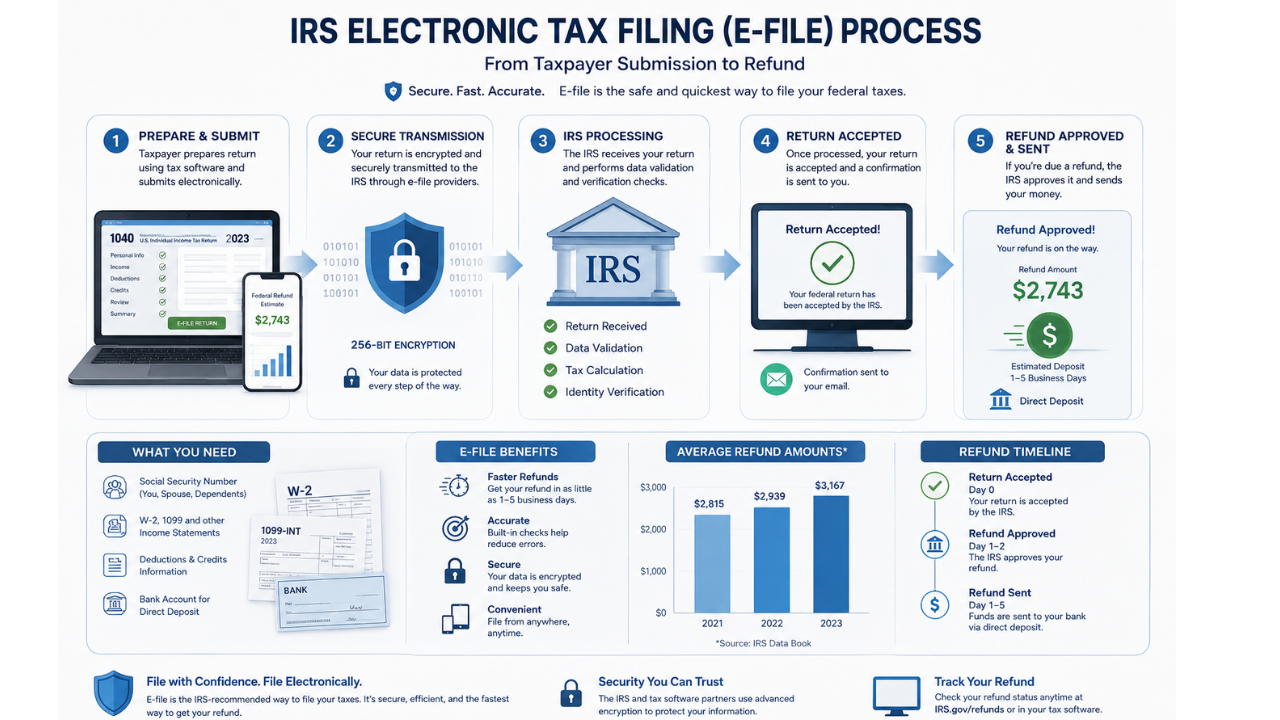
Tax filing is the process of reporting your income, deductions, credits, and tax payments to the IRS each year. Most taxpayers file using Form 1040, which serves as the standard individual income tax return. The IRS encourages electronic filing because it is faster, more accurate, and processes refunds more quickly than paper filing.
IRS Free File is a program that allows eligible taxpayers to file their federal taxes at no cost using guided tax preparation software. Taxpayers whose adjusted gross income falls below a certain threshold can access this service through the IRS website. For those who prefer to prepare their own returns, Free File Fillable Forms offer an electronic version of IRS paper forms.
Tax filing deadlines typically fall on April 15 each year, though the date may shift if it lands on a weekend or holiday. Taxpayers who need more time can request an extension, which gives them until October 15 to file. However, an extension to file is not an extension to pay. Any taxes owed must still be paid by the original deadline to avoid interest and penalties.
The IRS recommends that taxpayers keep copies of their filed returns and supporting documents for at least three years. In certain situations, such as underreporting income by more than 25%, the IRS may review returns from up to six years ago. Good recordkeeping helps protect you if questions arise later.
Common IRS Tax Forms Explained
IRS tax forms can feel intimidating at first glance, but most taxpayers only need to know a handful of them. The forms serve different purposes depending on your income type, employment status, and financial situation.
| Form Number | Purpose | Who Uses It |
|---|---|---|
| Form 1040 | Standard individual income tax return | Most individual taxpayers |
| Form W-2 | Reports wages and tax withholdings | Employers provide to employees |
| Form 1099-NEC | Reports nonemployee compensation | Freelancers and independent contractors |
| Form 1099-INT | Reports interest income | Banks and financial institutions |
| Form 941 | Employer's quarterly payroll tax return | Employers |
| Form 4868 | Application for automatic extension | Taxpayers needing more time to file |
| Schedule C | Profit or loss from business | Sole proprietors and small business owners |
All IRS forms are available for download at IRS.gov. The IRS also provides detailed instructions for each form, including line-by-line explanations that clarify what information belongs where. Taxpayers can use the Interactive Tax Assistant tool on the IRS website to determine which forms they need based on their specific situation.
IRS Refunds Explained
A tax refund occurs when a taxpayer has paid more in taxes throughout the year than they actually owe. This can happen because of withholding from paychecks, estimated tax payments, or refundable tax credits such as the Earned Income Tax Credit. The IRS issues refunds after processing a filed tax return and confirming that an overpayment exists.
Most refunds are issued within 21 days for electronically filed returns. Paper returns take significantly longer, often six to eight weeks. The fastest way to receive a refund is through direct deposit. Taxpayers can track their refund status using the "Where's My Refund?" tool available on IRS.gov or the IRS2Go mobile app.
Refund Tracking Tips
- Use the official IRS "Where's My Refund?" tool
- Refund status updates once daily, usually overnight
- Direct deposit refunds typically arrive in less than 21 days
- Paper check refunds may take 4 to 6 weeks
IRS Payment Plans and Penalties
Taxpayers who cannot pay their full tax bill by the filing deadline still have options. The IRS offers payment plans, also called installment agreements, that allow individuals and businesses to pay their tax debt over time. Setting up a payment plan can reduce the risk of more aggressive collection actions such as liens or levies.
Short-term payment plans are available for taxpayers who can pay within 180 days. Long-term installment agreements allow monthly payments over a longer period. The IRS charges interest on unpaid balances, and certain penalties may apply for late payment or late filing. Even if you cannot pay in full, filing your return on time is critical because the failure-to-file penalty is generally higher than the failure-to-pay penalty.
The IRS recommends paying as much as you can by the deadline to minimize interest and penalty charges. Taxpayers can apply for a payment plan online through the IRS website, by phone, or by mail using Form 9465. Approval is typically straightforward for taxpayers who owe less than certain thresholds and have filed all required returns.
IRS Audits and Notices
An IRS audit is a review of a tax return to verify that the income, deductions, credits, and other items reported are accurate. Audits do not automatically mean a taxpayer did something wrong. Sometimes the IRS simply needs additional documentation or clarification. Audits can be conducted by mail (correspondence audit) or in person at an IRS office or the taxpayer's business location.
The IRS selects returns for audit based on several factors, including random statistical sampling, document matching (comparing W-2s and 1099s against what was reported on the return), and related examinations involving business partners or investors whose returns are being audited. Certain red flags, such as unusually large deductions relative to income, can also increase audit risk.
IRS notices are official letters the agency sends to taxpayers for a variety of reasons, including balance due notices, requests for additional information, or notification of changes made to a return. Not every IRS notice is a cause for alarm. Many are informational and can be resolved by responding with the requested documentation. Taxpayers who receive an IRS notice should read it carefully, compare it against their tax records, and respond by the stated deadline.
Taxpayer Rights and Responsibilities
Every taxpayer in the United States has a set of fundamental rights when dealing with the IRS. These are outlined in the Taxpayer Bill of Rights, which the IRS adopted in 2014. Knowing these rights helps taxpayers feel more confident and protected during any interaction with the agency.
The Right to Be Informed
Taxpayers have the right to know what they need to do to comply with tax laws and to receive clear explanations of IRS decisions.
The Right to Quality Service
Taxpayers deserve prompt, courteous, and professional assistance from IRS employees.
The Right to Pay No More Than the Correct Amount
Taxpayers only owe what the law requires, including interest and penalties that are properly calculated.
The Right to Challenge the IRS's Position
Taxpayers can object to IRS actions and provide additional documentation to support their case.
The Right to Appeal
Taxpayers can appeal most IRS decisions in an independent forum.
The Right to Finality
Taxpayers have the right to know how long the IRS has to audit a return and when an audit is finished.
Along with rights come responsibilities. Taxpayers are responsible for filing accurate returns on time, paying taxes owed, and maintaining proper records. Meeting these responsibilities helps avoid penalties and keeps the tax system functioning fairly for everyone.
How Businesses Work With the IRS
Businesses interact with the IRS in several ways, from obtaining an Employer Identification Number (EIN) to filing employment tax returns and paying estimated taxes. A business's tax obligations depend on its legal structure, including whether it operates as a sole proprietorship, partnership, corporation, or S corporation.
Employers must withhold federal income tax, Social Security tax, and Medicare tax from employee wages and deposit those amounts with the IRS on a regular schedule. They also file quarterly payroll tax returns using Form 941 and annual returns using Form 940 for federal unemployment tax. Self-employed individuals pay self-employment tax, which covers their Social Security and Medicare contributions, calculated on Schedule SE and reported with their individual Form 1040.
The IRS offers several resources specifically for small businesses and self-employed individuals, including the Small Business and Self-Employed Tax Center on IRS.gov. This resource hub provides information on recordkeeping, deductible business expenses, estimated tax requirements, and tax credits available to businesses. Staying organized and filing on time helps business owners avoid costly penalties and keeps their operations running smoothly.
IRS Online Tools and Services
The IRS has significantly expanded its online services in recent years, making it easier for taxpayers to manage their tax obligations without needing to call or visit an IRS office. These digital tools are available 24 hours a day and can handle many common taxpayer needs.
| IRS Tool | Purpose |
|---|---|
| Where's My Refund? | Track your tax refund status online or via the IRS2Go app. |
| IRS Free File | File federal taxes for free if you meet income requirements. |
| Online Payment Agreements | Set up installment plans for unpaid tax balances. |
| Direct Pay | Pay taxes directly from a checking or savings account at no cost. |
| Interactive Tax Assistant | Answer tax law questions tailored to your specific situation. |
| IRS2Go Mobile App | Check refunds, make payments, and get tax tips on your phone. |
IRS Scams and Fraud Awareness
IRS scams are a serious problem affecting taxpayers across the country. Scammers often impersonate IRS agents through phone calls, emails, or text messages, demanding immediate payment and threatening arrest, deportation, or license revocation. Understanding how the real IRS communicates can help you spot and avoid these schemes.
The IRS does not initiate contact with taxpayers by email, text message, or social media to request personal or financial information. The agency also does not demand immediate payment using prepaid debit cards, gift cards, or wire transfers. The first contact from the IRS is typically through official correspondence sent by U.S. mail.
Common IRS Scam Warning Signs
- Callers demanding immediate payment without prior written notice
- Threats of arrest, deportation, or license suspension
- Requests for payment via gift cards or wire transfers
- Emails claiming to be from the IRS with links or attachments
- Text messages asking you to click a link to resolve a tax issue
If you receive a suspicious communication claiming to be from the IRS, report it to [email protected]. If you believe you may actually owe taxes, contact the IRS directly using the phone number listed on IRS.gov to verify the situation. Never provide personal financial information to unsolicited callers or through unverified websites.
Want to See How Federal Taxes Affect Your Paycheck?
Use our free paycheck calculator to estimate your take-home pay after federal income taxes, Social Security, and Medicare deductions. Knowing your net pay helps you budget better and plan for tax season.
Calculate Your Take-Home Pay NowOfficial IRS Resources
These links connect you directly to official IRS tools, forms, and payment portals. Always verify tax information through these trusted sources.
These resources are provided directly by the Internal Revenue Service. Taxpayers should verify any tax guidance through official IRS channels or consult a qualified tax professional.
What Is the Internal Revenue Service (IRS)? – FAQs
Is the IRS part of the federal government?
Yes, the IRS is a bureau of the U.S. Department of the Treasury and operates as a federal agency within the executive branch of the United States government. It was established by Congress and receives its funding through the federal budget. The IRS commissioner is appointed by the President and confirmed by the Senate.
What does the IRS do with taxes?
The IRS collects tax revenue and transfers it to the U.S. Treasury. These funds are then allocated by Congress to pay for government operations and public services including national defense, healthcare programs, education, infrastructure projects, and social services. The IRS itself does not decide how the money is spent.
Can I contact the IRS directly?
Yes, taxpayers can contact the IRS by phone, mail, or through local IRS Taxpayer Assistance Centers. The main IRS phone number for individuals is 1-800-829-1040. The IRS website also offers numerous online tools and resources that can answer many common questions without needing to call. Wait times may vary depending on the time of year.
What happens if I do not file taxes?
Failing to file a required tax return can result in the failure-to-file penalty, which is generally 5% of the unpaid taxes for each month the return is late, up to 25% of the unpaid tax. If you are owed a refund, there is no penalty for filing late, but you must file within three years of the original deadline to claim your refund. The IRS may also file a substitute return on your behalf based on information it has from employers and financial institutions.
How long does the IRS keep tax records?
The IRS generally recommends that taxpayers keep copies of their filed returns and supporting documents for at least three years from the date of filing. The IRS itself may retain tax records for longer periods internally. For situations involving substantial underreporting of income, the IRS can look back up to six years. Records related to property or investments should be kept longer.
What is an IRS audit?
An IRS audit is an examination of a tax return to verify its accuracy. The IRS may request documentation to support income, deductions, or credits claimed on the return. Audits can be conducted by mail or in person. Being selected for an audit does not necessarily mean you made an error. The IRS selects returns based on statistical models, document matching, and other factors.
How do IRS payment plans work?
IRS payment plans, also called installment agreements, allow taxpayers to pay their tax debt over time. Short-term plans give you up to 180 days to pay, while long-term plans set up monthly payments. Taxpayers can apply online if they owe less than certain thresholds. Interest and penalties continue to accrue until the balance is fully paid, so paying as quickly as possible minimizes total costs.
Can the IRS help me file taxes?
Yes, the IRS offers several free resources to help taxpayers file. IRS Free File provides free guided tax preparation software for eligible taxpayers. Free File Fillable Forms allow anyone to file electronically at no cost. The Volunteer Income Tax Assistance program offers free tax help to people with low to moderate income, disabilities, or limited English proficiency. The Tax Counseling for the Elderly program serves taxpayers age 60 and older.
How do I avoid IRS scams?
To avoid IRS scams, remember that the IRS never initiates contact by email, text, or social media. The agency does not demand immediate payment over the phone using gift cards or wire transfers. If you receive a suspicious call or message, do not provide any information. Report phishing attempts to [email protected]. Always verify any communication by contacting the IRS directly through the official phone number listed on IRS.gov.
Does the IRS issue tax refunds?
Yes, the IRS issues tax refunds when taxpayers have overpaid their taxes during the year through withholding or estimated payments, or when they qualify for refundable tax credits. Most refunds are issued within 21 days for electronically filed returns. The fastest way to receive a refund is through direct deposit. Taxpayers can track their refund using the "Where's My Refund?" tool on IRS.gov.
Take Control of Your Tax Planning Today
Understanding how the IRS works is just the first step. To make informed financial decisions, you need to know exactly how taxes impact your income. Our salary after taxes calculator helps you see your real take-home pay in seconds, so you can plan ahead with confidence.
Try the Paycheck Calculator NowFor those who enjoy using free online tools to simplify everyday tasks, FreeAiden offers a growing collection of AI-powered utilities including QR code generators, barcode generators, PDF converters, image tools, and productivity resources, all available at no cost.
Disclaimer
This article is provided for general educational and informational purposes only. Tax situations vary widely, and IRS rules and regulations may change over time. The information presented here does not constitute legal advice, tax advice, or professional financial guidance. Readers should verify any tax-related details directly through the official IRS website at IRS.gov or by consulting a qualified tax professional. The author and publisher are not responsible for any actions taken based on this information.
Understanding the IRS
The Internal Revenue Service plays a central role in the financial lives of every American. Understanding what the IRS is, how it operates, and what your responsibilities are as a taxpayer removes much of the fear and confusion that surrounds the tax system. The IRS is not an agency to dread. It is the administrative body that keeps the government funded and ensures that tax laws are applied consistently.
By learning the basics of tax filing, knowing your taxpayer rights, using IRS online tools, and staying alert to scams, you can navigate tax season with greater confidence. Whether you file independently, use a tax professional, or take advantage of IRS Free File, staying informed is the best way to protect yourself and make sound financial choices.
Tax rules evolve, deadlines shift, and personal circumstances change. Bookmark reliable resources like IRS.gov and tools such as a trusted paycheck calculator to stay on top of your tax situation year after year. The more you know about the IRS, the better equipped you are to manage your finances and plan for a secure future.