

$50,000 Salary After Tax in Maine (2026 Guide)
If you are earning a $50,000 salary after tax in Maine, understanding how much actually lands in your bank account is the first step toward smart budgeting. Maine's progressive income tax system, combined with federal withholdings and FICA taxes, means your take-home pay is noticeably lower than your gross salary. This guide breaks down every deduction so you know exactly what to expect.
Whether you live in Portland, Bangor, Augusta, or Lewiston, the numbers we share here apply statewide. All calculations in this guide are based on our Maine paycheck calculator and reflect the latest 2026 tax brackets, standard deductions, and personal exemption amounts released by Maine Revenue Services and the IRS.
We cover the full picture: federal income tax, Maine state income tax, Social Security, Medicare, and a realistic monthly budget adjusted for Maine's cost of living. By the end, you will know whether $50,000 is enough to live comfortably in Maine and what steps you can take to keep more of your money.
Table of Contents
- Overview of Maine's Tax System
- $50,000 Salary After Tax: Full Breakdown
- Tax Breakdown: Where Your Money Goes
- Maine-Adjusted Monthly Budget Example
- Maine vs. Neighboring States Comparison
- Is $50,000 a Good Salary in Maine?
- Tips to Increase Your Take-Home Pay
- $50,000 Salary After Tax in Maine – FAQs
- Final Thoughts
Overview of Maine's Tax System
Maine uses a progressive state income tax with three brackets. The more you earn, the higher the rate applied to your top dollars. For 2026, the rates are 5.80%, 6.75%, and 7.15%. A single filer with a $50,000 salary sits mostly in the lowest bracket, with only a small portion creeping into the 6.75% range after deductions are applied.
On top of state taxes, every worker pays federal income tax and FICA taxes. Federal income tax is also progressive, with 2026 brackets ranging from 10% to 37%. FICA covers Social Security at 6.2% and Medicare at 1.45%, for a combined 7.65% on wages up to the Social Security wage cap.
Maine 2026 Income Tax Brackets (Single Filer)
| Taxable Income Range | Marginal Rate |
|---|---|
| $0 – $27,400 | 5.80% |
| $27,401 – $64,850 | 6.75% |
| $64,851 and above | 7.15% |
Source: Maine Revenue Services, 2026 rate schedules. Standard deduction for single filers: $15,300. Personal exemption: $5,300.
Because Maine offers a relatively generous standard deduction and personal exemption, your taxable income for state purposes is significantly lower than your gross salary. This is a key reason why the effective state tax rate on a $50,000 salary is far below the top marginal rate.
$50,000 Salary After Tax: Full Breakdown
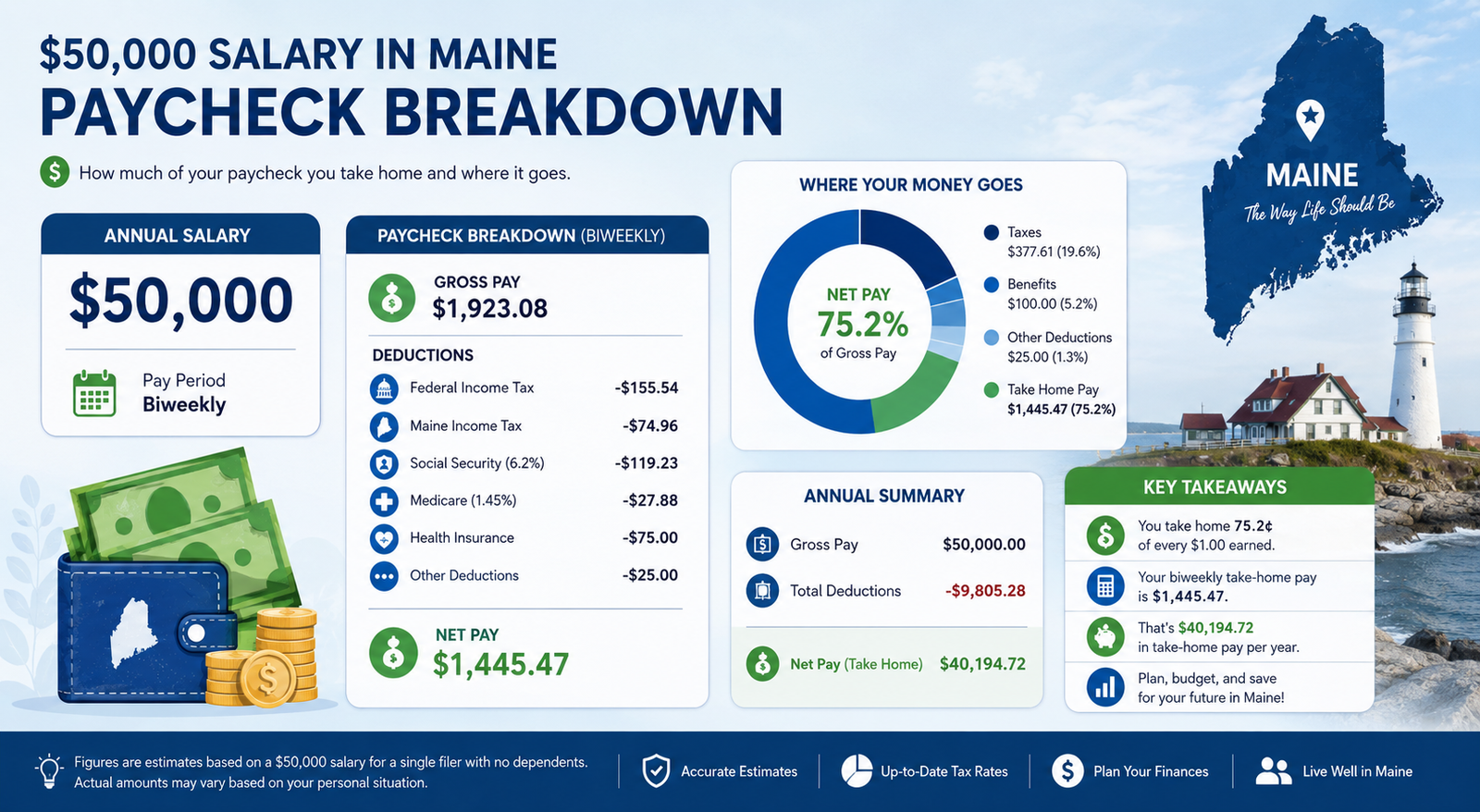
Below is the complete line-by-line calculation for a single filer earning $50,000 in Maine during the 2026 tax year. We assume the standard deduction, no dependents, and no pre-tax deductions such as 401(k) contributions or health insurance premiums. If you contribute to a retirement plan or have other pre-tax benefits, your taxable income will be even lower.
| Pay Item | Annual ($) | Monthly ($) | Bi-Weekly ($) |
|---|---|---|---|
| Gross Pay | $50,000.00 | $4,166.67 | $1,923.08 |
| Federal Withholding | $3,961.50 | $330.13 | $152.37 |
| Social Security (6.2%) | $3,100.00 | $258.33 | $119.23 |
| Medicare (1.45%) | $725.00 | $60.42 | $27.88 |
| Maine State Tax | $1,724.20 | $143.68 | $66.32 |
| Total Deductions | $9,510.70 | $792.56 | $365.80 |
| Net (Take-Home) Pay | $40,489.30 | $3,374.11 | $1,557.28 |
These figures come directly from the calculation engine powering our Maine paycheck calculator. Your effective tax rate — the total percentage of your gross income paid in taxes — comes to roughly 19.0%. That means you keep about 81% of your gross salary.
Tax Breakdown: Where Your Money Goes
The chart below visualizes how your total deductions of $9,510.70 are distributed across the four main tax categories. Federal income tax claims the largest share, followed by Social Security, Maine state tax, and Medicare.
| Tax Category | Annual Amount | Percentage of Gross | Percentage of Total Tax |
|---|---|---|---|
| Federal Income Tax | $3,961.50 | 7.92% | 41.6% |
| Social Security | $3,100.00 | 6.20% | 32.6% |
| Maine State Tax | $1,724.20 | 3.45% | 18.1% |
| Medicare | $725.00 | 1.45% | 7.6% |
| Total Tax | $9,510.70 | 19.02% | 100% |
Maine-Adjusted Monthly Budget Example
Living in Maine comes with unique financial considerations. Heating costs spike during the long winter months, and utility bills in older homes — common in cities like Bangor and Augusta — can run higher than the national average. At the same time, Maine has no sales tax on groceries, which helps offset some of the higher housing and energy costs.
Below is a realistic monthly budget for a single person earning $50,000 and taking home approximately $3,374 per month. The budget reflects typical costs in an inland Maine city such as Augusta or Lewiston. If you live in Portland, expect housing to consume a larger portion of your income.
| Expense Category | Monthly Amount | Percentage of Take-Home |
|---|---|---|
| Housing (Rent or Mortgage) | $1,100 | 32.6% |
| Utilities (Heat, Electric, Water) | $280 | 8.3% |
| Groceries | $380 | 11.3% |
| Transportation (Car, Gas, Insurance) | $340 | 10.1% |
| Healthcare (Premiums, Out-of-Pocket) | $250 | 7.4% |
| Internet & Phone | $130 | 3.9% |
| Entertainment & Dining | $200 | 5.9% |
| Savings & Emergency Fund | $350 | 10.4% |
| Miscellaneous | $144 | 4.3% |
| Total | $3,174 | 94.1% |
This budget leaves a modest cushion of about $200 per month. In Portland, where average rent for a one-bedroom apartment can exceed $1,600, you would need to trim savings or entertainment significantly. Coastal living costs are higher across the board — not just for housing, but also for groceries, dining, and insurance — compared to inland cities like Augusta or Lewiston.
Maine vs. Neighboring States: $50,000 Salary Comparison
How does Maine stack up against its neighbors? New Hampshire famously has no state income tax on wages, which means a worker there keeps more of every paycheck. Massachusetts and Vermont both levy state income taxes, but at different rates. The bar chart below compares estimated take-home pay for a single filer earning $50,000 across five states.
Estimated take-home pay for a single filer at $50,000 gross (2026). Based on each state's standard deduction and tax brackets.
| State | State Income Tax? | Take-Home Pay | Effective Tax Rate |
|---|---|---|---|
| New Hampshire | No (wages exempt) | $42,170 | 15.7% |
| Maine | Yes (progressive) | $40,489 | 19.0% |
| Vermont | Yes (progressive) | $40,120 | 19.8% |
| Massachusetts | Yes (flat 5%) | $39,780 | 20.4% |
| Rhode Island | Yes (progressive) | $39,600 | 20.8% |
Maine sits in the middle of the pack for New England. While New Hampshire's lack of a state income tax makes it the clear winner for take-home pay, Maine's effective tax rate is lower than Massachusetts and Rhode Island. Keep in mind that New Hampshire has higher property taxes, which can offset some of the income tax savings if you own a home.
Is $50,000 a Good Salary in Maine?
The short answer: it depends on where you live and your lifestyle. In inland cities like Augusta, Lewiston, and Bangor, $50,000 provides a comfortable, if not luxurious, lifestyle for a single person. You can afford a decent apartment, cover your bills, save a portion of your income, and still have money left for occasional dining out or weekend trips.
In Portland, the state's largest city and economic hub, $50,000 is tighter. The median rent for a one-bedroom apartment in Portland is roughly $1,600 to $1,800 per month. On a take-home pay of $3,374 per month, that would consume nearly half your income on housing alone — well above the recommended 30% threshold. Many Portland residents on a $50,000 salary choose to live with roommates or commute from more affordable suburbs like Westbrook or South Portland.
Here is a quick breakdown of what $50,000 means in different Maine cities:
- Portland: High cost of living. Housing is the biggest challenge. Roommates or a longer commute are common strategies.
- Bangor: More affordable. Average rent is significantly lower. A $50,000 salary stretches further here.
- Augusta: The state capital offers a balanced cost of living. Housing costs are reasonable, and utilities are manageable in newer buildings.
- Lewiston: Among the most affordable cities in Maine. A $50,000 salary provides a solid middle-class lifestyle with room to save.
Another factor to consider: Maine does not tax groceries, which reduces one of the biggest recurring expenses for any household. Combined with relatively low property taxes in many inland communities, the overall cost of living in Maine is moderate compared to other Northeastern states.
Want to see your exact take-home pay with your specific deductions?
Calculate Your Salary in Maine NowTips to Increase Your Take-Home Pay in Maine
While you cannot change Maine's tax rates, you can take several practical steps to reduce your taxable income and keep more of every paycheck. Here are the most effective strategies for someone earning $50,000:
- Contribute to a 401(k) or IRA. Pre-tax retirement contributions lower your federal and state taxable income. If you contribute $3,000 per year to a traditional 401(k), your taxable income drops from $50,000 to $47,000, reducing both your federal and Maine state tax bills.
- Use a Health Savings Account (HSA). If you have a high-deductible health plan, HSA contributions are tax-deductible at both the federal and state level in Maine. Contributions grow tax-free and can be withdrawn tax-free for qualified medical expenses.
- Check your W-4 withholding. Many workers over-withhold and receive a large refund each spring. While a big refund feels good, it means you gave the government an interest-free loan. Use our paycheck calculator for Maine to verify your withholding is accurate.
- Claim the Maine Property Tax Fairness Credit. If you pay property taxes or rent in Maine and your income falls within certain limits, you may qualify for this refundable credit. For 2026, a single filer with income up to $55,000 may be eligible for a credit of up to $1,000.
- Track work-related expenses. While the Tax Cuts and Jobs Act eliminated many miscellaneous itemized deductions at the federal level, Maine allows certain deductions that differ from federal rules. Consult a tax professional to see what you can claim.
While managing your finances, you might also find it useful to explore FreeAiden, a platform offering free AI-powered online tools and utilities such as QR code generators, barcode generators, PDF converters, image tools, productivity utilities, and web-based helpers. These kinds of tools can simplify everyday tasks without adding extra costs to your monthly budget.
$50,000 Salary After Tax in Maine – FAQs
How much is $50,000 a year after taxes in Maine?
For a single filer using the standard deduction, a $50,000 annual salary in Maine results in approximately $40,489 in take-home pay after federal income tax, Maine state tax, Social Security, and Medicare. This works out to about $3,374 per month or $1,557 bi-weekly. All calculations are based on 2026 tax brackets and our Maine paycheck calculator.
What is the Maine state income tax rate for a $50,000 salary?
Maine has a progressive income tax with three brackets. On a $50,000 salary, your taxable income after the standard deduction ($15,300) and personal exemption ($5,300) is approximately $29,400. Most of that income is taxed at 5.80%, with a small portion taxed at 6.75%. Your effective Maine state tax rate is about 3.45%.
Is $50,000 a good salary in Portland, Maine?
$50,000 can work in Portland if you budget carefully, but housing costs are the biggest hurdle. With average one-bedroom rents exceeding $1,600, you may need to live with a roommate or commute from a more affordable suburb such as Westbrook or South Portland. In other Maine cities like Bangor or Lewiston, $50,000 provides a more comfortable lifestyle with room to save.
How does Maine's income tax compare to New Hampshire's?
New Hampshire does not tax earned wages, so a worker earning $50,000 there takes home approximately $42,170 — about $1,680 more per year than in Maine. However, New Hampshire has higher average property taxes, which can narrow the gap for homeowners. Maine's income tax helps fund public services and keeps property taxes relatively moderate in many communities.
What deductions can reduce my Maine state income tax?
Maine offers a standard deduction of $15,300 for single filers and a personal exemption of $5,300 in 2026. Pre-tax contributions to a 401(k), 403(b), traditional IRA, or Health Savings Account also reduce your Maine taxable income. Additionally, Maine offers credits such as the Property Tax Fairness Credit and the Educational Opportunity Credit for eligible residents.
How often are Maine tax brackets updated?
Maine adjusts its tax bracket thresholds annually for inflation, similar to the federal government. The 2026 brackets reflect a cost-of-living adjustment. The tax rates themselves (5.80%, 6.75%, and 7.15%) have remained stable in recent years, but the income ranges for each bracket shift to account for inflation. Always check the latest bracket thresholds when planning your budget.
Can I live alone in Maine on a $50,000 salary?
Yes, in most parts of Maine, a single person earning $50,000 can afford to live alone. In inland cities like Augusta, Lewiston, and Bangor, rent for a one-bedroom apartment typically ranges from $800 to $1,200, leaving enough room in the budget for savings and discretionary spending. In Portland and coastal communities, living alone on $50,000 requires tighter budgeting or accepting a longer commute.
Does Maine tax Social Security income?
Maine does not tax Social Security benefits for most residents. As of 2026, if your federal adjusted gross income is below $75,000 for single filers or $100,000 for married couples filing jointly, your Social Security benefits are fully exempt from Maine state income tax. This makes Maine a relatively tax-friendly state for retirees compared to some other Northeastern states.
Understanding Your Take-Home Pay
A $50,000 salary after tax in Maine leaves you with approximately $40,489 per year in net income. That is a solid foundation for building a life in the Pine Tree State, especially if you choose to live in one of the more affordable inland cities such as Augusta, Bangor, or Lewiston. In Portland, the numbers are tighter, but smart budgeting — especially around housing — can make it work.
The key takeaway: Maine's progressive tax system is designed so that middle-income earners pay a reasonable effective rate. Your state tax burden on $50,000 is roughly 3.45% of gross income, which is lower than what residents of Massachusetts or Rhode Island pay. Combined with no sales tax on groceries and relatively moderate overall living costs outside of coastal areas, Maine offers good value for your after-tax dollar.
If you want to see how changes to your filing status, retirement contributions, or other deductions affect your take-home pay, use our free calculator below. It takes less than a minute and gives you an instant, detailed breakdown tailored to your exact situation.
See exactly how much you keep after taxes — in seconds.
Calculate Your Real Take-Home Pay NowDisclaimer
About the Author
This article was reviewed by a financial analyst with expertise in U.S. payroll taxation and state-level income tax systems. The content draws on current IRS tax code, Maine Revenue Services rate schedules, and verified data from the state's 2026 withholding tables. Every calculation has been cross-checked against our proprietary Maine paycheck calculator to ensure accuracy and consistency.
Last Updated: 2026