

Last Updated: June 12, 2026
Form 1040-X: What It Is and How to Amend Your Tax Return
Filing taxes requires careful attention, but mistakes happen. Perhaps you forgot a W-2, claimed the wrong filing status, or discovered a credit you were eligible for after submitting your return. Form 1040-X is the official IRS document designed to correct a previously filed individual income tax return. This guide explains exactly how the amendment process works, who needs to file, and how to avoid common pitfalls.
Amending a tax return can feel intimidating, but the steps are straightforward when you understand the form. This resource uses official IRS instructions and current 2026 guidance to walk you through every part of Form 1040-X. Whether you’re expecting a larger refund or realize you owe a bit more, here’s how to set things right.
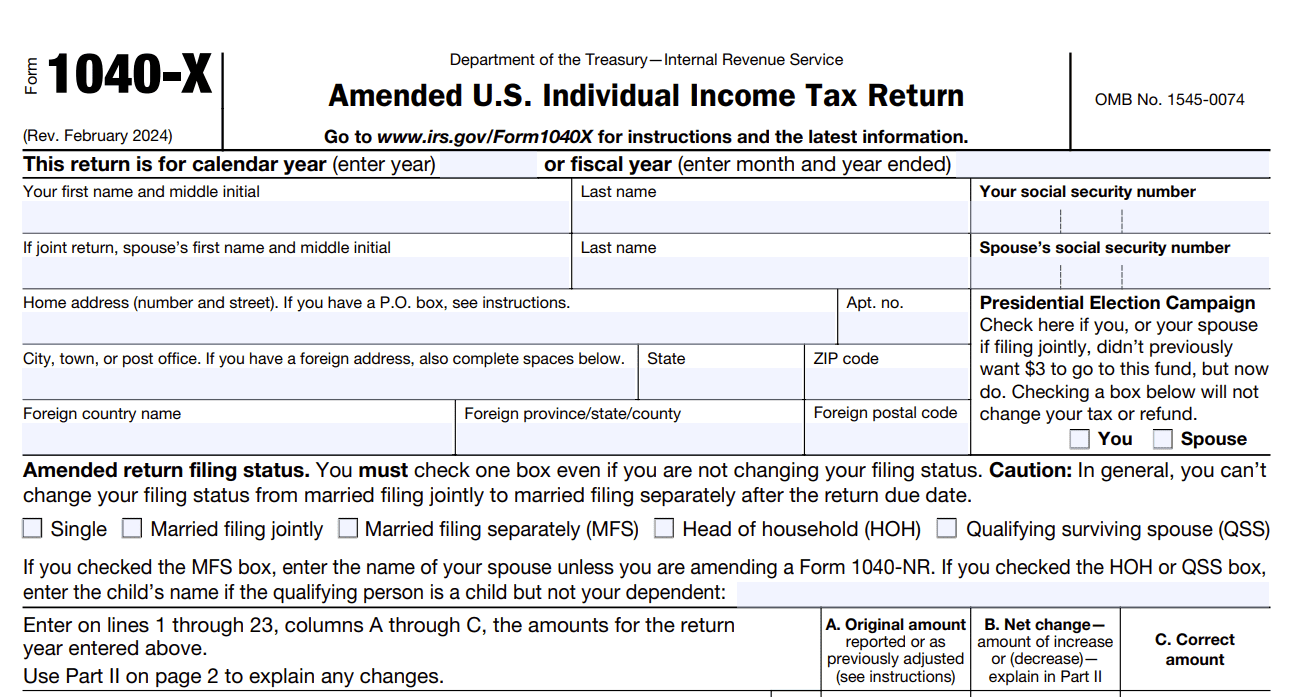
Table of Contents
- What Is Form 1040-X?
- Who Should File Form 1040-X?
- Reasons You May Need to Amend a Tax Return
- When Should You File Form 1040-X?
- When You Do Not Need to File Form 1040-X
- How to Fill Out Form 1040-X Step-by-Step
- Line-by-Line Form 1040-X Instructions
- Understanding the Original Amount, Net Change, and Correct Amount Columns
- What Documents to Include With Form 1040-X
- How to File Form 1040-X Electronically or by Mail
- How Long Does the IRS Take to Process Form 1040-X?
- How to Check Your Amended Return Status
- How an Amended Return Affects Your Refund or Tax Due
- Common Form 1040-X Mistakes to Avoid
- Amending State Tax Returns
- Special Situations for Amended Returns
- FAQs
What Is Form 1040-X?
Form 1040-X, officially titled “Amended U.S. Individual Income Tax Return,” is a two-page form that taxpayers use to correct a previously filed Form 1040, 1040-SR, 1040-NR, 1040-PR, or 1040-SS. It does not replace your original return; instead, it updates the IRS’s records with the corrections you’re making.
The form is divided into three columns for each line item: original amount as filed, net change (increase or decrease), and the correct amount after the change. You also write a detailed explanation of what you changed and why. According to IRS guidance, you must file a separate 1040-X for each tax year you want to amend. You cannot use one form to adjust multiple years.
Who Should File Form 1040-X?
You should file Form 1040-X if you already submitted an individual tax return and later realize that information was incorrect or incomplete. This includes situations where you discover additional income, miss a deduction, or need to change your filing status. The form is not for fixing math errors—the IRS usually catches and corrects those automatically. But any change that affects your tax liability, credits, or payments typically requires an amendment.
For example, if you filed as Single but were actually eligible to file as Head of Household, you would amend to reduce your tax and possibly receive a refund. Similarly, if you forgot to report a side gig income, you need to amend to pay the correct tax.
Reasons You May Need to Amend a Tax Return
There are many legitimate reasons to file an amended return. The most common include:
- Correcting income: You received an additional W-2 or 1099 after filing.
- Changing filing status: Switching from Married Filing Separately to Joint, or Single to Head of Household.
- Updating dependents: Adding a new child or removing one you claimed incorrectly.
- Claiming missed deductions or credits: Forgot the Earned Income Tax Credit, Child Tax Credit, or education credits.
- Adjusting itemized deductions: You originally took the standard deduction but itemizing would save more money.
- Correcting capital gains or losses: A corrected 1099-B changes your reported transactions.
Each situation requires a full recalculation of your tax liability, which is exactly what Form 1040-X walks you through.
When Should You File Form 1040-X?
Generally, you must file Form 1040-X within three years from the date you filed your original return, or within two years from the date you paid the tax, whichever is later. The 3-year period starts from the original due date of the return (usually April 15), not the date you filed. For 2026, that means you can still amend 2023, 2024, and 2025 returns if filed on time. The IRS does not accept amended returns after the statute of limitations expires, so act promptly if you discover a mistake.
If you are amending to claim a refund, you should file as soon as you have the correct information. Waiting too long could mean losing your refund. On the other hand, if you owe additional tax, filing quickly reduces potential interest and penalties.
When You Do Not Need to File Form 1040-X
Not every error requires an amendment. The IRS automatically corrects simple math errors and will send you a notice if there's a mismatch. You also do not need to file if you forgot to attach a form (like a W-2) and the IRS already processed your return and sent a letter requesting it—just respond to that notice. Similarly, if you receive a corrected 1099 that changes your income by a very small amount that doesn’t alter your tax, you may not need to amend. If you are unsure, use the IRS Interactive Tax Assistant or consult a tax professional.
How to Fill Out Form 1040-X Step-by-Step
The amendment form looks different from the regular 1040, but the logic is consistent. The top of the form asks for your name, Social Security number, and the tax year you are amending. You also indicate your current filing status. Below that, you work through three columns for each relevant line on your return.
Identify Error
Find the mistake on your original return and gather supporting documents.
Download Form
Get the latest 1040-X and its instructions from IRS.gov.
Complete Columns
Fill in original, net change, and corrected amounts for each line.
Explain Changes
Write a clear reason in Part III for every adjustment.
Attach & File
Include required schedules and submit electronically or by mail.
Line-by-Line Form 1040-X Instructions
The form is organized to mirror the original 1040, but you only complete lines that change. According to IRS instructions, use the current year’s 1040-X for any tax year you amend, but refer to the tax year's original instructions when recalculating. Below are key parts of the form.
Part I – Tax Return Information
Enter your name and Social Security number exactly as shown on the original return. Check the box for the tax year you are amending. If you are changing your filing status, that correction will be reflected later in the form.
Part II – Explanation of Changes
This is where you tell the IRS what you changed and why. Write clearly and concisely. For example: “I am adding $3,200 in wages from a corrected W-2 from ABC Corp. My original return omitted this income.” If you have multiple changes, list each one. Do not leave this section blank.
Part III – Exemptions and Dependents (if applicable)
If you are adding or removing a dependent, provide their name, Social Security number, and relationship. Attach any required forms, such as Schedule EIC for the Earned Income Credit.
Understanding the Original Amount, Net Change, and Correct Amount Columns
The core of Form 1040-X is the three-column layout. For each line you are changing:
| Column A – Original Amount | Column B – Net Change | Column C – Correct Amount |
|---|---|---|
| Enter the number exactly as it appeared on your original return (or as previously adjusted by the IRS). | Show the increase or decrease. Use parentheses for negative numbers. For example, if income increased by $1,500, enter “1,500.” If a deduction decreased by $200, enter “(200).” | Column A plus or minus Column B. This is the final, corrected figure. |
If you are only changing one line item, the other lines stay the same, but you must still copy the original amounts into Column A and Column C for those lines, leaving Column B blank or zero. This tells the IRS you reviewed everything.
What Documents to Include With Form 1040-X
Attach copies of any forms or schedules that are new or changed because of the amendment. For example, if you are adding a missing W-2, include a copy of that W-2. If you changed your itemized deductions, attach a corrected Schedule A. Do not attach a copy of your entire original return—just the supporting documents that are relevant to the changes.
If you are claiming an additional refund due to a credit, include Form 8862 if required after a previous disallowance. Always refer to the Form 1040-X instructions for a complete list of attachments.
How to File Form 1040-X Electronically or by Mail
The IRS now accepts electronically filed amended returns for tax year 2020 and later. You can use commercial tax software like TurboTax, H&R Block, or a tax professional’s e-file system. E-filing is faster, reduces errors, and provides immediate confirmation. For tax years 2019 and earlier, you must file on paper and mail the form to the IRS.
If mailing, always check the most current IRS instructions for the correct mailing address, as it depends on your state of residence and whether you are including a payment. Mail each tax year’s amendment in a separate envelope. Send it via certified mail with return receipt if you want proof of delivery.
Download the official Form 1040-X
Always use the latest PDF from the IRS website.
Review the official IRS instructions before submitting your amended return.
How Long Does the IRS Take to Process Form 1040-X?
According to IRS guidance, processing an amended return typically takes up to 16 weeks from the date of receipt. However, due to IRS backlogs, some returns may take longer than 16 weeks. Electronically filed amendments are often processed within 8 to 12 weeks, but there is no guarantee. The IRS updates its operational status page regularly, so check for current estimates.
If more than 16 weeks have passed and you haven’t received a notice or refund, you can call the IRS, but using the online tool is usually faster.
How to Check Your Amended Return Status
Use the Where's My Amended Return? tool on IRS.gov or call 866-464-2050. You’ll need your Social Security number, date of birth, and ZIP code. The system tracks your Form 1040-X for the current year and up to three prior years. Status updates generally appear three weeks after you file. The tool will show whether your return is received, adjusted, or completed.
How an Amended Return Affects Your Refund or Tax Due
If your corrections result in an overpayment, the IRS will issue a refund. Amended return refunds can be direct deposited to your bank account if you provide your routing and account numbers on Form 1040-X. Otherwise, you’ll receive a paper check. If you owe additional tax, include payment with your amended return or pay online through IRS Direct Pay. Interest accrues on unpaid tax from the original due date, so it’s wise to pay as soon as possible.
In some cases, your amendment may reduce a previously issued refund or even create a balance due. The IRS will send you a notice explaining any adjustments.
Common Form 1040-X Mistakes to Avoid
- Not explaining changes: Always fill out Part II. An unexplained change can delay processing or be rejected.
- Forgetting to sign and date: Unsigned forms are invalid and will be returned.
- Incorrect columns: Double-check that Column B reflects the net change correctly, and that Column C equals A plus B.
- Omitting supporting forms: If you add a new Schedule C, attach it. Missing schedules cause processing delays.
- Filing for the wrong year: Use a separate 1040-X for each tax year. Mark the correct year box.
- Mailing to the wrong address: Check the instructions for the correct IRS center; it changes based on your location.
A quick review of these areas before mailing can save weeks of frustration.
Amending State Tax Returns
Once you amend your federal return, you likely need to amend your state tax return as well. Most states use federal adjusted gross income as a starting point, so any change flows through. Contact your state’s department of revenue for the appropriate amended form. Some states accept electronic amendments; others require paper. Don’t forget—state refunds may also change.
Special Situations for Amended Returns
There are a few unique scenarios where Form 1040-X is the right tool:
- Injured spouse allocation: You may amend to request relief from a joint refund offset due to your spouse's debt.
- Net operating loss carryback: Use Form 1040-X to apply a current year NOL to a prior year’s return.
- Changing from separate to joint return: Both spouses must sign, and you must attach a statement.
Always consult the official IRS instructions or a tax professional for complex issues.
See How a Tax Change Affects Your Take-Home Pay
Adjusting your income or deductions? Use a paycheck calculator to estimate your updated salary after taxes.
Calculate Your Take-Home PayForm 1040-X: What It Is and How to Amend Your Tax Return – FAQs
Filing Form 1040-X With Confidence
Amending a tax return does not need to be stressful. By following the official IRS instructions and double-checking every entry, you can correct mistakes accurately. Remember to explain each change clearly, attach the right documents, and keep a copy of everything for your records. If your amendment lowers your tax, you might even receive an unexpected refund that improves your monthly cash flow.
Before you submit, consider how the corrected income or deductions affect your overall financial picture. A quick calculation can show you exactly what your earnings look like after all adjustments. Use a salary after taxes calculator to see your real take-home pay once everything is settled.
Finally, stay patient. The IRS processes millions of amendments, and your thorough, well-documented 1040-X will be handled correctly. Keep an eye on the status, and reach out only if the processing window extends significantly beyond 16 weeks.
This guide is based on official IRS Form 1040-X instructions and educational tax resources. Reviewed by a financial analyst and IRS tax education researcher.