

How to Avoid IRS Penalties: Complete Guide for Taxpayers in 2026
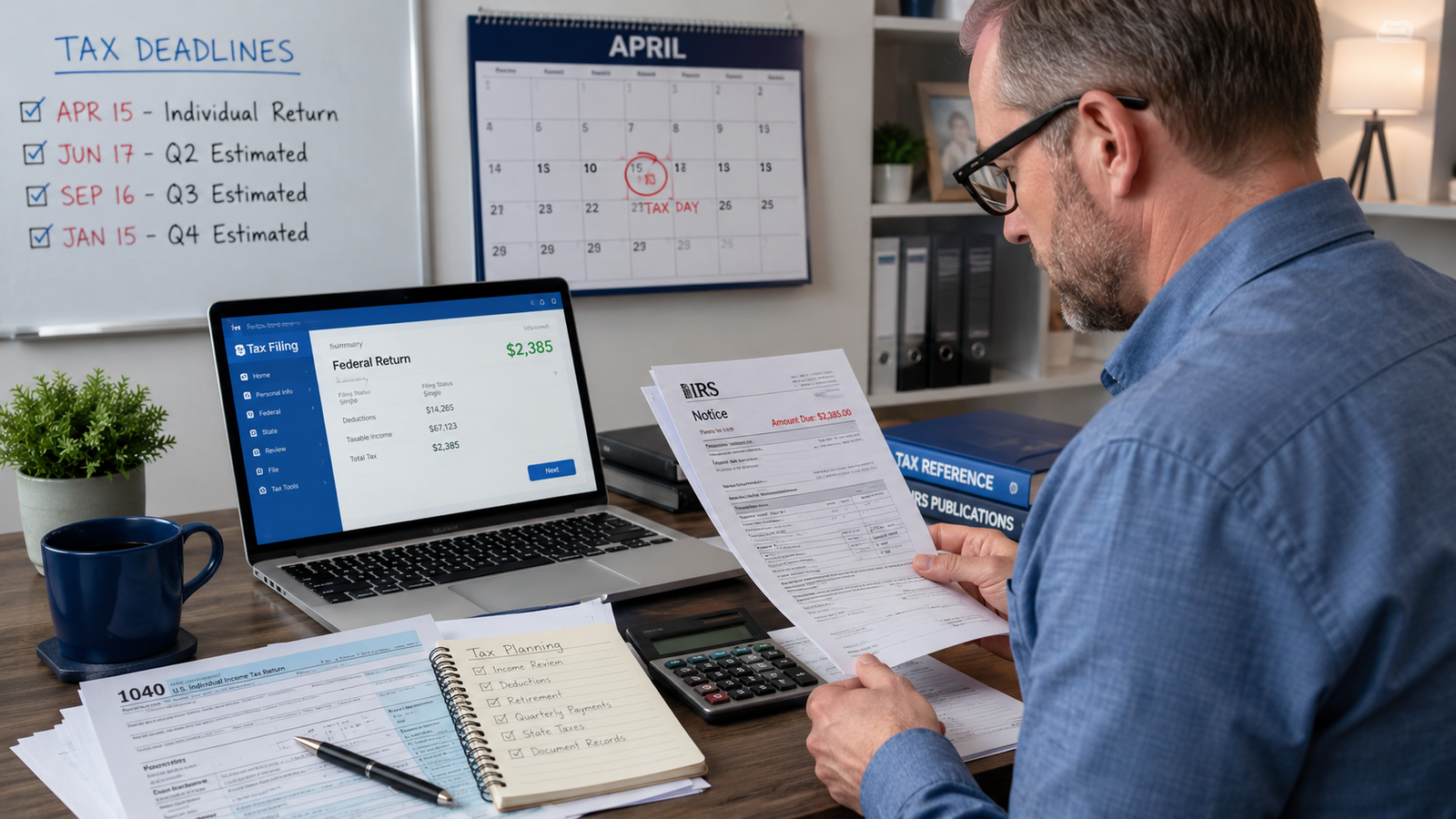
How to avoid IRS penalties in 2026 by filing and paying taxes on time.
Dealing with the Internal Revenue Service can feel overwhelming, especially when you're worried about potential penalties. Whether you're an individual taxpayer, self-employed professional, or small business owner, understanding how to avoid IRS penalties is crucial for maintaining good standing with the tax authorities and protecting your finances.
IRS penalties can add up quickly, turning a manageable tax bill into a significant financial burden. The good news is that most penalties are preventable when you know what to watch for and take proactive steps. This comprehensive guide walks you through everything you need to know about IRS penalties in 2026, from understanding what triggers them to learning about relief options that may be available to you.
This guide is based on official IRS penalty guidance, payment resources, and taxpayer compliance information.
IRS penalties are financial charges imposed when taxpayers fail to meet tax obligations such as filing returns on time, paying taxes owed, reporting income accurately, or making required estimated tax payments. Most IRS penalties can be avoided through timely filing, accurate reporting, and proactive communication with the IRS.
What Are IRS Penalties?
IRS penalties are monetary charges the Internal Revenue Service assesses when taxpayers do not comply with tax laws and regulations. These penalties serve as enforcement mechanisms to encourage timely filing, accurate reporting, and prompt payment of taxes owed.
According to the IRS, penalties can apply to various situations including late filing of tax returns, late payment of taxes, underpayment of estimated taxes, inaccurate reporting, and failure to meet payroll tax obligations. Each type of penalty has specific rules, calculation methods, and potential relief options.
Understanding these penalties is the first step toward avoiding them. The IRS provides detailed guidance on their website about each penalty type, when it applies, and how it's calculated. By familiarizing yourself with these rules, you can take proactive steps to stay compliant and avoid unnecessary costs.
Why the IRS Charges Penalties
The IRS imposes penalties for several important reasons that support the overall tax system:
- Encouraging Compliance: Penalties motivate taxpayers to meet their filing and payment obligations on time
- Maintaining Fairness: They ensure that all taxpayers follow the same rules, preventing those who comply from subsidizing those who don't
- Compensating for Lost Revenue: Late payments mean the government has less money available for public services
- Promoting Accuracy: Penalties for inaccurate returns encourage taxpayers to report correctly the first time
- Administrative Efficiency: Timely filing and payment help the IRS process returns and manage resources effectively
Important Note: The IRS recognizes that mistakes happen and circumstances vary. That's why they offer several penalty relief programs for taxpayers who have reasonable cause or meet specific criteria for first-time relief.
Most Common IRS Tax Penalties
While the IRS assesses various types of penalties, several occur more frequently than others. Understanding these common penalties helps you focus your compliance efforts where they matter most.
Failure-to-File Penalty
This penalty applies when you don't file your tax return by the due date (including extensions). It's typically 5% of the unpaid taxes for each month or part of a month that a return is late, up to a maximum of 25%.
Failure-to-Pay Penalty
When you don't pay the taxes you owe by the deadline, the IRS charges 0.5% of your unpaid taxes for each month or part of a month after the due date, up to 25% of the unpaid amount.
Estimated Tax Penalty
If you don't pay enough tax through withholding or estimated tax payments, or if you pay them late, you may owe this penalty. It applies to individuals, estates, and trusts.
Accuracy-Related Penalty
This 20% penalty applies to underpayments resulting from negligence, disregard of rules, substantial understatement of income tax, or substantial valuation misstatements.
How taxpayers can avoid common IRS penalties through proper tax planning and compliance.
Failure-to-File Penalty Explained
The failure-to-file penalty is one of the most costly IRS penalties you can face. According to IRS guidance, this penalty applies when you don't file your tax return by the due date, including any extensions you've requested.
How the Penalty Is Calculated
The failure-to-file penalty is generally 5% of the unpaid taxes for each month or part of a month that your return is late. The penalty caps at 25% of your unpaid taxes. If your return is more than 60 days late, the minimum penalty is either $485 or 100% of the unpaid tax, whichever is less (for returns required to be filed in 2024, 2025, and 2026).
Key Points to Remember
- The penalty is based on the amount of tax you owe, not your total income
- If you're due a refund, there's no penalty for filing late, but you must file within three years to claim your refund
- Filing an extension gives you more time to file but not more time to pay
- The penalty starts accruing the day after the filing deadline
Critical: The failure-to-file penalty is much higher than the failure-to-pay penalty. If you can't pay your full tax bill, file your return on time anyway to avoid the larger penalty.
Failure-to-Pay Penalty Explained
The failure-to-pay penalty applies when you don't pay the taxes you owe by the original due date of your return. This penalty is separate from and in addition to any failure-to-file penalty.
Penalty Rate and Calculation
The IRS charges 0.5% (one-half of one percent) of your unpaid taxes for each month or part of a month after the due date that the tax remains unpaid. The penalty can increase to 1% per month if the IRS issues a notice of intent to levy and you don't pay within 10 days. The maximum penalty is 25% of your unpaid tax.
When Both Penalties Apply
If both the failure-to-file and failure-to-pay penalties apply in the same month, the failure-to-file penalty is reduced by the failure-to-pay penalty amount. This means the combined penalty for that month is 5% (4.5% for failure to file and 0.5% for failure to pay) rather than 5.5%.
| Penalty Type | Rate | Maximum | Based On |
|---|---|---|---|
| Failure-to-File | 5% per month | 25% | Unpaid tax |
| Failure-to-Pay | 0.5% per month | 25% | Unpaid tax |
| Combined (same month) | 5% per month | 25% | Unpaid tax |
Estimated Tax Underpayment Penalties
If you're self-employed, have significant investment income, or don't have enough tax withheld from your wages, you generally need to make estimated tax payments throughout the year. Failing to do so can result in an underpayment penalty.
Who Needs to Pay Estimated Taxes
You typically need to make estimated tax payments if you expect to owe at least $1,000 in tax after subtracting your withholding and refundable credits. This commonly applies to:
- Self-employed individuals and independent contractors
- Freelancers and gig workers
- Investors with significant dividend or capital gains income
- Retirees receiving pension or retirement account distributions
- Those with rental income
How to Avoid the Penalty
You can avoid the estimated tax penalty if you meet one of these safe harbor rules:
- You owe less than $1,000 in tax after subtracting withholding and estimated tax payments
- You paid at least 90% of the tax shown on your current year's return
- You paid at least 100% of the tax shown on your prior year's return (110% if your adjusted gross income was more than $150,000, or $75,000 if married filing separately)
Pro Tip: Use the IRS Form 1040-ES worksheet or an online paycheck calculator to estimate your tax liability and determine how much you should pay quarterly.
Payroll Tax Penalties
Business owners have additional compliance responsibilities when it comes to payroll taxes. The IRS takes payroll tax violations seriously because these taxes fund Social Security, Medicare, and unemployment programs.
Common Payroll Tax Violations
- Failure to Deposit: Not depositing withheld income tax, Social Security, and Medicare taxes on time
- Failure to File: Not filing Forms 941, 940, or other required payroll tax returns
- Failure to Pay: Not paying the employer's share of payroll taxes
- Trust Fund Recovery Penalty: A 100% penalty on unpaid trust fund taxes (withheld employee taxes) for responsible persons who willfully fail to pay
Penalty Rates
Payroll tax deposit penalties range from 2% to 15% depending on how late the deposit is made. The penalty increases the longer you wait:
- 1-5 days late: 2% penalty
- 6-15 days late: 5% penalty
- 16 or more days late: 10% penalty
- Within 10 days of first IRS notice: 10% penalty
- More than 10 days after first notice or on the day of notice and demand: 15% penalty
Serious Consequence: The Trust Fund Recovery Penalty can be assessed against individuals (not just the business) who are responsible for collecting and paying payroll taxes and willfully fail to do so. This penalty equals 100% of the unpaid trust fund taxes.
How to Avoid IRS Penalties
The best approach to IRS penalties is prevention. By following these proven strategies, you can significantly reduce your risk of facing costly penalties.
Essential Penalty Prevention Strategies
- File your tax returns on time, even if you can't pay in full
- Pay as much as you can by the filing deadline
- Request an extension if you need more time to file
- Make estimated tax payments quarterly if required
- Keep accurate records throughout the year
- Use tax software or hire a qualified tax professional
- Respond promptly to IRS notices
- Set up payment plans if you can't pay in full
- Stay informed about tax law changes
- Review your return carefully before filing
Filing Extensions
If you need more time to prepare your return, file Form 4868 to request an automatic six-month extension. This gives you until October 15 to file (for individual returns). However, remember that an extension to file is not an extension to pay. You still need to estimate and pay any tax owed by the original April deadline to avoid failure-to-pay penalties and interest.
Electronic Filing Benefits
E-filing your tax return offers several advantages that help prevent penalties:
- Faster processing and confirmation of receipt
- Automatic error checking catches mistakes before submission
- Electronic payment options make it easier to pay on time
- Proof of filing date protects you if there's a dispute
- Direct deposit refunds arrive faster
IRS Filing and Payment Deadlines
Knowing and meeting IRS deadlines is crucial for avoiding penalties. Here are the key dates every taxpayer should remember.
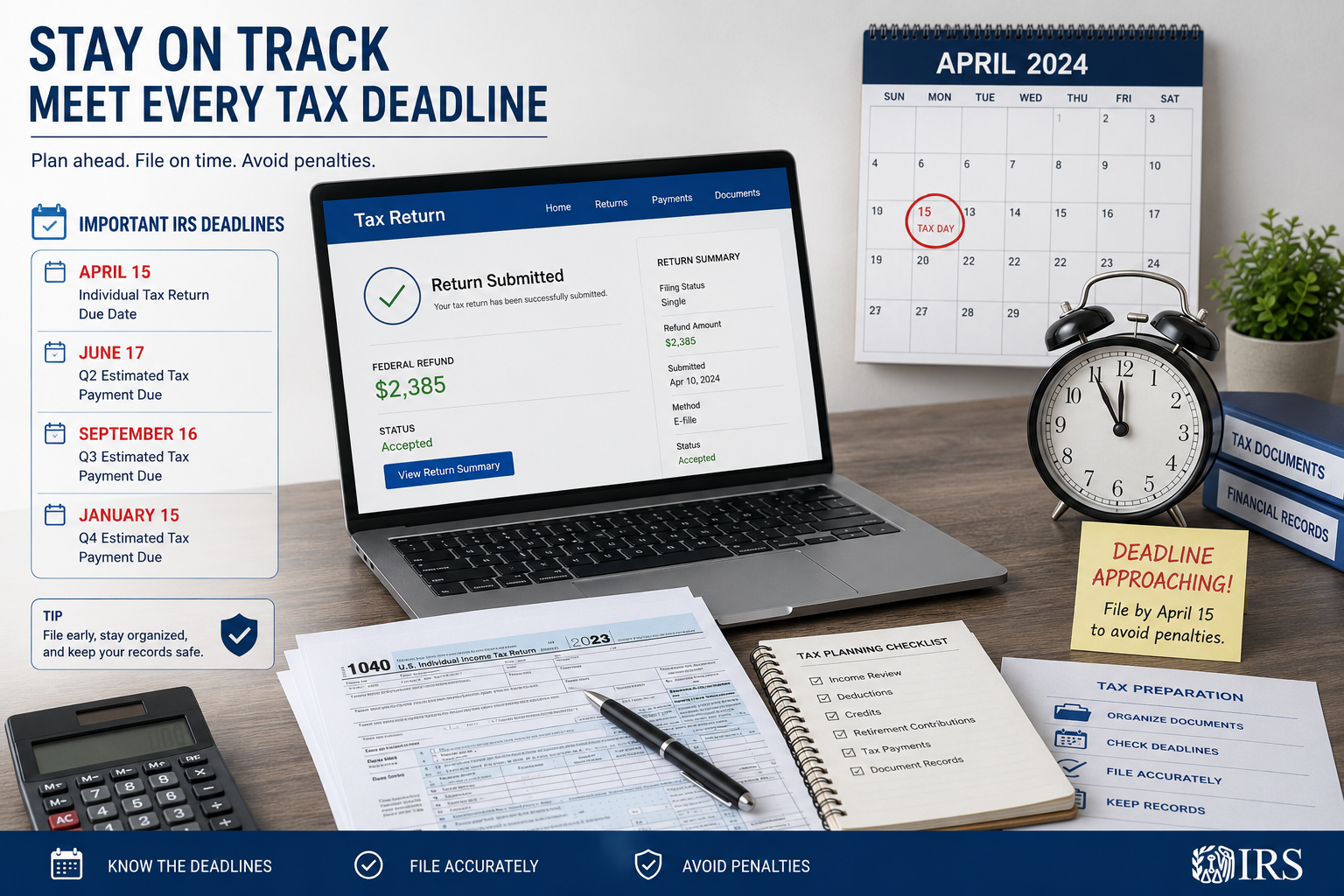
Important IRS filing deadlines that taxpayers should remember to avoid late filing penalties.
April 15 (or next business day)
Individual tax returns (Form 1040) are due. This is also the deadline for paying any tax owed to avoid failure-to-pay penalties. If April 15 falls on a weekend or holiday, the deadline moves to the next business day.
June 15
Second quarter estimated tax payments are due for self-employed individuals and those who need to make estimated payments.
September 15
Third quarter estimated tax payments are due.
October 15
Extended filing deadline for individual returns who filed Form 4868. This is also the deadline for third quarter estimated payments if you're on a fiscal year.
January 15 (following year)
Fourth quarter estimated tax payments are due.
Business Tax Deadlines
- C-Corporations (Form 1120): April 15 (or 15th day of 4th month after fiscal year-end)
- S-Corporations and Partnerships (Form 1120-S, 1065): March 15 (or 15th day of 3rd month after fiscal year-end)
- Quarterly Payroll Taxes (Form 941): Last day of month following end of quarter (April 30, July 31, October 31, January 31)
- Annual Payroll Taxes (Form 940): January 31
Weekend and Holiday Rule: When a deadline falls on a Saturday, Sunday, or legal holiday, the due date is automatically extended to the next business day. You don't need to file anything to claim this extension.
IRS Payment Plans and Compliance Strategies
If you can't pay your full tax bill by the deadline, don't panic. The IRS offers several payment plan options that can help you stay compliant while managing your cash flow.
Short-Term Payment Plan
If you can pay your balance in full within 180 days (about 6 months), you can request a short-term payment plan. There's no setup fee for this option, though you'll still owe interest and possibly penalties on the unpaid balance.
Long-Term Payment Plan (Installment Agreement)
For balances that will take longer than 180 days to pay, you can apply for a long-term payment plan or installment agreement. The IRS offers several types:
- Guaranteed Installment Agreement: Available if you owe $10,000 or less (excluding interest and penalties) and can pay within 3 years
- Streamlined Installment Agreement: For individuals who owe $50,000 or less in combined tax, penalties, and interest
- Regular Installment Agreement: For balances over $50,000, requiring financial disclosure
How Payment Plans Help Avoid Penalties
While payment plans don't eliminate the failure-to-pay penalty entirely, they can help in several ways:
- The failure-to-pay penalty rate drops to 0.25% per month while you're in an installment agreement
- You avoid more severe collection actions like liens and levies
- You demonstrate good faith effort to comply with tax obligations
- You may qualify for penalty abatement once you complete the agreement
Good to Know: You can apply for most payment plans online through the IRS Online Payment Agreement tool. The application is quick, and you'll receive an immediate response in most cases.
Penalty Relief Options
The IRS understands that taxpayers face various challenges that may prevent them from meeting their tax obligations. That's why they offer several penalty relief programs for those who qualify.
Types of Penalty Relief
According to IRS guidance, there are three main types of penalty relief available:
- First-Time Penalty Abatement (FTA)
- Reasonable Cause
- Statutory Exceptions
Each type has specific requirements and application processes. Let's explore each option in detail.
First-Time Penalty Abatement (FTA)
First-Time Penalty Abatement is an administrative waiver that the IRS offers to taxpayers with a clean compliance history. It's one of the most accessible forms of penalty relief.
FTA Eligibility Requirements
To qualify for FTA, you must meet all of these criteria:
- You filed all required returns or filed an extension
- You paid or arranged to pay any tax due (through a payment plan if necessary)
- You had no penalties (other than estimated tax penalties) in the three tax years prior to the year you're requesting relief for
What Penalties FTA Covers
First-Time Penalty Abatement can remove or reduce:
- Failure-to-file penalties
- Failure-to-pay penalties
- Failure-to-deposit penalties (for businesses)
How to Request FTA
You can request FTA in several ways:
- By Phone: Call the IRS at the number on your penalty notice
- In Writing: Respond to your penalty notice with a written request
- Through a Tax Professional: Have your authorized representative request it on your behalf
Pro Tip: Even if you don't meet all FTA requirements, it's worth asking the IRS representative about it. Sometimes they can offer alternative relief options or payment arrangements.
Reasonable Cause Penalty Relief
If you don't qualify for First-Time Penalty Abatement, you may still be able to get penalties removed by showing reasonable cause for your failure to comply.
What Constitutes Reasonable Cause
The IRS considers reasonable cause to exist when you exercised ordinary business care and prudence but were still unable to meet your tax obligations. Common reasonable cause situations include:
- Death or Serious Illness: Death or serious illness of the taxpayer or an immediate family member
- Natural Disasters: Fire, casualty, natural disaster, or other disturbance
- Unavoidable Absence: Inability to obtain necessary records despite exercising due diligence
- System Issues: IRS system problems that prevented timely filing or payment
- Reliance on Professional Advice: Reasonable reliance on erroneous written advice from the IRS
- Military Service: Active duty military service in a combat zone
What Doesn't Qualify as Reasonable Cause
The IRS generally doesn't accept these as reasonable cause:
- Forgetting the deadline
- Lack of funds (unless you can show extraordinary circumstances)
- Reliance on a tax preparer without providing complete information
- Simple negligence or oversight
How to Request Reasonable Cause Relief
To request penalty relief based on reasonable cause:
- File all delinquent returns
- Pay as much tax as you can
- Write a statement explaining why you couldn't meet your tax obligations
- Include documentation supporting your claim (medical records, death certificates, disaster declarations, etc.)
- Submit your request with your penalty notice response or separately
Important: Be honest and thorough in your reasonable cause explanation. The IRS reviews each case individually, and providing complete information increases your chances of approval.
Common Tax Mistakes That Trigger IRS Penalties
Avoiding penalties isn't just about knowing the rules. It's also about avoiding common mistakes that many taxpayers make. Here are the most frequent errors that lead to IRS penalties.
Mistake #1: Not Filing Because You Can't Pay
Many taxpayers think if they can't pay their tax bill, they shouldn't file their return. This is exactly backwards. The failure-to-file penalty (5% per month) is ten times higher than the failure-to-pay penalty (0.5% per month). Always file on time, even if you can't pay.
Mistake #2: Missing Estimated Tax Deadlines
Self-employed individuals and those with significant non-wage income often forget about quarterly estimated tax payments. Setting calendar reminders and using automatic payments can prevent this costly mistake.
Mistake #3: Not Responding to IRS Notices
Ignoring IRS notices doesn't make them go away. In fact, it usually makes things worse. The IRS may assess additional penalties or take collection action if you don't respond. Always open and read IRS mail promptly.
Mistake #4: Poor Record Keeping
Without proper documentation, you can't substantiate deductions and credits if the IRS questions your return. This can lead to accuracy-related penalties. Keep receipts, logs, and supporting documents for at least three years.
Mistake #5: Misclassifying Workers
Businesses that misclassify employees as independent contractors face significant payroll tax penalties. If you're unsure about worker classification, consult a tax professional or use the IRS Form SS-8 to request a determination.
Mistake #6: Not Withholding Enough Tax
W-4 forms aren't set-it-and-forget-it documents. Life changes like marriage, having children, or a second job affect your withholding. Review your W-4 annually and after major life events.
Annual Tax Compliance Checklist
- Review and update your W-4 withholding
- Track income and expenses throughout the year
- Make estimated tax payments on schedule
- Keep receipts and documentation organized
- File for an extension if needed before April 15
- File your return by the deadline (or extended deadline)
- Pay as much as you can by the filing deadline
- Set up a payment plan if you can't pay in full
- Respond promptly to any IRS notices
- Review next year's tax planning strategies
Calculate Your Tax Situation Today
Don't guess about your tax obligations. Use our free tools to estimate your take-home pay, plan your estimated tax payments, and avoid costly penalties.
Calculate Your Take-Home Pay NowHow to Avoid IRS Penalties: Frequently Asked Questions
What is the most common IRS penalty?
The failure-to-file penalty is one of the most common and costly IRS penalties. It applies when you don't file your tax return by the due date and is calculated as 5% of your unpaid taxes for each month or part of a month that your return is late, up to a maximum of 25%. This penalty is particularly expensive because it's much higher than the failure-to-pay penalty, which is why the IRS always recommends filing on time even if you can't pay your full tax bill.
How can I avoid IRS penalties?
You can avoid most IRS penalties by filing your tax returns on time, paying as much as you can by the filing deadline, making estimated tax payments if required, keeping accurate records, and responding promptly to IRS notices. If you can't pay in full, file anyway and set up a payment plan. Request an extension if you need more time to file. Stay informed about tax deadlines and consider using tax software or hiring a professional to ensure accuracy.
What happens if I file taxes late?
If you file taxes late and owe money, the IRS will charge a failure-to-file penalty of 5% of your unpaid taxes for each month or part of a month your return is late, up to 25%. If your return is more than 60 days late, there's a minimum penalty of $485 or 100% of the unpaid tax, whichever is less. Interest also accrues on unpaid taxes and penalties. However, if you're due a refund, there's no penalty for filing late, though you must file within three years to claim your refund.
What happens if I pay taxes late?
When you pay taxes late, the IRS charges a failure-to-pay penalty of 0.5% of your unpaid taxes for each month or part of a month after the due date, up to 25%. Interest also accrues on the unpaid balance at the federal short-term rate plus 3%. The failure-to-pay penalty rate increases to 1% per month if the IRS issues a notice of intent to levy and you don't pay within 10 days. Setting up a payment plan can reduce the penalty rate to 0.25% per month.
Can IRS penalties be removed?
Yes, IRS penalties can be removed through several relief programs. First-Time Penalty Abatement (FTA) waives penalties for taxpayers with a clean compliance history. Reasonable cause relief is available if you can show that circumstances beyond your control prevented compliance. Statutory exceptions apply in specific situations defined by law. You can request penalty relief by calling the IRS, responding in writing to penalty notices, or working with a tax professional. The IRS reviews each request individually.
What is First-Time Penalty Abatement?
First-Time Penalty Abatement (FTA) is an administrative waiver that removes certain penalties for taxpayers who have a clean compliance history. To qualify, you must have filed all required returns, paid or arranged to pay any tax due, and had no penalties (other than estimated tax penalties) in the three prior tax years. FTA can remove failure-to-file, failure-to-pay, and failure-to-deposit penalties. You can request FTA by calling the IRS or responding to your penalty notice.
Does the IRS charge interest on penalties?
Yes, the IRS charges interest on unpaid penalties in addition to interest on unpaid taxes. Interest compounds daily and is calculated at the federal short-term rate plus 3%. The interest rate changes quarterly. Unlike penalties, which have maximum caps, interest continues to accrue until you pay the full balance. This is why it's important to pay as much as you can as soon as possible, even if you can't pay the full amount immediately.
Can an IRS payment plan stop penalties?
While an IRS payment plan doesn't completely stop penalties, it does help in several ways. Once you're in an installment agreement, the failure-to-pay penalty rate drops from 0.5% to 0.25% per month. More importantly, having a payment plan shows the IRS you're making a good faith effort to comply, which can protect you from more severe collection actions like liens and levies. You may also qualify for penalty abatement after completing your payment plan.
How do businesses avoid IRS penalties?
Businesses can avoid IRS penalties by filing all required returns on time (Forms 941, 940, 1120, 1120-S, 1065, etc.), depositing payroll taxes according to the schedule, paying taxes when due, correctly classifying workers as employees or independent contractors, keeping accurate records, and responding to IRS notices promptly. Businesses should also make estimated tax payments if required, use payroll software or services to ensure compliance, and consult with tax professionals for complex situations.
How do I request IRS penalty relief?
You can request IRS penalty relief in several ways. For First-Time Penalty Abatement, call the number on your penalty notice and ask for FTA. For reasonable cause relief, write a statement explaining why you couldn't meet your tax obligations and include supporting documentation. Submit this with your penalty notice response or separately. You can also have an authorized tax professional request relief on your behalf. The IRS will review your request and notify you of their decision in writing.
Disclaimer
This guide is provided for educational and informational purposes only. Tax situations vary significantly based on individual circumstances, and IRS rules and regulations may change. The information contained in this article is based on official IRS guidance available as of 2026, but it should not be considered legal or tax advice.
You should verify all tax information directly with the IRS at www.irs.gov or consult with a qualified tax professional before making decisions about your specific tax situation. The author and publisher disclaim any liability for actions taken based on the information provided in this guide.
How to Avoid IRS Penalties: Your Next Steps
Understanding how to avoid IRS penalties is essential for maintaining good standing with the IRS and protecting your financial well-being. By following the strategies outlined in this guide, you can minimize your risk of facing costly penalties and interest charges.
Remember these key takeaways:
- Always file your tax returns on time, even if you can't pay in full
- Pay as much as you can by the filing deadline to minimize penalties and interest
- Make estimated tax payments quarterly if you're self-employed or have significant non-wage income
- Keep accurate records and documentation throughout the year
- Request an extension if you need more time to file
- Set up a payment plan if you can't pay your full tax bill
- Don't ignore IRS notices - respond promptly
- Explore penalty relief options if you qualify for First-Time Penalty Abatement or reasonable cause relief
Taking proactive steps to understand your tax obligations and meet deadlines is the best defense against IRS penalties. If you're unsure about your situation, don't hesitate to seek help from a qualified tax professional or use available IRS resources.
Take Control of Your Tax Situation
Start by calculating your estimated take-home pay and tax obligations. Our free tools can help you plan ahead and avoid surprises at tax time.
Use Our Paycheck Calculator TodayFor additional resources and tools to help with your financial planning, visit FreeAiden.com, which offers free AI-powered tools including QR code generators, barcode generators, PDF converters, image tools, and productivity utilities to streamline your work.
Stay informed, stay compliant, and take control of your tax obligations today. Your future self will thank you.