

IRS Free File Tax Extension: How to File Form 4868 Online (2026 Guide)

Last Updated: 2026
✔️ IRS Free File Tax Extension — An IRS Free File Tax Extension allows eligible taxpayers to electronically submit IRS Form 4868 at no cost. The extension generally provides an additional six months to file a federal tax return, although any taxes owed must still be paid by the original tax deadline to avoid penalties and interest.
Table of Contents
- What Is an IRS Free File Tax Extension?
- How IRS Free File Works
- Who Can Use IRS Free File
- Understanding IRS Form 4868
- How to File a Tax Extension Online
- IRS Extension Deadlines Explained
- Common Tax Extension Mistakes to Avoid
- Benefits of Filing an Extension
- IRS Free File Tax Extension FAQs
- Disclaimer
- Final Thoughts
What Is an IRS Free File Tax Extension?
An IRS Free File Tax Extension is a no‑cost way to ask the Internal Revenue Service for more time to prepare and submit your individual federal income tax return. Using the IRS Free File program, you can electronically file Form 4868, Application for Automatic Extension of Time To File U.S. Individual Income Tax Return, without paying any software or filing fees. The extension gives you an additional six months to file, moving your filing deadline to October 15. However, it is critically important to understand that a tax extension gives you more time to file, not more time to pay taxes owed.
According to the official IRS website, any balance due must be paid by the original filing deadline — April 15, 2026 — to avoid late‑payment penalties and interest. The IRS Free File tax extension is designed to help taxpayers who need extra time to gather documents, reconcile complex situations, or simply avoid a rushed filing.
How IRS Free File Works
The IRS Free File program is a public‑private partnership between the IRS and leading tax software providers. For the 2026 filing season, eight trusted partners participate in the program. To access the IRS Free File tax extension feature, you must always start from the official IRS Free File landing page at IRS.gov.
Through IRS Free File, you can request an automatic extension in one of two ways:
- Guided tax software (for taxpayers with 2025 AGI of $89,000 or less).
- Free File Fillable Forms (available to all filers regardless of income).
The IRS reminds taxpayers that “All individual filers can use IRS Free File guided software at IRS.gov to electronically request an extension at no cost”. Similarly, “Taxpayers can complete and submit Form 4868 electronically, regardless of income” using Free File Fillable Forms.
If you prefer not to file Form 4868 directly, the IRS also grants an automatic extension when you make an electronic payment (using IRS Direct Pay, EFTPS, or debit/credit card) and select “extension” as the reason for payment. But the simplest free option for most filers is the IRS Free File tax extension process.
Who Can Use IRS Free File
IRS Free File eligibility depends on what you intend to do — file a full tax return or just request an extension. For requesting an extension, the rules are simple:
- Extension only: All individual filers can use IRS Free File guided software to request an extension, regardless of income, as long as they start from the IRS Free File portal.
- For filing a full tax return using guided software, you must have an Adjusted Gross Income (AGI) of $89,000 or less for the 2025 tax year.
- Free File Fillable Forms are open to everyone, regardless of AGI level, and can be used to submit Form 4868.
If you are new to federal taxes, our guide explaining what the IRS is and how it works can help you better understand the agency responsible for administering federal tax laws.
Understanding IRS Form 4868
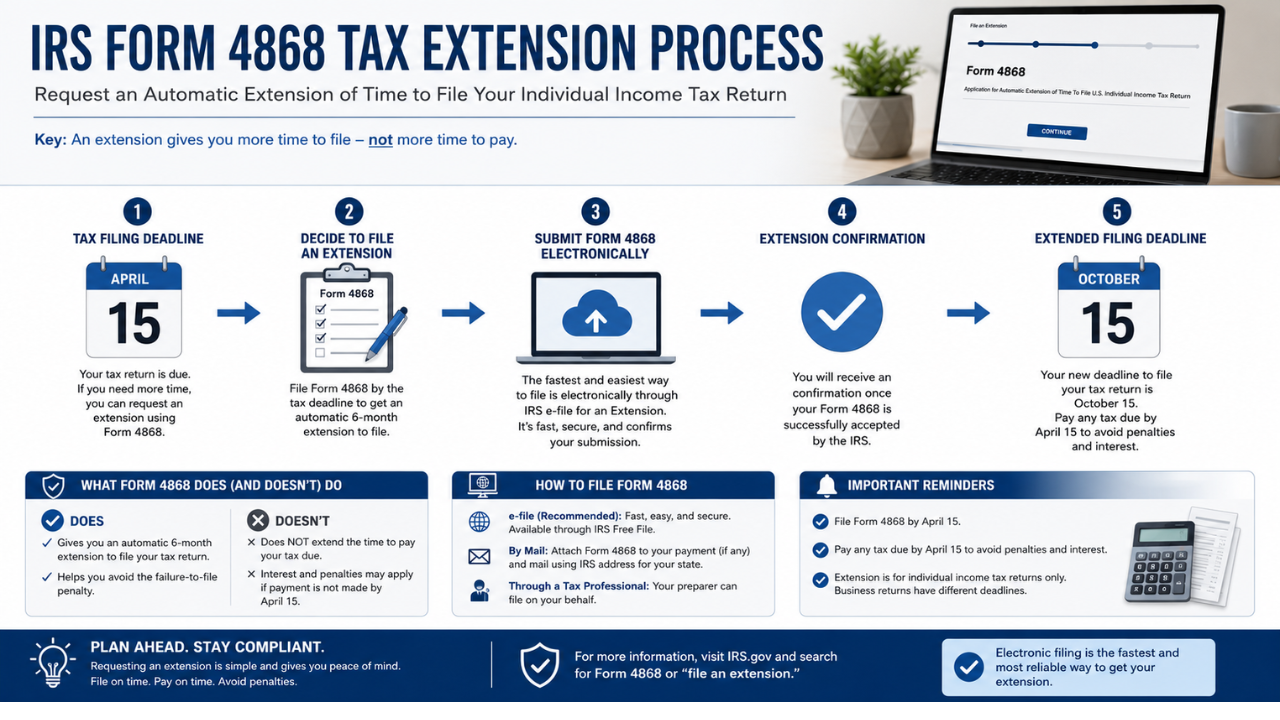
Form 4868 is the official IRS document used to request an automatic extension of time to file. The form is only one page, but it asks for a few essential pieces of information:
- Your name, address, and Social Security number (or ITIN).
- Spouse’s information if filing jointly.
- An estimate of your total tax liability for the year.
- The total amount of federal income tax you have already paid (withholding, estimated payments, etc.).
- Any balance due you expect to owe (the difference between total tax liability and payments already made).
The IRS explains that “Form 4868 can be used to apply for 6 more months (4 if 'out of the country' and a U.S. citizen or resident) to file Form 1040”. Even if you cannot pay the full amount you owe, you should still file Form 4868 to avoid the late‑filing penalty, which can be much more severe than the late‑payment penalty.
Step‑by‑Step Guide to Filing Form 4868 Online
Filing a free federal tax extension through IRS Free File takes only a few minutes. Follow this process:
The IRS notes that “you can get an automatic extension of time to file your tax return by filing Form 4868 electronically. You’ll receive an electronic acknowledgment once you complete the transaction. Keep it with your records”.
Business owners and self‑employed individuals may also need an Employer Identification Number (EIN) for tax purposes, and freelancers are often required to complete Form W-9 when working with clients.
IRS Extension Deadlines Explained
According to IRS guidance, “If you timely file Form 4868, you have until Oct. 15 to timely file your return. If Oct. 15 falls on a weekend or legal holiday, you have until midnight the next business day”. A tax extension does not push back the payment deadline; payment is still due by April 15, 2026.
What Happens If You Owe Taxes?
A tax filing extension only extends the deadline to file your return — it does not extend the deadline to pay any taxes you owe. If you owe money to the IRS and do not pay by April 15, 2026, you will face:
- Late‑payment penalty — usually 0.5% per month of the unpaid amount, up to 25%.
- Interest — compounded daily on any unpaid balance.
The IRS emphasizes that “to avoid or minimize penalties and interest, taxpayers should estimate their total tax liability, subtract any payments already made, and pay the remaining balance by the deadline”. If you cannot pay the full amount, you should still file your extension and pay as much as possible, then consider an IRS payment plan.
Regular Filing vs. Tax Extension: Key Differences
| Feature | Regular Tax Filing | Tax Extension (Form 4868) |
|---|---|---|
| Filing Deadline | April 15, 2026 | Extended to October 15, 2026 |
| Payment Deadline | April 15, 2026 | Still April 15, 2026 (no extra time to pay) |
| Additional Time | None | 6 months to complete and file return |
| Penalties | N/A if filed and paid on time | Late‑payment penalty if balance not paid by April 15 |
| Filing Method | E‑file or paper | E‑file via IRS Free File, mail, or pay‑by‑extension |
Benefits of Filing a Tax Extension
- Reduces errors: Avoid rushed filing mistakes that can lead to IRS notices.
- More time for complex situations: Rental properties, business income, investments, or crypto transactions.
- Protects against late‑filing penalty: The late‑filing penalty (5% per month) is far larger than the late‑payment penalty (0.5% per month).
- Peace of mind: You secure an additional six months to work with a tax professional.
Common Tax Extension Mistakes to Avoid
- Assuming you don’t have to pay: Many taxpayers incorrectly believe a filing extension also extends payment.
- Missing the April 15 deadline: Form 4868 must be filed or postmarked by the original due date.
- Not estimating your tax liability: Failing to provide a reasonable estimate can cause processing delays.
- Forgetting state extensions: A federal extension does not automatically extend state filing deadlines; you must check your state’s rules.
- Mailing instead of e‑filing too late: Paper forms must be postmarked by April 15; e‑filing is instant and safer.
Need help with tax planning? Explore our free tax calculators and IRS resources.
Explore Tax ToolsIRS Free File Tax Extension FAQs
While organizing tax records and documents, some users also utilize FreeAiden's collection of free online productivity tools, PDF utilities, QR code generators, barcode generators, and image tools.
Disclaimer
Information may change based on IRS updates. This content is for educational purposes and does not constitute legal, tax, or financial advice. Tax laws are complex and subject to change. Always consult a qualified tax professional for guidance specific to your situation. Verify all information directly with the official IRS.gov website before making any tax‑related decisions.
About the author
This content was researched and reviewed using official IRS publications, tax filing guidance, and federal tax education resources to help taxpayers better understand IRS Free File tax extension options. All information aligns with current IRS procedures for the 2026 filing season.
Final Thoughts
Requesting an IRS Free File tax extension is a smart, no‑cost strategy when you need more time to prepare an accurate return. The process takes only minutes through IRS Free File, and it automatically grants you until October 15, 2026 to file your federal tax return. Remember, an extension extends your filing deadline — not your payment deadline. Pay any taxes you owe by April 15 to avoid penalties and interest.
For those who need additional resources, we offer a complete IRS Free File Program Guide to help you file taxes online for free. Taxpayers looking for free filing options can also reference our beginner‑friendly IRS materials.
Stay ahead of IRS deadlines and make informed tax decisions with our free tax resources and calculators.
View More Tax Guides