

Apply for an Employer Identification Number (EIN): A Complete IRS-Based Guide for 2026

If you are launching a business, hiring employees, or starting a side hustle that requires a separate tax identity, you will probably need to apply for an Employer Identification Number (EIN). The process sounds formal, but it is actually free and straightforward when you understand the IRS rules. This guide walks you through every step—explaining exactly what an EIN is, who needs one, how to fill out Form SS-4, the differences between an EIN and your Social Security Number, and common mistakes to avoid. All information is sourced directly from the official IRS employer ID number guidance, so you can feel confident you are getting accurate, trustworthy instruction.
Table of Contents
- What Is an EIN?
- Who Needs an EIN?
- When Is an EIN Required?
- Why Businesses Need an EIN
- How to Apply for an EIN Step-by-Step
- Form SS-4 Instructions Explained
- EIN vs SSN Differences
- EIN for Sole Proprietors
- EIN for LLCs and Corporations
- Can You Apply for an EIN Without an SSN?
- How Long Does It Take to Get an EIN?
- Common EIN Application Mistakes to Avoid
- How Businesses Use EINs After Approval
- Apply for an Employer Identification Number (EIN) – FAQs
- Disclaimer
- Final Thoughts
What Is an Employer Identification Number (EIN)?
An Employer Identification Number, or EIN, is a unique nine-digit number the IRS assigns to business entities, trusts, estates, and certain other organizations. You might also hear it called a Federal Tax Identification Number or a business tax ID number. The format looks like this: 12-3456789. Once assigned, the number is permanent and does not expire.
According to the IRS, an EIN is used to identify a business for tax administration and filing. It is not the same as a business license or a state registration number—it is strictly federal. Even if your business never has employees, you may still need an EIN to open a bank account, apply for business credit, or file specific tax returns. The IRS provides the employer ID numbers page that details exactly when EINs are required.
Many new business owners confuse their personal Social Security Number with a business tax ID. While a sole proprietor without employees can use an SSN, obtaining an EIN adds a layer of privacy and helps separate personal and business finances. If you plan to file 1099 forms or need to provide a tax ID to vendors, an EIN becomes essential.
Who Needs an EIN?
The IRS outlines clear categories of entities that must have an EIN. Generally, you need an Employer Identification Number if you:
- Have employees
- Operate your business as a corporation or partnership
- File employment, excise, or alcohol, tobacco, and firearms tax returns
- Withhold taxes on income (other than wages) paid to a non-resident alien
- Have a Keogh plan (a tax-deferred pension plan)
- Are involved with certain types of trusts, estates, real estate mortgage investment conduits, non-profit organizations, farmers' cooperatives, or plan administrators
If your business structure is a multi-member LLC, an S corporation, or a C corporation, the IRS requires an EIN. Many single-member LLCs choose to get an EIN even if not legally required, simply because banks often demand one when opening a business account. Freelancers and independent contractors, who typically operate as sole proprietors, can use their SSN, but applying for an EIN protects personal information and looks professional when onboarding with clients who request a W-9 form.
When Is an EIN Required?
Legal requirements to obtain an EIN arise the moment you hire an employee, form a partnership or corporation, or need to file certain excise tax forms. The flowchart below, built around IRS guidelines, helps you quickly decide.
Why Businesses Need an EIN
Beyond IRS mandates, an EIN opens doors for day-to-day business operations. Banks almost universally require an EIN to open a business checking account. Without one, you would have to mix personal and business funds, which complicates accounting and tax preparation. An EIN also establishes business credit and allows you to apply for credit cards or loans under the business name.
When you hire your first employee, you must report wages using an EIN and deposit payroll taxes. Even if you are a freelancer, many companies will request a completed W-9 form listing an EIN instead of your SSN. Providing your EIN helps prevent identity theft because you share fewer personal identifiers. The IRS also uses your EIN to track your business tax returns, estimated payments, and refunds. For a broad understanding of the agency behind these processes, you can read our IRS beginner’s guide.
How to Apply for an EIN Step-by-Step
The IRS offers several application methods. The fastest and most convenient is the online EIN application, available Monday through Friday, 7 a.m. to 10 p.m. Eastern Time. Here is the typical walkthrough:
Determine Eligibility
Your principal business must be in the U.S. or U.S. territories. The responsible party must have a valid SSN, ITIN, or EIN.
Gather Information
Have your legal business name, address, responsible party details, and entity type ready.
Complete the Application
Use the online assistant, answer questions, and submit the electronic Form SS-4.
Receive EIN Instantly
After validation, you get your EIN and can download the CP 575 notice.
Save Your Records
Keep the EIN confirmation letter for your permanent business files.
If you are outside the U.S. or cannot use the online tool, you may apply by fax or mail using Form SS-4. International applicants can also call the IRS at 267-941-1099 (not a toll-free number) to apply by phone. The IRS recommends applying online because it eliminates mailing delays and data entry errors.
Form SS-4 Instructions Explained
Form SS-4, “Application for Employer Identification Number,” is the official document you need if you are not applying online. The form asks for basic details: legal name, trade name (DBA), mailing address, county and state of your principal business, entity type, reason for applying, and responsible party information. The responsible party is the individual who controls, manages, or directs the entity. This must be a real person, not a business entity.
The IRS provides detailed instructions for Form SS-4 that clarify each line. For example, line 9a asks for the type of entity. You must check only one box. Line 10 asks why you are applying; common reasons include “Started a new business” or “Hired employees.” Accuracy on the responsible party SSN/ITIN is critical—mistakes here often cause delays. Once completed, the form can be faxed or mailed to the appropriate IRS address depending on your state.
Download Official IRS Form SS-4
This PDF is provided directly by the IRS. Review the instructions carefully before submission.
Download Form SS-4 (PDF)Always double-check current IRS instructions to avoid processing delays.
EIN vs SSN Differences
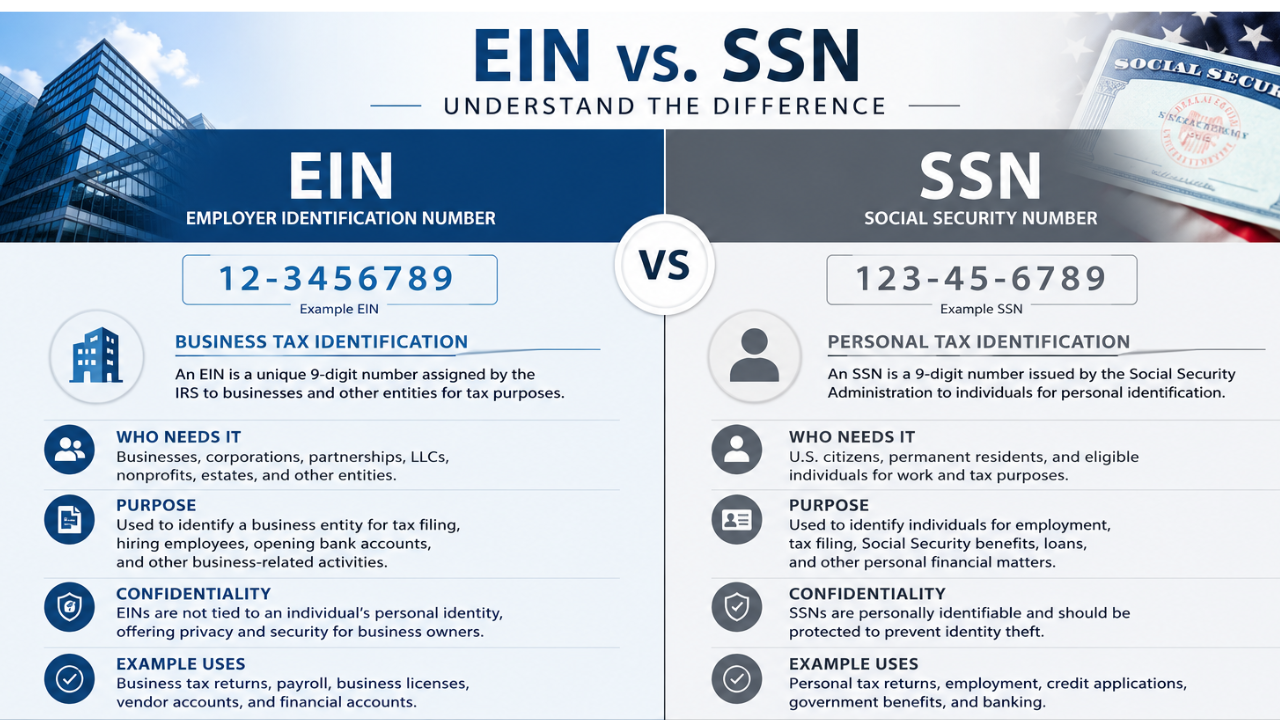
Both the EIN and Social Security Number are nine-digit identifiers, but they serve different purposes. The table below highlights the core distinctions.
| Feature | EIN | SSN |
|---|---|---|
| Purpose | Business tax ID, hiring, banking | Personal income tracking, benefits |
| Issued to | Business entities, trusts, estates | Individual U.S. citizens and eligible residents |
| Privacy | Shared with clients, banks, vendors | Highly sensitive, must be protected |
| Requirement | Mandatory for corporations, partnerships, employers | Mandatory for all individuals filing taxes |
| Format | 12-3456789 | 123-45-6789 |
Using an EIN instead of your SSN for business activities shields your personal number from exposure. This is especially valuable for independent contractors who must provide tax information to multiple companies. According to IRS guidance, the EIN does not replace your SSN for personal tax filings; you still file your individual return using your SSN and attach business schedules as needed.
EIN for Sole Proprietors
If you are a sole proprietor with no employees and you do not file excise tax returns, you are not legally required to have an EIN. You may use your SSN on tax forms and when conducting business. However, obtaining an EIN as a sole proprietor offers real benefits. It allows you to open a business bank account without exposing your SSN, makes you look more established to clients, and simplifies the process when you hire your first employee.
When you do apply for an EIN as a sole proprietor, the IRS still considers you a “sole proprietor” and not a separate legal entity. The EIN is attached to your name, and you remain personally liable for business debts. The tax filing process remains largely the same, except you provide the EIN on Schedule C. If you ever need to understand how your business income affects your take-home pay, try our paycheck calculator to model self-employment tax scenarios.
EIN for LLCs and Corporations
A Limited Liability Company (LLC) may be a single-member or multi-member entity. Multi-member LLCs are automatically classified as partnerships for tax purposes and must have an EIN. A single-member LLC is a disregarded entity unless it elects to be taxed as a corporation. Even though the IRS does not always require a single-member LLC to obtain an EIN, nearly every bank and vendor will ask for it. If the LLC later hires employees or adds members, the EIN becomes mandatory.
Corporations—whether C corps or S corps—are separate legal entities and must apply for an EIN immediately after incorporation. The EIN is used to file corporate tax returns and report employee wages. Nonprofits also need an EIN to apply for tax-exempt status and to receive grants. In all these structures, the responsible party listed on the SS-4 must be an individual with control over the entity’s finances or governance.
Can You Apply for an EIN Without an SSN?
The online EIN application requires the responsible party to provide either an SSN or an Individual Taxpayer Identification Number (ITIN). If you are a foreign entrepreneur without an SSN or ITIN, you cannot use the online tool. However, you can still apply by fax, mail, or phone. In the “responsible party” section, you may enter “Foreign” or “N/A” as appropriate and submit the form with a cover letter explaining your situation. The IRS will process these applications manually and assign an EIN.
It is important to understand that an EIN alone does not authorize you to work in the U.S. or meet state licensing requirements. The IRS simply uses the EIN for tax identification. Many non-U.S. business owners successfully obtain an EIN for their U.S.-based LLCs by following the alternative application methods clearly described in the Form SS-4 page.
How Long Does It Take to Get an EIN?
If you apply online and the information is valid, you receive your EIN immediately. The system displays the number and allows you to download the official CP 575 confirmation notice. Fax applications typically take four business days if you include a return fax number. Mailed applications take approximately four to five weeks, depending on IRS workload. International phone applications also provide an immediate EIN, but you must have the required information ready when calling.
After obtaining your EIN, it may take up to two weeks before the number is active in IRS systems for electronic tax filing or electronic payments. So plan ahead if you need to make a tax deposit or file a return shortly after incorporation.
Common EIN Application Mistakes to Avoid
Even a small error on Form SS-4 can cause delays. Here are the most frequent pitfalls:
- Incorrect responsible party details: The responsible party must be a natural person, not an entity. Providing a business name in this field leads to immediate rejection.
- Applying for multiple EINs unnecessarily: Generally, you need only one EIN per entity. If you change your business name or address, you do not need a new EIN. You simply update the IRS using Form 8822-B.
- Using the wrong entity type: Check the correct box on line 9a. Confusing an LLC with a corporation, for example, can misclassify your tax status.
- Missing or mismatched SSN/ITIN: The responsible party’s taxpayer ID must match IRS records exactly.
- Applying online outside of hours: The online EIN assistant is unavailable after 10 p.m. ET and on weekends. Plan accordingly.
Also, be aware of EIN scams. The IRS never charges a fee for an EIN. Do not pay third-party websites that offer to get an EIN for you unless you are hiring a trusted professional. The official IRS website is the only authorized source for free EIN applications.
How Businesses Use EINs After Approval
Once you have your EIN and CP 575 notice, you can immediately start using it. Open a business bank account, apply for business credit, and provide it to clients who issue payments to you. When hiring employees, you will use the EIN to file employment tax returns and report wages. The EIN also appears on all your business tax filings, including partnership returns and corporate income tax returns.
If you ever lose your EIN confirmation letter, you can call the IRS Business & Specialty Tax Line and request a 147C letter to verify your number. Keep your EIN secure, but remember it is a public business identifier; you will share it regularly. If you receive an IRS notice (like a CP 575 or a notice about a mismatch), respond promptly. The IRS may also send information letters if there are discrepancies between your reported business name and your EIN records.
To see how your business income translates into personal earnings, you might find our salary after taxes calculator helpful. For broader tax-saving strategies, check out tax tips in USA to legally reduce your tax bill.
Wondering how self-employment taxes impact your take-home income?
Use our free calculator to model your net pay after business deductions.
While building your business infrastructure, you may occasionally need quick utilities like QR code generators, barcode makers, or PDF converters. FreeAiden offers a collection of free AI-powered tools that can help with those everyday tasks, all in one place.
Apply for an Employer Identification Number (EIN) – FAQs
Is getting an EIN free from the IRS?
Yes. The IRS does not charge any fee to apply for an Employer Identification Number. Whether you apply online, by mail, fax, or phone, the process is completely free. Avoid third-party sites that request payment for an EIN application.
Can a sole proprietor apply for an EIN?
Absolutely. Even though sole proprietors without employees are not required to have an EIN, you can still apply for one online. It helps protect your SSN and simplifies banking and client onboarding.
Do LLCs need an EIN?
Multi-member LLCs must have an EIN. Single-member LLCs are generally not required to have one unless they have employees or file excise taxes, but obtaining an EIN is strongly recommended for banking and contractual purposes.
How long does EIN approval take?
Online applicants receive an EIN instantly. Fax applications take about four business days, and mailed applications take four to five weeks. International phone applicants also get an EIN immediately.
What is Form SS-4 used for?
Form SS-4 is the official IRS application for an Employer Identification Number. It collects information about your business entity, responsible party, and reason for applying. It is used for fax, mail, and phone applications.
Can I apply for an EIN online?
Yes, most businesses with a principal location in the U.S. and a responsible party who has an SSN or ITIN can apply online through the IRS EIN Assistant. The tool is available Monday through Friday, 7 a.m. to 10 p.m. Eastern Time.
Is an EIN the same as a business license?
No. An EIN is a federal tax identification number. A business license is issued by your state or local government and grants permission to operate. You may need both, but they serve completely different purposes.
Can I use my SSN instead of an EIN?
If you are a sole proprietor with no employees, you can use your SSN for tax filing and business activities. However, an EIN offers better privacy and is often required by banks and corporate clients.
What happens if EIN information is incorrect?
If you discover an error after receiving your EIN, you can correct it by sending a letter to the IRS or calling the Business & Specialty Tax Line. Do not submit a new application, as you generally cannot have two EINs for the same entity.
Final Thoughts on Applying for an EIN
Learning how to apply for an Employer Identification Number (EIN) is one of the first official steps toward building a solid business foundation. By understanding exactly what the IRS requires, who qualifies as a responsible party, and the differences between entity types, you avoid unnecessary delays and keep your business compliant from day one. Whether you are a freelancer wanting extra privacy or a corporation preparing to hire, the free EIN application process is designed to be accessible and efficient. Bookmark this guide and refer back whenever you need a refresher on the EIN rules.
Now that your business tax identity is in place, take the next step and see how your income translates into real take-home pay. Use the calculator below to stay on top of your finances.