

Schedule F (Profit or Loss From Farming): What It Is and How to File It
Last Updated: July 2026
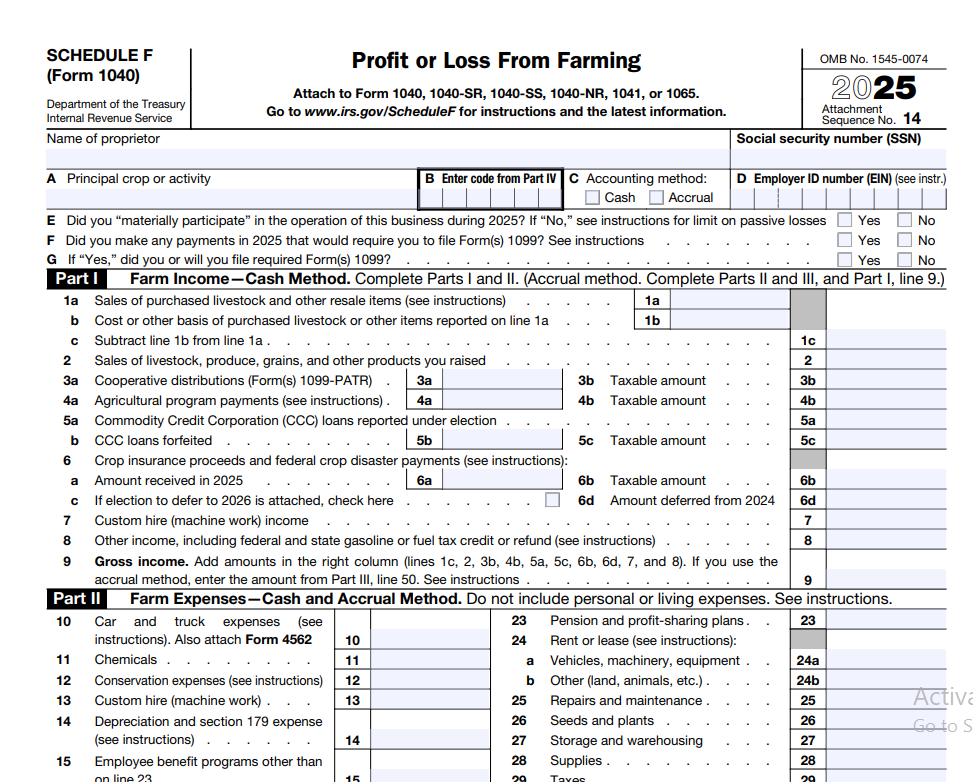
IRS Schedule F (Profit or Loss From Farming) tax form for reporting farm income and expenses.
Filing taxes as a farmer or rancher isn’t like filing a simple W-2 return. Whether you grow crops, raise livestock, or operate a specialty nursery, the IRS wants a detailed picture of your farming income and expenses. That’s where Schedule F (Profit or Loss From Farming) comes in. It’s the cornerstone of a farmer’s federal tax return, and understanding it can save you money, prevent audits, and keep your operation running smoothly. This guide breaks down everything you need to know, using official IRS instructions and 2026 guidance.
Table of Contents
What Is Schedule F (Profit or Loss From Farming)?
Schedule F is the tax form used by sole-proprietor farmers to calculate the annual profit or loss from their farming business. It’s part of your individual income tax return, Form 1040. The form has two main parts: Part I lists all sources of farm income, and Part II lists deductible farm expenses. After subtracting total expenses from gross income, you arrive at a net farm profit or loss. That net figure determines how much of your farming income is taxable and whether you owe self-employment tax.
The IRS defines farming very broadly. It includes cultivating land, operating a dairy, poultry, or fish farm, raising livestock, growing fruit or nuts, and even operating a ranch or plantation. If you’re in the business of producing agricultural or horticultural products for sale, you’re likely a farmer for tax purposes.
Who Must File Schedule F?
You need to file Schedule F if you are a sole proprietor running a farming operation and you meet the IRS income or filing threshold. This applies to full-time farmers, part-time ranchers, and even “gentlemen farmers” if the activity is a business, not a hobby. If your farm is organized as a partnership, corporation, or LLC taxed as a corporation, you won’t use Schedule F; those entities use other forms like Form 1065 or Form 1120. But for most family farms and independent producers, Schedule F is the correct form.
Even if your farm showed a loss for the year, you still file Schedule F if you materially participated in the operation. The loss may then offset other income on your 1040, subject to certain limitations.
What Farm Income Must Be Reported?
All income connected to your farming activity must be reported on Schedule F, even if you didn’t receive a 1099 form. The IRS wants to see the full scope of your agricultural revenue. Income can arrive in many forms, and each has a specific line on the form.
Common Farm Income Categories
| Income Type | Schedule F Line(s) | Examples |
|---|---|---|
| Sales of raised livestock & produce | 1a, 1b | Calves, wheat, tomatoes, hay |
| Sales of purchased livestock & resale items | 1a, 1b | Feeder cattle bought for resale |
| Sales of breeding/dairy/sport livestock | 2, 3a, 3b | Sale of a dairy cow used for breeding |
| Cooperative distributions | 5a–5c | Patronage dividends from a co-op |
| Agricultural program payments | 6a–6c | ARC, PLC, conservation reserve payments |
| Crop insurance proceeds | 8 (other income) | Indemnity for drought loss |
| Custom hire income | 7 | Plowing or harvesting for neighbors |
For example, if you sell 30 steers at the auction for $52,000 and also receive $4,800 from a federal conservation program, you must report both. The sale of raised animals goes on lines 1a and 1b, while government payments go on lines 6a–6c. Cooperative distributions, such as patronage refunds from a grain co-op, are reported at lines 5a–5c, and you may need to adjust for any per-unit retain allocations.
Farm Expenses You Can Deduct
Farmers can deduct ordinary and necessary expenses paid or incurred during the tax year to run the business. “Ordinary” means common in the farming industry; “necessary” means helpful and appropriate. The range of deductible costs is broad, but you must be able to substantiate them with records.
| Expense Category | Line on Schedule F | Typical Items |
|---|---|---|
| Feed | 18 | Grain, hay, protein supplements |
| Fertilizers and lime | 19 | Urea, potash, ag lime |
| Seeds and plants | 28 | Corn seed, vegetable transplants |
| Labor hired | 24 | Wages for farmhands, custom harvest crews |
| Repairs and maintenance | 27 | Tractor repairs, fence mending, barn upkeep |
| Fuel, gasoline, oil | 21 | Diesel for tractors, gas for ATVs |
| Insurance | 22 | Crop insurance, farm liability, livestock mortality |
| Property taxes on farm assets | 31 | Real estate taxes on farmland |
| Depreciation | 16 | Machinery, buildings, fences (via Form 4562) |
| Home office (business use) | 34 (other expenses) | Portion of home used exclusively for farm admin |
Depreciation deserves special attention. Tractors, combines, irrigation equipment, barns, and single-purpose livestock structures are depreciable assets. You may also elect Section 179 to expense the full cost of qualifying equipment in the year placed in service, subject to limits. Always attach Form 4562 to support your deduction on line 16.
A home office can be deducted if you use a part of your home regularly and exclusively for farm administrative work, such as ordering supplies, bookkeeping, or marketing. You’ll enter the allowable amount as an “other expense” on line 34 and include Form 8829 if required.
Cash vs. Accrual Accounting for Farmers
Choosing the right accounting method is a critical tax decision. Most small farmers use the cash method because it’s simpler: you report income in the year you actually receive it, and you deduct expenses in the year you pay them. Under the accrual method, income is reported when earned (even if payment hasn’t arrived), and expenses are deducted when the liability is incurred.
According to IRS guidance, if your average annual gross receipts are $29 million or less (adjusted for inflation for tax years beginning in 2026), you are generally permitted to use the cash method even if you maintain inventory. This safe harbor covers the vast majority of family farms. Larger operations may be required to use accrual, or they may choose it for better matching of income and expenses. If you switch methods, you must file Form 3115 and get IRS consent.
How to Complete Schedule F Step-by-Step
Here’s a practical walkthrough of the 2026 Schedule F. The form is divided into parts, and we’ll cover the sections that affect most farmers.
Part I: Farm Income
Lines 1a–1b: Sales of livestock and other items you raised or purchased for resale. Enter gross sales on line 1a and the cost or basis of those items on line 1b. The difference is your net gain (or loss). If you sold cattle you raised, line 1b is often zero because your basis is the cost of raising them (already deducted as expenses).
Lines 2, 3a–3b: Sales of livestock held for draft, breeding, dairy, or sport. Here you report the proceeds and the adjusted basis separately. For a breeding bull purchased for $3,000 and sold for $4,200, line 2 shows $4,200, line 3a shows $3,000, and line 3b shows any depreciation recapture, etc.
Lines 5a–5c: Cooperative distributions. Patronage dividends are reported at line 5a, and per-unit retain allocations at 5b. You may need to include the stated dollar value of non-cash allocations.
Lines 6a–6c: Agricultural program payments. Enter total government payments, such as Agriculture Risk Coverage or Price Loss Coverage. Use the information from Form 1099-G.
Line 7: Custom hire income. If you harvested a neighbor’s field for a fee, that’s farm income, not a separate business.
Line 8: Other income. This is a catch-all for items like crop insurance proceeds, state fuel tax refunds, or patronage dividends from non-cooperative sources. Attach a statement if needed.
Add lines 1a, 2, 4a, 5a, 5b, 6a, 6b, 7, and 8, then subtract line 1b to arrive at gross income on line 9.
Part II: Farm Expenses
Lines 11 through 34f capture your deductible operating costs. Here are a few that often cause confusion:
- Line 16 (Depreciation): Enter the total from Form 4562. Remember to claim bonus depreciation or Section 179 if eligible.
- Line 21 (Gasoline, fuel, oil): Include fuel used in tractors, trucks (if farm use), and equipment. If you also use the vehicle for personal trips, keep a log.
- Line 33 (Veterinary, breeding, medicine): Deduct vet bills, artificial insemination costs, and livestock medicine.
- Line 34 (Other expenses): Use this for farm office supplies, small tools, subscriptions, and the home office deduction. List each significant type.
Total all expenses on line 35, then subtract from gross income on line 36. The result is your net farm profit or loss. This number goes directly to Schedule 1 and then to Form 1040.
Download the official Schedule F form
Review the official IRS instructions before filing. Keep a copy for your records.
Know what your farm profit means for your wallet.
Estimate how much of your income you’ll actually keep after taxes. Use our paycheck calculator to see your take-home pay for off-farm income, or compare different scenarios.
Schedule F and Self-Employment Tax
Your net farm profit from Schedule F is generally subject to self-employment tax, which covers Social Security and Medicare. You compute this tax on Schedule SE, and it’s due in addition to your regular income tax. For 2026, the self-employment tax rate is 15.3% on the first $176,100 of net earnings (Social Security portion) and 2.9% on all net earnings (Medicare). Only 92.35% of your net farm profit is subject to the tax.
Farmers often need to make estimated tax payments quarterly to avoid penalties. If you expect to owe $1,000 or more in tax for the year, plan to send payments using Form 1040-ES. Many farmers time their estimated payments to coincide with harvest income cycles.
How Schedule F Flows to Your Form 1040
After completing Schedule F, you transfer the net profit or loss to Schedule 1 (Form 1040), line 6, “Farm income or loss.” That amount then moves to Form 1040, line 8, and becomes part of your total income. If you have other income sources—such as a spouse’s W-2 wages—the farm profit increases your adjusted gross income (AGI). A farm loss, on the other hand, may reduce your AGI, but it’s limited by at-risk rules and passive activity loss limitations. Most active farmers can use the loss to offset other non-passive income.
To see how the final tax liability affects your actual take-home pay, you can calculate your take-home pay using a salary after taxes calculator that accounts for both wage and self-employment income.
Recordkeeping Requirements for Farmers
Good records are the backbone of accurate tax filing and IRS audit defense. The IRS expects you to keep documentation that supports all income, deductions, and credits claimed. For farmers, that means saving:
- Sales receipts, auction statements, and settlement sheets.
- Bank and credit card statements showing farm purchases.
- Paid invoices for feed, seed, fertilizer, fuel, and repairs.
- Mileage logs for farm vehicles (if deducting actual expenses).
- Breeding records, livestock inventory, and death loss records.
- Forms 1099-G for government payments, and 1099-PATR for cooperatives.
- Asset purchase documents and depreciation schedules.
Keep these records for at least three years from the date you file, or longer if you underreport income by more than 25%. Digital copies are acceptable as long as they’re legible. Consider using farm accounting software to streamline the process.
Common Schedule F Filing Mistakes
Avoid these pitfalls that can trigger IRS notices or leave money on the table:
- Underreporting cash sales: Every dollar from a farmer’s market or direct-to-consumer beef sale is taxable.
- Mixing personal and farm finances: Use separate bank accounts and credit cards for your farm business.
- Forgetting depreciation: If you bought a new baler or built a hoop barn, claim depreciation or Section 179 expensing.
- Omitting cooperative distributions: Even non-cash patronage allocations are often taxable.
- Not filing Schedule SE: Without it, you won’t get Social Security credits for your farming years.
- Claiming hobby losses as farm losses: If the activity isn’t for profit, losses are limited and expenses are treated differently.
- Improperly classifying workers: Hired hands are employees, not independent contractors, unless they truly run their own business.
Schedule F (Profit or Loss From Farming): What It Is and How to File It – FAQs
You file Schedule F if you’re a sole proprietor operating a farming business with reportable income or expenses. This includes crop, livestock, dairy, poultry, aquaculture, and nursery operations. The form must be attached to your Form 1040.
Farm income comes from a trade or business run with a profit motive. Hobby income is from an activity not primarily for profit, and deductions are limited to the amount of hobby income. The IRS considers factors like the time and effort you put in and whether you depend on the income.
Yes. Under the cash method, you deduct the actual cost of feed purchased and consumed during the year. Prepaid feed may need to meet the 50% test to be currently deductible. Report feed expenses on line 18 of Schedule F.
Generally, yes. Net earnings from farming are self-employment income. Use Schedule SE to compute the tax. If your net profit is $400 or more, you must pay SE tax, which contributes to your Social Security and Medicare coverage.
Keep receipts, invoices, settlement sheets, bank records, inventory records, and depreciation logs for at least three years after filing. Good records prove your income and expenses and are essential for claiming deductions and credits.
Report government payments on lines 6a–6c of Schedule F. Use Form 1099-G to determine the amount. Payments from the Conservation Reserve Program, Agriculture Risk Coverage, and similar programs belong there. Crop insurance proceeds typically go on line 8.
A net loss on Schedule F can offset other income on your 1040, such as wages or investment income, provided you materially participated and have basis in the activity. Passive loss rules and at-risk limits may apply. A consistent loss may raise hobby-loss concerns.
Yes, most small farmers can use the cash method even if they have inventory, thanks to the gross receipts test of $29 million (adjusted for inflation). The cash method simplifies reporting because you don’t have to account for inventories on Schedule F.
The net profit or loss from Schedule F, line 36, is entered on Schedule 1, line 6, and then flows to line 8 of Form 1040. It becomes part of your total income, which determines your adjusted gross income and tax bracket.
Yes, crop insurance and federal disaster payments are generally taxable income. Report them as other farm income on line 8. You may be able to defer recognition if you meet certain replacement criteria, but that’s an advanced election.
Filing Schedule F With Confidence
Taking the time to understand Schedule F is one of the best investments you can make for your farming operation. Before you file your 2026 return, gather all your income records, organize expenses by the categories on the form, and double-check that you’ve chosen the most beneficial accounting method. Make sure you attach any required forms, like Form 4562 for depreciation or Schedule SE for self-employment tax.
If you pay yourself a salary from an off-farm job or want to estimate the impact of your farm profit on your overall tax picture, try our salary after taxes calculator. It helps you plan for estimated payments and avoid surprises. Keep your records in order, file on time, and you’ll sleep better knowing your return is complete and accurate.
Ready to see your real take-home pay?
Calculate your take-home pay